Photo by Chris Bosak
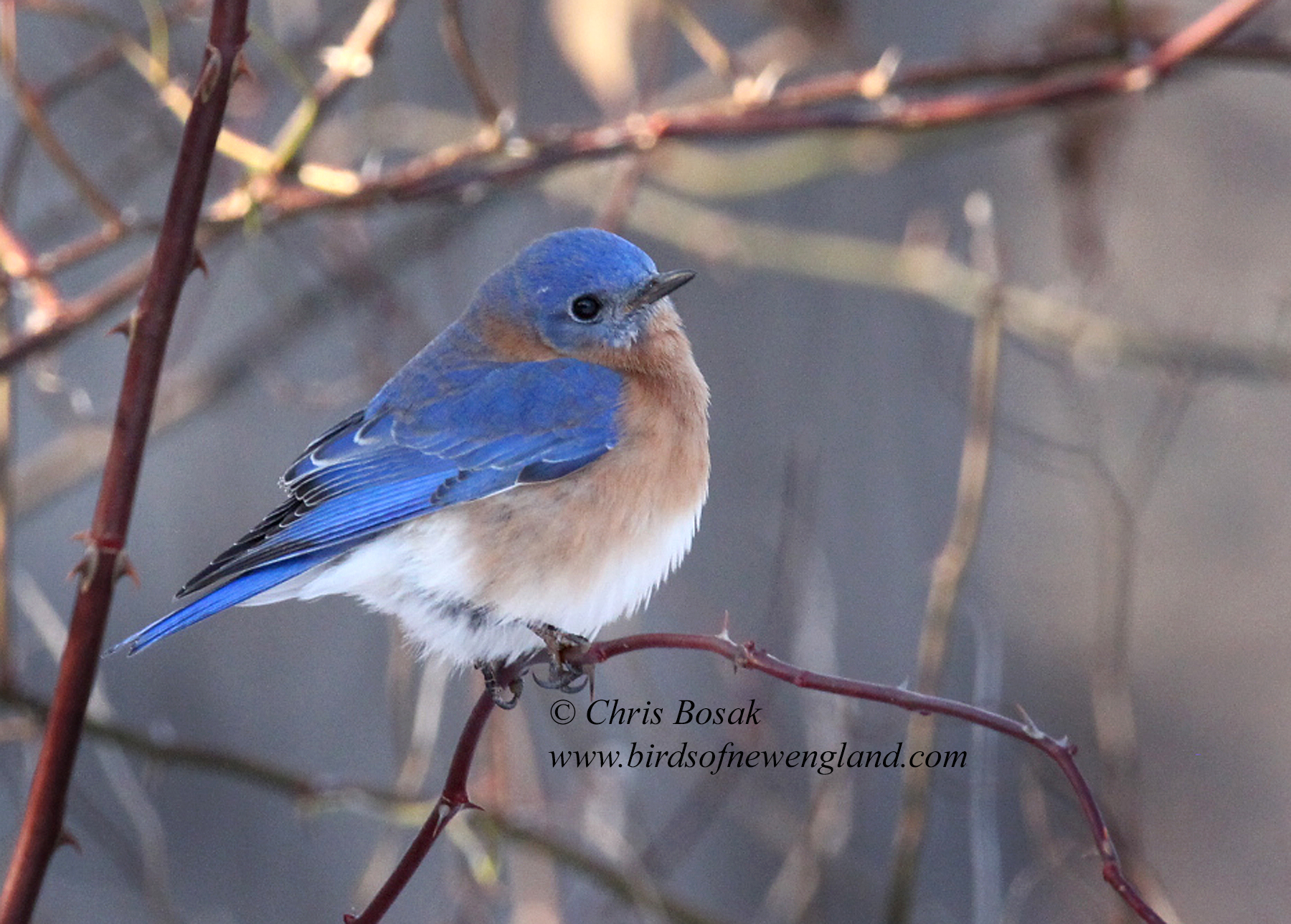
An eastern bluebird perches on a branch in New England, Jan. 2022.
Beautiful sights in nature can be long-lasting or fleeting. Sometimes a split second is all it takes to leave an impression.
A beautiful view from a mountaintop is always there. You could hike to the top of Mount Monadnock or Mount Washington and enjoy the panoramic splendor today, tomorrow or next month. The view will always be there. Sure, it will change with the seasons and weather, but the mountain isn’t going anywhere. You could plan months or even years ahead and count on seeing the beautiful view.
An awe-inspiring sunrise or sunset is more fleeting. First of all, there is no guarantee a gorgeous sunrise or sunset will happen at all. But when you do happen to catch one, the view lasts for 20 or 30 minutes. You could grab a seat and watch the show until it is either dark or light, depending on whether it’s a sunrise or sunset.
With birdwatching, most memorable sights are fleeting, and unless you are visiting a zoo or nature center, there are no guarantees. There are some almost certainties, such as a hawk watch location in the fall or a bald eagle watching spot in the winter, but those sightings are mostly fleeting. During a hawk watch, the bird is spotted as it approaches, observed as it flies overhead and then disappears into the distant sky. Eagle watches can offer a longer view as the large birds rest in trees near the water, but they can take off at any time.
Photo by Chris Bosak
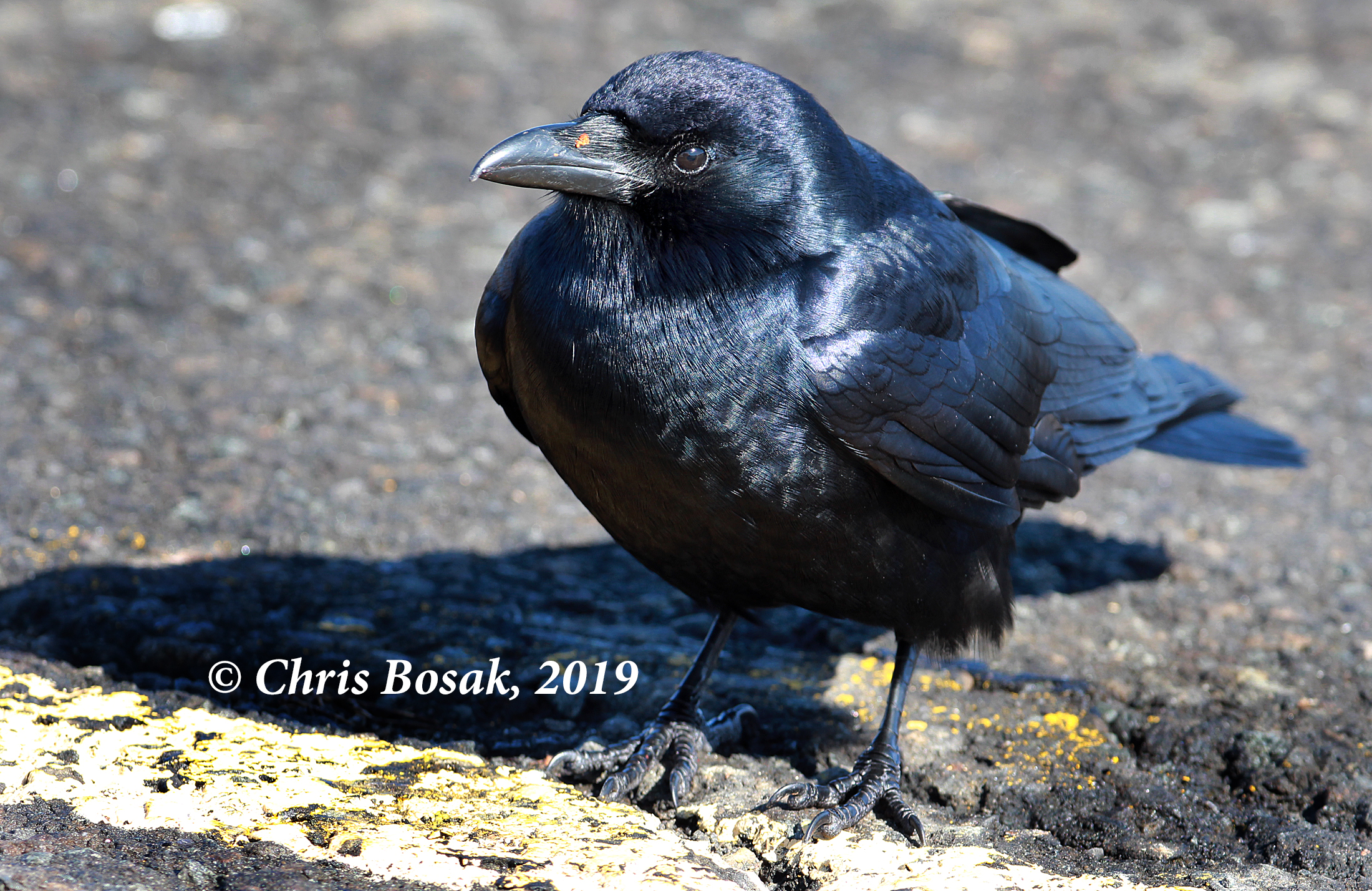
An American crow in Danbury, CT, winter 2019.
Crows are exceedingly smart, timberdoodles are back and cardinals just may be nesting already. Those are some of the interesting email topics I have received recently.
Don from Laconia wrote to say he has observed some interesting behavior from crows that hang around his yard. When the crows find a piece of food that is too big or hard, they carry the food to a nearby puddle and dip the food into the water to soften it and make it more manageable.
It has long been known that crows and other corvids, such as ravens and blue jays, have a high degree of intelligence. There is a video on YouTube with close to 10 million views that shows an experiment with a crow figuring out how to access food from tubes using water displacement. The pieces of food are floating on water in a tube just out of reach of the crow’s beak. In a series of tests, the crow has to figure out how to raise the level of water enough to reach the food. The crow eventually aces all of the tests and gets to the food each time.
There is a little pond I drive past on my way to work. By little pond, I mean tiny. Maybe the size of a basketball court. It’s probably man-made and it’s fenced off because it is on the property of a condominium complex.
It is pretty much right along the road, however, so I get a good look at it when I drive by. Usually, there is nothing of note in terms of birds or other wildlife. Every once in a while, a few Canada geese or mallards can be seen swimming along the surface. One day, I saw both Canada geese and mallards. I know, not very exciting.
But the other day I did see something on that tiny pond that made me look a little longer as I drove past. It was a pair of wood ducks effortlessly gliding along the mirror-like surface. The pair swam side-by-side with the male in front of the female – at least from my point of view. During my drive-by, the ducks were near the right edge and swimming toward the middle of the pond. It was like looking at a painting.
Photo by Chris Bosak — Tufted titmouse in New England, January 2024.
The tufted titmouse is one of the most reliable birds to find in New England, regardless of season. The slowest of bird walks are often graced by a tufted titmouse or two.
Even if the bird is not seen, it can usually be heard. Titmice have a big voice that belies their small stature. They are not as surprisingly boisterous as Carolina wrens, but gram-per-gram, titmice are still one of the most vociferous birds.
The bird’s common “peter peter peter” song is one of the first bird songs I learned as a beginning birder way back when. I heard the loud, clear whistles and refused to continue my walk until I found the source. The bird sang over and over as I scanned the area until, finally, I found the titmouse in a nearby tall evergreen. I remember being surprised at how dainty the bird appeared compared to the bravado of the song.
Cardinals also have songs with loud, clear whistles and the titmouse’s song is reminiscent of those. The cardinal’s songs, however, are more melodic and complicated than the simple “peter peter peter” of the titmouse. There are also variations in the titmouse’s song as it can be different in tone or number of syllables.
But that is hardly the only sound a titmouse makes. I have been stumped several times hearing a bird in the woods only to eventually find it was a titmouse. One of their calls sounds a lot like a chickadee and often causes confusion. It’s best to try to spot the bird to ensure which one is calling. To add to the confusion, titmice and chickadees are often found in the same area.
Titmice also have an extremely wide variety of harsh scolding calls, some of which are common and familiar and some that sound completely unfamiliar as they are not heard as often.
Which brings me to the next question about the titmouse. If there is more than one titmouse, are you looking at titmice or titmouses? The short answer is both are acceptable, but titmice is by far the more common usage, even if may not be technically correct. The titmouse (bird) and mouse (rodent) are obviously not related – in taxonomy or etymology — so why is it titmice? I guess it just sounds better and that’s what people have always called it. I’m sure there’s a better explanation, but I don’t know the true history of it.
Every birding organization and every well-known bird author I checked use titmice as the plural, and that includes the Cornell Lab of Ornithology, which I use as my go-to source for birding information. Even the dictionaries I checked use titmice. In fact, you’d be hard-pressed to find a source that uses titmouses. Some language purists may bristle at the term titmice, but it’s here to stay.
Regardless of how you choose to pluralize the word, the titmouse is a New England favorite that entertains us at our feeders and in the woods. Hardly a day goes by, regardless of the time of year, when I don’t see a titmouse, whether I’m actively looking for birds or not. That wasn’t always the case in New England as they were once regarded as a southern bird, but they have slowly and steadily expanded their range throughout New England and into Canada.
It is an energetic bird with a big personality and even bigger voice. Titmice, or titmouses if you prefer, are a welcome addition to the New England biosphere.
Photo by Chris Bosak
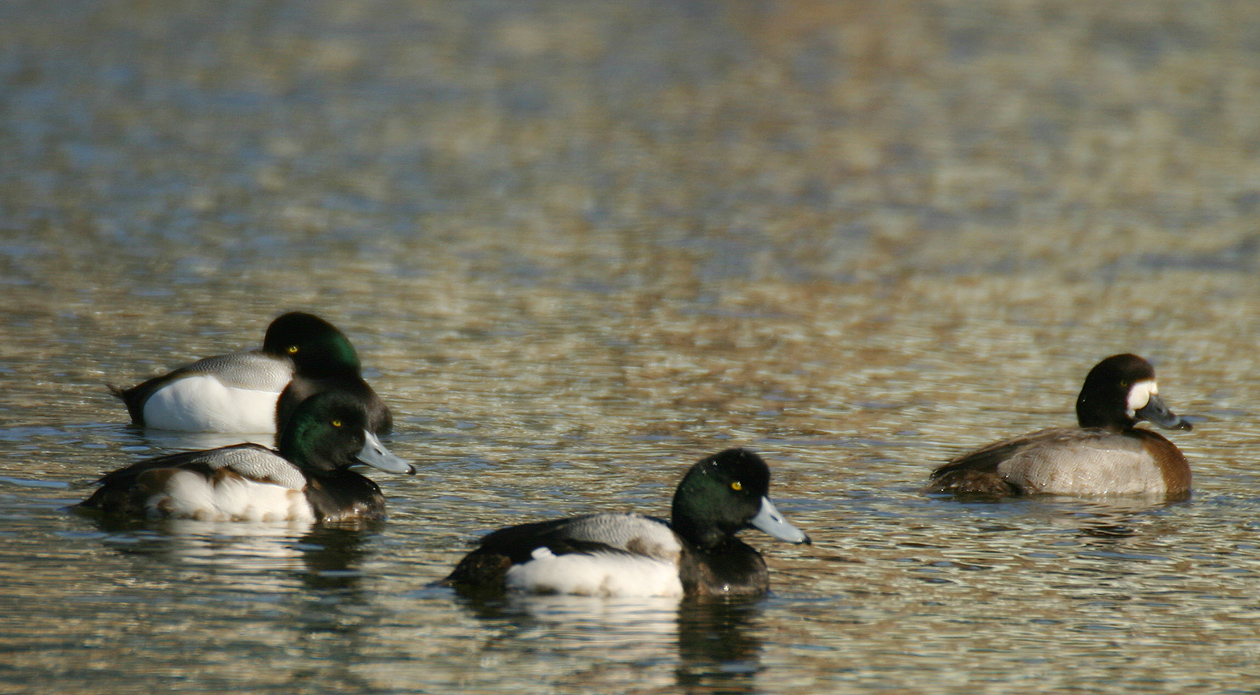
Scaup may be seen in huge numbers on large bodies of water in New England in the winter.
Late February and early March is somewhat of a transition period for birdwatching in New England.
The highly anticipated spring migration, which won’t hit its peak until late April and early May, starts with a trickle around mid-March, most notably with American woodcocks and eastern phoebes. Some consider the early male red-winged blackbirds the start of spring migration, but many of these blackbirds overwinter in New England so it’s tough to say if they are arriving in February or have been here all along.
On the other hand, a lot of the winter birds we have enjoyed seeing over the last few months have either gone further south, returned north, or, unfortunately for some, perished in the cold New England winter. Many birds that try to stick out a New England winter, either due to getting lost on their migration route or opting to forego migration altogether, underestimate the power and longevity of our winters and don’t make it to spring.
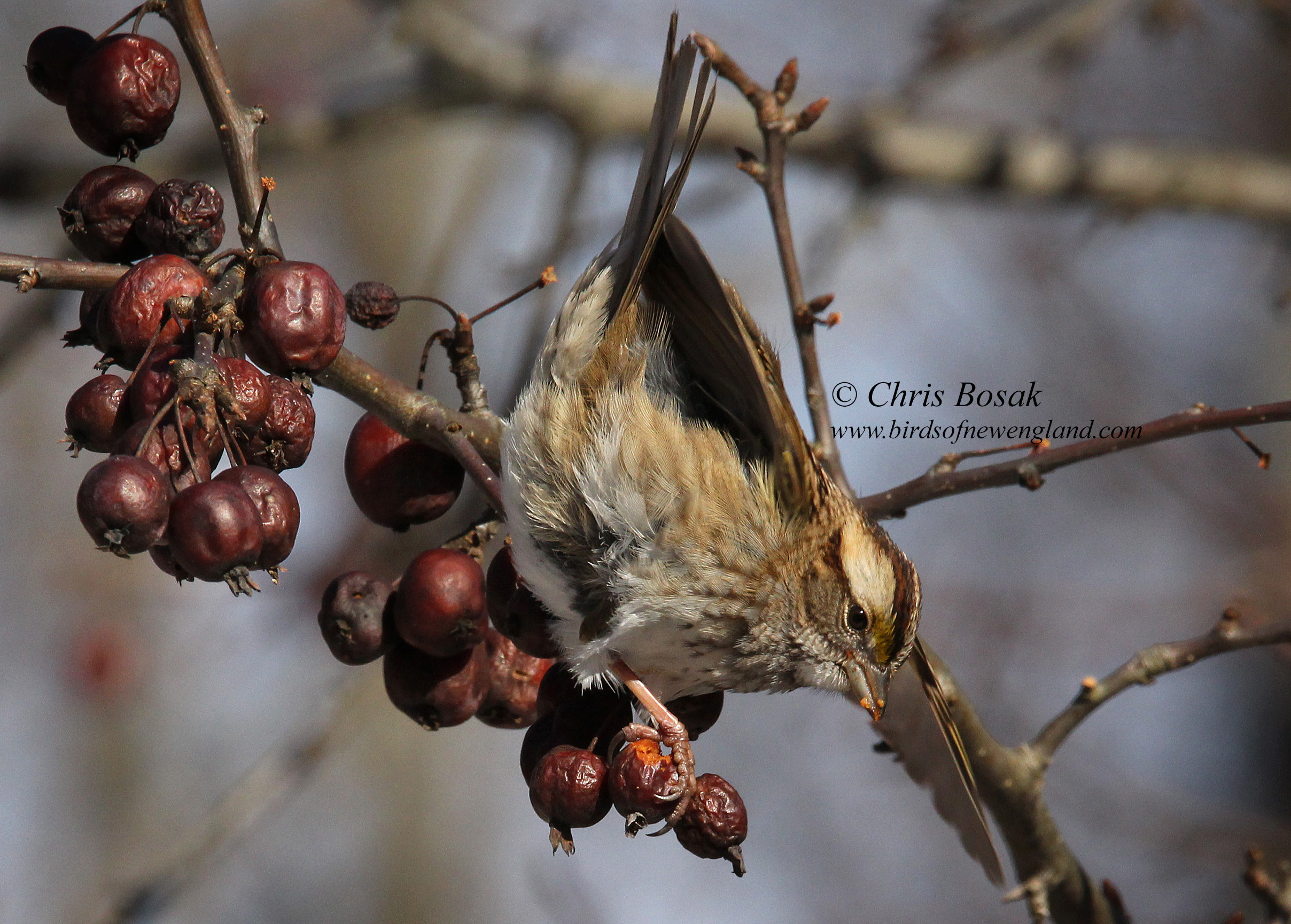
Photo by Chris Bosak
A white-throated sparrow eats a crabapple in New England, January 2024.
When I was just starting out in the hobby of birdwatching and bird photography, I saw a photo of a bird (I don’t recall the species) eating a berry. It became my mission to get a photo of a bird eating berries. But how would I ever get such a shot, I thought to myself at the time.
In the years that followed, I have had plenty of opportunities to get that coveted shot that once seemed so elusive. I’ve been lucky enough to photograph birds such as yellow-rumped warblers, blackburnian warblers, cedar waxwings, robins, catbirds, hermit thrushes, purple finches, house finches and song sparrows eating berries.
Photo by Chris Bosak – A hermit thrush in New England, January 2024.
For the past two weeks, I’ve written about surprise winter bird sightings such as the catbirds, hermit thrushes, yellow-bellied sapsuckers and purple finches I’ve seen on my recent walks.
It could be shaping up to be an interesting Great Backyard Bird Count this year with all these birds that typically migrate out of New England still hanging around. Who knows what other surprises will show up on the checklists of birders throughout the region, and the world for that matter?
The 27th annual Great Backyard Bird Count takes place from Friday, Feb. 16 through Monday, Feb. 19. Birders of all skill levels may participate in the Count. Simply count birds – alone or with a group – for at least 15 minutes and enter the birds able to be identified and the location at the GBBC website www.birdcount.org. While the results must be submitted online, the birding itself can take place anywhere: a park, backyard, conservation area.
Photo by Chris Bosak — A yellow-bellied sapsucker taps on a tree in New England, January 2024.
The woods seem to be full of surprises this winter.
Last week I wrote about the gray catbird I have been seeing on my walks this winter. On a walk last week, which was done when it was about 15 degrees outside, I had four species that were marked as “unusual” by eBird, a maassive database of bird sightings. That doesn’t necessarily mean that the birds are rare, but rather they are not commonly seen in New England during the winter. The species were: catbird, hermit thrush, purple finch and yellow-bellied sapsucker.
The catbird, thrush and finch were all species I had seen on previous walks this winter. In fact, it seems as though I typically find a hermit thrush or two each winter in New England. Like the catbird, hermit thrushes typically migrate south of New England before winter, but some remain in our region, opting to tolerate the cold weather rather than take on the risks of migration.
Photo by Chris Bosak – A gray catbird at Huntington State Park in Connecticut during a January 2024 snowfall.
Some things just don’t seem to go together. Peanut butter and tuna fish. Flip-flops on a treadmill. And hearing a catbird when it is 25 degrees and snowing during a New England winter.
I mentioned in last week’s column that I had seen a gray catbird during a recent bird walk. I returned to the same spot several days later. This time, snow was falling all around, painting the beautiful landscape in a covering of pristine white.
Mallards sit on a branch overhanging a pond in New England.
For just a moment, I was in their world.
As I stood there I could see nothing but branches, sticks and stubborn brown leaves that refused to fall off the low trees. Then I crouched like a baseball catcher and there they were: a flock of mallards taking a midday break in the tangled trees growing out of a small pond.
Normally mallards would not make for a memorable birdwatching outing, but this time was different.
A fairly busy road was no more than 50 yards away and my car was about 50 feet away, but I felt as if I were visiting the ducks’ world. The area was thickly wooded and a dark canopy of towering branches hung over the pond’s edge, adding to the feeling of seclusion. It was as if the world was reduced to the woods, the mallards and me.
It was a neat sensation, one that I’ve experience only a handful of times before — usually in extreme northern New Hampshire.




 Birds of New England.com