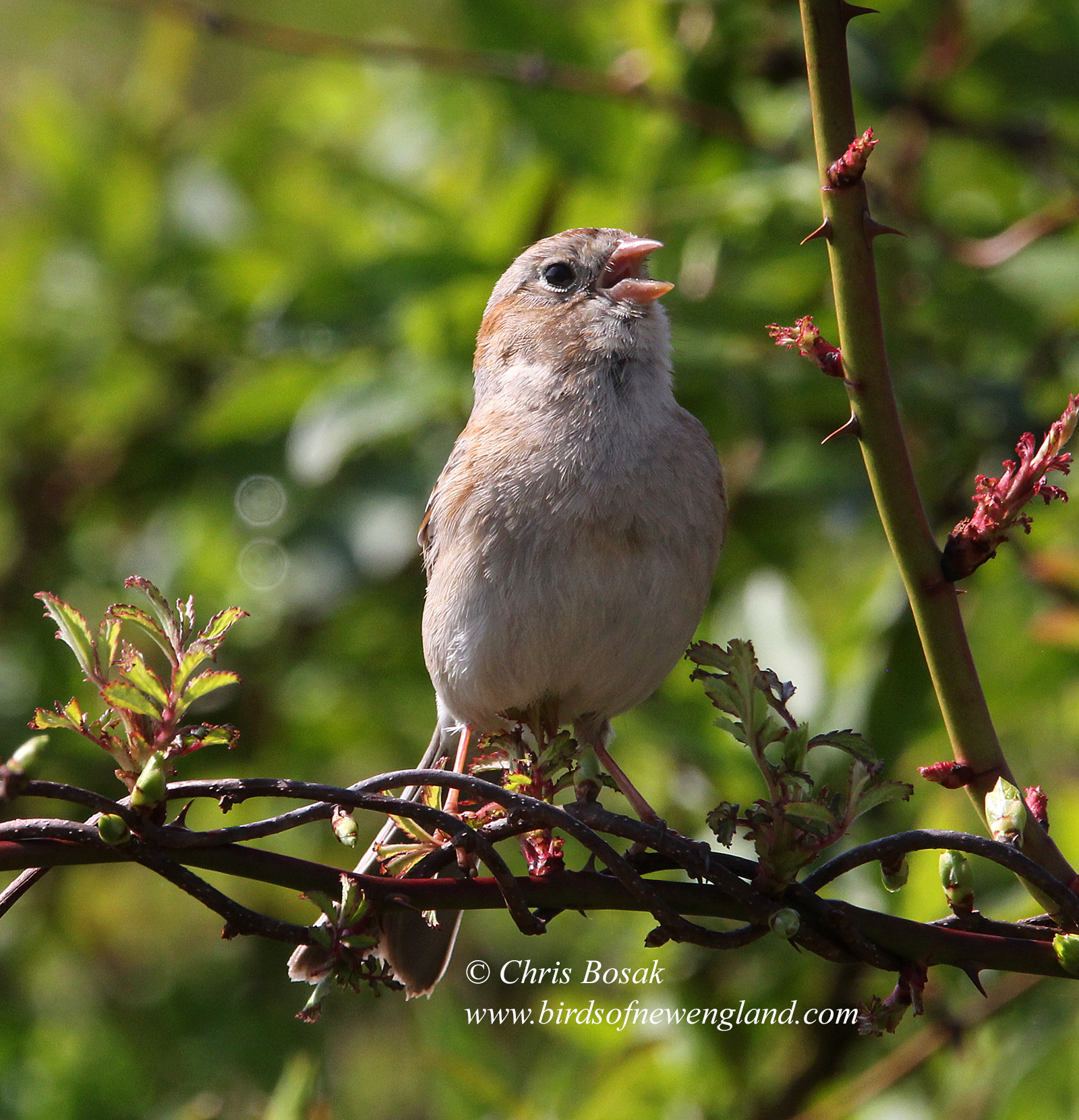
Photo by Chris Bosak – Field sparrow, New England, April 2024.
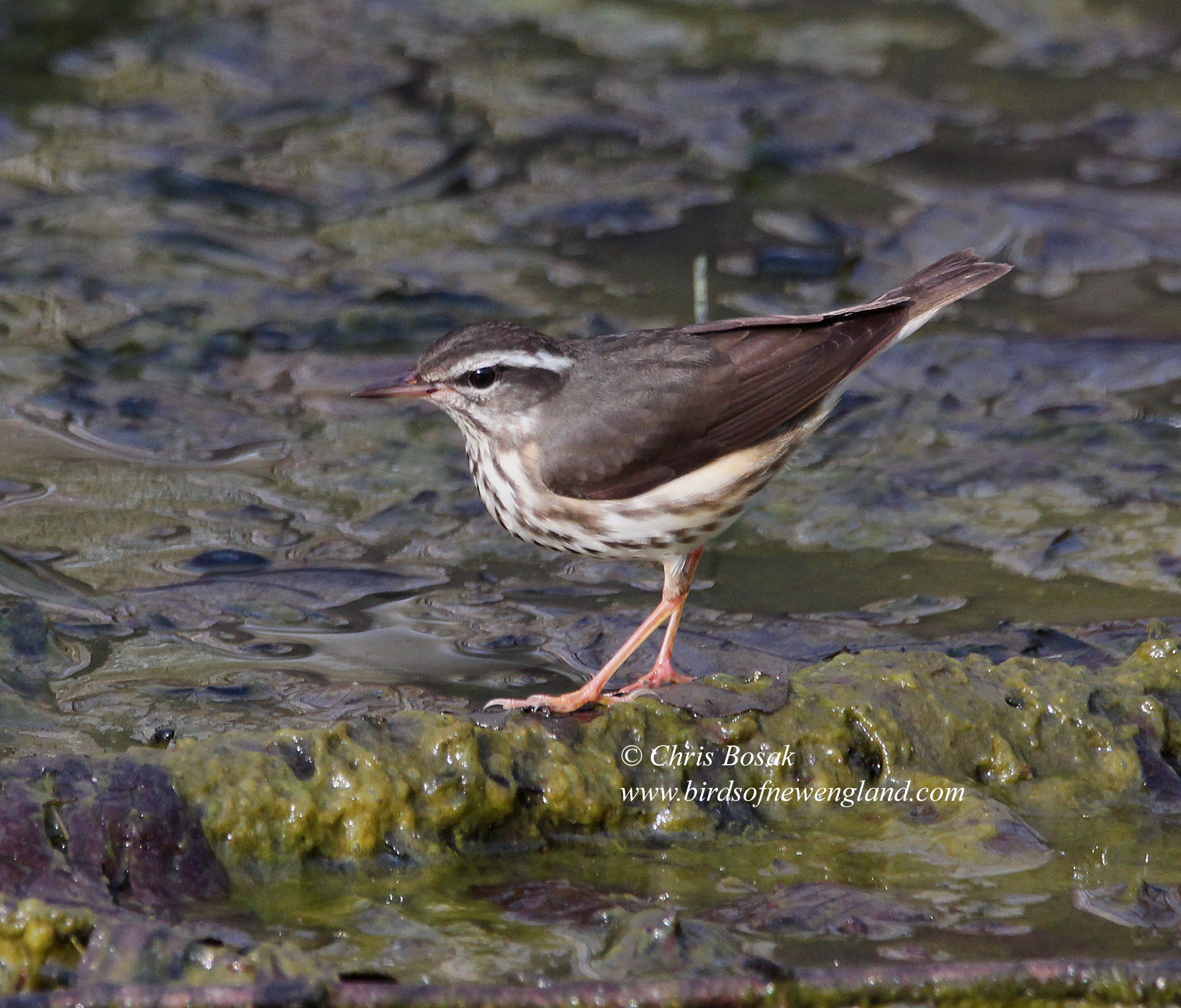
Judging from my own experience this morning and several posts on birding community websites, last night was a good night for migration with many of the long-awaited warblers and other songbirds arriving this morning. I had 43 species on my eBird list, including a few warblers, rose-breasted grosbeak, Louisiana waterthrush, Baltimore oriole, and American woodcock.
Here are a few shots from the day.
Photo by Chris Bosak – Ovenbird, New England, April 2024.Photo by Chris Bosak – Eastern towhee, New England, April 2024.Photo by Chris Bosak – Louisiana waterthrush, New England, April 2024.Photo by Chris Bosak – Chipping sparrow with nesting material, New England, April 2024.
Photo by Chris Bosak
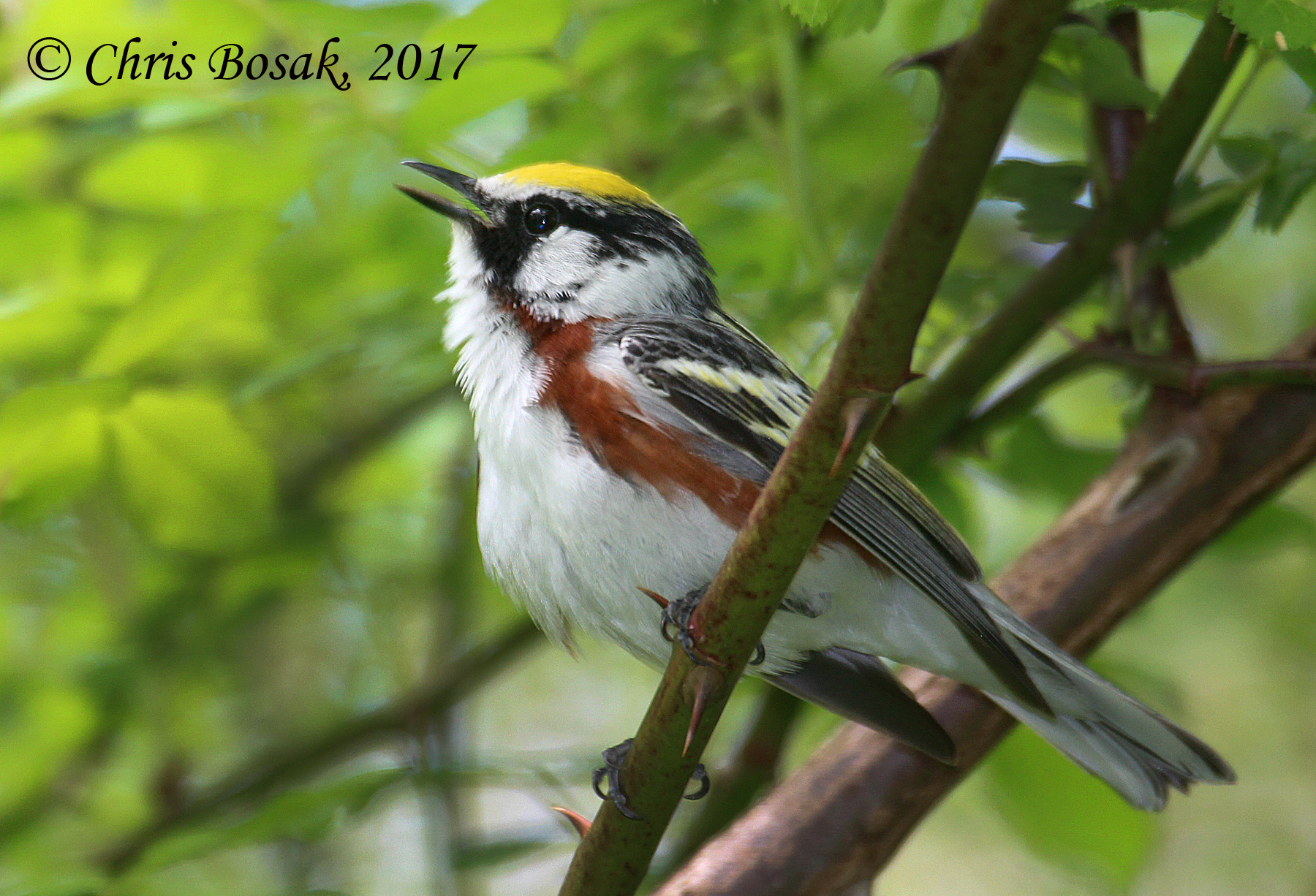
A chestnut-sided warbler sings from a lower perch in Ridgefield, Conn., during the spring of 2017.
I saw a yellow-rumped warbler, a few pine warblers and several palm warblers on my last bird walk. That can only mean one thing: time for my annual spring warbler column.
The aforementioned warblers are the earliest to arrive in New England in the spring. The rest will follow shortly.
But first, what is a warbler? A warbler is a small Neotropical songbird. Many are colorful but not all of them. Yellow is a common color among warblers, but white, black, orange, brown and tan are also found frequently on warblers. While some spend their winters in the southern part of the U.S., most migrate farther to Central or South America, or the islands south of the U.S. A few stragglers may be spotted in New England during the winter, but it’s not common.
Warblers breed throughout the U.S., mostly in the northern states and into Canada. By late September and into October, warblers do their southward migration. In April and May, they pass through the area again — this time in their fresh spring plumage.
Many warblers will remain in New England to raise families, and others will head farther north. Yellow warblers and common yellowthroats, for me anyway, are the species most commonly seen during the summer raising their families. I’ve also found the breeding spots of American redstart, ovenbird, pine warbler and a few other species.
Photo by Chris Bosak – An eastern towhee in New England, April 2024.
Well, it’s April and that means we are awaiting the arrival of warblers. It also means taking lots of photos of eastern towhees while we wait. Here are a few of this year’s shots. Their large size and awesome coloration belie the fact that towhees are members of the sparrow family.
Photo by Chris Bosak – An eastern towhee in New England, April 2024.
The weather icons on my iPhone showed rain starting at 8 a.m. I figured that would give me about an hour of dry weather to look for some early spring migrating birds.
No such luck. The rain started even before sunrise so my hour of dry weather wasn’t going to happen. Instead of rolling over and going back to sleep (a very tempting option) or mindlessly scrolling through social media, I decided to head out into the rain anyway. OK, I did take a few minutes to do Wordle quickly before heading out.
The walk started in a light rain, and a lot of birds were out singing. Immediately, I heard robins, cardinals, blue jays, song sparrows and a field sparrow in the distance. Field sparrows have a very distinctive song that sounds like a ping-pong ball bouncing on a table with the time between bounces getting progressively shorter, just like a real ball would do.
As soon as I committed to a trail leading me farther into the woods, the rain picked up. It never turned into a downpour, but it was a good, steady rain. Thankfully, the temperature was a very manageable 55 degrees, so I just got wet instead of wet and cold. I like birdwatching in all types of weather, but a cold rain is probably the worst. Heavy wind is not much fun either, but I would take it over a cold rain.
Photo by Chris Bosak
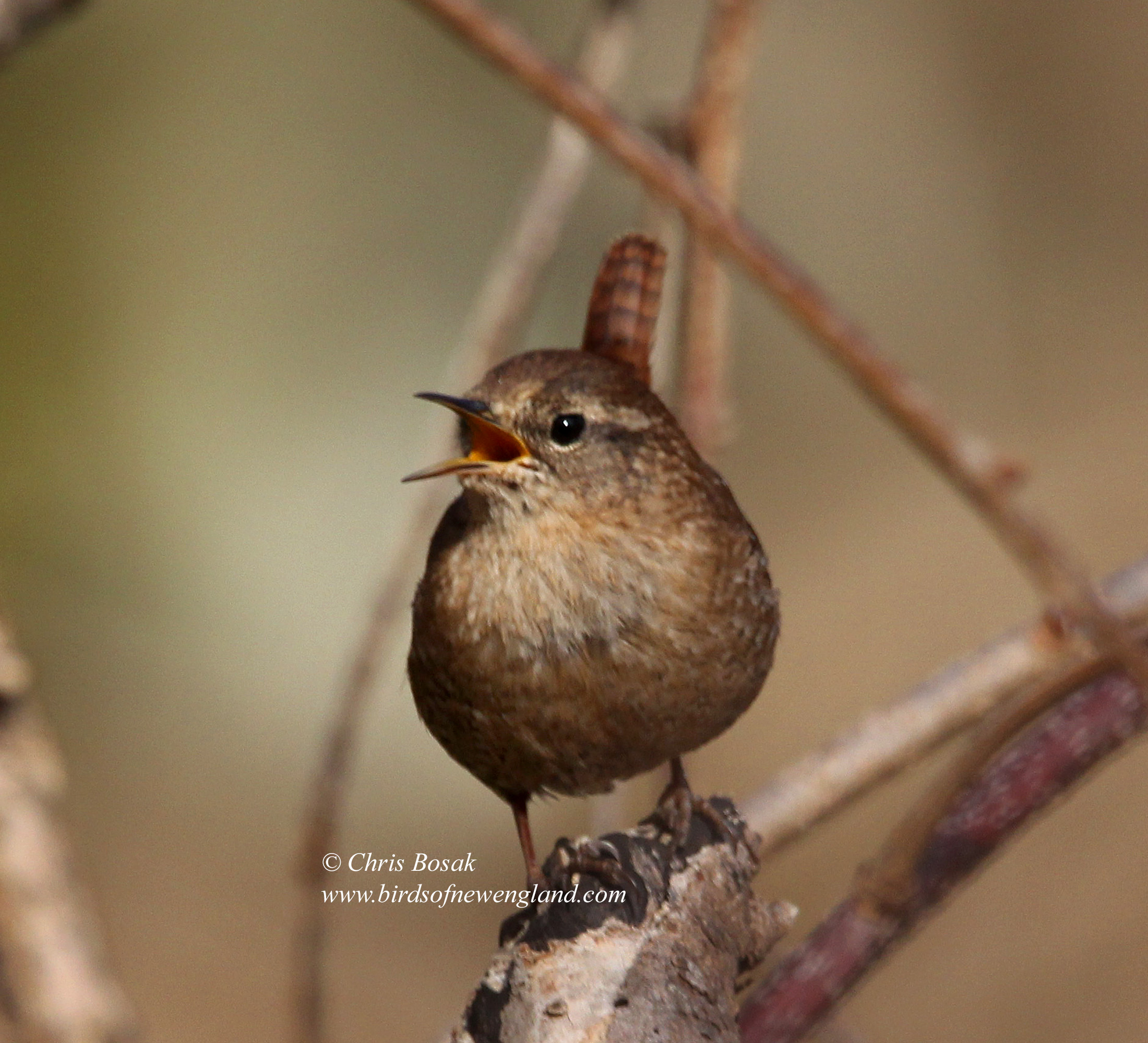
A winter wren sings from a perch in New England, March 2024.
The average person most likely would not understand my excitement. Anyone who has more than a casual appreciation of nature, including everyone who is reading this I’m sure, will get where I’m coming from.
From an outsider’s perspective, a winter wren is not much to get excited about. It’s a small brown bird – even smaller and more nondescript than a sparrow. Big deal.
Photo by Chris Bosak
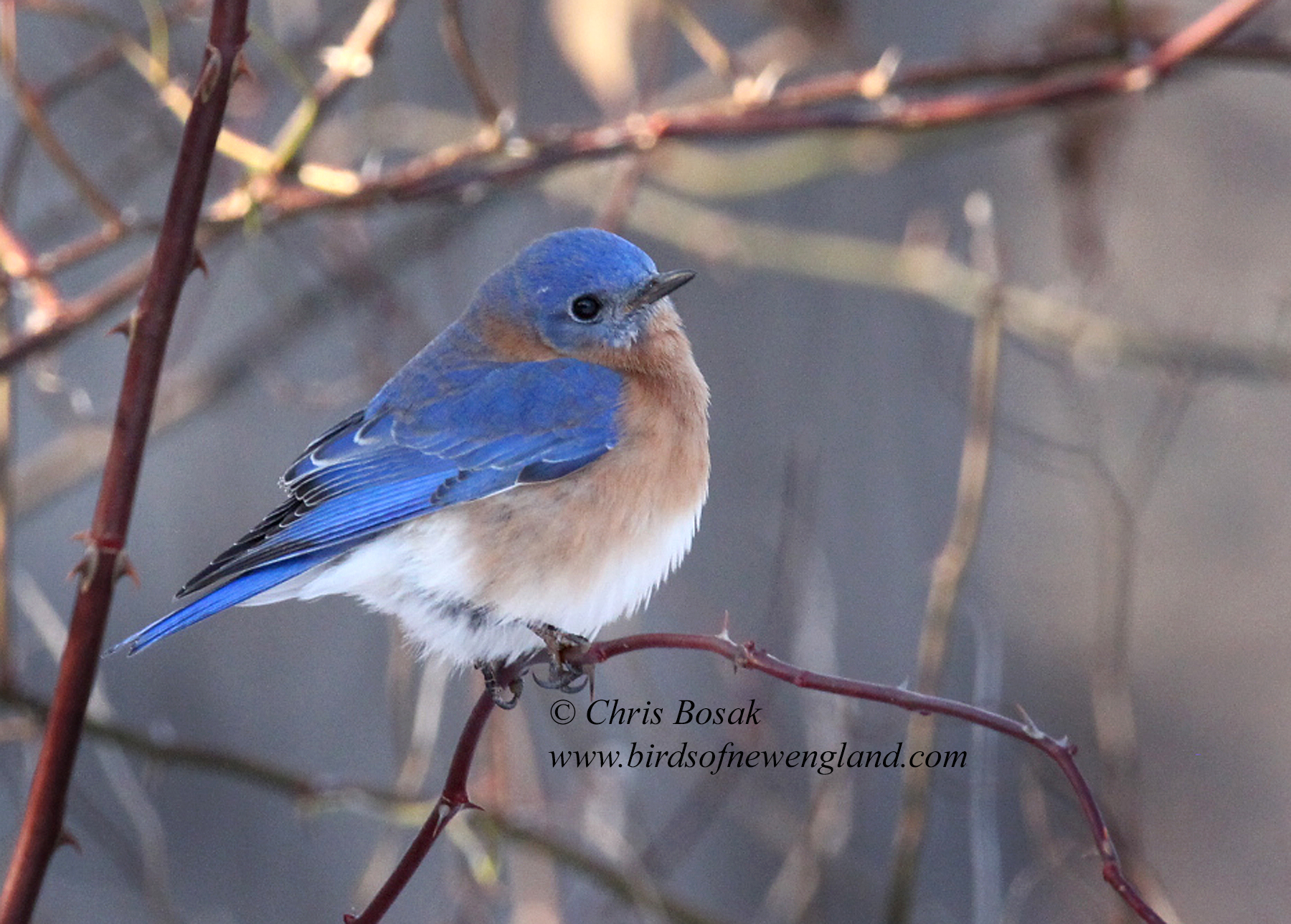
An eastern bluebird perches on a branch in New England, Jan. 2022.
Beautiful sights in nature can be long-lasting or fleeting. Sometimes a split second is all it takes to leave an impression.
A beautiful view from a mountaintop is always there. You could hike to the top of Mount Monadnock or Mount Washington and enjoy the panoramic splendor today, tomorrow or next month. The view will always be there. Sure, it will change with the seasons and weather, but the mountain isn’t going anywhere. You could plan months or even years ahead and count on seeing the beautiful view.
An awe-inspiring sunrise or sunset is more fleeting. First of all, there is no guarantee a gorgeous sunrise or sunset will happen at all. But when you do happen to catch one, the view lasts for 20 or 30 minutes. You could grab a seat and watch the show until it is either dark or light, depending on whether it’s a sunrise or sunset.
With birdwatching, most memorable sights are fleeting, and unless you are visiting a zoo or nature center, there are no guarantees. There are some almost certainties, such as a hawk watch location in the fall or a bald eagle watching spot in the winter, but those sightings are mostly fleeting. During a hawk watch, the bird is spotted as it approaches, observed as it flies overhead and then disappears into the distant sky. Eagle watches can offer a longer view as the large birds rest in trees near the water, but they can take off at any time.
Photo by Chris Bosak
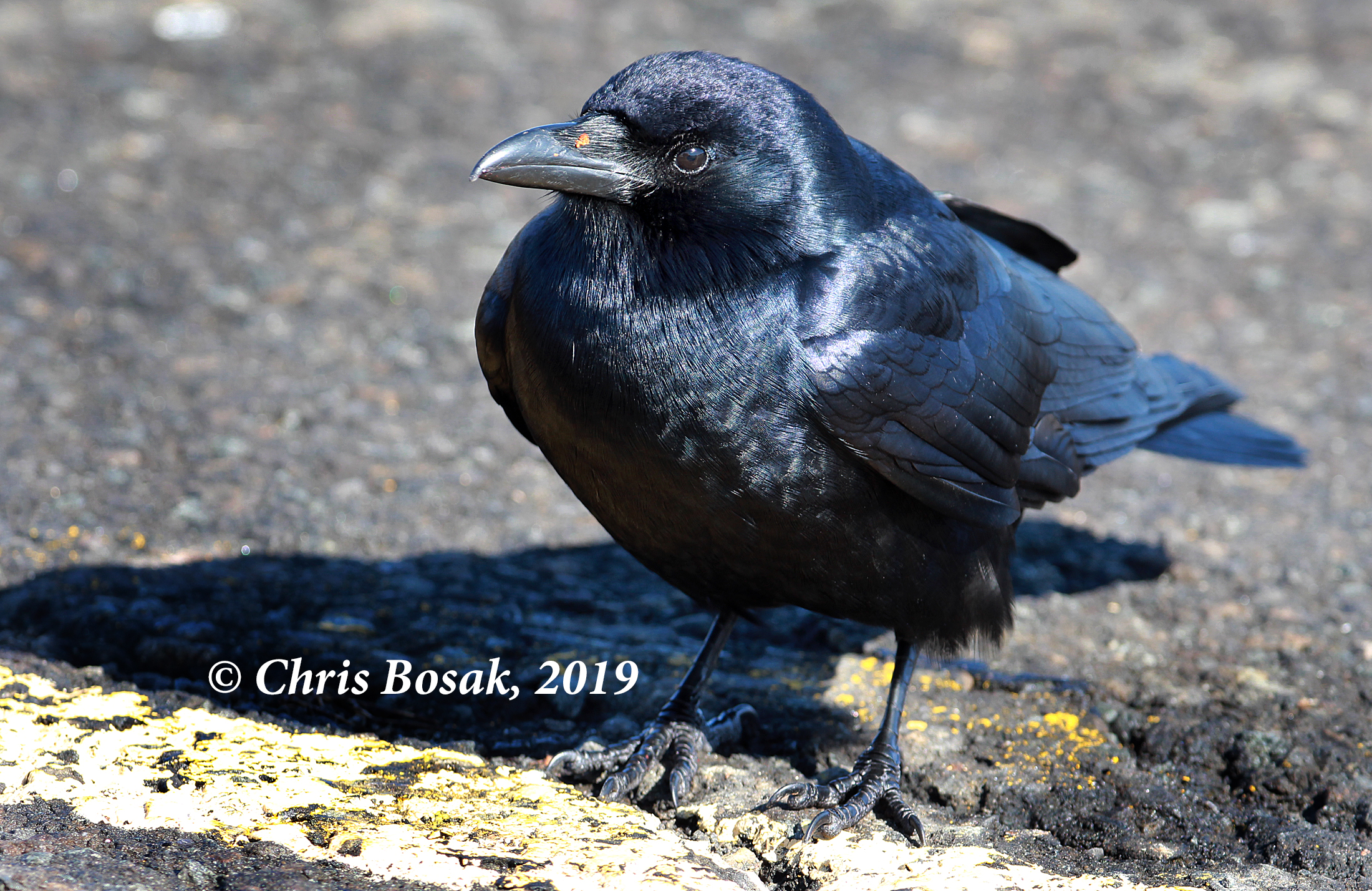
An American crow in Danbury, CT, winter 2019.
Crows are exceedingly smart, timberdoodles are back and cardinals just may be nesting already. Those are some of the interesting email topics I have received recently.
Don from Laconia wrote to say he has observed some interesting behavior from crows that hang around his yard. When the crows find a piece of food that is too big or hard, they carry the food to a nearby puddle and dip the food into the water to soften it and make it more manageable.
It has long been known that crows and other corvids, such as ravens and blue jays, have a high degree of intelligence. There is a video on YouTube with close to 10 million views that shows an experiment with a crow figuring out how to access food from tubes using water displacement. The pieces of food are floating on water in a tube just out of reach of the crow’s beak. In a series of tests, the crow has to figure out how to raise the level of water enough to reach the food. The crow eventually aces all of the tests and gets to the food each time.
Photo by Chris Bosak – White-throated sparrow, New England, March 2024.
It won’t be long until white-throated sparrows become more scarce as they head north and become less conspicuous for the breeding season. Until then, there are still photo opportunities like this …
Photo by Chris Bosak – White-throated sparrow, New England, March 2024.Photo by Chris Bosak – White-throated sparrow, New England, March 2024.








 Birds of New England.com