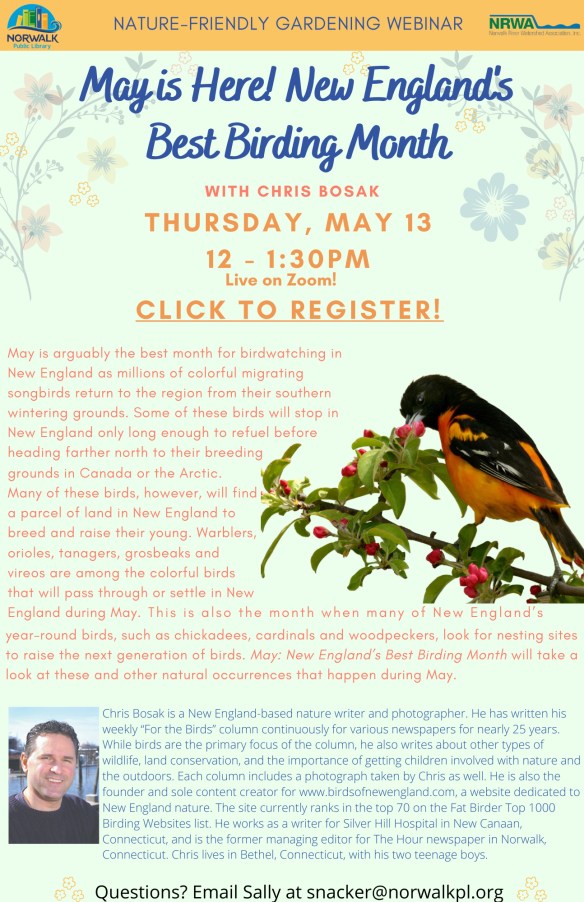
Norwalk Library did a great job with the announcement for my upcoming bird talk. It’s virtual, so please join us.
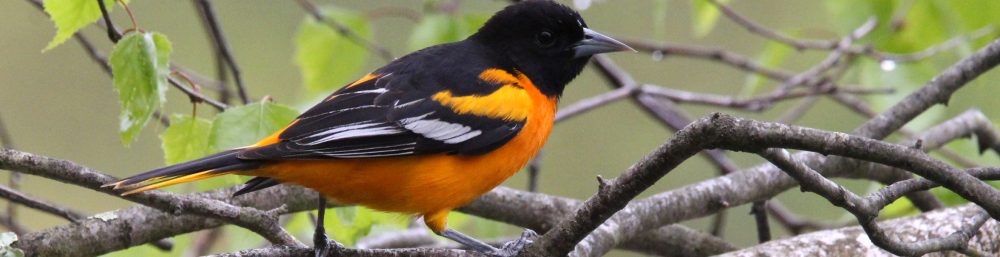
Norwalk Library did a great job with the announcement for my upcoming bird talk. It’s virtual, so please join us.

I had hobbled almost all the way from the car to the entrance of work when I noticed a flock of cedar waxwings picking off leftover berries in a nearby tree.
Even with the persistent tendinitis in my feet acting up, I made my way back to the car to grab the camera. Usually, in situations like this the camera is sitting at home, but this time I was prepared for the unexpected. Cedar waxwings, in my experience anyway, are always unexpected. They are fairly nomadic, and it’s hard to go out looking specifically for them. But they appear now and then and it’s always a thrill to see them.
I retrieved the camera and hobbled back through the parking lot to the tree in question. Of course, the tree was empty when I got back as the waxwings had taken off for parts unknown.
Continue reading
One of my favorite sights of early spring: wood duck drake on pond.

I’ve seen a few reports of pine warblers showing up in New England already. The thick of warbler season is still weeks away, however, so let’s put warblers on the back burner for now.
Phoebe reports are bursting all over the region. Those small, rather nondescript songbirds are an early spring migrant and get a head start on the competition by their early arrival. The risk, of course, is that winter lingers into spring in New England, and phoebes have a hard time coping with the weather. It’s all about risk-reward strategy when it comes to migration for birds.
Continue reading
The large field is bordered by hedgerows on three sides and woods on the fourth. Additional hedgerows divide the field perpendicularly about every 100 yards with small cutouts where the trails pass through.
I emerged from the woods and spotted something large walking along the east hedgerow about 40 yards away from the trail. It was tan, but then again so was everything else around it: the grass, the weeds, the hedgerow. I stopped in my tracks to watch it.
Before my brain fully comprehended the situation, I thought it was either a deer or a mountain lion. I quickly eliminated deer as it was clearly a large cat based on its smooth, stealthy and powerful stride. Can I finally put the mountain lion (or cougar or catamount) debate to rest with solid photos documenting the sighting?
Continue reading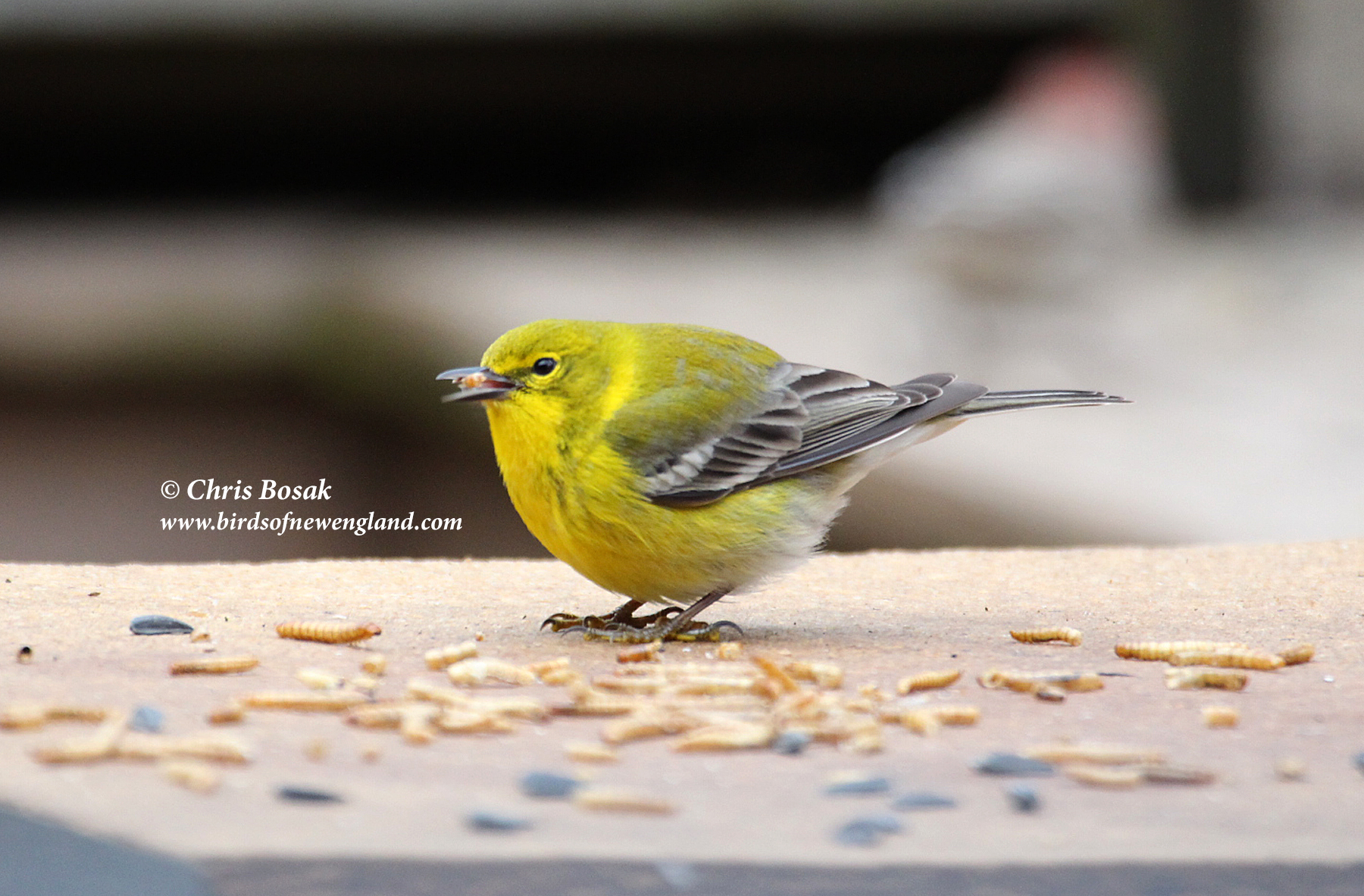
Other than the very few warblers of various types that remained in New England all winter, the pine warbler and palm warbler will be the first arrive in the region. I have seen them show up on rare bird alerts already but they will return in larger numbers over the next two weeks. Keep you eyes on your feeders as pine warblers are one of the few warbler species that will visit feeders. I’ve seen them eat suet, suet nuggets and meal worms. Above is the pine warbler; below is the palm.

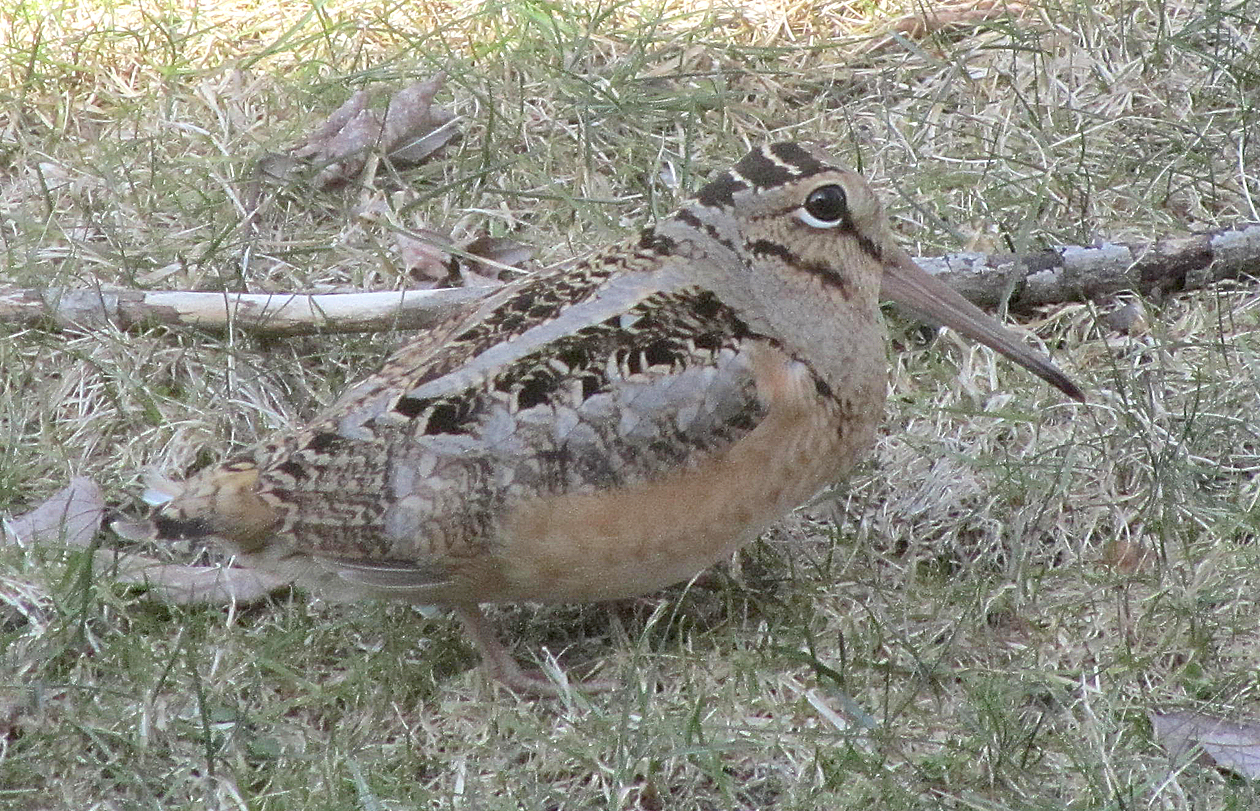
Woodcock are being seen and heard at dusk, phoebes are showing up slowly but steadily, mixed flocks of blackbirds are headed north, and the weather is sunny and warm one day and freezing and wet the next. It must be March in New England.
As we get ready for migration to pick up steam, here’s what readers have been reporting over the last few weeks. Bill from Keene wrote to say he’s hearing spring songs from the woods, which is always a good sign and pleasing chorus. Spring peepers, wood frogs and some birds are starting to call. I’ve heard cardinals almost daily now, which is a most welcomed, cheerful song.
Jeannie from Marlow wrote to say she has had upwards of four red-breasted nuthatches visiting her feeders at once. I thought my two-at-a-time visits were good. Jeannie also sent along a terrific photo of a barred owl having its feathers blown around by a strong wind. The photo may be found at www.birdsofnewengland.com under the “Reader Submitted Photos” category.
Jane from Marlborough wrote, questioning whether a small bird of prey she saw take a chickadee could be a merlin. Merlins are small falcons that breed mostly north of New Hampshire, but some do breed in the state and many pass through during fall and spring migrations. So it is very possible that her bird in question was a merlin.
Here’s what the N.H. Fish and Game website says about the merlin’s range: “Expanding range southward in NH. Currently breeds in the north and at scattered locations in central and western parts of the state. Occurs statewide during migration which peaks during September and early October; occasionally winters along the seacoast or in southern suburban areas.”
Thanks to the Keene Lions Club for having me as a guest speaker via Zoom last week at its meeting. I enjoyed meeting everyone virtually and appreciated the many thoughtful questions at the end. A question was posed that I didn’t have the answer for at the moment. I had referenced early in the presentation the 2019 study that shows there has been a decline of 2.9 billion birds in the U.S. and Canada over the last 50 years. The question came up as to what percentage that number represented. I thought it was a great question as numbers are sometimes presented to show a point, but proper context is missing.
I looked back at the study and found out that the 2.9 billion missing birds represent a 28 percent decline — roughly down from 10 billion adult breeding birds to 7 billion. That is a substantial number no matter how you look at it, but when you consider birds of certain habitats have declined by more than 50, the number becomes even more stark. Grassland birds, for instance, have declined by 53 percent since 1970, according to the study. That is fewer than half of the meadowlarks, bobolinks and more of our favorite grassland birds remaining.
On the bright side, which I was reminded of when I looked back on the study, numbers of waterfowl, raptors and woodpeckers have increased in the last 50 years.
The study, by the way, is entitled “Decline of the North American avifauna” and was conducted by researchers from several organizations such as Cornell Lab of Ornithology, American Bird Conservancy and National Audubon Society.
I hope everyone is ready for spring migration. Be sure to let me know what you’re seeing.

As promised (and expected, I’m sure), here are a few more photos of the bobcat I saw the other day at Huntington State Park in Redding earlier this week. Here’s the original post with more details.
Continue reading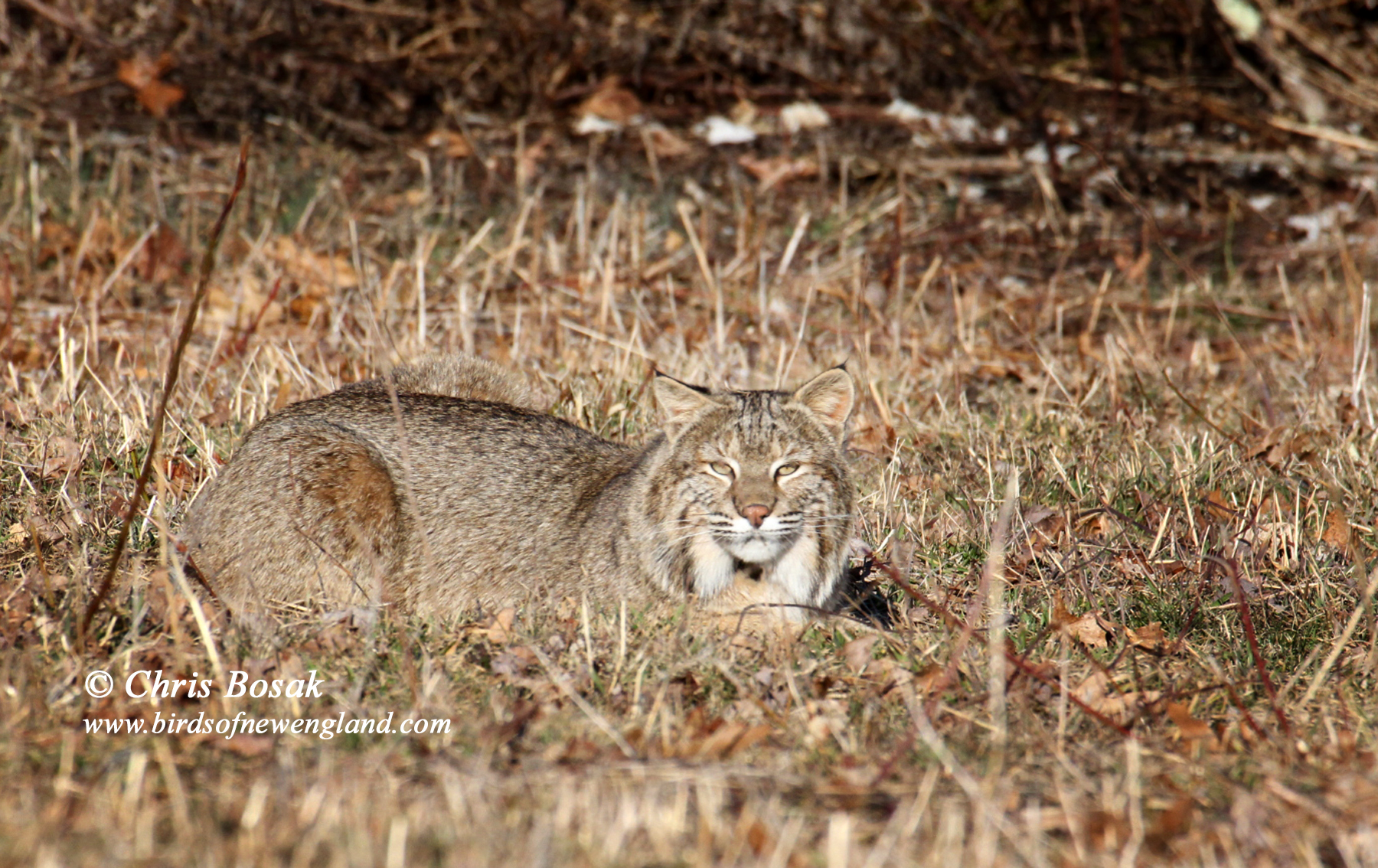
I came out of the woods and started walking through a field at Huntington State Park in Redding, Connecticut, Monday evening. I noticed something walking through the field parallel to my path about 50 yards to the east. As you can see from the photo, it was a bobcat, a photographic target of mine for years. Finally, I had found one. I can understand why some people mistakenly think they see a mountain lion when, in fact, they see a bobcat. It was much larger than I thought it would be. I’ve heard bobcats described as looking like “large house cats.” I don’t believe that does the bobcat justice. I have a fairly large house cat at home and this bobcat was much, much larger. More photos to come … of course.

March is an interesting month for birdwatching. In terms of variety and new birds to be found, it does not rank very highly, but March does welcome our first spring migrants.
Red-winged blackbirds have been around for a few weeks already, and in fact, some had never left and remained with us throughout the winter. American Woodcock have been seen and heard throughout New England already. Their aerial displays at dusk are one of the month’s birding highlights for sure.
In a few weeks, eastern phoebes will show up in New England and for me anyway, that really signals the beginning of spring migration.
In March, we also have our remaining winter birds. Juncos and white-throated sparrows are still around my feeders, and a few red-breasted nuthatches are Continue reading
 Birds of New England.com