Photo by Chris Bosak
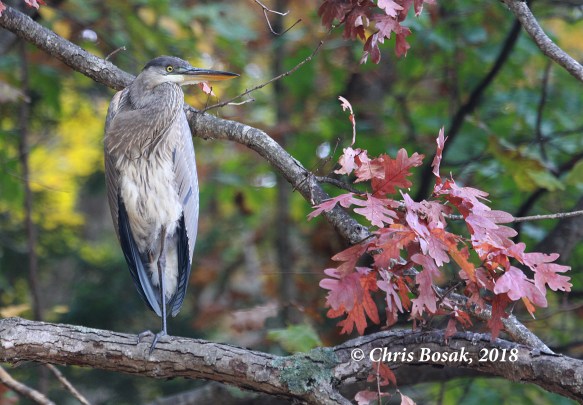
A great blue heron perches on one leg in a tree in Brookfield, Conn., during the fall of 2018.
Summer wouldn’t be summer without our waders, birds such as herons and egrets. We may not get as many individuals or different types as Florida, but New England boasts a good number of these recognizable birds. Here’s the start of a short photo series on these long-legged beauties.
Photo by Chris Bosak
A Great Blue Heron stands in a pond in Danbury, Conn., March 2017.Photo by Chris Bosak
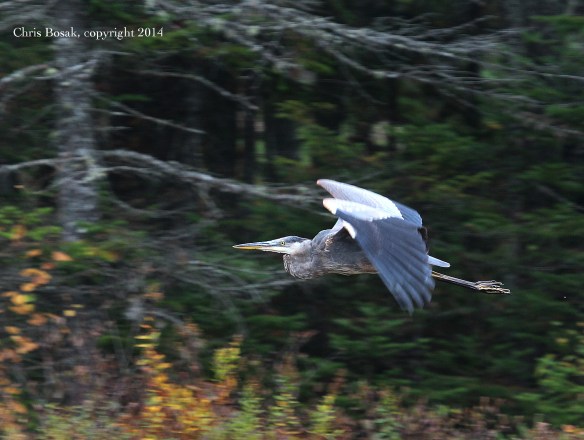
A Great Blue Heron flies across the scene at a pond in northern New Hampshire, Oct. 2014.
Photo by Chris Bosak
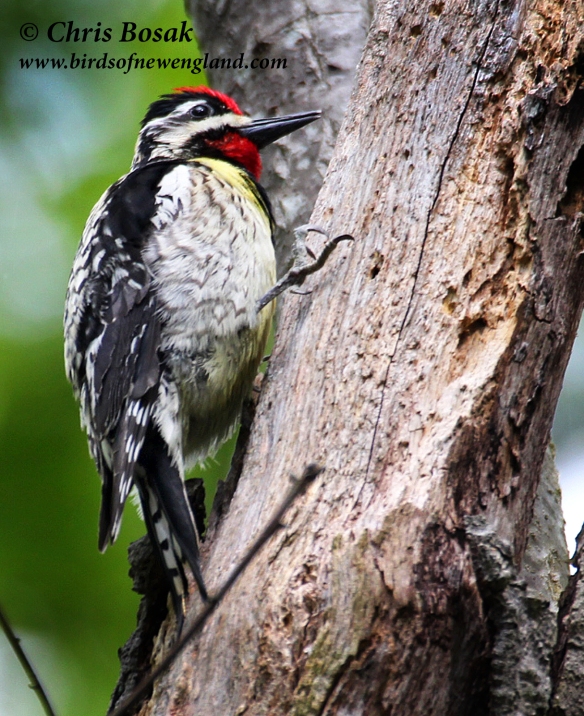
A male yellow-bellied sapsucker perches on a dead tree branch in New England, June 2020. Merganser Lake.
I am quite sure I am not his intended target, but when the yellow-bellied sapsucker drums on the hollow branch in my side yard, I come running. I mentioned in last week’s column that I have a yellow-bellied sapsucker that drums on a branch in my side yard and a pileated woodpecker that drums on a branch in the backyard. Woodpeckers often drum on objects such as hollow branches, the sides of houses, gutters, and chimney flashings. They pick objects such as these because the noise resonates far and wide. This drumming is done to attract mates or announce territory. Obviously, they do not tap on gutters or chimney flashings to find food or make homes.
They may pick hollow branches to make homes, naturally, but the territorial and mate-attracting drumming is more rhythmic and the cadence is specific to individual woodpecker species.
I also mentioned in last week’s column that I was impressed the first time I saw a birdwatcher identify the type of woodpecker from its drumming in the distance. I still do not have that skill down very well, but I am getting a lot of practice distinguishing the yellow-bellied sapsucker and the pileated woodpecker. Just as it is exciting when a bird chooses your property to eat, drink, or make a home, it is also exciting when a woodpecker chooses a branch on your property for its drumming.
It may not be so exciting when they return to your siding, gutter or chimney flashing for this purpose, however. If this is happening, there are measures you can take to try to stop it. Of course, nothing is a guarantee when we are talking about wildlife.
There are literally dozens of products on the market to deter woodpeckers from tapping on your house. Do a simple Internet search for “stop woodpecker damage” and they will all pop up.
New England has several woodpecker types. Most of New England has the aforementioned yellow-bellied sapsucker and pileated woodpecker, as well as downy and hairy woodpecker, and northern flicker. Southern New England and increasingly the middle part of the region also has red-bellied woodpecker. The northern part of New England features the black-backed woodpecker and, to a lesser degree, the American three-toed woodpecker.
The red-headed woodpecker is also an occasional sighting in New England. Many people mistakenly call the red-bellied woodpecker the red-headed woodpecker because it does indeed have a red head, or at least mostly red. The red-bellied woodpecker has a faint pinkish wash on the belly, which gives it its name. The red-headed woodpecker, indeed, has a fully red head. They are more common south and west of New England but, as I mentioned, are occasionally seen in our region.
This is just my own theory, and it hasn’t been scientifically proven to my knowledge, but the dreaded diseases that have ravaged so many of our tree species have greatly benefited woodpeckers. They build their nests in dead trees and branches, and sadly, between hemlock woolly adelgid, chestnut blight, Dutch elm disease and locust borers, they have plenty of dead trees to choose from. And, of course, lots of drumming branches.
Photo by Chris Bosak
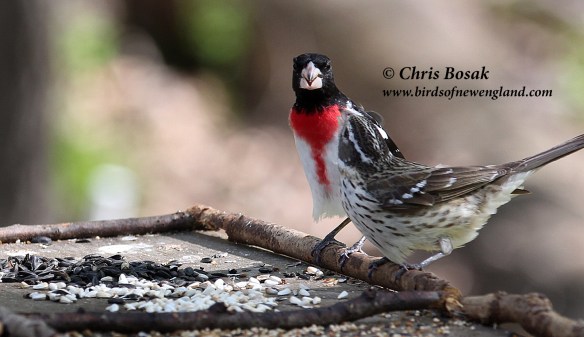
A rose-breasted grosbeak pair visits a feeder in Danbury, CT, May 2020. Merganser Lake.
A Day on Merganser Lake
Here are a few more shots of the grosbeaks in love.
Photo by Chris Bosak
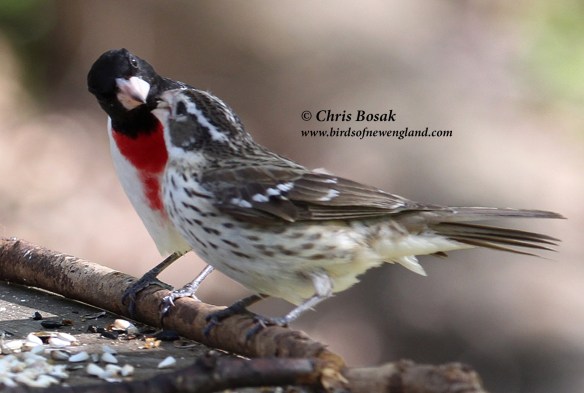
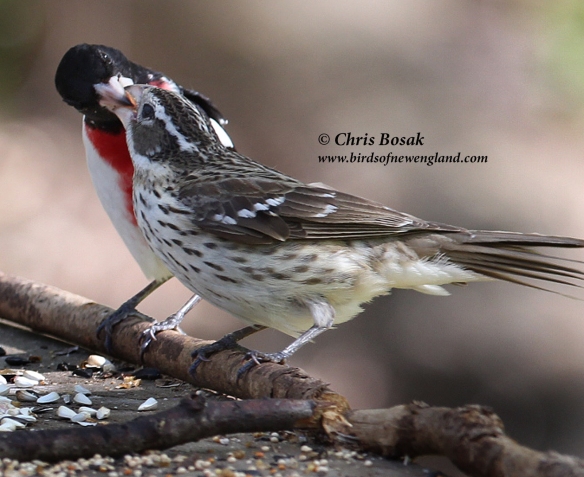
A male rose-breasted grosbeak feeds a female rose-breasted grosbeak in Danbury, CT, May 2020. Merganser Lake.Photo by Chris Bosak
A male rose-breasted grosbeak feeds a female rose-breasted grosbeak in Danbury, CT, May 2020. Merganser Lake.Photo by Chris Bosak
A male rose-breasted grosbeak feeds a female rose-breasted grosbeak in Danbury, CT, May 2020. Merganser Lake.Photo by Chris Bosak
A male rose-breasted grosbeak feeds a female rose-breasted grosbeak in Danbury, CT, May 2020. Merganser Lake.Photo by Chris Bosak
A male rose-breasted grosbeak feeds a female rose-breasted grosbeak in Danbury, CT, May 2020. Merganser Lake.
Photo by Chris Bosak
A male rose-breasted grosbeak feeds a female rose-breasted grosbeak in Danbury, CT, May 2020. Merganser Lake.
A Day on Merganser Lake
I’ve already posted photos of eastern bluebirds and northern cardinals feeding each other. Now, it’s the rose-breasted grosbeak’s turn. I took these photos a few weeks ago, but just now getting around to posting them. Click here to read I column I wrote about the behavior.
Photo by Chris Bosak
A red squirrel eats seeds from a platform feeder in New England, April 2020. Merganser Lake.
A Day on Merganser Lake
It’s been about four years since a red squirrel visited my backyard (at least that I’ve seen.) In northern New England, this is the dominant squirrel species and I often hear their rattle-like call when I’m camping. In southern New England, the gray squirrel takes over. In most of the region, the two overlap. I have no shortage of gray squirrels (or chipmunks), but these guys rarely show up. It visited for a few minutes for two or three days and I haven’t seen it since. That was in April.
Photo by Chris Bosak
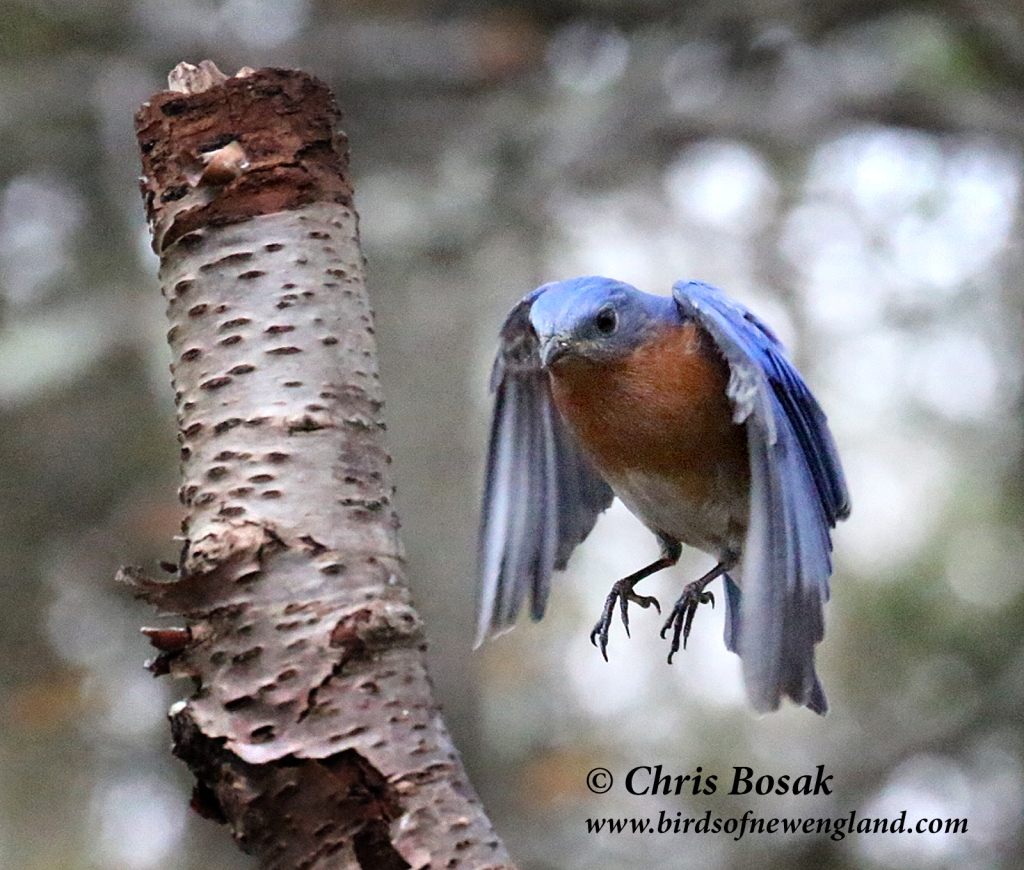
An eastern bluebird comes in for a landing on a branch in Danbury, CT, May 2020. Merganser Lake.
A Day on Merganser Lake
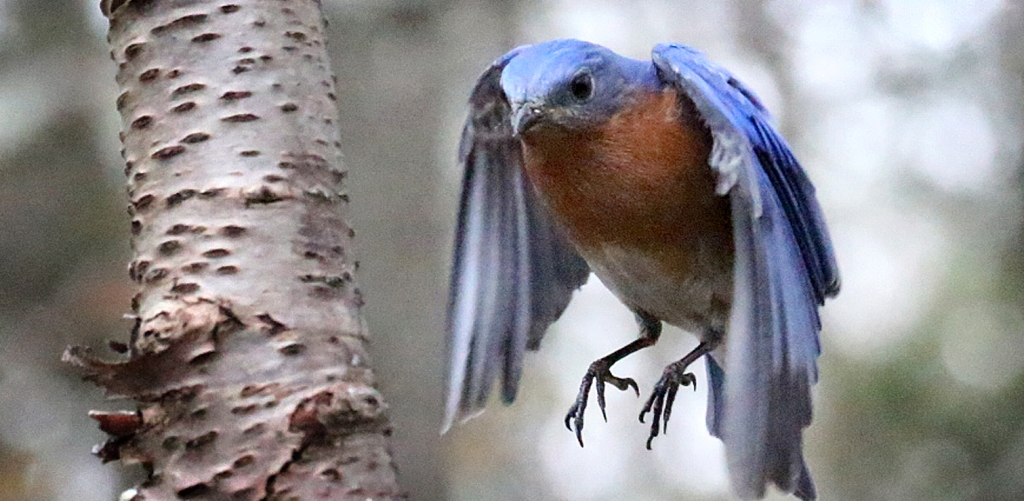
I posted more than my share of eastern bluebird photos in April and May, but somehow this one slipped through the cracks. Here’s a shot of one coming in for a landing on a birch branch.
Photo by Chris Bosak
An eastern bluebird comes in for a landing on a branch in Danbury, CT, May 2020. Merganser Lake.
Photo by Chris Bosak
An American robin perches in a tree in New England, June 2020. Merganser Lake.
Late spring/early summer is a great time to sleep outdoors. I’m lucky enough to have a porch that is screened from floor to ceiling on three sides. It’s like sleeping outdoors with the comforts of home. There’s usually not a lot to see as the woods encroach pretty closely on the porch. There wouldn’t be much to see in the dark anyway, of course. But I can hear everything. I typically sleep through the night but am occasionally jarred awake by a barred owl hooting or opossum trying to get into the compost pile. After years of breaches, I finally have the compost properly secured. The dawn chorus usually wakes me up. I listen to it for about half an hour and then fall back asleep. The other morning, it started at 4:21 with a lone robin singing in the nearby woods. An eastern wood pewee soon chimed in with its high-pitched song as if asking the robin to please be quiet. By 4:30, other robins joined in and it was game on. A tufted titmouse sang its “peter-peter-peter” song from a nearby branch. Titmice are small birds with a big voice. If the robin hadn’t awoken me at 4:21, the titmouse certainly would have. A cardinal sang in the distance and I heard a turkey gobbling from deep in the woods. I’ve seen turkeys in my yard twice in all the time I’ve lived here so I was surprised to hear them join the fray that morning. A hermit thrush sang its flute-like song and I recalled the nice poem that a reader had written and sent me last week. Thrushes certainly do have interesting and beautiful songs. I also heard a song I didn’t recognize. It sounded somewhat like a black-billed cuckoo, but I’m sure it wasn’t that. It’s always nice to know there is more to learn. Then the woodpeckers started tapping on their territorial branches. They choose branches, or other objects such as houses or chimney flashing, that are loud and reverberate. A yellow-bellied sapsucker favors a dead branch in my side yard and a pileated woodpecker uses one in my backyard. Thankfully, the tappings I heard that morning were coming from deeper in the woods. Many birders can determine a species of woodpecker by the cadence of its tapping. I was amazed the first time I had seen that and figured I’d never reach that level of expertise. After studying the sapsucker and pileated woodpecker up close, I’m starting to get the hang of it. Also significant was what I didn’t hear. No leaf blowers, lawn mowers, weedwackers, chainsaws or machinery of any kind. Not even any cars or trucks. These sounds have become so pervasive in everyday life they become like background noise. But at this time of day, only the birds could be heard. That thought pleased me greatly and I dozed back off to sleep.
Photo by Chris Bosak
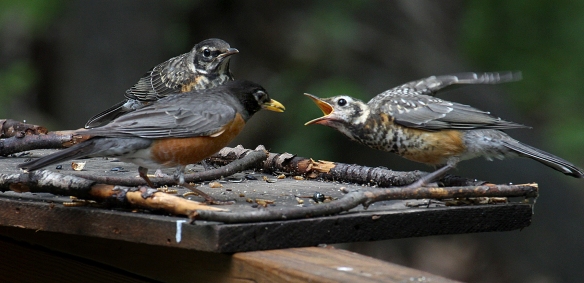
An American robin family visits a feeder in New England, June 2020. Merganser Lake.
Photo by Chris Bosak
An eastern bluebird and pine warbler share a suet feeder in New England, April 2020. Merganser Lake.
A Day on Merganser Lake
Unfortunately, the bluebirds that had visited daily since February have moved on. I haven’t seen them in about a week. Hopefully they will return next winter. It seems an appropriate time to look back on an action-packed April, which included scenes like this: an eastern bluebird and pine warbler sharing a suet feeder.