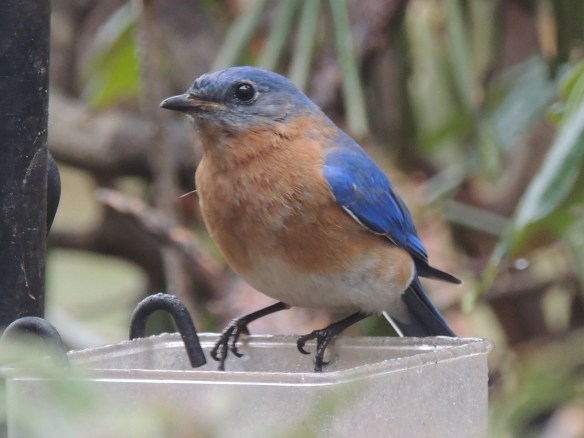
Annette Connor of New Hampshire got this shot of an eastern bluebird this winter.
The reports keep coming in so I’m going to ride the Eastern bluebird train for one more week.
In what is shaping up to be the unofficial Winter of the Bluebird, many sightings continue to come in from throughout New England, and beyond. Bluebirds, as I’ve written before, are not uncommon in New England in the winter, but the sheer number of reports this year is unique.
In case you missed the column from a few weeks ago, each winter seems to have a bird that shows up more frequently and noticeably than in typical winters. In recent years we’ve had the winter of the snowy owl, barred owl, American robin and dark-eyed junco. I’m sure you’ve figured out by now that this is highly unscientific and based on my own observations and the anecdotal observations of others.
I’ll run down the most recent sightings sent in and then close with a few fun facts about bluebirds.
Dick and Pat from Westmoreland wrote to say they had four bluebirds on their roof one recent morning, presumably drinking melted snow as it rolled down the shingles.
What’s better than having three bluebirds show up in your yard on a consistent basis in the winter? Having four show up, of course. That’s what Kathy from Swanzey is experiencing this year. She was pleasantly surprised to host three bluebirds last winter; this winter she added one to the count.
“We see them almost every day. It’s wonderful to hear their chirping Continue reading →
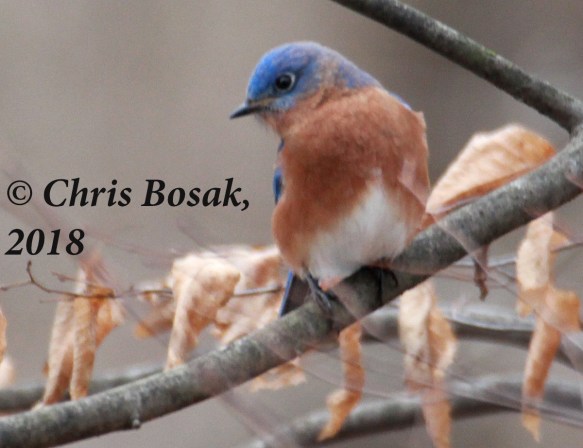
Photo by Chris Bosak An eastern bluebird, Brookfield, CT, fall 2018.
Here’s the latest For the Birds column, which runs in several New England newspapers …
It’s still too early to make any official declarations, but it is looking more and more like the Winter of the Bluebird.
After last week’s hint that it might be heading in that direction I received several more emails from astute birdwatchers finding eastern bluebirds. It’s not that bluebirds are a rare New England winter sighting but it appears that more people than usual are reporting them.
Similar to the American robin, another member of the thrush family, many eastern bluebirds remain with us throughout the winter. The trick is finding them.
Although I have still been shut out of the bluebird frenzy this winter, many others have written to tell me about their encounters. I appreciate the reports. Keep them coming.
Celia from Keene said there was “no missing the blue” of the bluebirds she saw on the rail trail in her city. She said they were the first ones she had seen during the winter.
Celia added that bluebirds nested on her property for the first time last summer. The way she described it explains in a nutshell why I love New England so much: “We put a bluebird house up in our yard overlooking the pumpkin patch …” Who else but a New Englander could start a sentence that way?
Elena from Winchester reported that a friend of hers saw a large flock of bluebirds near the Connecticut River in the Hinsdale area. Elena, like me, has been shut out of the bluebird party this winter so far, but she did report that a small flock of red-winged blackbirds continues to eat suet and sunflower seeders from her feeders.
Marie Anne from Guilford has had bluebirds visit her backyard for the past seven winters. She has had as many as eight but this year she has four “cranky little guys arguing over the mealworm feeder.”
“Their winter presence brings me as much peace and joy as their sweet complaints do during the gardening season,” she wrote.
Last but not least, Andrew wrote to let me know that bluebirds were at Continue reading →
Photo by Chris Bosak
A broken birdbath and several inches of snow made for an ideal canvas to make a face made out of nuts and seeds used to feed birds.
Happy Friday everyone. Here’s a random photo just because.
Photo by Chris Bosak An eastern bluebird scans a yard in Danbury, CT, March 2019.
I thought it was going to be the winter of the junco again, but it’s looking more and more like the winter of the bluebird.
Last year was the winter of the barred owl. As you recall, barred owls were being seen in great numbers all throughout New England. Experts had conflicting theories on why so many of these beautiful owls were being seen, but there is no denying that more than usual were found. On one trip to visit my brother in upstate New York, I found two barred owls. The second owl was perched atop a Welcome to New York sign on the Vermont border.
Several years ago, Christmas Bird Count results were teeming with huge dark-eyed junco numbers. Whereas there are usually hundreds of juncos in a particular count area, there were thousands that year. I dubbed it the winter of the junco and have been on the lookout for similar anecdotal phenomena since then.
Who can forget the winter of the snowy owl a few years back? I can recall robins and pine siskins being highlighted in previous winters.
As I drive to work every day, one stretch of a particular road often has a large flock of juncos. They scatter as I drive by; their white-outlined tails giving away their i Continue reading →
Photo by Chris Bosak
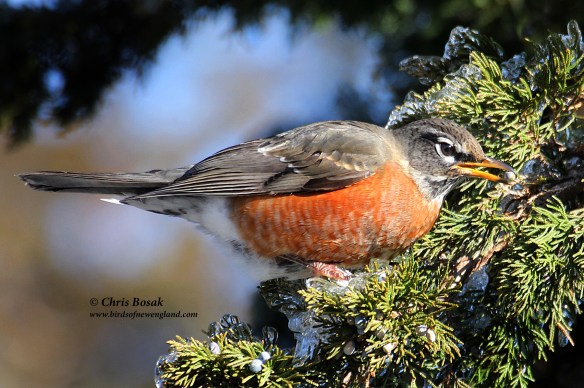
An American robin eats berries from a cedar tree in New Canaan, CT, December 2019.
Any photographer, regardless of subject interest or specialty, will tell you about the importance of always having your camera handy because you never know when those special moments will happen. I rarely follow that advice, truth be told, even though I’ve preached that advice many times. I did, however, happen to have my camera handy at work the other day when a flock of robins gathered in a cedar tree to pick at the small, blue berries. Maybe this will be the impetus for me to have my camera at the ready more often. Time will tell.
Photo by Chris Bosak An American robin eats berries from a cedar tree in New Canaan, CT, December 2019.
Photo by Chris Bosak Blue-headed vireo, Pillsbury State Park, N.H., June 2019.
Last year at this time I wrote about my New Year’s resolutions to help birds. They largely focused on citizen science projects I would either undertake for the first time or continue to be involved in.
Looking back, I could say that I did fairly well with my resolutions. Some of them, however, like most resolutions, just never came to fruition.
I did participate in a number of citizen science projects. I have done the Christmas Bird Count and the Great Backyard Bird Count for many years continuously. This past year was no exception.
Also, last year was the second year of the three-year Connecticut Breeding Bird Atlas, an ambitious project to document what birds are breeding in that state. I have an adopted area and look forward to this spring to add to my breeding bird list. I also beefed up this past year my contributions to eBird, a free app in which all reported sightings are entered into a massive database.
I fell short in a few areas. I never did take the steps to join Project FeederWatch, which I had vowed to do. Maybe this year.
I will take a slightly different approach to my bird New Year’s resolutions this year. I will continue to do the citizen science projects, of course, but will also add some resolutions of a different sort.
I have been thinking about and being encouraged to write a book or two about my birding adventures. I haven’t done so after all these years because I wasn’t Continue reading →
Photo by Chris Bosak A rose-breasted grosbeak eats safflower seeds from a feeder in Danbury, Conn., May 2019.
I promise, here’s the last 2019 birding highlight that didn’t make my Top 10 list. This usually does make my yearly Top 10 list, but other highlights nudged it out this year. Last year was another great year of feeding birds and watching birds in my back yard proved to be a highlight once again. So here’s to those backyard feeder birds. OK, now on to 2020.
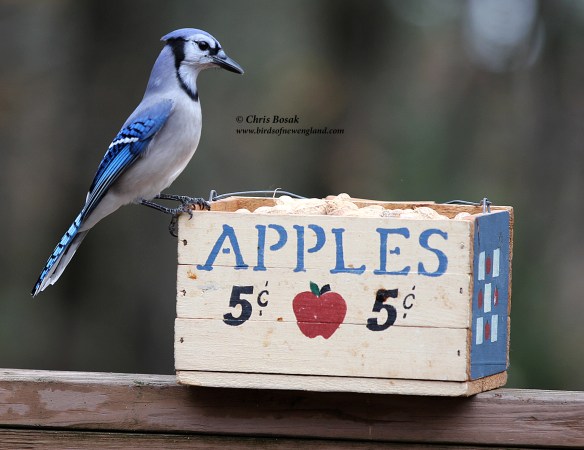
Photo by Chris Bosak A blue jay checks out a box for peanuts in New England, fall 2019.
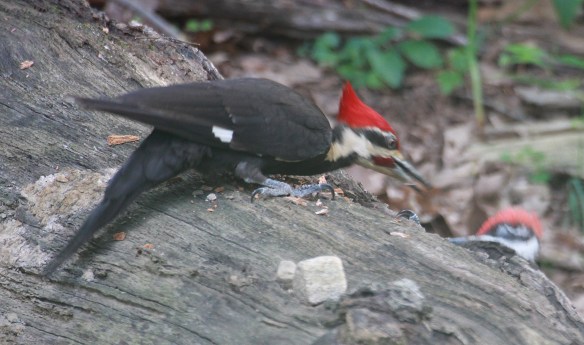
Photo by Chris Bosak
A young pileated woodpecker knocks on a fallen tree trunk as it looks for insects, Danbury, Conn., summer 2019.
I couldn’t let this 2019 birding highlight go unrecognized. I, like everyone else, love any pileated woodpecker sighting. This sighting was in my backyard and featured a male adult teaching a young pileated how to look for food. Here’s the original post with more information.
Photo by Chris Bosak
An osprey eats a catfish at Cayuga Lake State Park, October 2019.
Here’s another 2019 highlight that could have easily made my Top 10 list, which I posted a few days ago. During an early September camping trip with three college friends in the Finger Lakes region of N.Y., we were treated to a sighting of an osprey eating a catfish. Wayne noticed the spectacle first and pointed it out to the rest of us as we were, coincidentally, having our breakfast.
Later in the day, we walked to the nearby beach and saw a few snow geese. It seemed early for snow geese sightings, but I didn’t complain as they are hard to come by in New England.
More leftover highlights to come …
Photo by Chris Bosak
Snow geese at Cayuga State Park in Seneca Falls, N.Y., fall 2019.
Photo by Will Bosak
Kingbird rescue, Danbury, CT, 2019.
Here is the latest For the Birds column, which runs in several New England newspapers.
It’s time for my favorite column of the year. This is the time when I look back on the past year and give my top 10 birding highlights. Every year, I struggle to narrow it down to 10, but I will do my best and perhaps put a few honorable mention moments on my website in the next few days.
10. I visited my brother in Naples, Fla., in April and, of course, birds were everywhere. Waders such as egrets, herons, limpkins, and ibis were the dominant species. We have our fair share of waders in New England, for sure, but they are more numerous and more brave in the Sunshine State. I enjoy my visits to Florida, but always long for New England when I’m away.
9. A solid bald eagle sighting has to make this list. A summer canoe trip to the Bashakill Wildlife Management Area in Wurtsboro, N.Y., yielded just that. We saw the female and male, but the young eagles that locals said were around escaped us. The comeback of the bald eagle is a great conservation story. I hope it continues.
8. One last sighting outside of New England … Last winter was the Year of the Barred Owl, or so it seemed. People were seeing barred owls all over the place, day and night. My son and I were driving to Hoosick Falls, N.Y., last February to see another one of my brothers when, about half an hour shy of our destination, sure enough we saw a barred owl perched on a wire hanging over Route 22. The next morning, we saw another barred owl perched on a Welcome to New York sign. The photo was taken from the Vermont side of the sign so, technically, it was a New England sighting.
7. The Christmas Bird Count is always on this list somewhere. My CBC birding partner Frank and I found 52 species, totaling nearly 2,000 individual birds. The birds, the camaraderie, and feeling of doing good for conservation make the Christmas Bird Count a special event each year.
6. This year, after many years of procrastination and talking myself out of it, I tried my hand at selling some of my photography as Christmas cards. I was a vendor at a few craft fairs and did pretty well. The selling part was great, but talking to people about the photography and turning them on to birds was the real highlight. I’ll try again next year and try to figure out how to sell them online.
5. This spring, small flocks of common mergansers made their home for a few days at a small pond adjacent to a nearby shopping destination. I love my common mergansers and my sightings are typically of huge flocks hundreds of yards away. To see a few up close and personal was an unexpected treat, if only for a few days.
4. Barred owls were not the only species garnering attention last winter. Pine siskins were plentiful throughout New England and farther south and I certainly played host to more than my fair share. They stuck around for a long time, too, and visited daily in rain, sleet, snow and sun.
3. I started a new job a few months ago and, of course, I figured out a way to feed the birds out the window near my desk. I found a large, curled oak leaf, rested it on the flat top of a yew bush, and threw in some shelled sunflower seeds. I fill it daily and watch the juncos, white-throated sparrows and song sparrows partake.
2. I was sitting at my computer, probably writing a bird column or something, when my youngest son, Will, came charging up the driveway and into the house. He had been fishing with some friends at the nearby lake. “Dad, there’s a bird stuck on fishing line. I feel so bad for it.” I put the canoe on the car and rushed to the lake. An eastern kingbird tangled in fishing line was dangling helplessly from a tree over the water. Long story short, Will and I paddled out to the bird, untangled it and set it free. The full story, including when Will and I swamp the canoe in mucky water and the bird poops on my head, is archived on my website. Visit www.birdsofnewengland.com and put “kingbird” into the search field. I was proud that Will felt compelled to leave his friends and come get me to help a bird in despair.
1. The top highlight of the year is a morning I spent with three loons at Pillsbury State Park, near Lake Sunapee. The three-day camping trip was marred with rain on two of the mornings, but the middle morning featured a beautiful sunrise and mirror-like water with fog lifting. I saw the loons in the distance and stopped paddling. Eventually, they worked their way over to me and gave me fantastic views. Patience certainly paid off that morning.
I hope everyone had a terrific 2019. Best wishes for an even better 2020. I look forward to sharing more bird stories in the year to come.
Photo by Chris Bosak
A common loon swims at May Pond in Pillsbury State Park in New Hampshire in June 2019.







 Birds of New England.com