Katydids are one of summer’s most ubiquitous creatures, yet we rarely see them. We sure hear them, though.
That beautiful (to my ears anyway) sound you hear all evening and night during warm weather is a katydid, which rubs its wings together to make its namesake sound. I’ve heard people say they’ve heard cicadas all night, but what they are likely hearing are katydids. Cicada are usually heard during the day and have a different insect sound. Crickets also chirp at night, but katydid sounds can easily be differentiated.
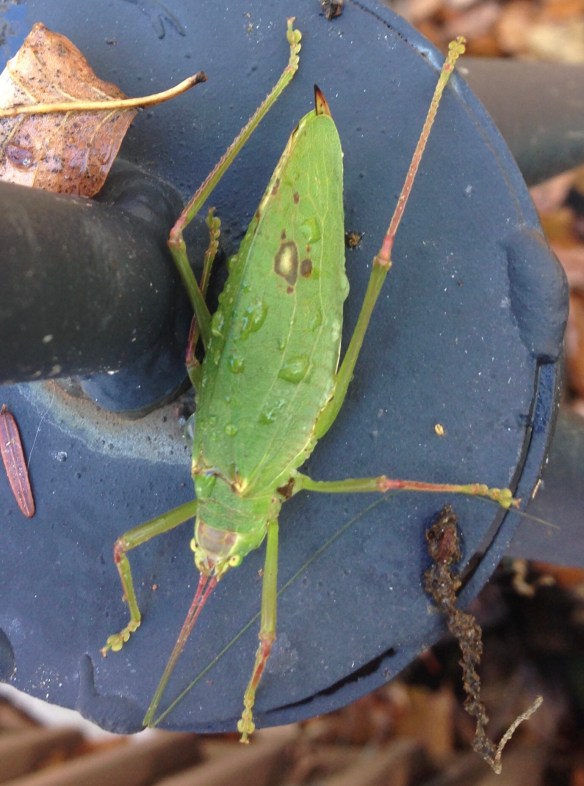
Katydids are bright green and somewhat resemble a grasshopper. They also look like leaves, a handy attribute to have to fool predators.
If you are lucky enough to find one, check out its face. It looks (again, to me anyway) like a mini lobster.
The katydids we have in New England are about two inches long. The giant katydid of Malaysia grows to six inches, but is still completely harmless to humans.
Photo by Chris Bosak An eastern phoebe sits on a sign near the edge of Deer Pond in Sherman, CT, fall 2019.
Here’s an interesting scene I came across the other day during a walk at Deer Pond Farm, a property of Connecticut Audubon in Sherman, CT. Phoebes are one of the first migrants to arrive in New England in the spring and one of the last to leave in the fall.
Here is the latest For the Birds column, which runs in several New England publications.
Photo by Chris Bosak
An osprey eats a catfish at Cayuga Lake State Park, October 2019.
Summer is hanging on, if only by a thread.
It’s always fun to see the nutty people who refuse to dig into their long-dormant jeans pile and insist on wearing shorts even when the temperature dips into the 40s. I see one of those yokels every time I walk past a mirror.
In the natural world, some flowers are still putting on a show, but it’s mostly the late bloomers such as goldenrod and asters. Some, but not many, traditional summer bloomers are toughing it out, but store-bought mums are the most commonly seen flowers these days.
The other day I walked past a pollinator garden and a monarch caterpillar stuck out like a sore thumb on the top of a milkweed plant. I hope the caterpillar does what it has to do quickly before the prolonged deep freezes come. It also made me think of all the fields that have been cut down already and I wonder how many monarch caterpillars lost their homes because of it.
Eastern phoebes, which are one of our first migrants to appear in spring with their late March arrivals, are still seen from time to time. I saw a few perched over a pond and bobbing their tails last week. The tangle of brush a few yards away from the pond was teeming with white-throated sparrows, however; a sure sign of fall and pending winter.
I had another exciting reminder of summer during a recent camping trip I took with some long-time friends. We were having breakfast at the picnic table when Wayne pointed to a distant snag and asked: “Is that a hawk or what?”
We grabbed the binoculars and trained them on an osprey eating a fish. We closed in on the dead tree for a closer look and noticed the bird was eating a fair-sized catfish. No blackened seasoning was necessary as the “fish hawk” tore through the skin and into the meat of the fish. Anyone who has ever caught a catfish knows how tough that skin is. The osprey didn’t struggle in the least.
I attended a presentation last week by Alan Poole, the author of two books on osprey. His latest book is “Ospreys: The Revival of a Global Raptor.”
Poole noted interestingly that an osprey has self-sharpening talons. The hard upper part of the talon, or claw, grows at a faster rate than the softer under part of the talon, leaving the large bird of prey with sharp claws at all times.
The osprey we watched did not push the timetable too far, but most ospreys in New England and nearby states have started their journey south by the end of September. Ospreys are not like most hawks and eagles whereby some individuals remain north throughout winter. All ospreys go south so to see one in October is a nice treat for a birdwatcher.
Poole noted that, while ospreys do mate for life, they go on separate migratory journeys.
Much of Poole’s presentation focused on the amazing comeback of the osprey population. After being nearly wiped out in the 1950s due to heavy pesticide use, the osprey has made a remarkable comeback and is now flourishing in North America and northern Europe, as well as on their winter grounds in South America and Africa.
The population turnaround is welcomed news considering the study released a few weeks ago that shows that North America has lost 29 percent of its birds in the last 50 years.
Poole concluded his presentation with this: “Ospreys are a good example that we can get things right if we pay attention and get organized.
Photo by Chris Bosak
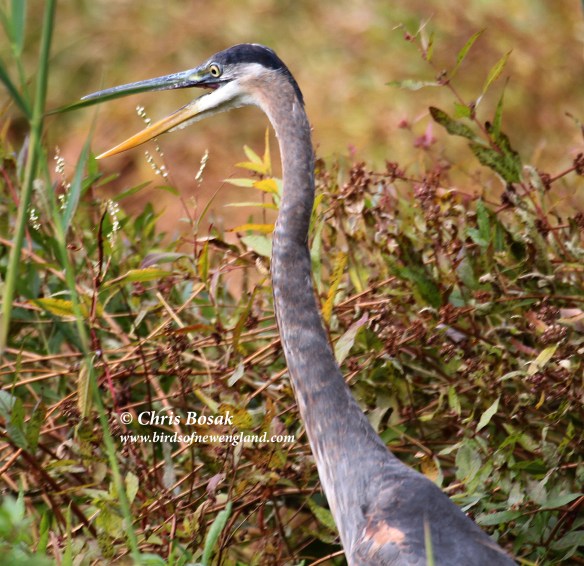
A great blue heron in Danbury, CT, fall 2019.
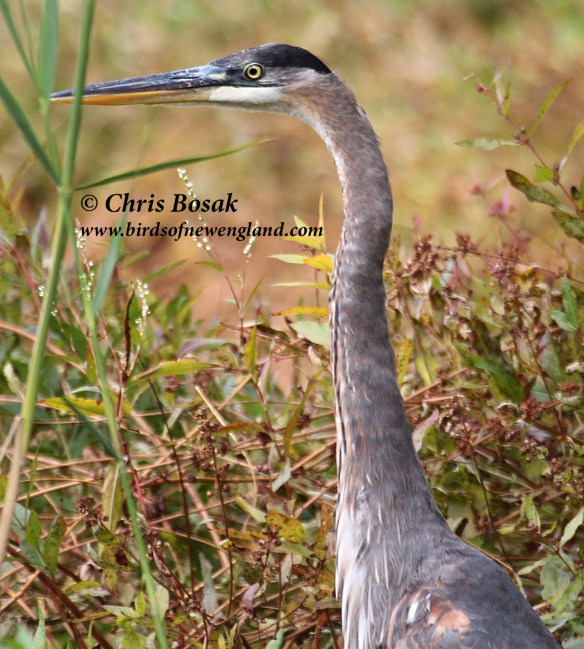
Fall migration is in full swing and many of our spring and summer birds have left us already. Thankfully, we have great blue herons all year round. Most leave by the winter, but some remain with us (or try to at least) even through the most brutal seasons. It’s always a thrill to see great blue herons, or any birds for that matter, with a background of our famous New England fall foliage.
Photo by Chris Bosak
A great blue heron in Danbury, CT, fall 2019.Photo by Chris Bosak
A great blue heron in Danbury, CT, fall 2019.
Photo by Chris Bosak
An osprey eats a catfish at Cayuga Lake State Park, October 2019.
There is more coming on this story next week, but here are a few photos of an osprey eating a catfish. Some longtime friends and I went camping a few weeks ago and spotted this exciting scene.
Photo by Chris Bosak
An osprey eats a catfish at Cayuga Lake State Park, October 2019.
Photo by Chris Bosak Tufted titmice gather near a container with coneflower during November 2018. Coneflower is a native plant that attracts birds.
The study released a few weeks ago that reported a 29 percent decline in the number of birds in North America since 1970 did not merely throw out some discouraging facts and leave it at that.
It also included many reasons why bird populations are decreasing, most notably habitat loss. There is not a whole lot the average person can do about habitat loss — other than plead with local officials to stop the development of critical habitat. But the authors of the study did include seven actions that we can all do to help improve birds’ chances of survival.
The actions are as follows: use native plants, avoid pesticides, keep cats indoors, make windows safer, do citizen science, reduce the use of plastic and drink shade-grown coffee. Now, let’s take a closer look at each of these actions.
Planting native flowers, bushes and trees gives birds and insects a source of food they have evolved with. It restores the natural balance of an area and limits the spread of invasive plant species. A simple internet search will yield dozens upon dozens of bird-friendly native choices for your garden and yard.
Pesticides should be avoided for much the same reason. Killing off insects, especially native insects, limits the food available for birds. Many birds rely on insects as the main part of their diet. This is particularly important during the nesting season as birds feed their youngsters and teach their fledglings how to hunt. If an area is void of insects, it is likely void of birds.
I know how difficult it can be to keep cats indoors. Most cats want to be outdoors and it’s hard to deny them that desire. My cat sneaks out on occasion when I have my hands full of groceries and the screen door closes too slowly, so I have work to do in this area as well. But it really is in the birds’ best interest to keep kitty inside. Feral cats? That’s another bigger problem.
If you have some particularly problematic windows that bird keep crashing into, consider buying decals to put on the outside of those windows. The decals are relatively unobtrusive and may be found at bird stores or online. The decals break up the scene that may otherwise be confused as an extension of the outdoors. Building windows? That’s a way bigger problem that many developers are starting to address with bird-friendly design.
Participating in citizen science projects such as the Great Backyard Bird Count, Christmas Bird Count and Project Feeder Watch gives important data to ornithologists that they use to track bird population trends. In fact, this data was a key source of information for the latest study.
There are several easy steps to take to reduce the amount of plastic used. Reusable water bottles, although many are made of plastic, greatly reduce waste. Filling a water bottle each morning instead of drinking two or three store-bought waters has a great impact over the course of time.
Similarly, reusable shopping bags reduce the need for the one-time use plastic bags. That also keeps those annoying bags out of trees, which I often mistake for birds from a distance.
Industrial-scale coffee plantations are an environmental nightmare as large swaths of land are clear cut on many birds’ winter grounds. Thankfully there are many bird-friendly, shade-grown options. Birds and Beans brand is based in New England.
Employing some of these strategies will help the birds that live in and around your property. It may seem like a drop in the bucket compared to the 2.9 billion birds that have disappeared in the last 50 years, but enough drops will eventually overfill a bucket.
Alan Poole at Connecticut Audubon Society’s annual meeting held Monday, Oct, 7, 2019, at Pequot Library in Southport, CT.
I’ve taken a keen interest in the burgeoning osprey population ever since I covered the story about the osprey pair that built a nest at a Norwalk (Connecticut) beach park. The nest was being built high atop a light pole overlooking a softball field. It seemed a peculiar place to build a nest with the giant lights right there.
At the time, however, even more out of the ordinary was that an osprey pair was building a nest in Norwalk, which is a city in southwestern Connecticut on the shore of Long Island Sound. Norwalk hadn’t hosted an osprey nest — and certainly not one that public and visible — in many years, perhaps decades.
That was 2004. Fast forward 15 years and Norwalk is now home to a more than a dozen osprey nests. Connecticut, in fact, now has more than 500 osprey nests. All up and down the East Coast — shoreline and inland — ospreys have come back with a fury.
It is truly a conservation success story. Ospreys were nearly wiped out by pesticides in the 1950s. Now they have bounced back mightily throughout the U.S. and Europe, and their accompanying winter grounds in South America and Africa.
So when I saw that Alan F. Poole, a Massachusetts resident and noted expert/author on ospreys, was going to be the keynote speaker at the Connecticut Audubon Society’s annual meeting, I marked the date on my calendar.
Poole’s informative presentation on osprey included photos, graphs and charts on the incredible comeback of the “fish hawk.” Some tidbits from the presentation:
osprey are the only bird species that eats live fish exclusively
baby osprey take about 50 days to reach full size
in 1940 there were one thousand ospreys in New England; by the end of the 1950s only 90 pairs remained
artificial nesting sites such as man-made platforms and light poles have played a major role in the recovery
ospreys mate for life but do not migrate together
about half of the first-year osprey will die within the first year
osprey nests are made of large sticks and may weigh a half ton or more
osprey are gentle birds for the most part but will fiercely defend its nest
John James Audubon was a big fan of osprey and called them “This Famed Bird”
Osprey have self-sharpening talons as the hard upper layer of the talon grows faster than the soft under part
Poole recently wrote Ospreys: The Revival of a Global Raptor.
In other business, Connecticut Audubon Society (@CTAudubon) reinstated its officers, confirmed new board members and doled out awards to volunteers. It’s a great organization worthy of support.
Poole ended his presentation with an interesting comment. Referring to the study released a few weeks ago about the bird population decreasing by 29 percent since 1970, Poole said: “Ospreys are a good example that we can get things right if we pay attention and get organized.”
Amen to that.
Photo by Chris Bosak A first-year Osprey sits on the top of a sailboat mast along the Norwalk River in Norwalk, Conn., summer 2015.
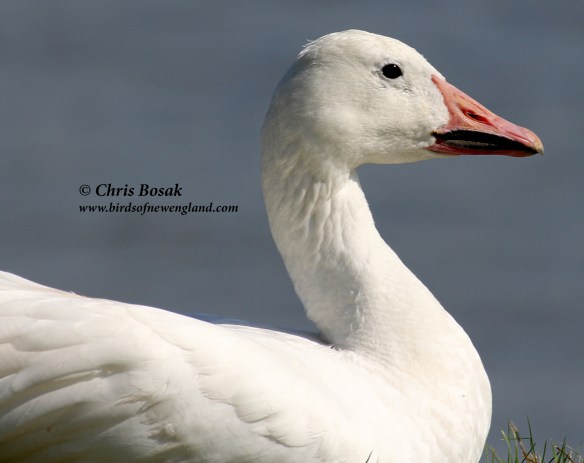
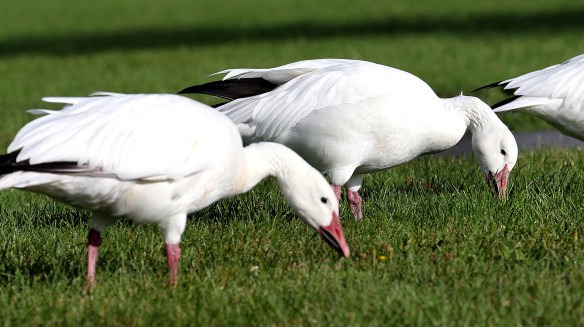
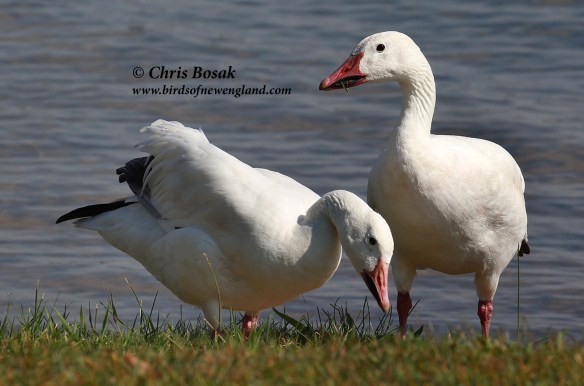
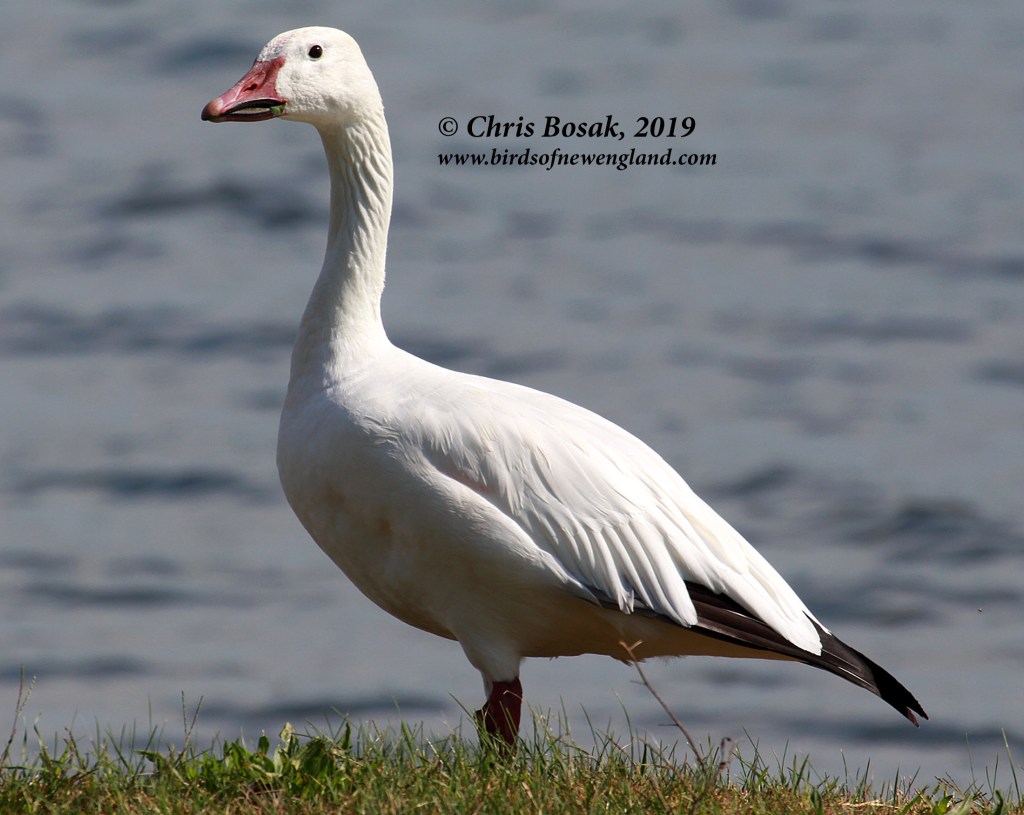
Photo by Chris Bosak Snow geese at Cayuga State Park in Seneca Falls, N.Y., fall 2019.
You didn’t think I was going to post one snow goose photo and leave it at that, did you? Here’s the link to my previous post on snow geese in which I mention that New England, for the most part, misses out (but not by much) on the massive snow goose migrations.
I found these snow geese near the beach at Cayuga State Park in Seneca Falls, N.Y., during a camping trip with three long-time friends. Yes, it’s not New England, but it’s only a few hours drive away and the area gets so many snow geese that people actually complain about them. (At least the one wine pourer did.) It just goes to show the narrow margin by which New England misses the spectacle.
Here are some more shots of the geese. There were four geese there when we visited in late September. In a few weeks, the mowed corn fields will be filled with these beautiful birds.
Photo by Chris Bosak Snow geese at Cayuga State Park in Seneca Falls, N.Y., fall 2019.Photo by Chris Bosak
Snow geese at Cayuga State Park in Seneca Falls, N.Y., fall 2019.Photo by Chris Bosak Snow geese at Cayuga State Park in Seneca Falls, N.Y., fall 2019.
New England is not known for its snow geese. In fact, most snow geese that I have seen in New England are “stray” individuals hanging out with Canada geese. The massive flocks seem to be reserved for nearby states such as Delaware, Maryland, Pennsylvania and New York. There are, however, pockets of New England that host large numbers of snow geese for relatively short periods of time. Northern Vermont comes to mind for such a spectacle.
Snow geese are one of the world’s most numerous species. Most snow geese are white (hence the name) but young ones are grayish and there is a blue morph variety. Here’s an interesting tidbit from allaboutbirds.org: “In wintering and migrating flocks that are feeding, lookouts keep an eye out for eagles and other predators. Upon sighting a threat they call out to the rest of the flock, which may take flight.”








 Birds of New England.com