For the Birds: Marching through winter

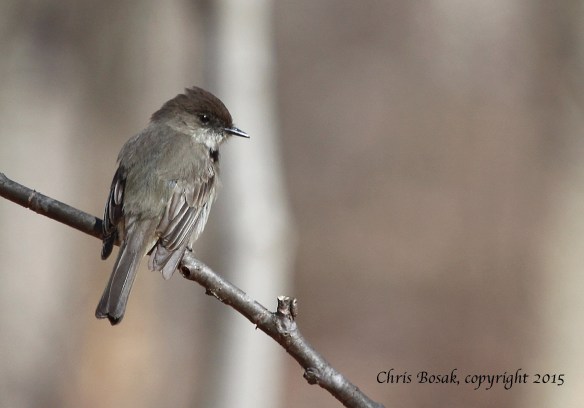
Photo by Chris Bosak An Eastern Phoebe perches on a branch in Selleck's Woods in Darien, Conn., in late March 2015.
Photo by Chris Bosak
Eastern Phoebes are one of the first songbirds to arrive in New England during the spring migration.

March can be a tough month for birders.

Winter is getting long and the season seems to be extending each year. It’s already been a snowy month this year, counting Sunday, and remember last March was ridiculously cold and snowy, even pushing into April.

March is also a time of anticipation for birders as the spring migration starts to pick up by the end of the month. Early red-winged blackbirds, for instance, began arriving in February, but March is really when the migration begins in New England.

April, of course, is when it heats up significantly before peaking in May. By the end of March, however, we can expect to see birds such as tree swallows, purple martins and hermit thrushes returning to our region.

To me, the surest sign of spring is the return of eastern phoebes in late March. The robin is still considered the traditional harbinger of spring even though many of them spent their winters in New England. I rejoice when I see the first phoebe perched on a branch in my backyard bobbing its tail endlessly.

March birding is not limited to the late-month migrants. American woodcock, with their amazing evening aerial displays, are a highlight species of the month. I’ve never had great luck finding woodcock. Maybe this will be my year. (I say that every year.) Also, ducks start moving north to open water in big numbers in March.

One of the best things about March birdwatching, however, is that it’s still winter and our winter birds are still around. Chickadees, titmice, nuthatches, cardinals, blue jays, mourning doves and woodpeckers still have the feeders to themselves, for the most part. Any winter finches that have come south to New England may still be around. I’m still getting dozens of pine siskins daily.

I noticed another sign of spring in the bird world the other day as a male American goldfinch with bright yellow splotches visited the tube feeder. The brightness stood out as a shade of yellow not seen in many months.

The barred owl barrage continues throughout New England, too, as reports pile up. A friend of mine had one visit a pine tree behind her unit in a condominium complex last week. The owl remained most of the day before disappearing in late afternoon.

March may be tough in terms of waiting out the winter and anticipating what is to come, but it offers much to the patient birder.
Working for peanuts

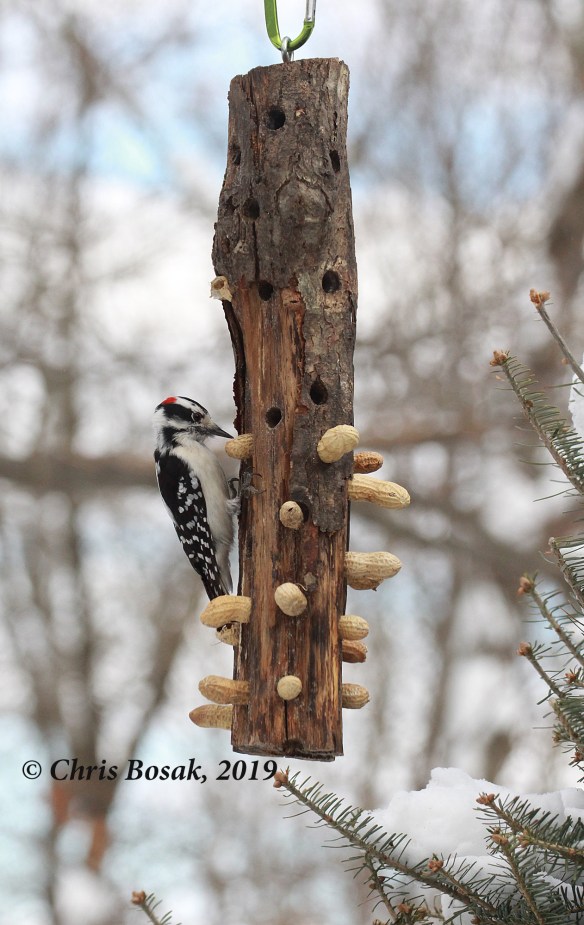
Photo by Chris Bosak A downy woodpecker eats peanuts from a feeder in Danbury, CT, March 2019.

Here’s a downy woodpecker getting peanuts from the homemade feeder I mentioned in yesterday’s post.

It’s funny how birds prefer their food offered in different ways. White-breasted nuthatches and downy woodpeckers are all over this feeder. They typically perch on the feeder and peck away at the shell to expose the nut inside. My other peanut eaters — blue jays, red-bellied woodpeckers and tufted titmice — barely touch this feeder and prefer to grab their peanuts from a platform feeder and fly off with it.

Homemade peanut birdfeeder does the trick

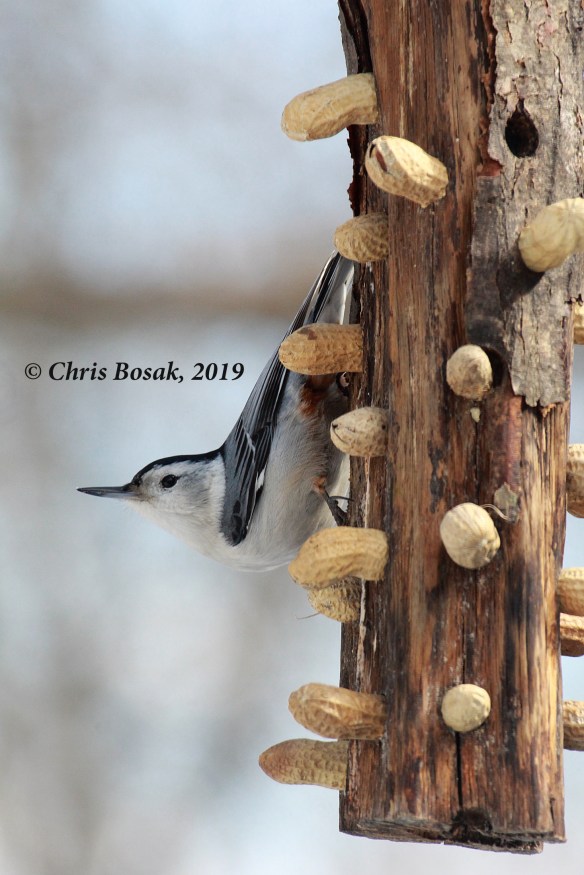
Photo by Chris Bosak A white-breasted nuthatch lands on a birdfeeder offering peanuts, Danbury, CT, March 2019.

I originally used this homemade birdfeeder (made from simply from drilling holes into a section of a fallen branch I found in the yard) to serve suet to the birds. It proved to be quite labor intensive to get the suet into the holes and it has the potential to harm birds if they get the suet on their feathers, so I put the feeder on the backburner for a while. I never like to discard things like this because you never how it may be repurposed.

The other day I got the idea to stick peanuts in the holes instead. It worked out great. The larger birds such as blue jays and red-bellied woodpeckers are strong enough to pull the peanuts out and fly off. The smaller birds such as nuthatches, downy woodpeckers and titmice simply perch on the branch, or even another peanut, to pick apart the shell and get at the nuts inside.

Wintery scene with siskin

Photo by Chris Bosak A pine siskin finds food on the top of a mini toboggan in Danbury, CT, March 2019.

These pine siskins sure are photogenic. I’ve taken tons of photos of the small, irruptive finches and have shared many of them here. Well, here’s another one — this one trying to hitch a ride on a small toboggan.

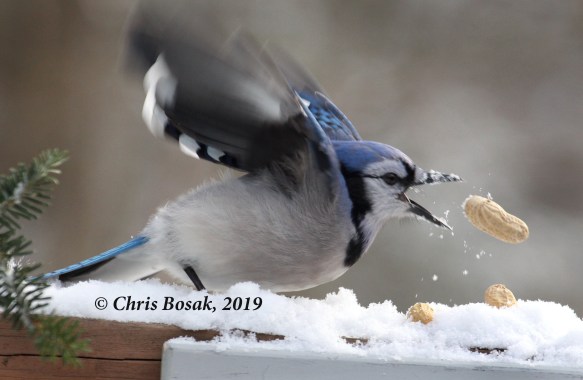
Just a cool photo of blue jay catching a peanut

Photo by Chris Bosak A blue jay adjusts a peanut at a feeding station in Danbury, CT, March 2019.

Well, it’s actually adjusting the peanut, but it is snagging the food out of midair, so “catching” is technically correct. The blue jay originally grabbed the peanut horizontally in its bill. Jays prefer to carry peanuts lengthwise, so this jay tossed the nut into the air and caught it in the desired position.

The reasons may differ, but it is similar to how osprey carry their prey. Ospreys typically emerge from a successful dive with a fish horizontally in its talons. While flying away, the “fish hawk” will adjust the fish to a more aerodynamic lengthwise position.

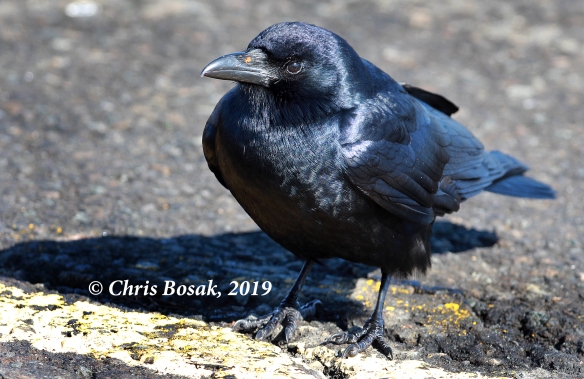
Crow close-up

Photo by Chris Bosak An American crow in Danbury, CT, winter 2019.

Crows are surprisingly difficult to photograph, especially considering how common they are. During the winter in many New England cities, we see massive flocks of crows headed to their nighttime roosts. Obviously their numbers are not hurting so why are they so tough to capture on film? (I know that nobody uses film anymore; it’s just an expression.)

First of all, they are fairly wary. Smart, in other words. They typically do not allow for a very close approach. Even crows in a very public place will take off as soon as you point a camera at it. I’ve heard that crows are difficult to hunt as well. They may be all over a certain area, but as soon as a gun comes out, the birds are gone. They must sense that something is amiss.

If you do get a cooperative crow, it is still difficult to get a nice photograph because of the bird’s plumage. Very black and very white birds are tough because of the lighting and contrast challenges. If you do get it right, however, the results can be very satisfying. Crows, similar to other dark birds, display a captivating iridescence in their plumage when the light catches the feathers just right.

For whatever reason, crows are a much-maligned bird. I think it’s time to change that perception and appreciate them for what they are: smart, personable and stylish.

Here’s further reading on the intelligence of crows. This article suggests that crows may be among the most intelligent animals on earth.

For the Birds: Joining the owl party

I’ve written about my barred owl sightings before, but here is the official column version …

Photo by Chris Bosak
A barred owl perches on a Welcome to New York sign on the border of Hoosick Falls, N.Y., and Bennignton, Vermont, in February 2019.

Two weeks ago I wrote a column about the Winter of the Barred Owl. A photo sent in by a reader from Westmoreland showing a barred owl perched on a feeder pole in his backyard accompanied the column.

A day or two after the column was published, I received two more photos of barred owls perched on feeder poles in the Monadnock Region. Yes, these handsome, large owls have been quite prolific throughout New England this winter.

At the time of that writing, however, I hadn’t yet seen any barred owls myself this winter. That all changed with a visit to my brother, who lives in Hoosick Falls, N.Y., a small town just over the border from Bennington, Vt.

My son Andrew and I had a day of skiing planned at Mount Snow, and figured Continue reading

Finally bit the Instagram bullet

The first time I heard “You should create an Instragram page” was about seven years ago. I ignored it just like I ignored the several other times I’ve heard it since. It’s a younger generation thing, I thought. Who wants to see bird photos on Instagram, I thought. People only look at Instagram to see what the Kardashians are having for dinner, I thought. Well …

Yes, you guessed it, I’ve created an Instagram page — @birdsofnewengland (thankfully that name was still available after all these years.) It couldn’t hurt, I now think. Continue reading

Snow photo: Downy woodpecker and the big apple

Photo by Chris Bosak A downy woodpecker eats suet from a feeder in Danbury, CT, March 2019.

This apple birdfeeder has been green, yellow and now red. The birds don’t care what color it is as long as I put my home-made suet in it.

The bird version of an old drinking game

Photo by Chris Bosak Pine siskins visit a feeder in Danbury, Connecticut, March 2019.

This post may be stretching it a bit, but what the heck …

During my college years, one of the drinking games we used to play was “One up, one down.” Those who knew the secret would always get the right answer and not have to drink. Those who guessed wrong had to drink. I’ll give away the secret and spoil the game because I doubt a lot of college students are regularly checking in with BirdsofNewEngland.com. Anyway, one player raises both hands, one hand or neither hand. (It’s actually a bit more complicated, but you get the idea.) Another player has to say “one up,” “two up,” or “zero up.” The game only works, obviously, when new people are at the party; otherwise, everyone would always get the right answer.

Well, the reason for that stroll down Memory Lane was that I was reminded of that game while watching pine siskins at my feeder during yesterday’s snowfall. Check out the photos and you’ll see why.

See, I told you it was a stretch.

Photo by Chris Bosak Pine siskins visit a feeder in Danbury, Connecticut, March 2019.