Photo by Chris Bosak
An American robin eats border privet berries in New England, January 2025.
I was finishing up a bird walk the other day when I came across another birder just starting their day’s adventure. She asked a question common among birdwatchers: “Did you see anything good out there?”
Of course, all birds are good, but the underlying question is whether anything rare or uncommon was spotted. I shared that there were a few warblers and songbirds around, but I hadn’t seen anything too noteworthy.
I started naming off some of the highlights. I had found a bluebird nest in a snag (dead tree) and the parents were busy feeding the youngsters. The warblers included American redstart, common yellowthroat, yellow warbler, ovenbird and black-and-white warbler. I had spotted a few rose-breasted grosbeaks and Baltimore orioles, but no scarlet tanagers or indigo buntings.
Photo by Chris Bosak
Bald eagle in New England, March 2025.
I pulled into the small dirt parking lot at the reservoir to see what ducks were hanging around the dam. The water by the dam does not freeze, and there is always a good variety of waterfowl there all winter.
As I stepped out of the car, I noticed two large birds perched in a tree along the shoreline. I knew immediately they were much too large to be hawks. They must be eagles. Sure enough, it was one adult and one immature bald eagle. It takes eagles four or five years to get their signature white heads and tails. Immature eagles are, however, just as large and impressive as adults.
Of course, I was thrilled to see the bald eagle. However, I was not surprised. Bald eagle sightings have become increasingly common over the last several years as the population continues to rise.
The bald eagle’s recovery is one of the best conservation stories of the last several decades. The osprey recovery is equally exciting.
Photo by Chris Bosak
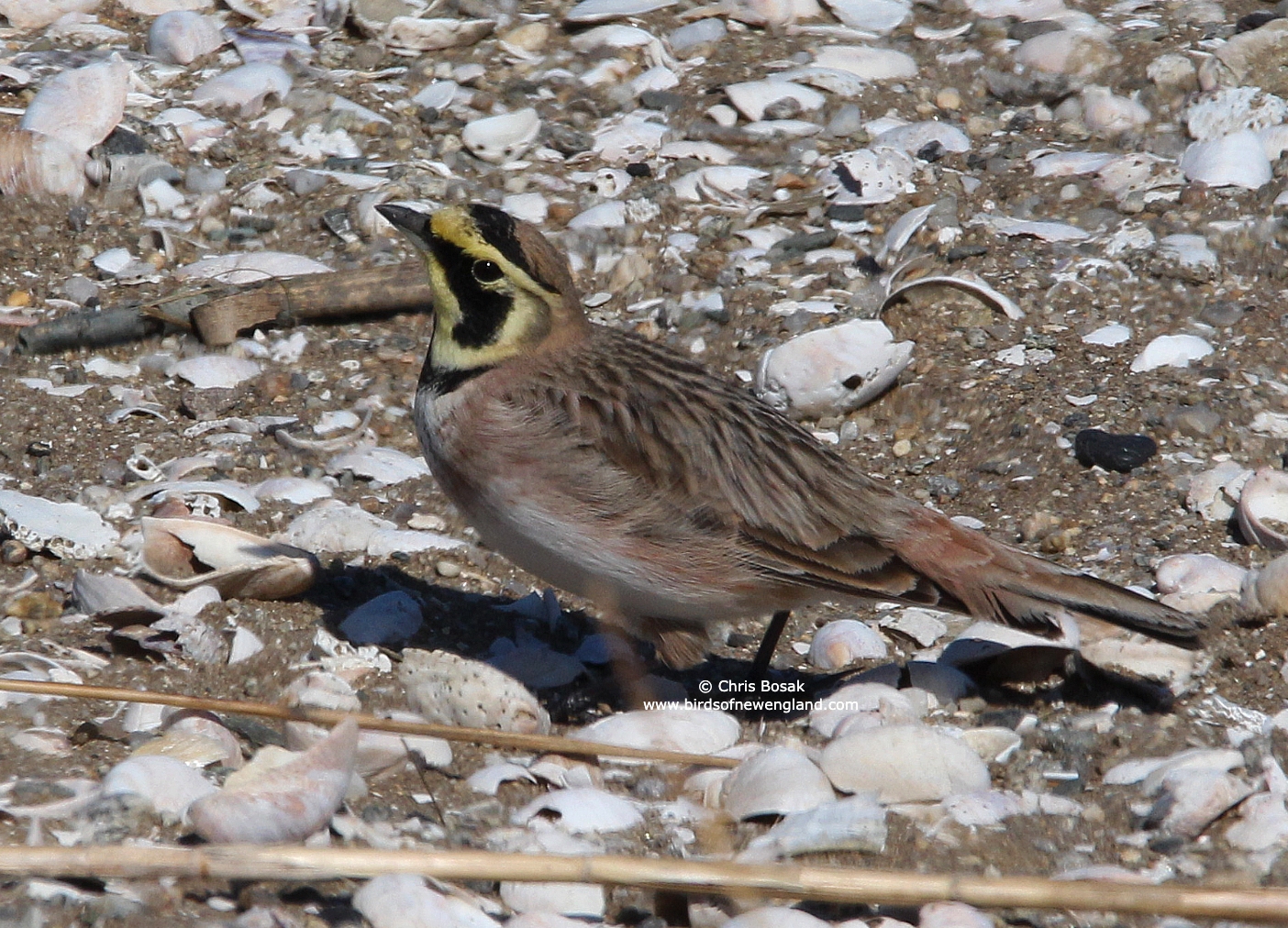
A horned lark at a Connecticut beach, February 2025.
I came across these horned larks during a recent walk along a beach in southern Connecticut the other week. Larks and buntings are often seen during the winter along the Long Island Sound coast. I’m yet to get a quality photo of one with its “horns” raised. Until then, enjoy these photos.
Photo by Chris Bosak
Male long-tailed ducks on Long Island Sound, February 2025.
You have to mix it up every once in a while. This goes for most things in life, but certainly for birdwatching.
The other day, I pulled into the parking lot of the state park where I do the majority of my walking and birding. I never got out of the car this time. I had a rare several-hour block to myself, and, as I pondered my options, the siren song of water kept calling me.
While I love walking at my local patch, and I know just where to look and what I might find, I was craving something different on this day. My patch is mostly woods with a few fields, like much of New England. It does have a large pond, but it has been frozen solid since December.
I backed out of the parking lot and headed to a reservoir a relatively short distance away. I knew at least some of the water would be unfrozen and undoubtedly holding some ducks. Open freshwater has been hard to come by this winter.
The reservoir, as it turned out, was mostly frozen as well. A small area near the dam was open, and that’s it. This oasis of unfrozen water was, however, a gathering place for a lot of waterfowl. Canada geese were, by far, the dominant species, along with mallards and mute swans. There were also a few buffleheads and ring-necked ducks, along with a lone male wood duck in his splendid breeding plumage. It had been a while since I had seen a wood duck, so that was the highlight of my visit to the reservoir.
Since I had gone that far already and still had time to spare, I figured I’d keep going and pay a visit to Long Island Sound. It wasn’t terribly far and, even though it’s almost always cold and windy in the winter, I knew a lot of ducks and other fowl would be there.
I arrived at the Connecticut state park, and Long Island Sound did not disappoint. I immediately spotted a huge raft of greater scaup and a few small groups of common goldeneye. The odd common loon popped up here and there as well. Common loons are a blend of dull whites and grays in their winter plumage, unlike their iconic black-and-white spotted summer plumage.
Canada geese were there in large numbers, of course, but a massive flock of brant flew past as well. There were also smaller groups of brant hugging the shoreline.
The highlight for me was the long-tailed ducks. Formerly called oldsquaw, long-tailed ducks are another species that look completely different in the winter than in the summer. Not that I’ve ever seen a long-tailed duck in the summer, as they breed well north of New England, but I’ve seen pictures. The male’s winter plumage is a mix of bright white, black and different shades of brown. The bill is dark with a pink patch in the middle. The female’s plumage is more modest with white and brown.
Many of the long-tailed ducks were relatively close to the shore, offering decent photo opportunities. Unfortunately, it wasn’t a great day for photos as it was very gray. Of course, gray can be good for photography as it eliminates harsh shadows, but this was a dull, dark, color-robbing gray. I did my best with the long-tailed ducks nonetheless.
The inland part of the park was good too, with Savannah sparrows, a northern harrier, fox sparrows and a large group of American tree sparrows.
The next day, I was right back at my patch enjoying a walk in the woods. I guess I needed a little change of pace, if only for one day.
The Atlantic coast is not terribly far for a day trip, and Long Island Sound is not that much farther. If the sea is calling your name and you have the time, pack up and go. Let me know what you see.



 Birds of New England.com