The weather icons on my iPhone showed rain starting at 8 a.m. I figured that would give me about an hour of dry weather to look for some early spring migrating birds.
No such luck. The rain started even before sunrise so my hour of dry weather wasn’t going to happen. Instead of rolling over and going back to sleep (a very tempting option) or mindlessly scrolling through social media, I decided to head out into the rain anyway. OK, I did take a few minutes to do Wordle quickly before heading out.
The walk started in a light rain, and a lot of birds were out singing. Immediately, I heard robins, cardinals, blue jays, song sparrows and a field sparrow in the distance. Field sparrows have a very distinctive song that sounds like a ping-pong ball bouncing on a table with the time between bounces getting progressively shorter, just like a real ball would do.
As soon as I committed to a trail leading me farther into the woods, the rain picked up. It never turned into a downpour, but it was a good, steady rain. Thankfully, the temperature was a very manageable 55 degrees, so I just got wet instead of wet and cold. I like birdwatching in all types of weather, but a cold rain is probably the worst. Heavy wind is not much fun either, but I would take it over a cold rain.
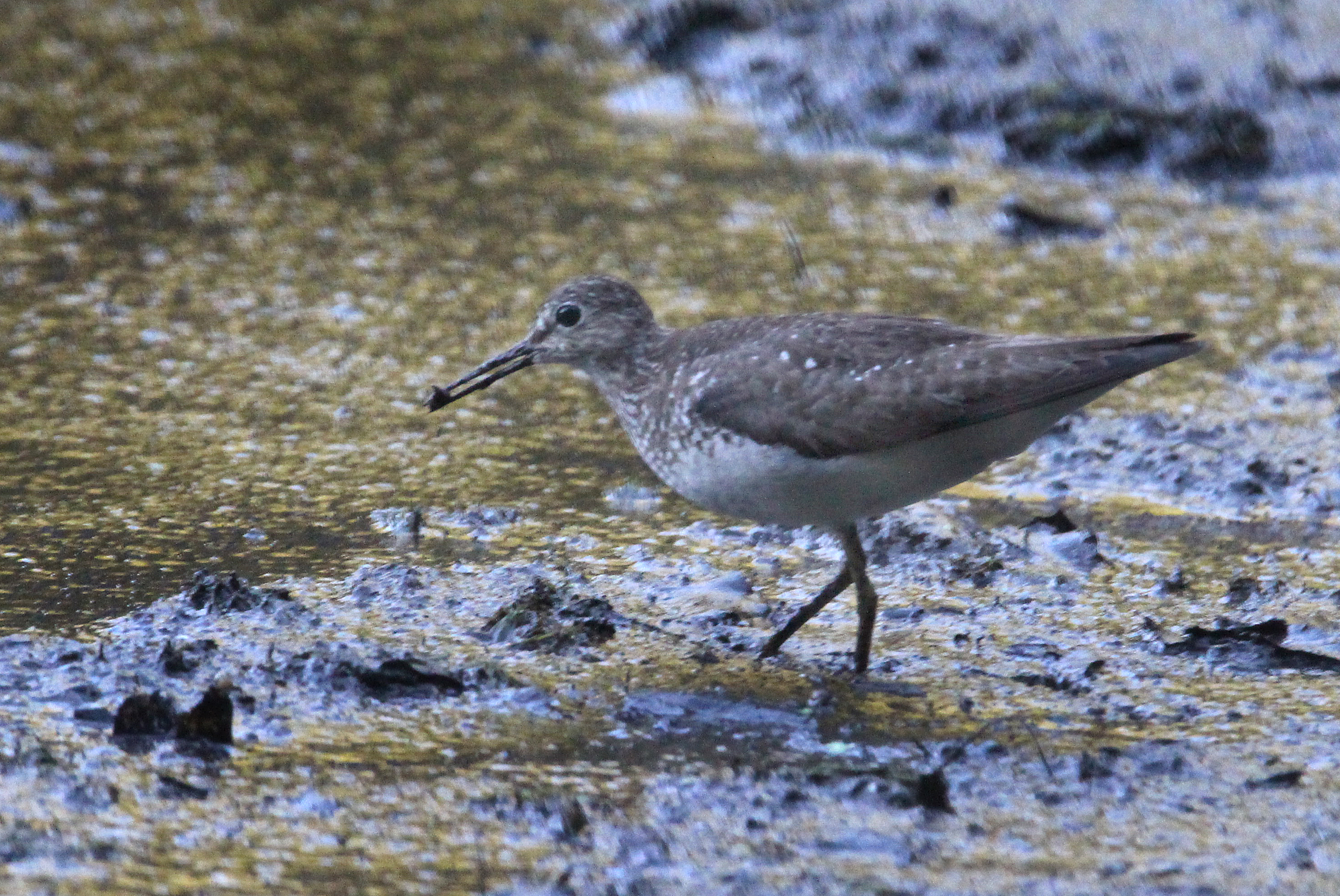
Photo by Chris Bosak – A solitary sandpiper on the edge of a pond in New England, August 2022.
When hearing the word shorebirds, most people likely think of sanderlings and other small sandpiper-like birds running back and forth among the waves at the ocean.
Shorebirds, however, are not limited to small “peeps,” nor are they limited to the ocean. While it is true that the ocean and other coastal regions, such as Long Island Sound, are the best places to find shorebirds, inland lakes and ponds have shorebirds too.
I have seen lesser yellowlegs at many inland lakes in New Hampshire, all the way from the northern tip in Pittsburg to southern lakes such as Edward McDowell Lake in Peterborough. Yellowlegs may be seen on the edges of inland lakes during migration periods, such as now.
Photo by Chris Bosak
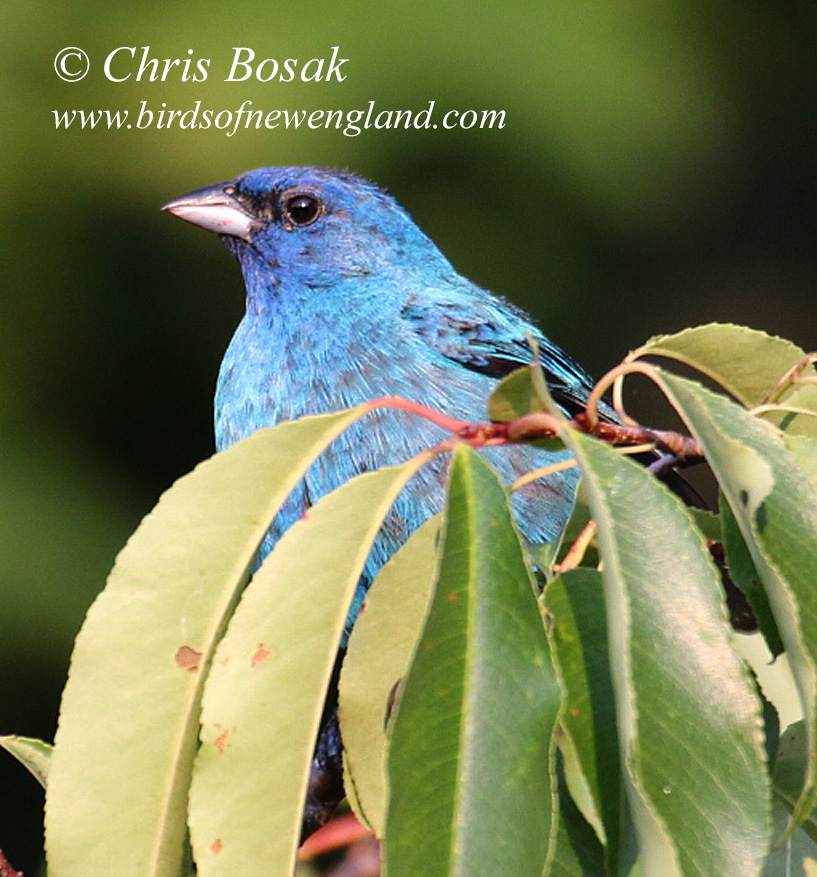
An indigo bunting perches in a tree in New England, July 2021.
I’m not going to try to emulate Dr. Seuss, but I think he would have drawn plenty of inspiration from a walk in the woods in New England in May.
His classic “Oh, the Thinks You Can Think!” comes to mind, but only altered to “Oh, the Colors You Can See.”
A recent walk made me think of this. The majority of the walk was along a wide dirt path with shrubby habitat on both sides. Beyond the thickets on one side was a large field and beyond the thickets on the other side were deep woods. It is perfect habitat for a bird walk.
The first bird I saw was a male eastern towhee. It was once called rufous-sided towhee because of the unique dark orange color of its sides that complement the otherwise white and black plumage of the bird. The bird’s red eyes are visible when it approaches among the shrubs closely enough. I did not see a female towhee on this particular day, but they are lighter brownish-orange where the male is black.
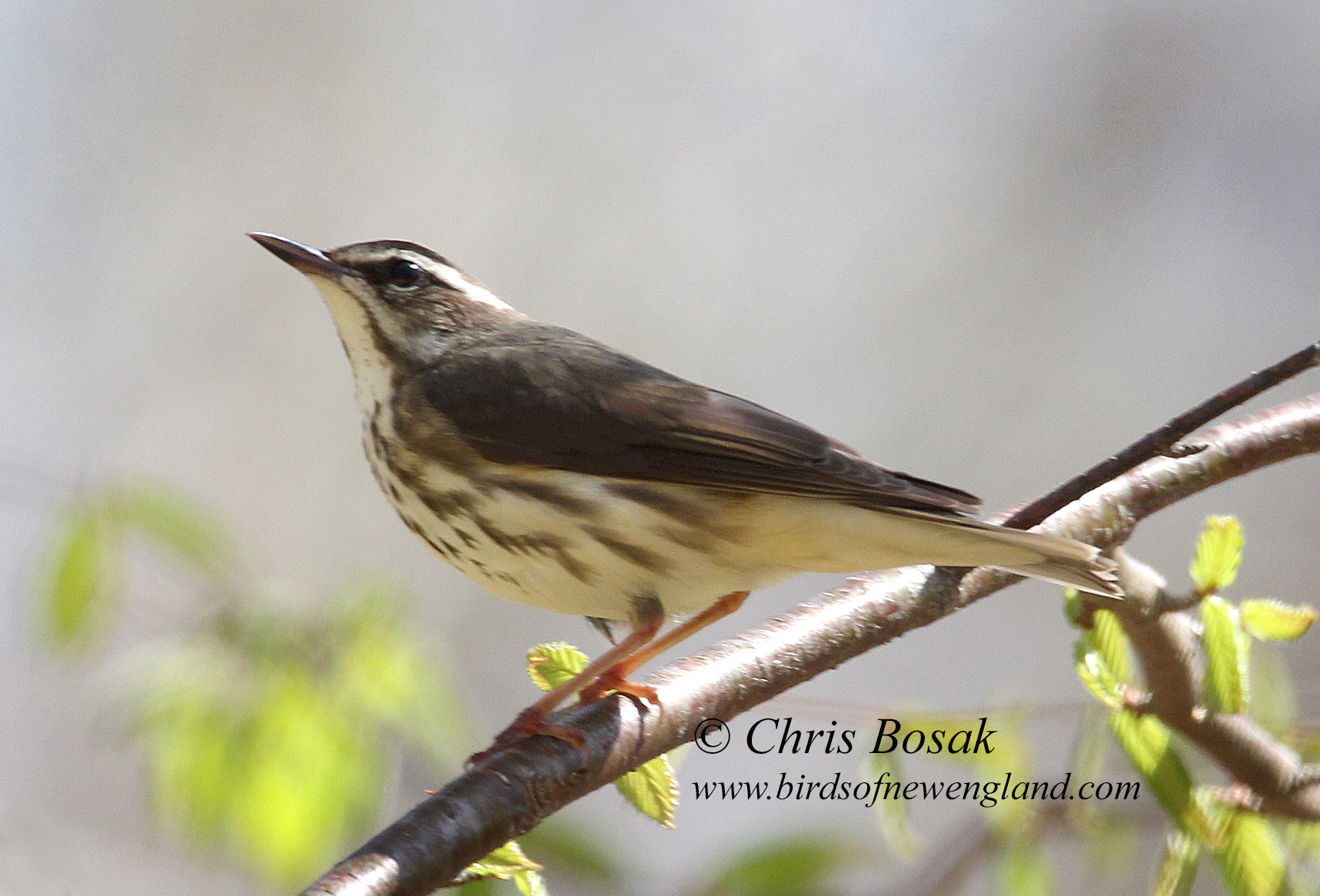
Photo by Chris Bosak — Louisana waterthrush in New England, May 2022.
If it looks like a duck, swims like a duck and quacks like a duck, then it probably is a duck.
That great old expression doesn’t work for thrushes because a lot of birds look like thrushes but aren’t thrushes at all. So you can’t say: If it looks like a thrush, then it probably is a thrush.
Members of the thrush family in New England include wood thrush, hermit thrush, veery, Swainson’s thrush and Bicknell’s thrush. They are medium-sized birds, brown overall and their buff-colored bellies and chests are decorated with brown spots. American robins and Eastern bluebirds are thrushes as well but have their own distinctive appearances.
Thrushes are perhaps best known for their songs. Wood and hermit thrushes have amazing flute-like songs that sound otherworldly and have inspired many a line in poetry and literature.
Photo by Chris Bosak
An American goldfinch perches on a wire in New England, March 2020.
I’ve been getting a lot of inquiries about goldfinches lately. Everything from how to attract them to why am I suddenly seeing more of them to why do some of them seem much duller than other ones.
To answer the question about how to attract them, you have to start with Nyjer seed. Nyjer seed, also sometimes called thistle, are the tiny seeds that are a fraction the size of a sunflower seed. Birds such as goldfinches, pine siskins, and indigo buntings love Nyjer seeds. It is hard to imagine there is a whole lot of meat inside the shells, but apparently, it is enough to satisfy the smaller birds.
Goldfinches also prefer tube feeders. If you get one with several ports there will be times when all of the perches will be occupied by goldfinches. So the best way to get goldfinches is to offer Nyjer seed in tube feeders.
But that is not the only way to attract goldfinches. Goldfinches will also eat sunflower seeds and visit hopper or platform feeders. They will also eat Nyjer seed from a mesh “sock.“
Goldfinches will also visit flowers such as sunflowers, coneflowers, and black-eyed Susans. But you have to wait until fall to see them eating those seeds. Goldfinches will also readily visit birdbaths. In fact, they are one of the most frequent visitors to my birdbath.
As to why some of them look different, that is a somewhat tricky question. The obvious answer is that females are duller and males are brighter. However, a goldfinch’s plumage is constantly changing and some males may be ahead of others in obtaining their breeding plumage.
Even males are drably colored in the winter and slowly gain their famous bright yellow feathers by the spring. This week, I have seen some goldfinches that are already fully decked out in their splendid yellow. Others are still splotchy with some bright and some dull plumage.
Well-known ornithologist David Sibley has a great article with photos, or more accurately drawings, of what a goldfinch’s plumage looks like each month throughout the year. The article can easily be found with an Internet search by entering “goldfinch monthly plumage” in the search field.
Females are duller in color year-round. Like other dimorphic birds (male and female have different appearances), females are more dully colored to offer protection from predators. The flashy males attract the attention of predators and cause a diversion away from the females on nests.
I have always had decent luck attracting and finding goldfinches. There are certain birds I just can’t seem to find, but goldfinches, thankfully, have never been one of those problematic species.
Goldfinches are also nomadic. If you have goldfinches throughout the day, it is likely that you are seeing more than one group of goldfinches. Perhaps that explains why some people are seeing more of them lately. The goldfinches have only recently discovered the feeding station.
Goldfinches are a favorite bird of many people, and with good reason. They are striking with their bright yellow plumage, they are common backyard inhabitants, and they are year-round New England residents, not fair-weathered friends. What’s not to like?
Photo by Chris Bosak
A Carolina wren visits to a New England backyard, January 2021.
I find myself saying “that’s one of my favorite birds“ a lot. I know that list should be relatively short so as to not water down the significance of the birds on it, but it’s a list that grows and never gets pared down.
I have always been fond of the Carolina wren, but in recent years I have become more enamored with that little brown bird. Not surprisingly, it’s on that list.
Carolina wrens are a bit more brightly colored and a bit more loquacious than the other wrens we see in New England. That is saying a lot as the house wren is quite the loud talker as well.
Photo by Chris Bosak A snow bunting eats seeds on a beach in Connecticut, fall 2021.
A snowy owl at a Connecticut beach caused a big rift among birdwatchers last month.
Many people were posting its location, and others felt it was inappropriate and dangerous to the bird to post its whereabouts. On top of that, many people took exception to some photographers who were getting too close and being too aggressive with their craft.
I wasn’t there to see the bird or the behavior of the spectators, but I have certainly seen aggressive photographers before and most definitely do not condone their behavior. However, I have also seen non-photographers get annoyed at photographers for no legitimate reason. Like most situations, the truth is likely somewhere in the middle and dependent upon where you fall in the “how close is too close” spectrum.
I found myself in the vicinity of the beach last week and couldn’t resist trying to find the owl. It had been seen and photographed reliably for about two weeks before my visit. In fact, I met a birder in the parking lot that morning who had seen the owl the previous day.
Photo by Chris Bosak
A blackpoll warbler eats berries in New England, November 2021.
Birdwatching can be as easy or as difficult as you want to make it. I’ve said it before, but that is one of the things I like most about the hobby.
If you are content being able to identify a handful of birds, then that’s fine as long as you enjoy it. If you can’t sleep unless you know the species, age and sex of every bird you see, then that’s fine as well.
Most of us, including myself, fall somewhere in the middle. The middle, of course, is a pretty vast area. Knowing a robin, blue jay, cardinal and a few other species is in one area of the middle. Knowing your sparrows, shorebirds, gulls and ducks falls in another area of the middle.
Photo by Chris Bosak
A song sparrow eats berries at Dolce Center in Norwalk, Conn.
I had just discovered a new berry tree at work and thought to myself how great it would be to see the birds raid the tree when the berries ripened.
At the time, the majority of the berries were red with a few purple ones mixed in. It wouldn’t be long now, I figured, before they were all purple and the birds would be feasting on them.
About a week later, I went back to check out the tree and it was practically picked clean. Apparently, the berries ripened quicker than I thought they would, and the birds wasted no time in having their feast.
I missed the flurry of activity that had the tree stripped clean, but I did see a lone gray catbird fly in and out to grab a few of the remaining berries. At least I wasn’t completely shut out of the show.
Photo by Chris Bosak
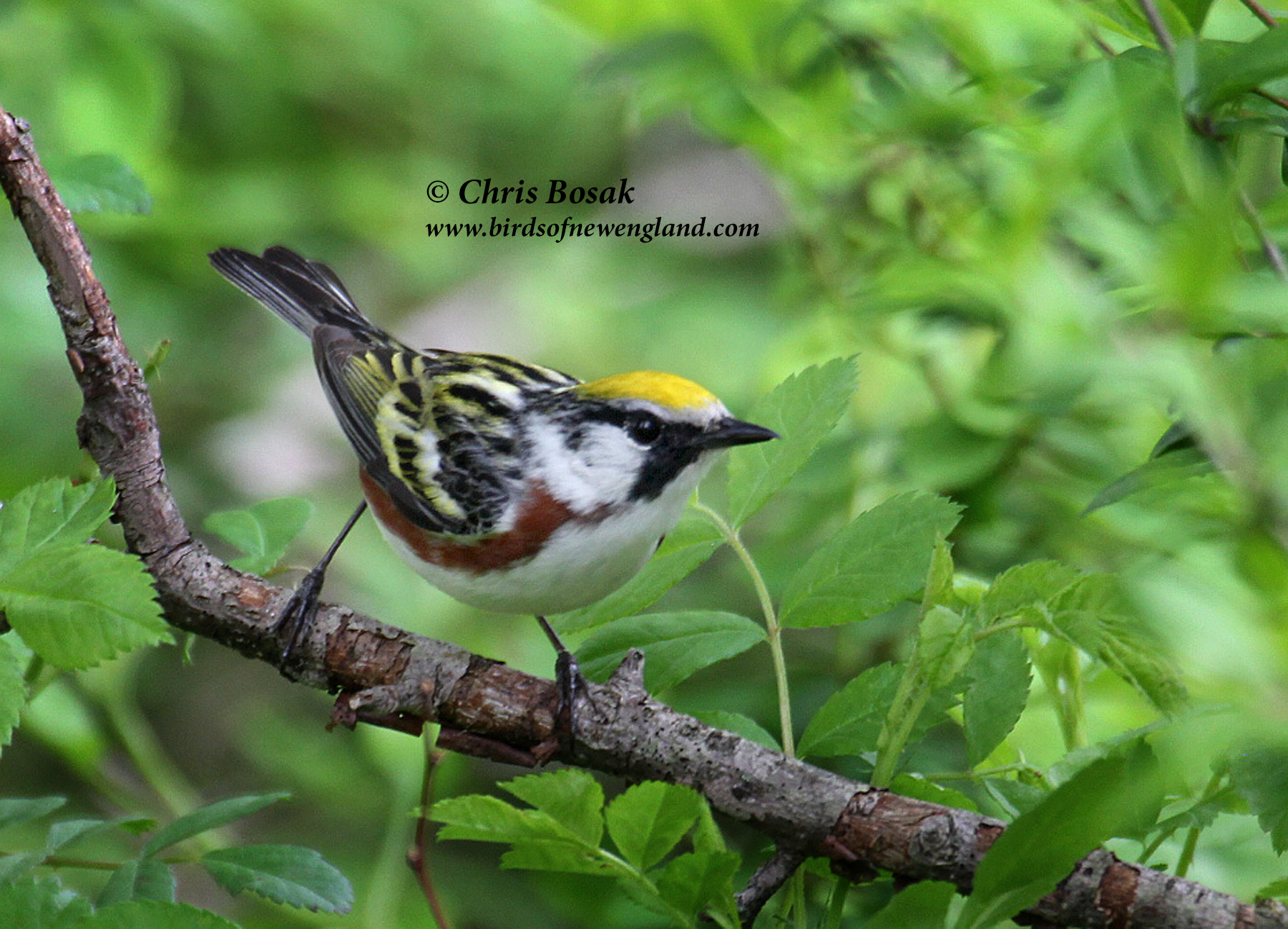
A chestnut-sided warbler lurks in the brush in New England, May 2020. Merganser Lake.
Welcome to May, arguably the best month of the year for birdwatching.
So many exciting things happen in the bird world in May that it’s hard to know where to begin. The breeding season is in full swing and our year-round birds as well as newly arrived migrant birds are either looking for nesting sites or already raising young. Suddenly our feeders are visited by colorful newcomers such as rose-breasted grosbeaks, Baltimore orioles or indigo buntings. Waders are back in full force stalking our ponds and rivers.
When it comes to May, however, talk of the birding world has to begin with warblers, those small and often colorful Neotropical migrants that add life to our neck of the woods every spring. Some of these warblers will simply stop by for a few days before heading farther north to their breeding grounds. Many, however, will find a suitable place to raise young and will be with us until the fall.



 Birds of New England.com