For the Birds: Evening grosbeaks on the move

Mike Quinn of Ticonderoga, N.Y. had these evening grosbeaks visit recently (December 2025.)

There is a thing in birding called a “spark bird.”

It is not a species of bird like a bluebird, mockingbird or blackbird, but rather the type of bird that piqued (or sparked) someone’s interest in birding and got them hooked. For many people, it is something big or colorful, like a loon or eagle or Baltimore oriole or great blue heron.

Because I have to be different, my spark bird is actually a moose. Yes, I know a moose is not a bird, but my quest to see a moose in the Vermont woods led me to my love of birdwatching.

There is also a thing in birding called a “nemesis bird.” Again, it is not a species of bird, but rather a bird that always seems to elude a birder. For instance, I see dozens of owl photos and read dozens of owl reports on Facebook and elsewhere on the internet, but I rarely see owls myself. I see the very occasional barred owl, but that’s about it.

I also have a nemesis feeder bird. It’s the evening grosbeak, a large yellow, white and black finch with a stocky bill. It’s not that the evening grosbeak is a common feeder bird in New England, but they do venture throughout New England enough, particularly in the winter, that in all my years of feeding birds, I figure I would have seen them at least once.

I have seen them a few times in the wild in northern New Hampshire, but never at my feeders. I’ve hosted siskins, purple finches, red-breasted nuthatches, indigo buntings, rose-breasted grosbeaks and a few warbler species, but never an evening grosbeak.

Evening grosbeaks are part of the Winter Finch Forecast, an annual prediction (based on food supply up north) of what birds may be heading south. Birds such as siskins, redpolls, crossbills, and grosbeaks visit New England sporadically in winter, and the people who run the Winter Finch Forecast try to predict each fall which birds to look out for in the winter.

This year’s forecast called for a strong irruption of several bird finch species. An irruption is when a species of bird visits New England and points south in higher than usual numbers in the winter. The evening grosbeak is one of those birds.

Although I haven’t seen any yet this year (of course), I have received several reports of people seeing evening grosbeaks at their feeders. Mike Quinn, an old friend I’ve known since the mid-1970s, sent me a text recently asking if I could identify a bird that was at his feeder. Naturally, it was a pair of evening grosbeaks. Mike lives in Ticonderoga, N.Y., near the Vermont border. His feeder cam photo accompanies this column.

Moira from western Maine also sent in a photo of an evening grosbeak pair at her feeder. Susan from Nelson, N.H., emailed to say she had six to eight evening grosbeaks visiting daily for about a week. She added that it’s been about 10 years since she last saw them. Her grosbeaks were eating sunflower seeds and nyjer.

But it doesn’t end there. Gene from Plymouth, N.H., had an evening grosbeak at his feeder and noted “the most striking thing was the brilliant yellow stripe above the eye.” Phil Brown, the compiler for the Keene Christmas Bird Count, noted that birders found two evening grosbeaks on count day, which was held on December 14.

Evening grosbeaks are out there this winter and perhaps heading your way. Watch those feeders for stocky yellow birds vaguely reminiscent of overgrown goldfinches. If they do arrive, drop me a line and let me know. Then send them my way.

For the Birds: Evening grosbeaks remain elusive

Photo by Chris Bosak – Purple finches sometimes irrupt into New England in the winter.

For one of the few times in this column’s history, the accompanying photo will not match the content.

The reason for that is quite simple. I am yet to get a decent photo of the main subject. Even as I receive emails from readers across New England about evening grosbeaks showing up at feeders, I have yet to host them at my feeding station. I am also yet to see them in the “wild” closely enough to get a good photo.

Tricia from Alstread wrote in the day after Thanksgiving to say she had evening grosbeaks at her feeder. She was hopeful there may be an irruption of the birds this winter. I, too, am hopeful.

Continue reading

Latest For the Birds column: Evening Grosbeak kind of winter

Evening Grosbeaks visit a feeder near Jaffrey in this photo taken by For the Birds reader Pam Hoyt.

Evening Grosbeaks visit a feeder near Jaffrey in this photo taken by For the Birds reader Pam Hoyt.

Here’s the latest For the Birds column, which runs weekly in The Hour (Norwalk, Conn.), The Keene (NH) Sentinel and several Connecticut weekly newspapers.

………

The sightings of Evening Grosbeaks keep pouring in.
I mentioned these handsome finches in my last column, but now that I keep hearing from readers who see them, their story bears elaboration.
First, let me mention a few of the sightings that came in this week. Pam, who lives near Jaffrey, had a flock of Evening Grosbeaks visiting her feeder for three days in a row.
“We almost never see them here so I was surprised,” she wrote.
Pam also attached a great photo of her visitors.
I particularly appreciated getting the photo as I could use it to accompany this column. I don’t have any photos of Evening Grosbeaks because I rarely see them as well. I take that back, I do have one photo that I took in Pittsburgh, N.H., about 20 years ago. It was a one-legged male Evening Grosbeak and it was finding seeds along one of the many logging roads in the northern tip of the state. It appeared otherwise healthy so the loss of a leg didn’t seem to be holding this bird back.
I was brand new to photography so the photos I did take Continue reading

Latest For the Birds column: Notes from New England readers

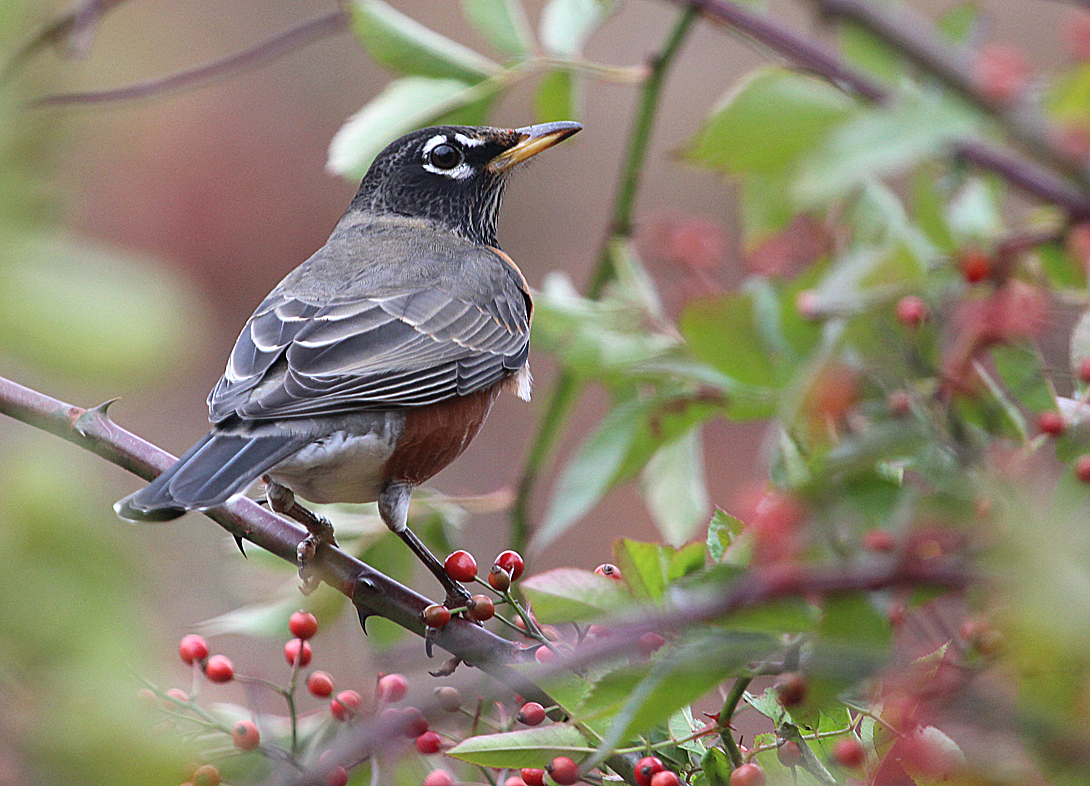
Photo by Chris Bosak American Robin in Selleck's Woods in fall 2013.

Photo by Chris Bosak
American Robin in Selleck’s Woods in fall 2013.


Here’s the latest For the Birds column, which runs weekly in The Hour (Norwalk, Conn.), The Keene (NH) Sentinel and several Connecticut weekly newspapers.

………………

Catching up on some news from For the Birds readers.

Carol wrote in to share a story about a backyard spectacle she witnessed at her new home.

Her new place overlooks a pond surrounded by trees and from her living room window she peers down on two dogwood trees and an adjacent white pine. In early fall, the dogwoods were “both laden with berries,” she wrote.

One day she noticed movement between the pine and dogwoods and inspected the situation. She saw close to a dozen American Robins moving from tree to Continue reading