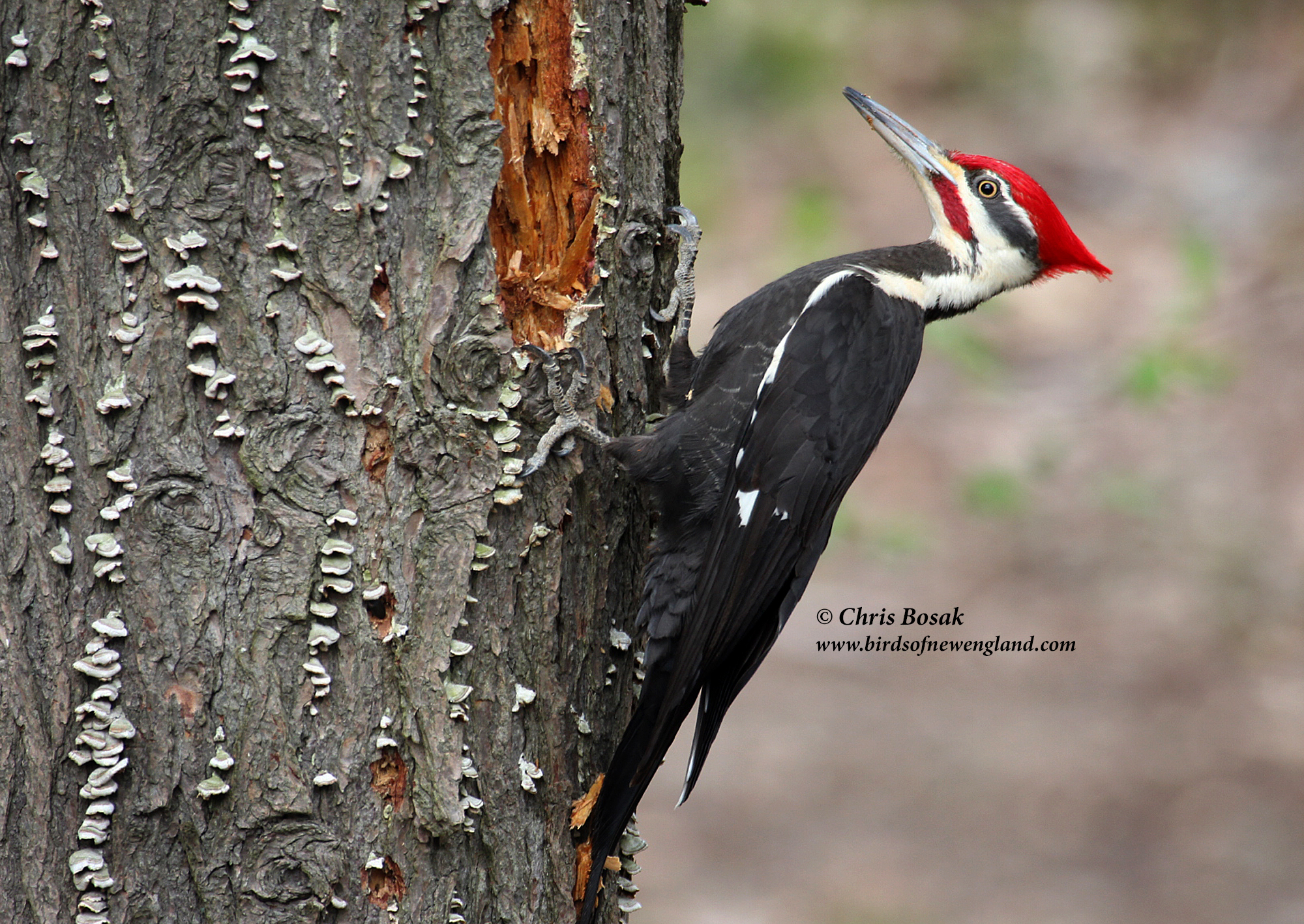
Photo by Chris Bosak A pileated woodpecker works over a tree in New England, May 2020. Merganser Lake.
It may have been a disastrous year in most regards, but one bright spot is the connection with nature many people made while dealing with the pandemic and associated quarantines, isolation and soul-searching.
Bird-feeding stores reported increased sales as people stuck at home turned to the hobby as a much-needed escape. Nature preserves closed their visitor centers, but most of the trails remained open and people flocked to them to ward off cabin fever.
I worked from home for most of the year and, while I missed seeing my co-workers, I did enjoy watching my backyard bird-feeding station daily as the seasons changed. I never realized how much you miss when you go about your regular routine.
With that in mind, here are my top 10 bird/nature watching highlights of 2020. Feel free to send me an email with some of your highlights.
10. Warblers in the snow
A rare overnight snowfall in early May dropped a coating of snow that lasted until about noon. It provided a short window to see warblers and other migratory songbirds in snow. I managed a few photos of an ovenbird and blue-winged warbler.
With Thanksgiving upon us, I am going to revisit my turkey fun facts column. I used to do this annually, but the content got staler than week-old stuffing. To add a little spice to this year’s column, I will start out by debunking a widely held belief about America’s favorite game bird.
If you do a web search for “turkey fun facts,” invariably the “fact” that Ben Franklin wanted the wild turkey to be our national bird instead of the bald eagle will come up. In full disclosure, an old column of mine may come up in that search as I’ve used it as fact before in my own writing. But is that really a fact? Evidently, no. I’m not a historian and I certainly wasn’t around in the 1700s to verify it myself, but I’ve come across several accounts that challenge the notion that Ben Franklin wanted the turkey to be our national symbol.
According to the articles, he actually wanted a Biblical scene to be our national symbol, not a bird at all. He did reference the bald eagle and wild turkey in some of his correspondences, but the references had nothing to do with our national symbol and some of the references were believed to be Continue reading →
Photo by Chris Bosak A purple finch perches on a log in New England, November 2020.
The regular flow of feeder birds continued this past week, but they were joined by a few newcomers.
Two weeks ago, it was a lone red-breasted nuthatch that showed up and stayed for a day. This past week, a lone purple finch and a lone pine siskin joined the usual gang of backyard birds. The purple finch stayed for only one day — a few hours, to be more precise. The pine siskin, however, has visited daily ever since it first arrived on the scene.
Pine siskins are notorious for showing up in large numbers and cleaning out thistle feeders. I am surprised this siskin has not been joined by others of its kind, but so far it has been just the one. It mixes with a large group of American goldfinches and can be quite feisty when another bird tries to steal its perch. Pine siskins often flock with American Continue reading →
Photo by Chris Bosak A tomato hornworm is covered in braconid wasp larvae on a tomato plant in New England, August 2020.
(Note: This post has been updated from its original content to correct information about the hummingbird moth caterpillar.)
I was all set to follow my last column about fall migration with a closer look at some of the songbirds, including warblers, that are heading south now and will be for the next several weeks.
That column has been put on hold as I saw something in the garden last week that just can’t wait. Experienced vegetable gardeners have likely seen this before, but it was a first for me and I was amazed at the gruesome details when I researched it online.
First, a little background. It is a first-year garden plot. I dug it during April at the height of the COVID-19 outbreak in the Northeast. More than anything else, it was a diversion from the nuttiness going on in the world; something to keep my mind and body occupied during quarantine. I’ve never had a green thumb and I had little hope in the garden ever yielding impressive crops.
As it turns out, my pessimism was warranted. Once the leaves popped on the giant oaks that surround my property, the garden didn’t stand a chance. Tomato plants require how much sunlight? Continue reading →
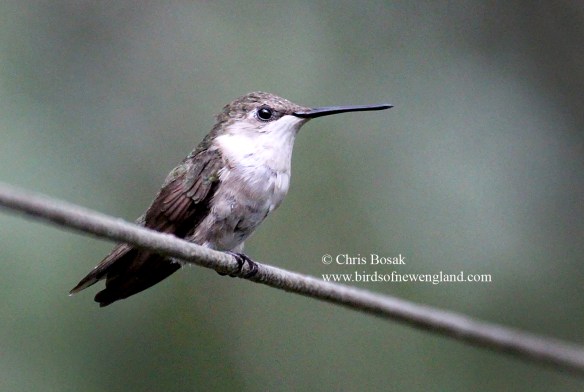
Photo by Chris Bosak A female ruby-throated hummingbird sits on a rope in a backyard in New England, August 2020.
I wasn’t the only one who enjoyed watching the hummingbirds ignore the stormy weather of Aug. 4 and visit the feeders. As you’ll recall, last week I wrote about the tiny birds going about their day as usual as rain fell and wind whipped all around.
I heard from Deb from Royalston, Mass., who said her hummingbirds “had no problem with the fierce winds and rain. All this year’s babies are there now, so we had more than a dozen.” She said it was hard to count them there were so many. I, of course, had only one visit my feeder that day as it was a dominant female who “owns” the feeder.
Jill from Keene wrote: “I too was amazed during the storm the hummingbirds seemed unfazed.” Jill also had a peaceful gathering of hummingbirds and sent me a few photos showing six of them on the feeder at once.
“They did not fight much at all and it was eerily quiet as I usually have several swooping and ‘chirping’ noisily,” Jill added.
A few days later, Jill wrote to say: “The peaceful dinner party was really an anomaly, as they are back to fighting and chasing each other!”
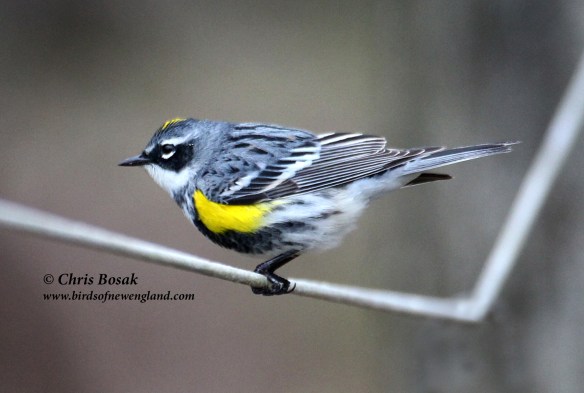
Photo by Chris Bosak A yellow-rumped warbler perches on a clothesline in Danbury, CT, April 2020. (Merganser Lake)
I doubt Tom Petty had birdwatching in mind when he wrote the lyrics “the waiting is the hardest part,” but it sure is appropriate for birders in the spring.
Signs of spring start as early as January or February when a few hardy flowers poke out of the ground. Owls also start their breeding season about this time but that is done in secret and largely unbeknownst to humans. March brings the first spring peeper calls, more flowers, red-winged blackbirds, American woodcock and, finally, eastern phoebes, at the end of the month. March also brings the official start to spring, of course.
April starts off fairly slowly until the first pine warblers arrive. Then it’s warbler season! The problem is, pine warblers are three weeks to a month ahead of most of the other warblers and other colorful migratory songbirds. Palm warblers and yellow-rumped warblers are the exceptions as they closely follow the pines.
Those three weeks to a month can seem like an eternity. We’ve endured winter and have slowly gotten small teases of spring. Bring it on already! We jump Continue reading →
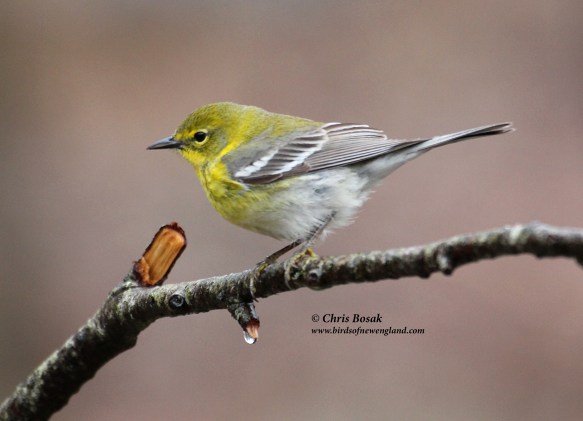
Photo by Chris Bosak A pine warbler visits a backyard in New England, April 2020, Merganser Lake.
Another quick, one-day break from the A Day on Merganser Lake photo series to bring you the latest For the Birds column …
Could it be warbler season already?
It sure is and I’m just as surprised as the next person. Not that the first week of April is unusual for the early warblers to arrive; it’s right on time.
Still, I was surprised when I looked up and saw a pine warbler perched at the top of my bird-feeder pole system the other day. I wasn’t ready for it. In a normal year, I’d be counting down the days until the first warblers arrived. But this is no normal year. I think we can all agree on that.
Like many others, I’m sure, I’ve been consumed with COVID-19, or coronavirus. It’s on the news 24/7. Grocery stores have one-way aisles, most people are wearing masks and the cashiers are wearing face shields. My work (thankfully I am still working) is busier than ever due to the virus and the days start earlier and end later than ever.
No sports. No concerts. No parties. Heck, no talking to your Continue reading →
Photo by Chris Bosak Blue-headed vireo, Pillsbury State Park, N.H., June 2019.
Last year at this time I wrote about my New Year’s resolutions to help birds. They largely focused on citizen science projects I would either undertake for the first time or continue to be involved in.
Looking back, I could say that I did fairly well with my resolutions. Some of them, however, like most resolutions, just never came to fruition.
I did participate in a number of citizen science projects. I have done the Christmas Bird Count and the Great Backyard Bird Count for many years continuously. This past year was no exception.
Also, last year was the second year of the three-year Connecticut Breeding Bird Atlas, an ambitious project to document what birds are breeding in that state. I have an adopted area and look forward to this spring to add to my breeding bird list. I also beefed up this past year my contributions to eBird, a free app in which all reported sightings are entered into a massive database.
I fell short in a few areas. I never did take the steps to join Project FeederWatch, which I had vowed to do. Maybe this year.
I will take a slightly different approach to my bird New Year’s resolutions this year. I will continue to do the citizen science projects, of course, but will also add some resolutions of a different sort.
I have been thinking about and being encouraged to write a book or two about my birding adventures. I haven’t done so after all these years because I wasn’t Continue reading →
Photo by Chris Bosak Tufted titmice gather near a container with coneflower during November 2018. Coneflower is a native plant that attracts birds.
The study released a few weeks ago that reported a 29 percent decline in the number of birds in North America since 1970 did not merely throw out some discouraging facts and leave it at that.
It also included many reasons why bird populations are decreasing, most notably habitat loss. There is not a whole lot the average person can do about habitat loss — other than plead with local officials to stop the development of critical habitat. But the authors of the study did include seven actions that we can all do to help improve birds’ chances of survival.
The actions are as follows: use native plants, avoid pesticides, keep cats indoors, make windows safer, do citizen science, reduce the use of plastic and drink shade-grown coffee. Now, let’s take a closer look at each of these actions.
Planting native flowers, bushes and trees gives birds and insects a source of food they have evolved with. It restores the natural balance of an area and limits the spread of invasive plant species. A simple internet search will yield dozens upon dozens of bird-friendly native choices for your garden and yard.
Pesticides should be avoided for much the same reason. Killing off insects, especially native insects, limits the food available for birds. Many birds rely on insects as the main part of their diet. This is particularly important during the nesting season as birds feed their youngsters and teach their fledglings how to hunt. If an area is void of insects, it is likely void of birds.
I know how difficult it can be to keep cats indoors. Most cats want to be outdoors and it’s hard to deny them that desire. My cat sneaks out on occasion when I have my hands full of groceries and the screen door closes too slowly, so I have work to do in this area as well. But it really is in the birds’ best interest to keep kitty inside. Feral cats? That’s another bigger problem.
If you have some particularly problematic windows that bird keep crashing into, consider buying decals to put on the outside of those windows. The decals are relatively unobtrusive and may be found at bird stores or online. The decals break up the scene that may otherwise be confused as an extension of the outdoors. Building windows? That’s a way bigger problem that many developers are starting to address with bird-friendly design.
Participating in citizen science projects such as the Great Backyard Bird Count, Christmas Bird Count and Project Feeder Watch gives important data to ornithologists that they use to track bird population trends. In fact, this data was a key source of information for the latest study.
There are several easy steps to take to reduce the amount of plastic used. Reusable water bottles, although many are made of plastic, greatly reduce waste. Filling a water bottle each morning instead of drinking two or three store-bought waters has a great impact over the course of time.
Similarly, reusable shopping bags reduce the need for the one-time use plastic bags. That also keeps those annoying bags out of trees, which I often mistake for birds from a distance.
Industrial-scale coffee plantations are an environmental nightmare as large swaths of land are clear cut on many birds’ winter grounds. Thankfully there are many bird-friendly, shade-grown options. Birds and Beans brand is based in New England.
Employing some of these strategies will help the birds that live in and around your property. It may seem like a drop in the bucket compared to the 2.9 billion birds that have disappeared in the last 50 years, but enough drops will eventually overfill a bucket.
Photo by Chris Bosak Ice on Little Merganser Lake in Danbury, Conn., winter 2019.
Any walk in the woods is a good walk.
I’ve always believed that and am reminded of it every time I step foot in New England woods, a field, a marsh or along a coastline.
For the birdwatcher, not every walk is filled with birds, but there is always something interesting to discover or observe. Even if you’ve walked your patch a thousand times, the next walk almost always holds something special.
A recent walk on the nature trail behind my house drove home that point. I wasn’t expecting much in terms of birds as the temperature was in the low 20s and the pond at the end of the trail was surely frozen.
Turns out I was right. Hardly any birds to speak of on this walk, but it was enlightening nonetheless.
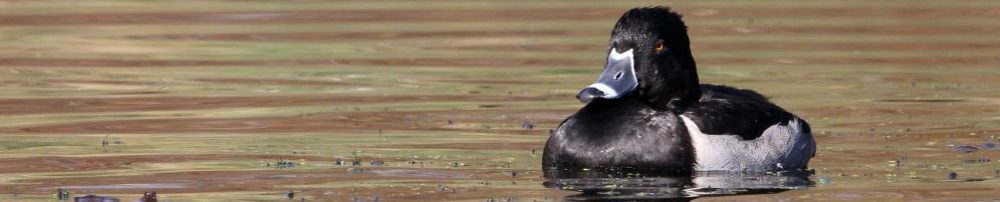
I got to the pond, which is about a 20-minute walk, without seeing a single bird. The frozen pond, obviously, did not offer any hooded mergansers, ring-necked ducks, or even Continue reading →