Photo by Chris Bosak
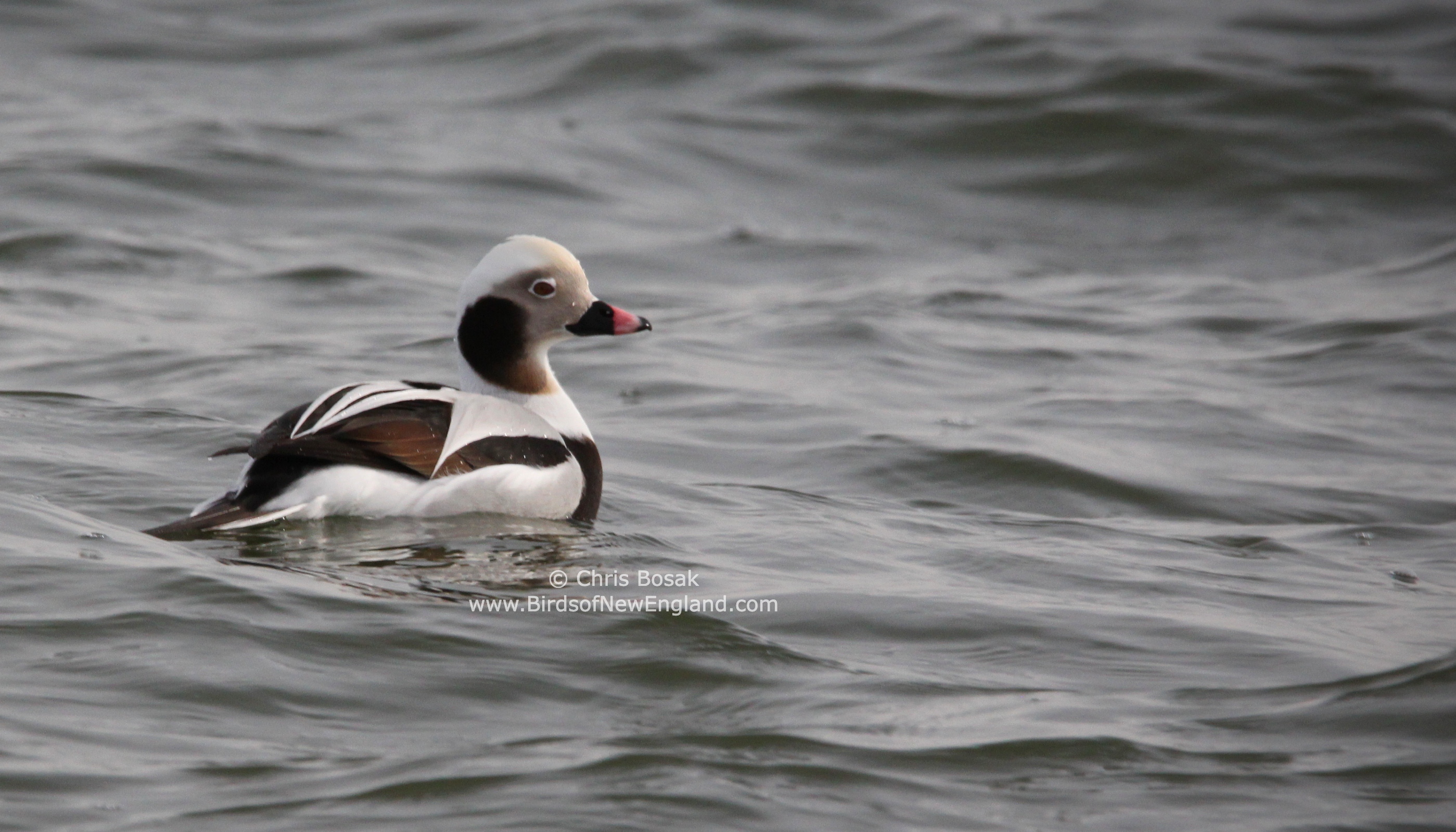
Male long-tailed duck on Long Island Sound, February 2025.
I took a trip to the coast this morning to check out Sherwood Island State Park in southern Connecticut. I have birded there a lot in the past, but it has been several years since I’ve been to the large park on Long Island Sound. I finished the day with 32 species with a good mix of water and land birds. A few photos from the walk are included below.
The weather icons on my iPhone showed rain starting at 8 a.m. I figured that would give me about an hour of dry weather to look for some early spring migrating birds.
No such luck. The rain started even before sunrise so my hour of dry weather wasn’t going to happen. Instead of rolling over and going back to sleep (a very tempting option) or mindlessly scrolling through social media, I decided to head out into the rain anyway. OK, I did take a few minutes to do Wordle quickly before heading out.
The walk started in a light rain, and a lot of birds were out singing. Immediately, I heard robins, cardinals, blue jays, song sparrows and a field sparrow in the distance. Field sparrows have a very distinctive song that sounds like a ping-pong ball bouncing on a table with the time between bounces getting progressively shorter, just like a real ball would do.
As soon as I committed to a trail leading me farther into the woods, the rain picked up. It never turned into a downpour, but it was a good, steady rain. Thankfully, the temperature was a very manageable 55 degrees, so I just got wet instead of wet and cold. I like birdwatching in all types of weather, but a cold rain is probably the worst. Heavy wind is not much fun either, but I would take it over a cold rain.
Photo by Chris Bosak A song sparrow perches on a fence post during a snowstorm in New England, Jan. 2022.
Here’s a tribute to the sparrows that brighten our winter days, all taken during the Jan. 29 storm.
Photo by Chris Bosak
A white-throated sparrow looks for food on the ground during a snowstorm in New England, January 2022.Photo by Chris Bosak
A song sparrow perches on a fence post during a snow storm in New England, Jan. 2022.
Photo by Chris Bosak
A song sparrow perches on a branch following a snowfall in New England, January 2022.
The other day, I posted a photo of a white-throated sparrow. Song sparrows are another frequent visitor to my yard. From a distance, many sparrows look drab, but closer inspection yields an interesting mix of colors.
Photo by Chris Bosak A bobolink perches at the end of a branch in Brookfield, CT, May 2019.
I checked out Happy Landings, an open space of fields and shrubby areas in Brookfield, Connecticut, after dropping off my son Will at middle school the other day. With its huge fields, the protected space is a rare haven for bobolinks in New England. There should be more such field habitat. Anyway, I wanted to see if the bobolinks were back and sure enough, they were — along with plenty of other birds. Take a look …
Happy birding and let me know what you see out there this migration period.
Photo by Chris Bosak A yellow warbler sings from a perch in Brookfield Conn., May 2019.Photo by Chris Bosak A yellow warbler perches on a branch in Brookfield Conn., May 2019.
Photo by Chris Bosak A song sparrow perches on a branch at Happy Landings in Brookfield, CT, spring 2017.
Just like waders (herons and egrets) are good subjects for beginning nature photographers because of their size, abundance and relative approachability, the song sparrow is a good subject for photographers taking that next step into this highly addictive hobby.
Obviously they don’t have the size of waders, presenting more of a challenge to the photographer, but they are abundant and typically make their presence known when they are around. They are quite vocal and curious, often taking a perch near you when you walk through their habitat, which is typically shrubby areas near woods.
They aren’t the most colorful birds out there, but they are handsomely decorated with a variety muted tones.
To identify the song sparrow, look for the spot on the chest. (Not to be confused with the smaller chest spot on the tree sparrow.)



 Birds of New England.com