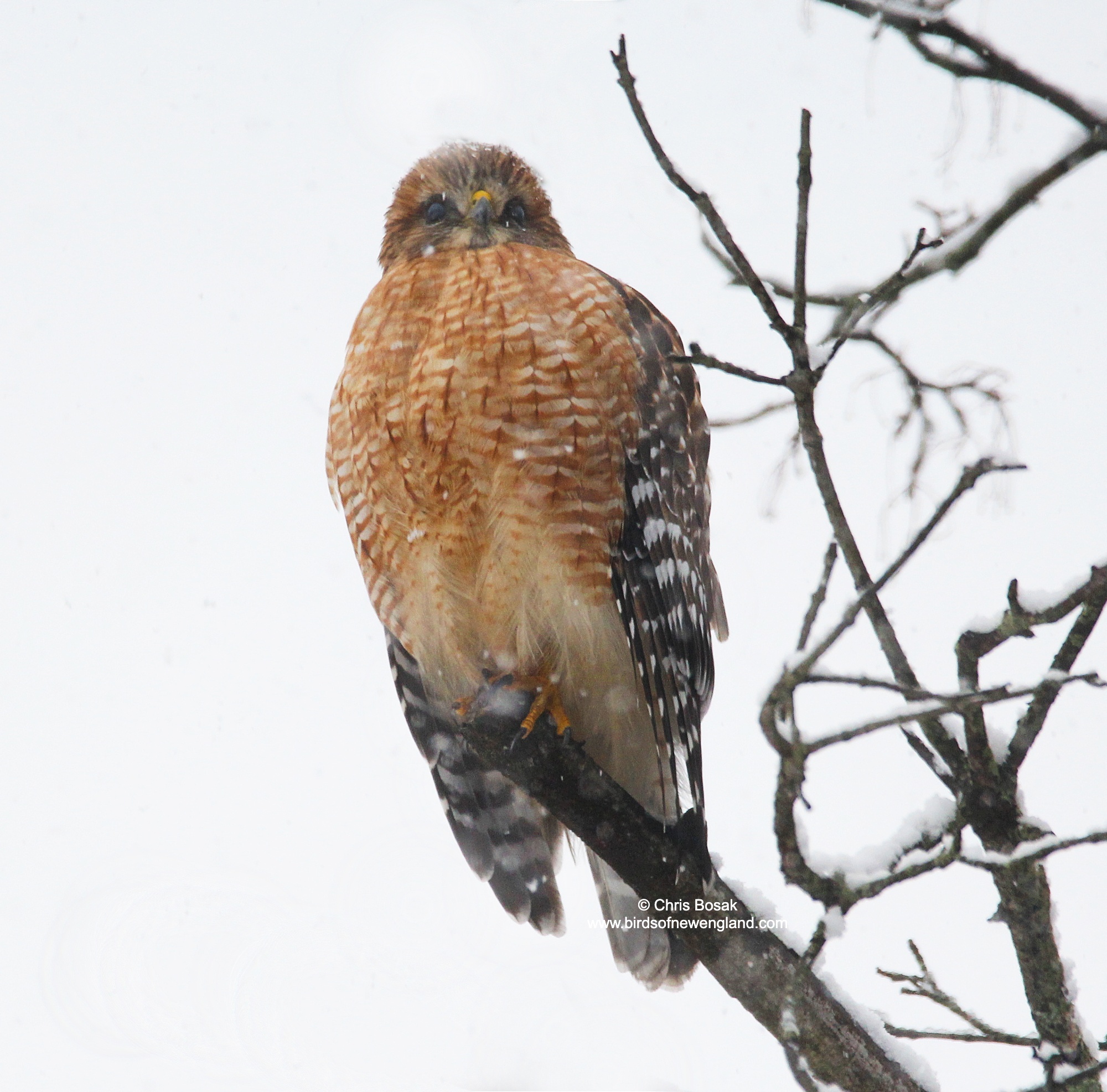
A red-shouldered hawk perches on a branch during a snowy day in New England, January 2026.
It should come as no surprise that birdwatching is growing in popularity, according to several studies and other metrics. It had been gaining in popularity for years, but the pandemic greatly accelerated the movement.
As I researched the Great Backyard Bird Count for this column, I was surprised at how much birdwatching had gained in popularity, at least as it is measured by the number of GBBC participants.
In the last 10 years, which is basically a blink of an eye, the number of people participating in the count has exploded. In 2016, roughly 164,000 people did the count. In 2025, last year’s count, roughly 838,000 people participated. That is an amazing increase.
There are several reasons for the increase other than birdwatching simply becoming more popular, although that certainly is a main factor.
The GBBC started as a North American project to have people count birds in the winter as a way to track bird populations over time. It is now a global phenomenon with birdwatchers from nearly every country participating.
It is also much easier to participate and submit results. Not long ago, results were submitted by hand using a checklist. Then the internet came along and results were submitted through a website. Now, most lists are submitted via eBird or Merlin. In fact, if you have an eBird account, any list submitted during the GBBC timeframe is automatically entered into the GBBC database.
The organizations behind the GBBC—Cornell Lab of Ornithology, National Audubon Society, Birds Canada and founding sponsor Wild Birds Unlimited—have also done a great job with marketing the event, which also helped to build participation numbers.
As the count’s popularity grows globally, obviously the number of species recorded grows as well. In 2016, just under 5,700 species were counted worldwide. Last year, just over 8,000 species were recorded.
Any guesses as to which country had the most participants last year? How about which country recorded the most species?
The answer to the first question is, not surprisingly, the United States, followed by Canada and India.
The answer to the second question is Colombia, with 1,374 different species recorded, followed by Ecuador, Brazil and India. Many countries in South America and Central America were in the top 10. Again, not surprising considering the climate and time of year. Asia and Africa were well represented in the second 10.
The United States was 12th with 670 species counted last year. Warm states such as Texas, Arizona and Florida accounted for the bulk of the species. New Hampshire birders recorded 111 species last year. Having a coastline provides a boost to that number. For comparison, Vermont had 96 species recorded.
Why am I going on and on about the Great Backyard Bird Count? Because it’s coming up soon and anyone can participate. And it’s free. Simply count birds and submit the results through eBird, Merlin, or birdcount.org. The results are entered into a massive database of birds that helps to track population trends of bird species.
The 29th annual GBBC will be held February 13-16. You don’t need to be an expert or be out all day. Look for birds, whether in the woods, on a boat or looking at your feeders, for at least 15 minutes and share the results with the world. More information is available at birdcount.org.
While you’re at it, you may as well participate in New Hampshire Audubon’s Backyard Winter Bird Survey, which takes place February 14 and 15. It is a statewide citizen science project similar to the GBBC, whereby birders of all skill levels watch birds at their feeders and submit results. Do an internet search for “NH Audubon Backyard Winter Bird Survey” for further details.
Let me know if you see anything interesting out there.
 Birds of New England.com
I have been casually watching birds for years, much the same as my dad did. During the 60’s and early 70s it was very rare to see a cardinal in Bow NH or anywhere else above the Manchester or south line…we would jot those unique sightings down on the calendar but alas the calendar would be sent off to our burn pile or in later years to recycle come Dec. 31 and some time later on we’d reminisce over “the cardinal we saw that time, wasn’t he beautiful, when was that…?” I leapt at the chance to join the GBBC when it was first brought to my attention about 6 years ago and now of course I’ve joined up with Cornell’s E-bird on line and keep a daily bird viewing log which is a wonderful convenience…none the less there are times I wish I could go back and watch birds with my dad again with a red felt tip marker to add to the calendar those unusual sightings…
LikeLike