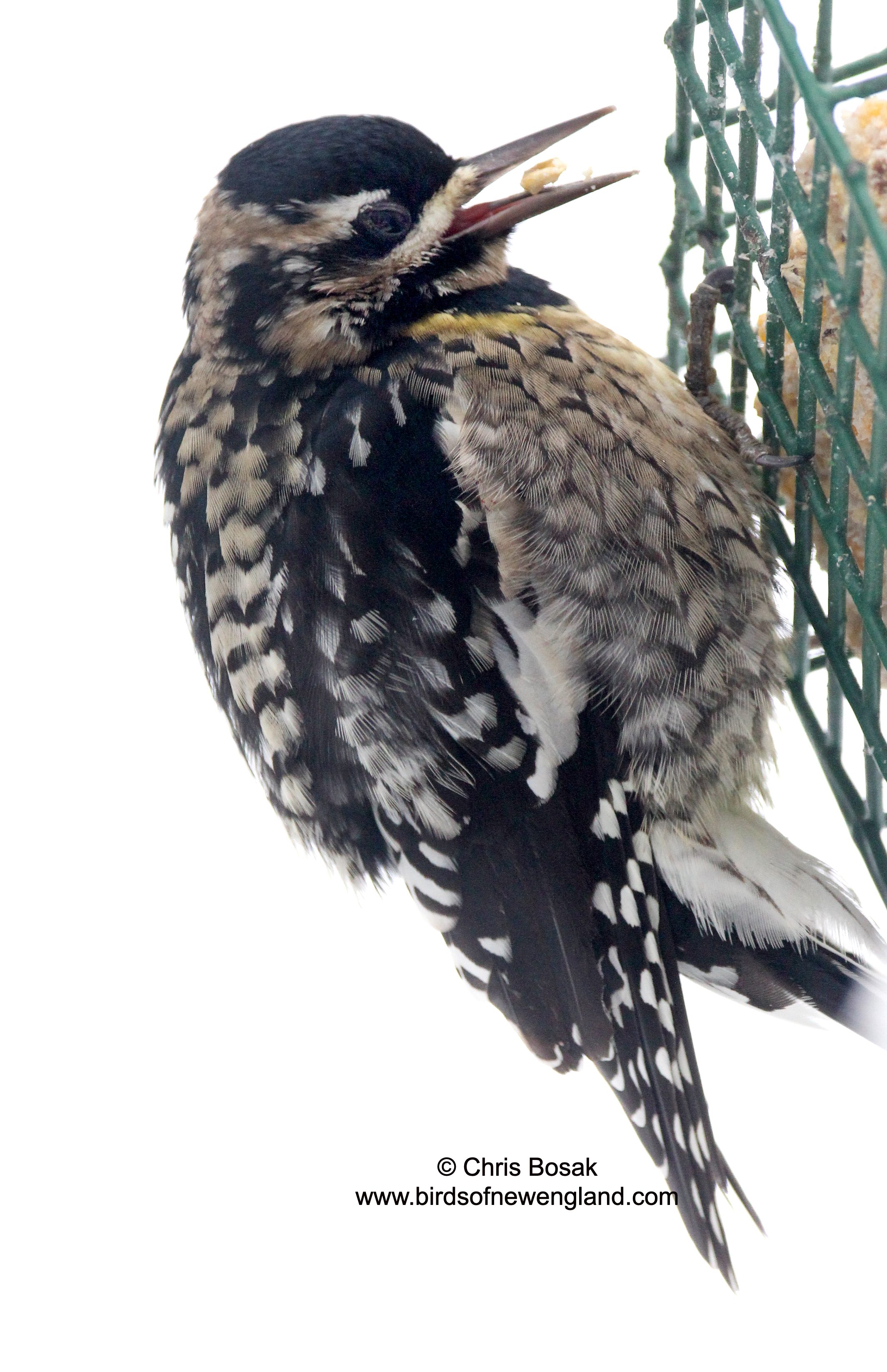
At first it looked like a growth on the tall bush near my bird feeding station. I quickly realized it wasn’t a growth at all but rather a yellow-bellied sapsucker hugging a small branch.
It was a first-year bird, and its dark coloration, lack of red head or throat, and barred plumage made it look like part of the bush. It also caught me by surprise because yellow-bellied sapsuckers are migratory and are not frequent visitors to feeders. It was also perfectly still for several minutes as, from the comfort of my living room, I watched it brave the single-digit temperatures.
It eventually swung a quarter turn around the branch, offering me a view of its profile. Then it darted over to the nearby suet feeder, where it pecked at the frozen cake for several minutes. It returned to the same branch on the bush where I had initially spotted it and remained there for as long as I could watch it.
The bird was there the next day as well, alternating between its favorite branch and the suet feeder.
It was the latest uncommon visitor to my feeders this winter, following the likes of a fox sparrow, red-breasted nuthatch and northern flicker. Yes, I’m still waiting for the evening grosbeaks to arrive.
Yellow-bellied sapsuckers breed throughout New England and up into Canada, but they are perhaps the most migratory of our woodpeckers. They leave in September or October for southern U.S., Central America or the West Indies. I have read that an increasing number are staying in New England for the winter, particularly the southern part of the region.
Northern flickers are also migratory, but again, some remain here all winter. That is in contrast to our other woodpeckers—downy, hairy, pileated and red-bellied—which are year-round birds here. Black-backed woodpeckers of the north are also non-migratory.
While I was surprised to see the sapsucker the other day, I probably shouldn’t have been. I mentioned nemesis birds in a column a few weeks ago and noted that evening grosbeaks and owls are among mine. I should have mentioned American woodcock as well. Nemesis birds are those that elude you regardless of how hard you try to find them.
For me, yellow-bellied sapsuckers are the opposite. I hope I don’t jinx myself by writing this, but I see a lot of them. I see them on my walks, in my backyard, and now, at my feeders. This wasn’t the first one I saw this winter either. I spotted one on the Christmas Bird Count and another on a recent walk in the woods.
The only problem with seeing a lot of yellow-bellied sapsuckers is that I have to explain that they are indeed real birds. It’s not just a funny-sounding name that was made up for a scene in The Honeymooners so many years ago. (Check it out on YouTube if you’ve never seen it.)
Birdwatching is full of surprises, whether on a walk in the woods or watching the feeders. The usual suspects are enough to keep me interested, but the surprises add a little oomph to the hobby.
 Birds of New England.com
How cool it is for you to enjoy multiple sightings of the yellow-bellied sap sucker! Never have I ever, nor did I anticipate a sighting being in the Lakes Region, though with the earth changing so much I shouldn’t be surprised to see one here as well.
I like your nemesis birds term, perfect word for those species we’d love to see but don’t…
LikeLiked by 1 person