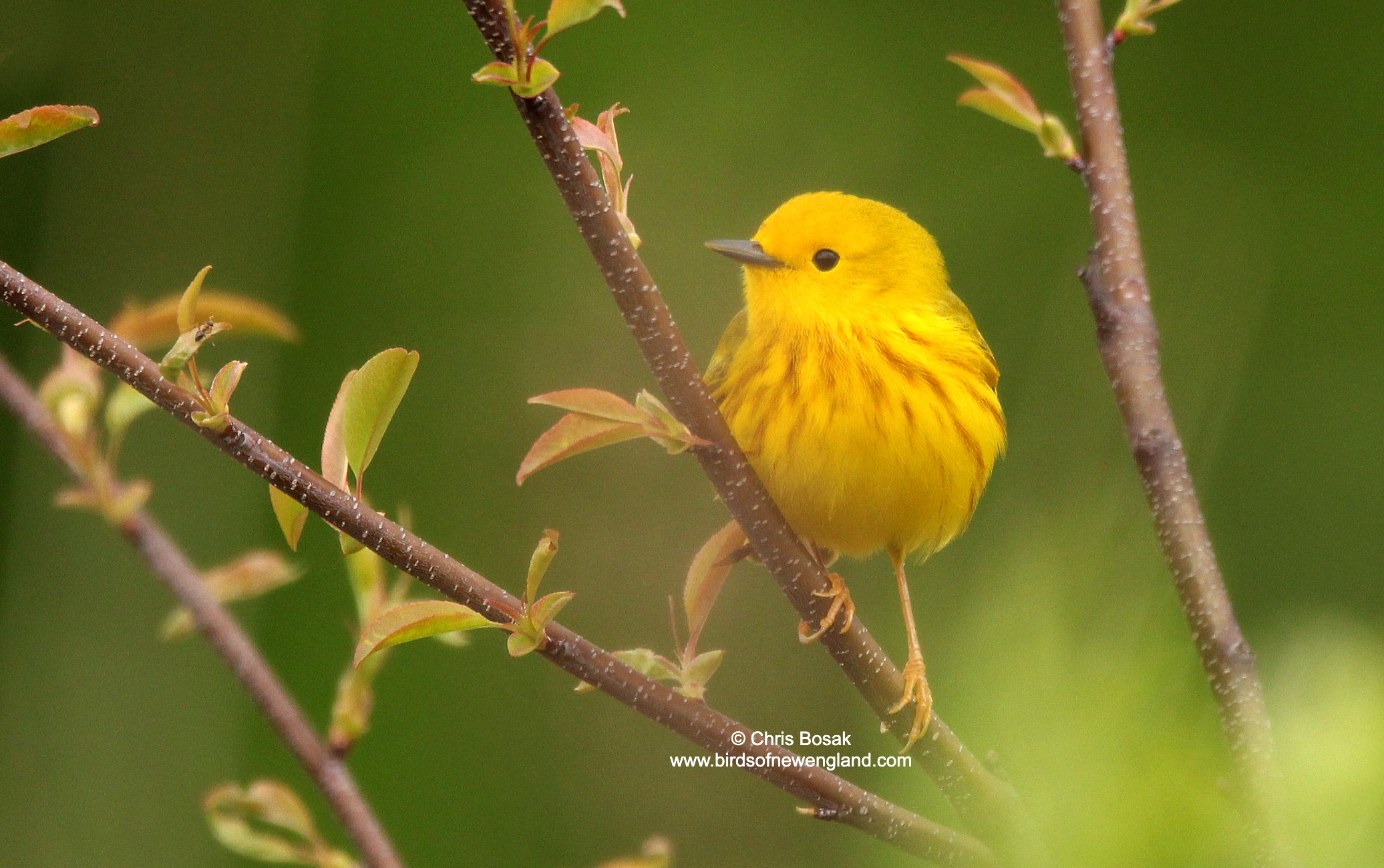
Yellow warbler at Huntington State Park, Redding, CT, May 2026.
Spring migration continues to work its magic.
My walks have been filled with migrants, including a few FOYs (first of years) each time I go out. On one recent walk, I saw a veery, red-eyed vireo, and American redstart, all firsts of the year. It’s always nice to see birds for the first time since last spring, summer or fall.
The feeling is a little different for birds that we know are just passing through and won’t nest here. Of course, it’s always nice to see the first rose-breasted grosbeak, scarlet tanager, Baltimore oriole or ruby-throated hummingbird, but we know they will nest locally, and we will have plenty more chances to see them over the next several months.
Some birds, however, especially select warblers, will not nest locally, so if we miss them during their short window of passing through New England, we have to wait until fall to try to catch a glimpse of them as they pass through during their southern flight. If we miss that opportunity, our next chance will be the following spring.
In many cases, it can be several years between sightings of a certain species. The other day, I saw a hooded warbler, an aptly named and cool-looking olive-and-yellow bird with a black hood and throat. It had been years since I had last seen one. I spotted the bird among a tangle of vines fairly high in the canopy, which was surprising because they tend to hang out in shrubs and the understory.
Unless you’re really lucky and these birds come to your yard, you have to get out there in order to see them. Some days it’s tough to get out of bed early, and some days work doesn’t allow for a birding break, but spring is the time of year to make every moment count.
Here are some other random birding highlights from recent days.
The northern flicker pair I wrote about a few weeks ago successfully dug out the rest of their nest in the snag in my backyard. It took several days of constant work for them, but the other day, I checked on them, and one was inside the hole with only its head sticking out.
During a recent work-from-home day, I glanced out at the birdbath and saw a blue jay on the edge. A moment later, another blue jay landed next to it and fed it a mealworm that it had plucked from my bird feeder. Earlier this spring, I saw a cardinal pair and a house finch pair do the same thing.
My son and I were working on a car in the driveway (actually, he was working on it, and I was watching) when I heard crows cawing and blue jays squawking in the nearby hemlocks. I said, “I bet there’s a hawk or owl in there.” He turned just in time, and we watched a barred owl fly out of the hemlock branches and disappear in the woods. A bit later, we heard its “who cooks for you, who cooks for you all” song over and over.
That’s it for now. Let me know what you’re seeing out there this spring.


Spring birds are the best! Here in central NH’s lakes region we enjoy the usual suspects not the least of which are our hummingbirds fighting at their feeders, phoebes, cardinals, bluebirds, blue jays, warblers, purple + house finches along with gold finches, sparrows, an aggressive red-winged hawk pair and so forth. Just across the road we are very blessed to enjoy the variety of notes bursting forth from a few loon families who nest on our tiny lil lake every year. This year we are enjoying a pair of Canadian Geese as well. Traditionally they fly over us frequently year to year but this is their first year landing and staying. LOL, certainly not what we’re used too. They arrive almost every early afternoon, hang out in the lower yard area where the grass is always thicker and the shade is moderate. Its more secluded there being bordered with woodsy swamp on one side, our garage and woodshed on the other and the long swooping area of lawn giving them plenty of obstacle free landing strip area….
LikeLiked by 1 person
Hello Hootie. That’s great about the geese. I’m glad you are getting to enjoy them this spring. And the loons? How awesome that must be.
LikeLike
Incredibly awesome!!!!
LikeLike