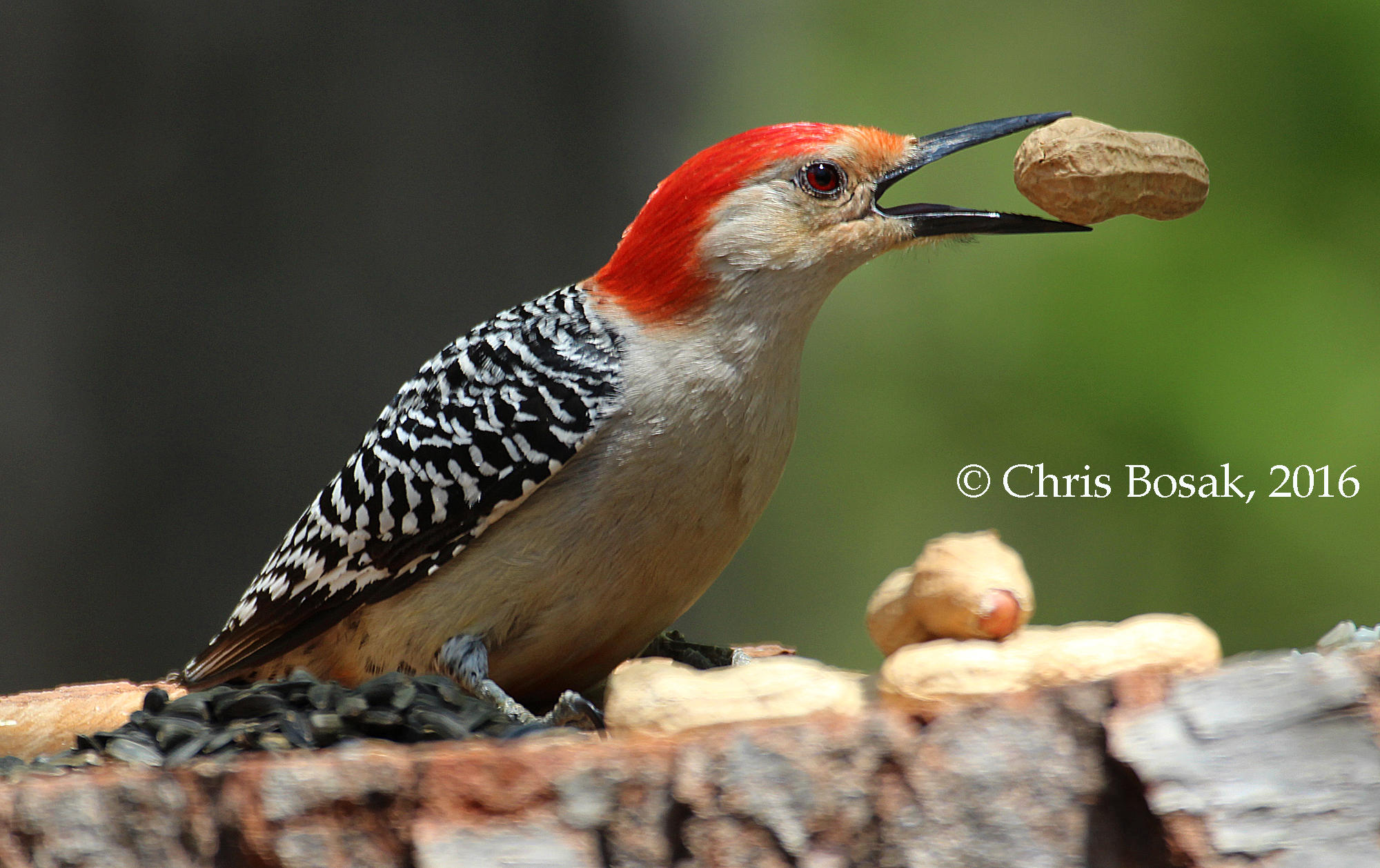
The call of the red-bellied woodpecker is often described as “querulous.”
I was walking across a parking lot at work when I heard a red-bellied woodpecker utter its loud churr call. I looked up and saw it swoop across the lot and land on a nearby tree trunk. It immediately scootched over to the other side of the trunk and disappeared out of view.
It was a perfectly clear and still fall day. The weather was crisp and the sky as blue as can be. The harsh churr abruptly broke the stillness, if only for a second.
Every time I hear a red-bellied woodpecker make that sound, I recall reading it described as “querulous” a long time ago. I had never heard that word before, and I found it fascinating for some reason. Even having never heard the word, at the time it sounded like the perfect description of the sound. Even though I had never heard the word before, it sounded like the perfect description of the sound at that time.
For the record, querulous is defined as “habitually complaining” by Merriam-Webster. Some synonyms include irritable, grouchy, grumpy and fretful. To me anyway, I never thought of the churr call of the red-bellied woodpecker as any of those things. To me, it was just a cool, unique sound I heard every so often in nature.
Now that we’re on the topic, written descriptions of bird songs or calls rarely resonate with me. The mnemonic phrases or adjectives used to describe the sounds only help me after I know the bird song or call already. If I had never heard a red-bellied woodpecker before and someone told me to listen for a querulous sound in the woods, I would never equate that to the sound a red-bellied woodpecker makes.
Even worse (again for me anyway), I had a book once that visualized bird songs using musical notation. Having zero musical talent or background, that obviously didn’t work for me. I did play the violin for one school year, but that was in third grade. I remember nothing.
This is not to say the words to describe bird songs have no value. In some cases, they make perfect sense to me. Again, I have to know the song first and then the words make sense and help to solidify the identification in my brain.
I can clearly make out “old sam peabody, peabody, peabody” when I hear a white-throated sparrow sing now. It wasn’t always that way, however. The northern version of that mnemonic, “oh sweet Canada, Canada, Canada” does not do it for me.
The mnemonics for the eastern towhee’s song and call make sense for me now that I know them and have heard them over and over. Of course it sings “drink your tea” and calls out “tow-hee.” Of course the Carolina wren says “teakettle, teakettle, teakettle,” and the tufted titmouse says “peter-peter-peter.”
Does the ovenbird really say “teacher, teacher, teacher?” Not to me, but maybe it works for other people. Warbler and other migrating bird songs are notoriously difficult to learn because there are so many and most are sung softly. Most of the mnemonics are of little help to me. Black-throated blue warbler: I’m so laa-zzy. Chestnut-sided warbler: pleased, pleased, pleased to meet you. Indigo bunting: fire, fire, where, where, here, here, see it, see it.”
I just don’t get those.
The best way to learn bird sounds is to match the descriptions when you are actively hearing the songs or calls. Knowing that a titmouse says “peter-peter-peter” doesn’t do a whole lot in a vacuum, but matching it to the bird when actually hearing it in the field can drive it home and perhaps allow you to remember it the next time.
What are your thoughts on learning bird songs and calls? What has worked for you and what hasn’t? Let me know at the email address below.


good to know it isn’t just my bird song inability to equate the verbal descriptions of songs such as teacher teacher teacher…I use both the Cornell and Audubon apps to learn the song sounds…
LikeLike