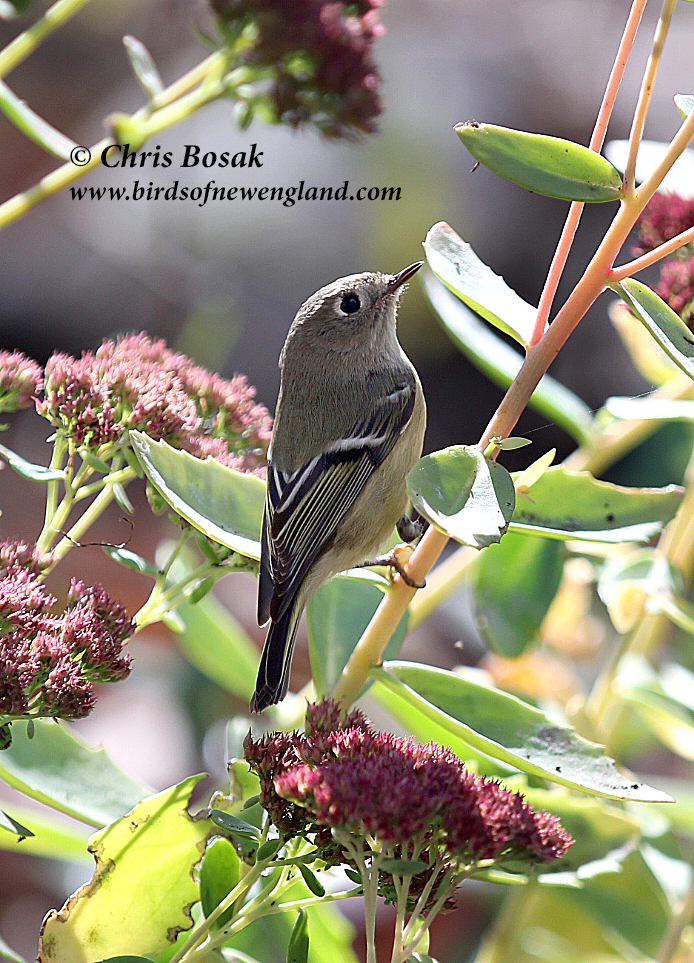
A ruby-crowned kinglet inspects sedum for food in New England, fall 2019.
I went down a birding rabbit hole on the internet the other day and came across an interesting website.
The part that caught my eye on the search page read something like “58 birds that regularly visit feeders in New Hampshire.” Naturally, I clicked on it and had a quick look. I wondered if the site did that for all of the states, or at least all of the states in New England.
The site does indeed have lists for all of the states and Canadian provinces. Not only that, it also has lists of specific types of birds (like wetland birds) that may be found in all of the states as well.
The part that initially caught my eye was the “regularly seen at feeders.” Before I looked at the site, I did a quick rundown in my head of the birds that I regularly see at my feeders. I covered all the very frequent visitors (cardinals, chickadees, titmice, etc.) and the ones that are seen enough to be considered regular (mockingbirds, catbirds, pine siskins).
I was surprised at how many birds I reeled off quickly in my head, but 58 still seemed like a big number. So I checked out the website’s list of “bird species that regularly visit backyard feeders in New Hampshire.” I soon discovered why my list came up considerably short.
The list included birds that, to me anyway, do not seem like birds that regularly visit feeders. “Occasionally” or even “rarely” may be better words to describe the frequency with which some of the birds visit feeders. Also, the list includes many northern birds that may be seen frequently in northern New Hampshire but not so much in southern New Hampshire. I can’t fault the website for that. New Hampshire is New Hampshire after all.
I also discovered why some of the birds listed seemed a little off. The site uses data from Project FeederWatch to aggregate the lists for each state. Project FeederWatch is a citizen science project of the Cornell Lab of Ornithology. Data and statistics are powerful indicators of what to expect, but sometimes a human element is necessary to confirm the findings. Again, I can’t fault the website for this. Having first-hand knowledge of what birds visit feeders in every state and province is nearly impossible.
This is slightly off-topic, but it seems like a good comparison. When my son played high school football, I followed a popular website that ranks each state’s teams. A disclaimer at the bottom of the rankings says that computers are 100 percent responsible for the rankings and no human element is included. The computer analyzes each team based on current record, past years’ performance, and a few other data points. I’ve personally witnessed teams winning 40-0 (or worse) and still being ranked below the team they just whipped. Strength of schedule and other factors that a human would recognize as important are not factored in.
Anyway, back to the birds that regularly visit backyard feeders. Some of the bird species that surprised me on the list were ruby-crowned kinglets, eastern towhee, hermit thrush, boreal chickadee, brown creeper, brown thrasher, rusty blackbird, field sparrow and red and white-winged crossbill.
Here’s the latest. Let me know if you have any questions. Thanks, Chris.
…
Photo by Chris Bosak
Ruby-crowned kinglets are commonly seen throughout New England in the fall but rarely visit feeders.
…
I went down a birding rabbit hole on the internet the other day and came across an interesting website.
The part that caught my eye on the search page read something like “58 birds that regularly visit feeders in New Hampshire.” Naturally, I clicked on it and had a quick look. I wondered if the site did that for all of the states, or at least all of the states in New England.
The site does indeed have lists for all of the states and Canadian provinces. Not only that, it also has lists of specific types of birds (like wetland birds) that may be found in all of the states as well.
The part that initially caught my eye was the “regularly seen at feeders.” Before I looked at the site, I did a quick rundown in my head of the birds that I regularly see at my feeders. I covered all the very frequent visitors (cardinals, chickadees, titmice, etc.) and the ones that are seen enough to be considered regular (mockingbirds, catbirds, pine siskins).
I was surprised at how many birds I reeled off quickly in my head, but 58 still seemed like a big number. So I checked out the website’s list of “bird species that regularly visit backyard feeders in New Hampshire.” I soon discovered why my list came up considerably short.
The list included birds that, to me anyway, do not seem like birds that regularly visit feeders. “Occasionally” or even “rarely” may be better words to describe the frequency with which some of the birds visit feeders. Also, the list includes many northern birds that may be seen frequently in northern New Hampshire but not so much in southern New Hampshire. I can’t fault the website for that. New Hampshire is New Hampshire after all.
I also discovered why some of the birds listed seemed a little off. The site uses data from Project FeederWatch to aggregate the lists for each state. Project FeederWatch is a citizen science project of the Cornell Lab of Ornithology. Data and statistics are powerful indicators of what to expect, but sometimes a human element is necessary to confirm the findings. Again, I can’t fault the website for this. Having first-hand knowledge of what birds visit feeders in every state and province is nearly impossible.
This is slightly off-topic, but it seems like a good comparison. When my son played high school football, I followed a popular website that ranks each state’s teams. A disclaimer at the bottom of the rankings says that computers are 100 percent responsible for the rankings and no human element is included. The computer analyzes each team based on current record, past years’ performance, and a few other data points. I’ve personally witnessed teams winning 40-0 (or worse) and still being ranked below the team they just whipped. Strength of schedule and other factors that a human would recognize as important are not factored in.
Anyway, back to the birds that regularly visit backyard feeders. Some of the bird species that surprised me on the list were ruby-crowned kinglets, eastern towhee, hermit thrush, boreal chickadee, brown creeper, brown thrasher, rusty blackbird, field sparrow and red and white-winged crossbill.
I’ve seen some of these birds on rare occasions at my feeder over the years, but I wouldn’t say they regularly visit backyard feeders. I’ve seen hundreds of ruby-crowned kinglets over the years, including many times in my garden eating seeds off spent flowers, but I’ve never seen one on a feeder. I had a brown creeper on my suet feeder once, but again, certainly not regularly.
American robin is also on the list. In my experience, robins largely avoid feeders and prefer fruit from nearby shrubs and trees. One year, I did have a robin family visit for several days straight to eat mealworms I had put out for bluebirds.
I don’t mean to disparage the website (avianreport.com) at all. It’s full of information and can serve as a terrific guide for planning birding trips throughout North America. It’s also easy to navigate, unlike trying to find specific data from the various projects like the Great Backyard Bird Count, Christmas Bird Count or Project FeederWatch. I’d just use the lists as a guide and combine the information with your own knowledge of birds.
Sometimes you find good stuff at the bottom of a rabbit hole.American robin is also on the list. In my experience, robins largely avoid feeders and prefer fruit from nearby shrubs and trees. One year, I did have a robin family visit for several days straight to eat mealworms I had put out for bluebirds.
I don’t mean to disparage the website (avianreport.com) at all. It’s full of information and can serve as a terrific guide for planning birding trips throughout North America. It’s also easy to navigate, unlike trying to find specific data from the various projects like the Great Backyard Bird Count, Christmas Bird Count or Project FeederWatch. I’d just use the lists as a guide and combine the information with your own knowledge of birds.
Sometimes you find good stuff at the bottom of a rabbit hole.

