Here’s a side-by-side (well, really top-to-bottom) comparison of the two nuthatches in New England. The White-breasted is more common throughout much of the region. It is also larger than its cousin. The Red-breasted is more common in the northern parts of New England and visits the southern region in the winter in numbers that vary greatly from year to year.
Author Archives: Chris Bosak
New bird pays a visit to my feeder
I suspected one or more might show up this fall/winter and, well, one did show up over the weekend. I had seen reports of Red-breasted Nuthatches showing up throughout New England. I’ve had these small birds at previous feeders, but not yet at my home on Merganser Lake in Connecticut. Until now …
For more information on this bird, visit my previous post by clicking here.
Hummingbird stories, tips and suggestions from BoNE readers
The vast majority of the hummingbirds have gone south by now. But that doesn’t mean I can’t do another post on these spectacular tiny birds. I did a series of posts and bird columns on hummingbirds a few months ago and received a tremendous amount of feedback. So here, in no particular order or font, is a ton of information from Birds of New England readers. Thanks so much for your feedback and feel free to write any time. Siimply comment on this post or send me an email to bozclark@earthlink.net
From Marsha,
We live in condos on a large open pond surrounded by trees so it’s a perfect environment for the little birds, lots of open space to chase each other around and lots of areas to perch. I can’t seem to get them to come to my feeder (I have one and my neighbor has 3) but they do occasionally visit my hanging petunias and fuschias which I specifically hung knowing hummers are attracted to the tubular flowers. They are extremely entertaining to watch and I was very disappointed to learn that they were actually being aggressive toward each other and not playing. Oh well, I guess it can’t be Disney all the time…
From Joan,
I have a feeder hanging about 2 feet from the glass jalousies that enclose my breezeway and see these little guys every day. I don’t have any flowers near them (my yard is very shaded) but there are some coleus plants below the feeder so perhaps they see those bright colors. I also have a hairy woodpecker who drinks from the hummingbird feeder and I find that I must refill it about every 4 days since he is so thirsty! He just hooks his feet over the edge where the base meets the clear upper part and drinks away. There are 3 plastic flowers around the base of the feeder that the birds drink from and they are a couple inches apart but if one hummingbird is drinking, the other one won’t go to one of the other flowers and in fact, if there are two of them around at the same time, they dive bomb each other. One of the hummingbirds that comes has the bright red spot on his throat and the other one looks like the one in your picture without the red throat. I can be just inside the windows that are tilted out and they come bopping around right up to the window. I love seeing them and know they won’t be around too much longer but then it will be time to start buying sunflower seed for all my other winged friends Continue reading
The other New England squirrel

Photo by Chris Bosak
A Red Squirrel stands its ground on a branch in Tarrywile Park in Danbury, Conn., Sept. 2016.
Here’s a nice shot of a Red Squirrel taken last week in Tarrywile Park in Danbury, Conn. The Gray Squirrel is the dominant squirrel in New England, especially the southern part of the region, but Red Squirrels are common in the area as well. I appreciate my Red Squirrel sightings because I don’t see them very often at my home in southern New England. When I visit northern New England, I see plenty of Red Squirrels and hardly see any Gray Squirrels.
Of course, New England is also home to Flying Squirrels (which don’t actually fly, but soar) but I rarely see them, unfortunately. They are a sight not to forget when you do see them.
Latest For the Birds column: Gulls and ants?
Here’s the latest For the Birds column, which runs weekly in The Hour (Norwalk, Conn.), The Keene (NH) Sentinel and several Connecticut weekly newspapers.
…
We’ve all seen gulls eat clams at the beach. They rise into the air, clam in bill, and drop the mollusk onto the pavement.
If the shell doesn’t break, the gull goes a little higher the next time and drops the clam again. Eventually they get just the right altitude and the shell breaks to expose the good stuff inside. If they go too high the shell will shatter into a million pieces and splatter the meat into an inedible mess.
If the gull is lucky, it will get to eat the clam waiting for it on the pavement. If they aren’t lucky, a marauding gull will have come by and stolen the clam before the industrious gull could even make its way back down to the pavement.
But that’s just part of the gull’s varied diet. We’ve also all seen gulls eating fries, potato chips and other human junk food at the beach or in a parking lot.
But did you know gulls eat insects, too? Even insects as small as ants make up part of a gull’s diet. How can an ant satisfy the appetite of a large bird like a gull? An ant can’t, of course, but lots of ants can. Humans don’t open a container of peanuts and eat one nut. We eat them by the handful.
Birding signs of winter

Photo by Chris Bosak
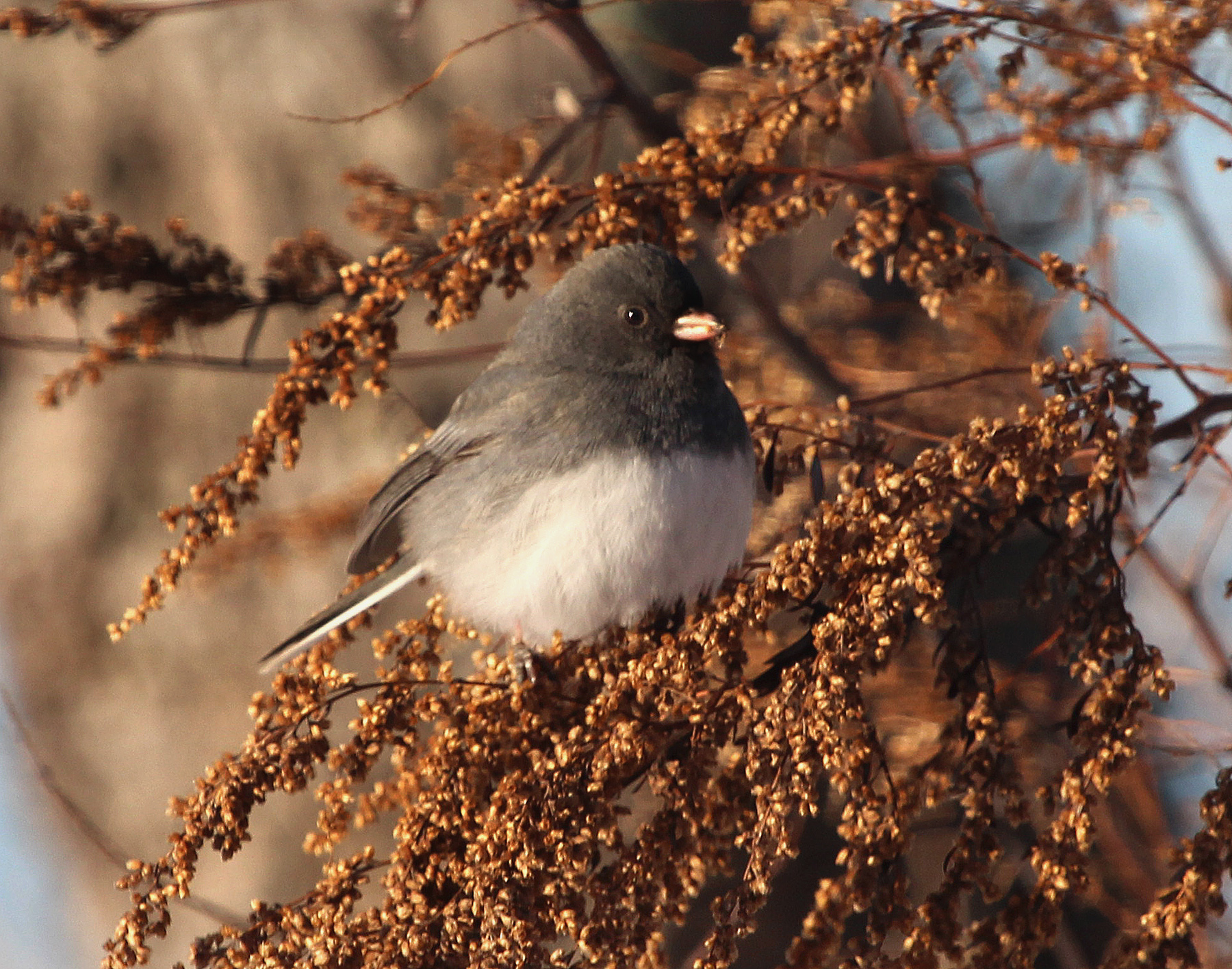
A junco perches on a dried up plant at Weed Beach in Darien, Conn., in Jan. 2015.
Sorry for that headline. I’m sure some of you out there are looking forward to winter, but for many it’s a dreaded time of year. Personally, I love winter because of all the different birds that show up just for that season. Plus, winter can be full of surprises (just like any season in New England.)
One sure sign of winter in the birding world is the arrival of Dark-eyed Juncos around feeding stations. Well, today was the day I saw my first one. A beautiful pitch-black and pure-white male hopped along my deck looking for seeds.
Winter’s coming and I’m not bummed at all.
Latest For the Birds column: Loving the ‘regulars’
Here’s the latest For the Birds column, which runs weekly in The Hour (Norwalk, Conn.), The Keene (NH) Sentinel and several Connecticut weekly newspapers.
…
The feeders went back up a few weeks ago. Nothing extraordinary has shown up yet, but it sure is nice to see the “regular” birds back.
My constant companions are nuthatches, titmice and chickadees. There is usually a downy woodpecker or two there as well, but they are not as reliable as the aforementioned birds.
I love seeing the nuthatches. I love the titmice and chick Continue reading
And the answer is …
Pat yourselves on the back because the selection with the most votes was the bird in question. The photo is of a Common Yellowthroat. The trick was that it is a female bird seen in the fall. When most people think of Common Yellowthroats they think of the male with its handsome masked face. Like many bird species, the female Common Yellowthroat is more drably plumaged than the male. Good job everyone!
Birding Quiz … name the bird
Bald Eagle visits pond
I live on Merganser Lake (real name Lake Waubeeka). A short walk away, down a trail that starts at my backyard, is Little Merganser Lake (really the Beaver Pond.) I like Little Merganser Lake because it is completely undeveloped and isolated. A wide variety of wildlife, mostly birds, can be seen at the lake and pond, but the pond is more productive because of its relative remoteness.
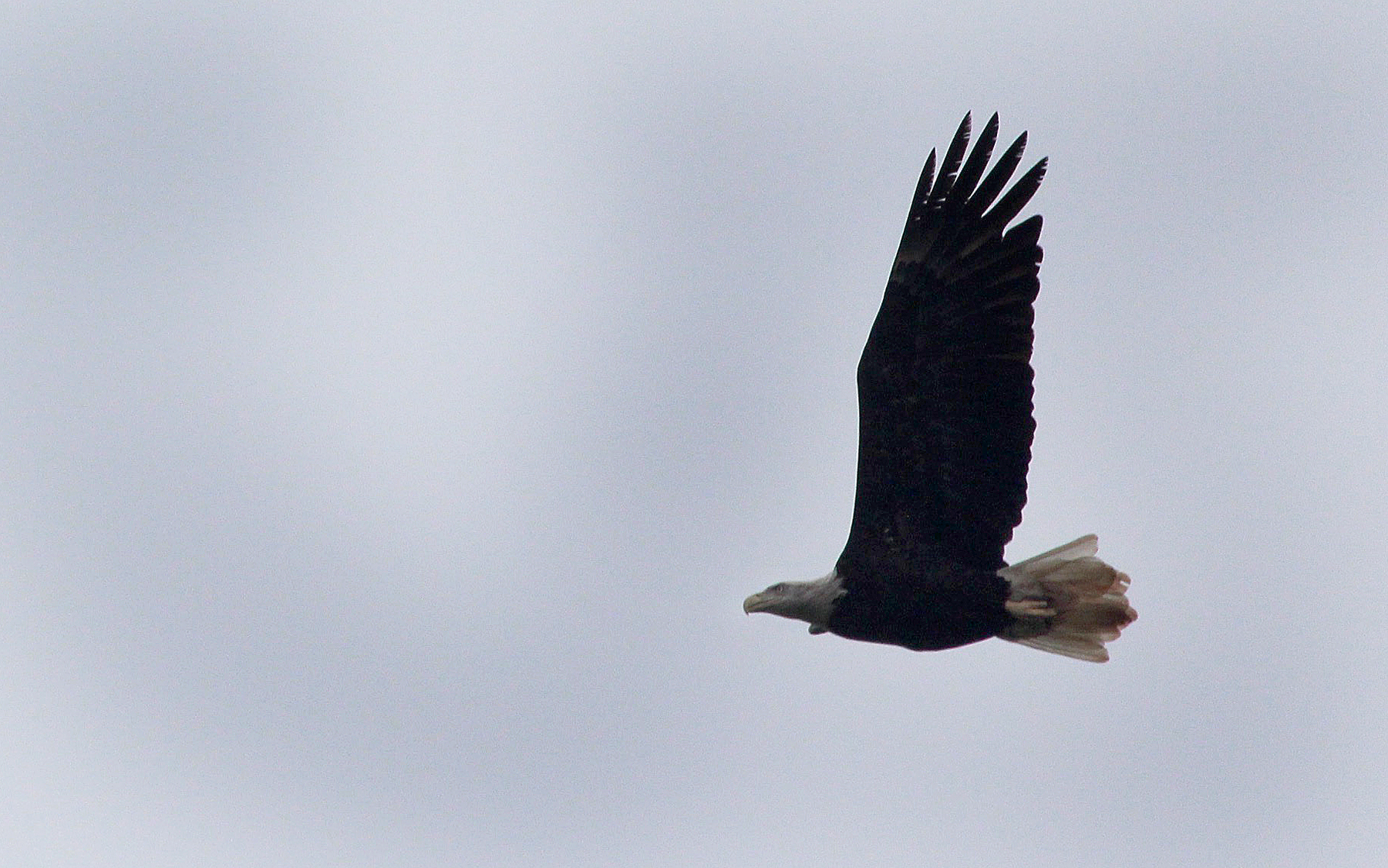
I’ve seen some pretty good ducks and herons down there, but today I saw a Bald Eagle there for the first time. I heard it calling and then it soared overhead. It was impossible to miss. Bald Eagles are becoming more and more popular and nest on nearby lakes such as Candlewood and Lillinonah. So to see one here is not overly surprising, but as I said, it was first time seeing one, so of course I have to post about it.
The photos, admittedly, are not the best because of the gray, drizzly conditions, but you get the picture …