Unknown's avatar

About Chris Bosak

Bird columnist and nature photographer based in New England.

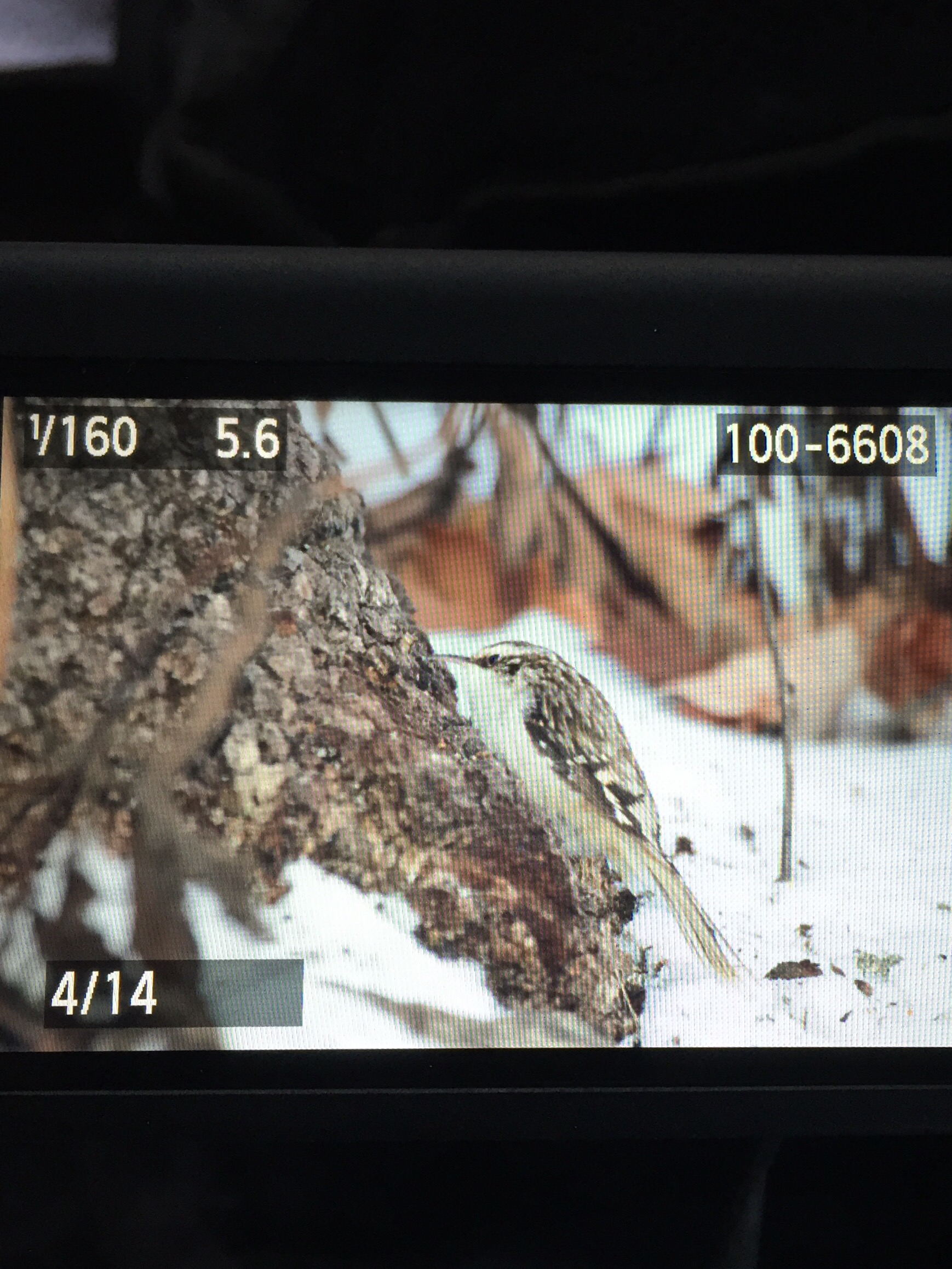
More Brown Creeper photos from #GBBC

Photo by Chris Bosak A Brown Creeper finds food at the base of a tree during a cold snap in February 2016, Danbury, Connecticut.

Photo by Chris Bosak
A Brown Creeper finds food at the base of a tree during a cold snap in February 2016, Danbury, Connecticut.

Here are some more shots of the Brown Creeper that visited my yard during the cold snap experienced in New England over the weekend. With temperatures at or even below zero for much of the weekend, it wasn’t easy snapping photos of birds in the yard, but the thrill of seeing these energetic, albeit rather nondescript, birds made me forget about the cold for the time being.

Brown Creepers may not be much to look at with their small size and white and brown coloring, they are a thrill to see nonetheless. They are rather common in New England, but it’s not a bird you see every day, or in great n Continue reading
Brown Creeper and Yellow-bellied Sapsucker pay a visit

Photo by Chris Bosak Brown Creeper at base of tree.

Photo by Chris Bosak
Brown Creeper at base of tree.

At one point today a Yellow-bellied Sapsucker was on the suet feeder and a Brown Creeper crept along the base of an adjacent tree. Neither are earth-shattering sightings, but both are rather unusual in my part of New England at Merganser Lake. In fact, it was the first time I had ever seen a sapsucker at one of my feeders. I even managed to get a decent photograph of the Brown Creeper, a species that can be tricky to shoot.

The photos accompanying this post, admittedly, don’t look that great. They are merely photos I took with my iPhone of the display screen of my camera. When I have more time I’ll get to a computer and download the photos, but for now the mediocre iPhone will have to do. Thanks for your patience. I wanted to post this as soon as possible as this is Great Backyard Bird Count weekend. It runs through Monday, so maybe this posting will inspire others to participate. For more information, click here.

Photo by Chris Bosak Yellow-bellied Sapsucker on suet feeder.

Photo by Chris Bosak
Yellow-bellied Sapsucker on suet feeder.

For the Birds column: Snow is no problem for birds

Photo by Chris Bosak A Tufted Titmouse and White-breasted Nuthatch share a feeder during a snowstorm in Danbury, Conn., Jan. 23, 2016.

Photo by Chris Bosak
A Tufted Titmouse and White-breasted Nuthatch share a feeder during a snowstorm in Danbury, Conn., Jan. 23, 2016.

Here’s the latest For the Birds column, which runs weekly in The Hour (Norwalk, Conn.) and Keene (NH) Sentinel:

One of my favorite times to watch birds is when the snow is falling. Not a driving snow with icy temperatures and high winds, but an otherwise rather pleasant day with frozen crystals falling from the sky and covering everything with a fresh coat of white.

I do not shy away from taking walks to look for birds when the snow is actively falling, in fact I thoroughly enjoy walks at such times. But I also enjoy very much watching the activity at the feeders during snow falls.

As long as the snow is not falling at too fast a rate, the birds will continue coming to feeders. Indeed, during light and moderate snow falls the birds may be seen at higher-than-usual …

Click here for the rest


More shots of that Northern Pintail drake

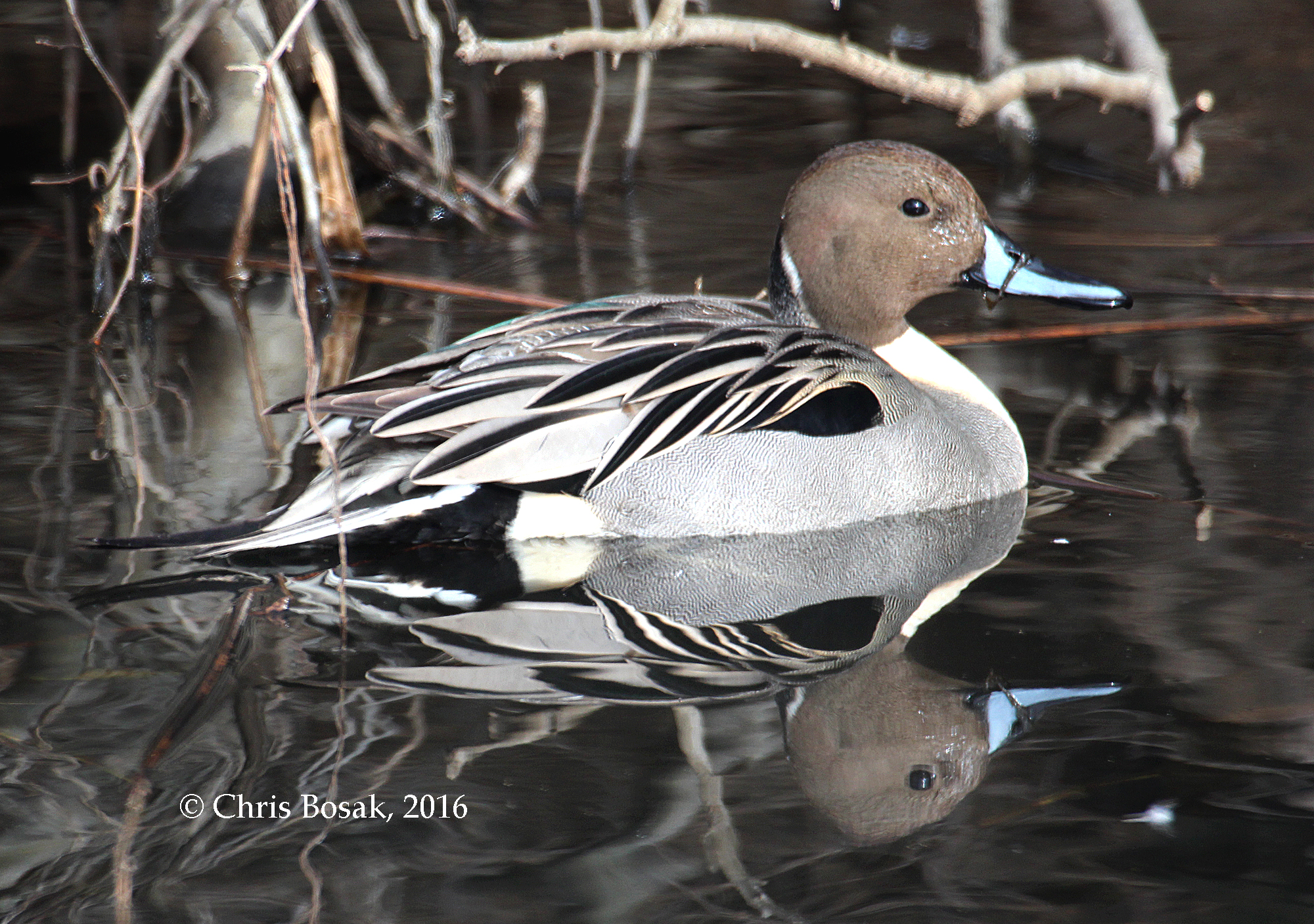
Photo by Chris Bosak A Northern Pintail swims in a small pond in Danbury, Conn., Jan. 2016.

Photo by Chris Bosak
A Northern Pintail swims in a small pond in Danbury, Conn., Jan. 2016.

Here are some more shots of the cooperative Northern Pintail I spotted in a small roadside pond in Danbury, Conn., the other week. It’s a beautiful bird and this was the first time I’ve ever seen one so close. Enjoy the photos and thanks for your support of http://www.birdsofnewengland.com

Continue reading

Pintail drake close up. The latest For the Birds column

Photo by Chris Bosak A Northern Pintail drake in a pond in Danbury, Conn., Jan. 2016.

Photo by Chris Bosak
A Northern Pintail drake in a pond in Danbury, Conn., Jan. 2016.

Here’s my latest For the Birds Column about a Northern Pintail drake I saw last week. Exciting sighting!

These are the moments nature photographers hope for. Every once in a great while you come across a bird you really want to photograph and the subject is extraordinarily brave, cooperative and within reach of a zoom lens.

Sometimes you even have your camera handy when those moments come around.

Such was the case last weekend when I drove past a pond in Danbury. The pond was small and nearly butted up against the road. I glanced over at the pond, as I always do, and this time saw a most welcomed visitor among the usual Mallards. A lone Northern Pintail drake swam among the greenheads, appearing indifferent to the cars driving past on the fairly busy road.

I found the nearest safe place to turn around. I drove past the pond again, this time on the opposite side of the road, and confirmed my initial identification. I turned around yet again and pulled onto the shoulder as far as I could next to the pond.

The Mallards — two males and two females — and the pintail all stayed put and ignored me. I already had the passenger’s side window down and the radio turned off.

Actually having my trusty camera with me, I go that out and started photographing the duck.

The ducks went about their day and, despite …

Read the rest here.

More “junco in the snow” photos

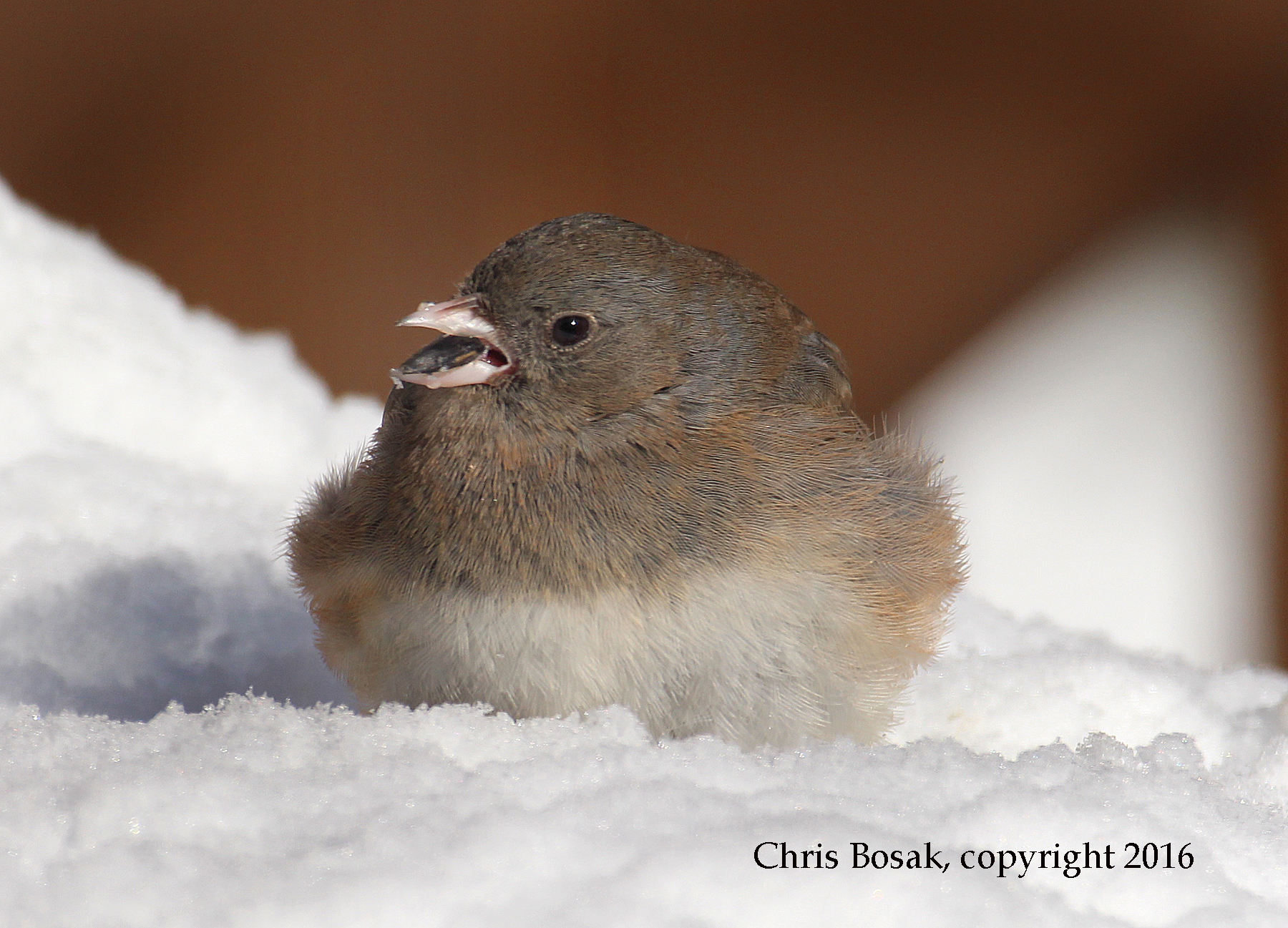
Photo by Chris Bosak A Dark-eyed Junco eats a sunflower seedsthe day following a snow storm in New England, Jan. 2016.

Photo by Chris Bosak
A Dark-eyed Junco eats a sunflower seedsthe day following a snow storm in New England, Jan. 2016.

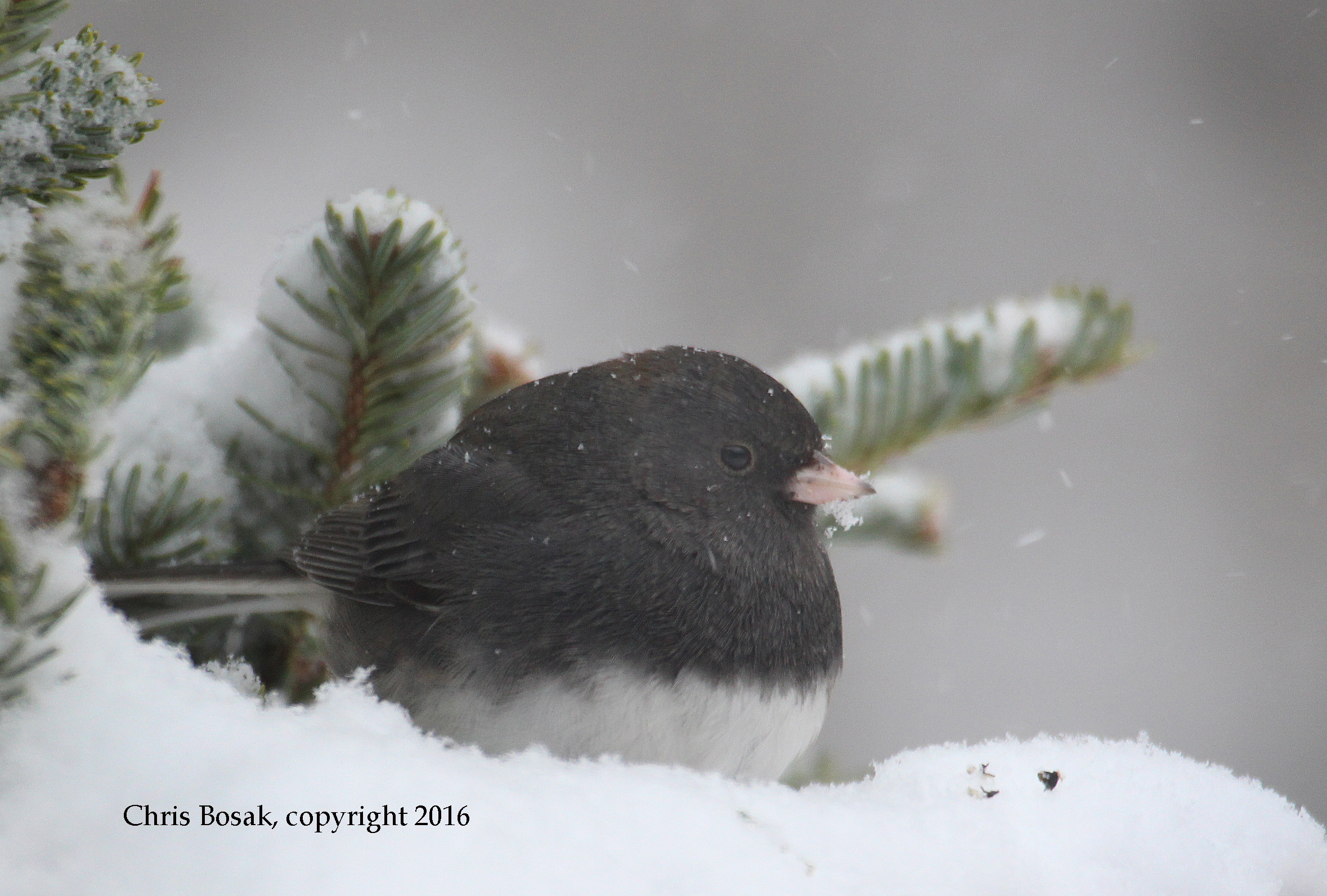
My last posting on this site highlighted the plumage of a Dark-eyed Junco. But why stop at just one photo of a junco in the snow? I can’t think of a reason, so here’s a few more. Juncos mainly show up at our feeders in the winter, so we may as well enjoy these small sparrows while we can. The ones with darker plumage are adult males; the ones with lighter plumage are females or first-year males.

Photo by Chris Bosak A Dark-eyed Junco looks for seeds during a snow storm in New England, Jan. 2016.

Photo by Chris Bosak
A Dark-eyed Junco looks for seeds during a snow storm in New England, Jan. 2016.

Photo by Chris Bosak A Dark-eyed Junco looks for seeds the day following a snow storm in New England, Jan. 2016.

Photo by Chris Bosak
A Dark-eyed Junco looks for seeds the day following a snow storm in New England, Jan. 2016.

Photo by Chris Bosak A Dark-eyed Junco looks for seeds the day following a snow storm in New England, Jan. 2016.

Photo by Chris Bosak
A Dark-eyed Junco looks for seeds the day following a snow storm in New England, Jan. 2016.

Feather layers on a Dark-eyed Junco

Photo by Chris Bosak A Dark-eyed Junco eats sunflowers seeds the day after a snowstorm in Danbury, Conn., Jan. 2016.

Photo by Chris Bosak
A Dark-eyed Junco eats sunflowers seeds the day after a snowstorm in Danbury, Conn., Jan. 2016.

Check out the amazing feathers on this Dark-eyed Junco, seen here eating sunflower seeds the day after last week’s snowstorm.

The full story on the Painted Bunting

Here’s an article I wrote for The Hour newspaper about the Painted Bunting in Stamford, Conn.

Photo by Chris Bosak A Painted Bunting visits a yard in Stamford, Conn., on Jan. 22, 2016.

Photo by Chris Bosak
A Painted Bunting visits a yard in Stamford, Conn., on Jan. 22, 2016.

STAMFORD — For the second consecutive year, one of America’s most colorful birds has flown off course and ended up in a yard in Stamford.

A male Painted Bunting, a five-inch songbird resplendent in bright blue, green, yellow and red plumage, has been seen daily since Jan. 21 in the Cove Road yard of David and Ginger Winston.

It is presumed to be the same bird that visited the Winstons’ yard last year from March to April. It is not, however, likely the same Painted Bunting that garnered national media attention in November by visiting Prospect Park in New York City.

“You never get tired of looking at it,” Stefan Martin, a birdwatcher from Stamford said Monday while looking for the bird.

David Winston, a birdwatcher and nature photographer, said about 80 people have visited in the last week in hopes of getting a look at the vibrantly colored bird. Last year, 330 people visited to see the bird. “People came from Maine, New Hampshire, Verm …

Click here for the rest of the story


Merganser Lake: Some snowy bird photos

carolina wren snow

Photo by Chris Bosak A Carolina Wren visits a feeder during a snowstorm in Danbury, Conn., Jan. 23, 2016.

You didn’t think the first snowstorm in New England would pass without me posting some photos of birds in the snow, did you?

Here’s a few to get started. I’ll post more later.

Continue reading

Painted Bunting returns to SW Connecticut

painted bunting 1

Photo by Chris Bosak A Painted Bunting visits a yard in Stamford, Conn., on Jan. 22, 2016.

No, I’m not on vacation in Florida. Why would I leave New England in the winter? I love New England winters. (I say that now, the day before a big storm is supposed to hit.)

No, these Painted Bunting photos were taken in Stamford, Connecticut. It’s a rare sight to see a Painted Bunting (or anything this colorful) in New England, but this guy is back for his second New England winter. In fact, he is in the same location as he was last winter … in the yard of a birder/nature photographer, ironically enough.

Luckily he is in the yard of David Winston, one of the nicer guys you’ll ever meet. He doesn’t mind (in fact he welcomes) the birders who come see this incredible bird. David and Ginger also hosted this guy last winter, from March to April. Well, that’s really spring, you may say to yourself. Not last year, it wasn’t. Last March and early April were definitely winter.

It was surprising enough that this gaudy bird showed up in Stamford last year, but a repeat performance? It seems this guy is just wired differently than most Painted Buntings. How will this guy fare in the storm that is scheduled to hit New England sometime on Saturday (Jan. 23, 2016) morning? Who knows for sure, but probably (hopefully) OK as he survived much colder temperatures last w Continue reading