Unknown's avatar

About Chris Bosak

Bird columnist and nature photographer based in New England.

For the Birds: A wasp nest no longer

Photo by Chris Bosak – A female downy woodpecker tears apart a wasp nest.

As birdwatchers, we are trained to look for things out of the ordinary. That blot in a tree or movement in the brush just may be a bird. Often the thing that grabs your attention is nothing but a discarded balloon or wind-swept plastic bag, but very often it is, indeed, a bird.

Autumn can be tricky with falling leaves capturing our attention and tricking us into thinking birds are near. The other day, a different sort of falling object caught my attention. While it wasn’t a bird, it did lead me to an interesting bird sighting.

I was walking on a trail when something about the size of a leaf floated down in front of me. It somewhat resembled a leaf but was shaped and colored differently. It even floated down from the trees with a different kind of motion.

Continue reading

Fall in New England

Photo by Chris Bosak

A black-capped chickadee perches in a burning bush in New England, November 2024.

You can’t beat New England for scenes like this one.

For the Birds: Spooky bird tales for Halloween

Photo by Chris Bosak Black vultures perch on a branch in New England, Dec. 2023.

In the spirit of Halloween and everything pumpkin spice season, here is a column about the scary side of birds.

I’m not going to sensationalize or fear monger, and I’ll try not to be too corny either, but there are times when birds can be a little unnerving. This being a column based in New England, I’ll also try to keep it to the birds of this region, so there will be no horror stories of shoebills or cassowaries. (Those two species invariably come up when you do an Internet search for “scary birds.”)

One of the more unnerving experiences a birder in New England can experience is being hissed at and chased by a Canada goose. From a distance Canada geese look peaceful enough and even quite beautiful and regal depending on the habitat. Get too close to one, however, and they are large, formidable birds that can be quite fearless and intimidating.

Continue reading

For the Birds: Thrasher makes surprise feeder visit

Phioto by Chris Bosak – A brown thrasher visits a suet feeder in New England, fall 2024.

There are trade-offs with everything in life.

When I lived in my house in the woods years ago, the action at the birdfeeder was nonstop with great birds. I never saw a single house sparrow, starling, or pigeon the entire time I lived there.

On the other hand, it took 20 minutes to drive to the nearest grocery store or restaurant. Nothing except a few trails through the woods, a small lake and a pond were within walking distance. That suited me just fine when I wanted to look for birds or simply take a nice peaceful walk, which was often. It didn’t do me much good when I needed food, however.

Now that I live close to a downtown area of a small town, I can walk to the grocery store, restaurants, and just about anything else I need. The flip side, of course, is that the action at the birdfeeder is not as robust. It is not void of birds by any stretch, but house sparrows and starlings are the most frequent visitors, sometimes converging on the feeders in great numbers.

Continue reading

For the Birds: Look carefully in the fall

black-throated blue female

Last fall, I watched and attempted in vain to photograph several little birds fitting among low-lying bushes at a particular spot in the woods.

Eventually, I was able to get a good look at one and identify them as golden-crowned kinglets. Fitful for kinglets, they moved constantly. They sat still for only a second or two as they moved from one branch to the next. Most of the time, they remained concealed by leaves.

The other day, I walked by that same exact patch in the woods and noticed two small birds flitting among the bushes. My instinct was to move on without getting a better look, as I assumed they were golden-crowned kinglets that wouldn’t let me photograph them anyway.

Continue reading

More scarlet tanager eating berries photos

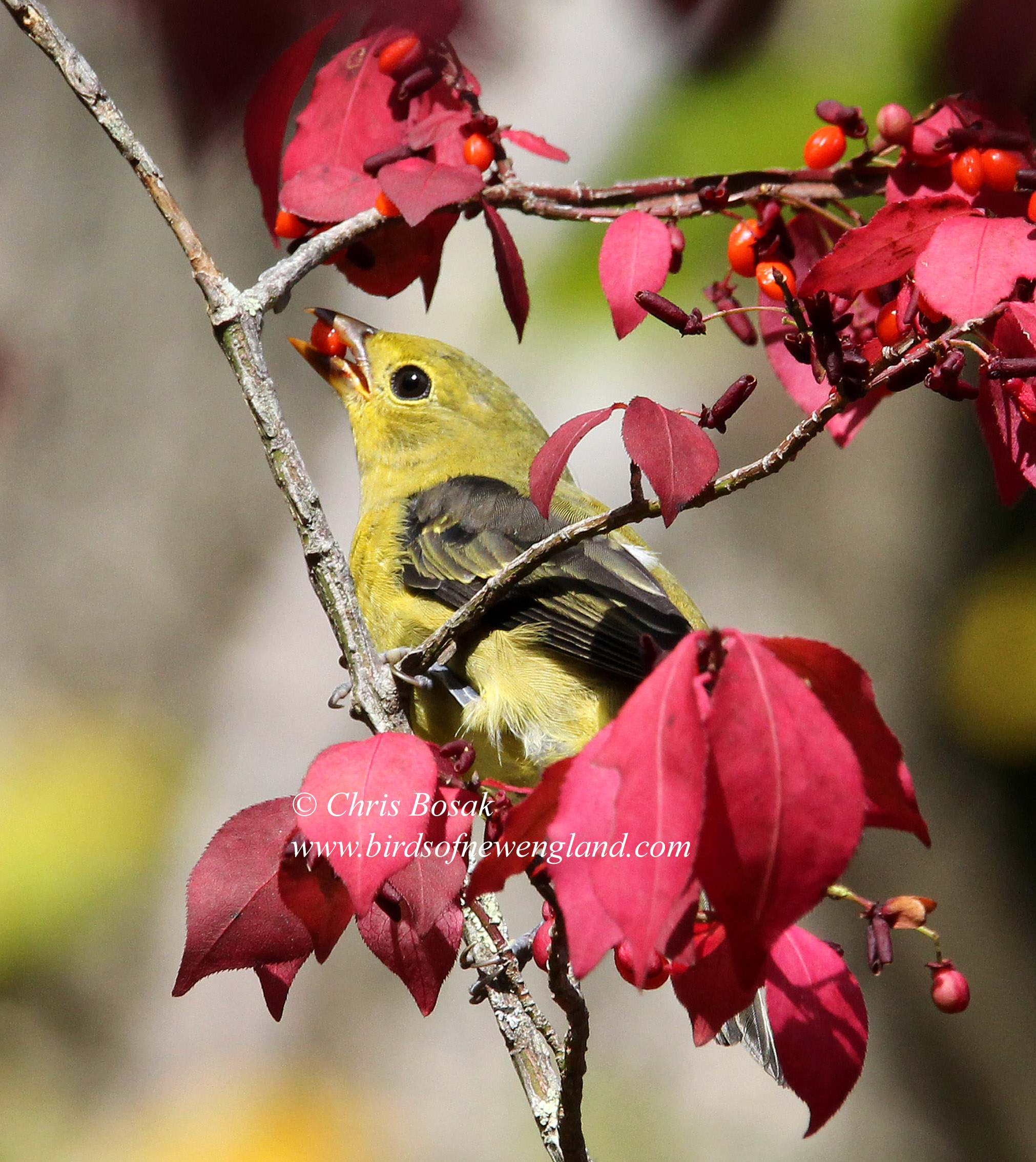
Photo by Chris Bosak A male scarlet tanager in fall plumage eats berries in New England, fall 2024.

Here are a few more photos to accompany my latest bird column. Here’s the column in case you missed it.

Thank you for supporting http://www.birdsofnewengland.com

Photo by Chris Bosak
A male scarlet tanager in fall plumage eats berries in New England, fall 2024.
Continue reading

For the Birds: Berries and scarlet tanagers

Photo by Chris Bosak A male scarlet tanager in fall plumage eats berries from a burning bush in New England, fall 2024.

One of my favorite parts of birdwatching in the fall is trying to find birds eating berries. Many New England plants, bushes and trees bear fruit in the fall, and birds fuel up on this vital food source.

The only skill involved in finding birds eating berries is either knowing where the berries are and keeping an eye on that area or getting out there and discovering the plants with berries while exploring. The rest is timing — in other words, luck. There’s no telling exactly when a bird will land on a bush and start eating the berries. You just have to be looking at the right time.

Continue reading

For the Birds: Perspective matters in birding

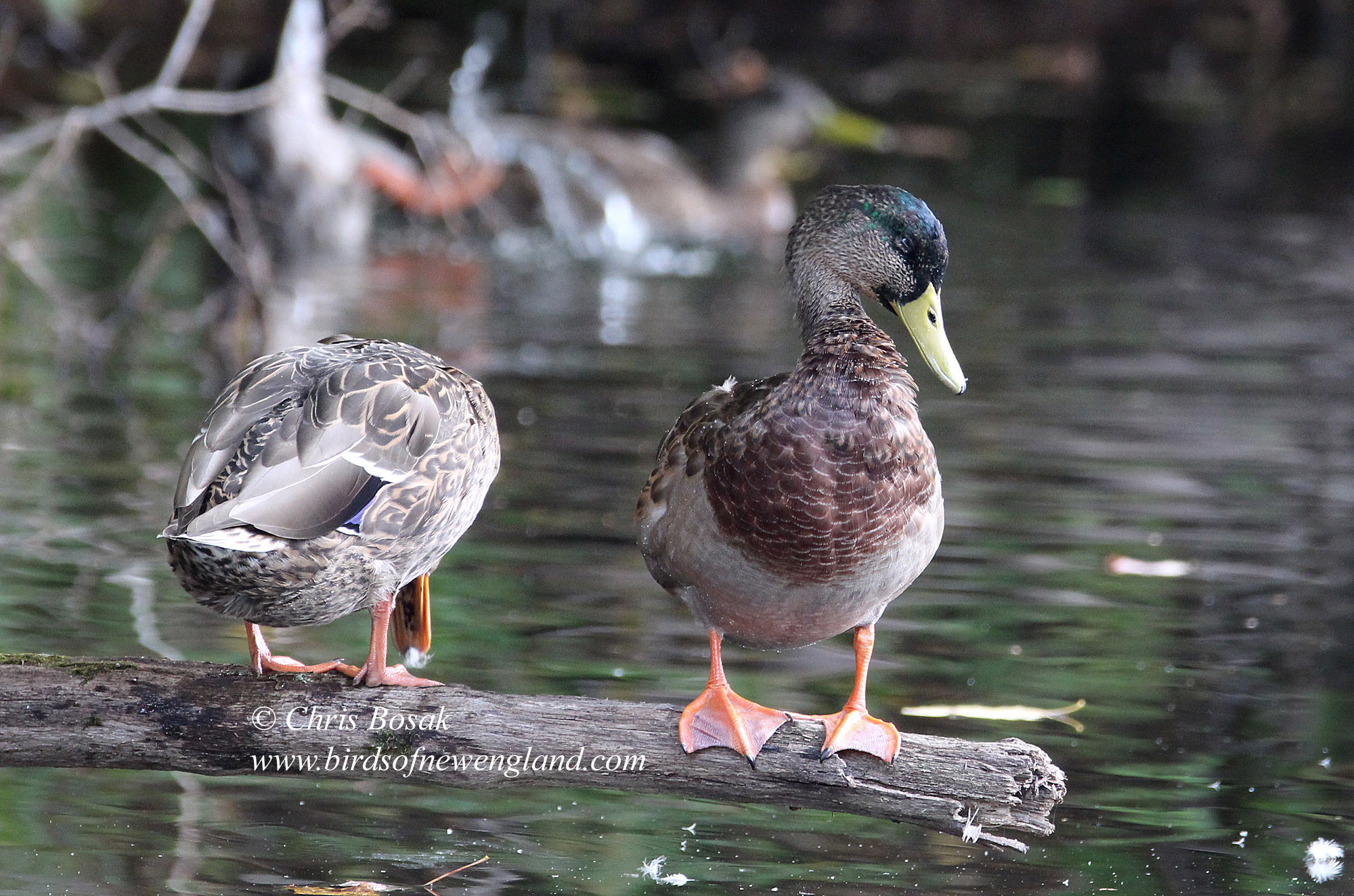
Photo by Chris Bosak – Mallards sit on a log in New England, fall 2024. The mallard on the right is a young male.

Some bird sightings are better than others.

Even if you love all birds and nature, as I do and imagine everyone who reads this column does, you still have your favorites. I don’t know many people who enjoy a house sparrow sighting as much as a bald eagle sighting.

Even a particular bird can be more exciting to see depending on the circumstances. I was struck by this realization during a recent birdwalk.

I was doing an eBird list and wanted to be as thorough as possible, so my senses were carefully attuned to my surroundings. Still, the birding was fairly slow, and my species count was well below what I was expecting. I approached the large pond, or perhaps it’s a small lake, with anticipation as I’ve seen cormorants, wood ducks, black ducks, osprey and a variety of waders there on previous walks.

Continue reading

For the Birds: Goldfinch steal late summer spotlight

Photo by Chris Bosak An American goldfinch perches on a thistle plant, summer 2024.

You have to love goldfinch season.

American goldfinches are year-round residents of New England, of course, but they are most visible and vocal during their breeding season. For goldfinches, breeding season is August and into September, much later than most New England songbirds. In fact, most songbirds are done with their breeding season, even those that have multiple broods, by the time the goldfinches even start.

Thistle is an important component of the goldfinch breeding season as it provides both food and nesting material for the birds. The pink or purple blooms of thistle are also popular among butterflies and other insects. The rest of the plant looks menacing with its thorny stalk and leaves. It can also grow to intimidating heights for a “weed.” I put weeds in quotes because that is what many people consider thistle to be. It is actually an extremely important native plant for New England birds and insects. Despite its prickly appearance, thistle is also edible for humans, although I have never tried it and cannot vouch for its flavor.

Continue reading

For the Birds: Phoebes shine in the spring and fall

Photo by Chris Bosak An Eastern Phoebe perches on a branch in Selleck's Woods in Darien, Conn., in late March 2015.

They aren’t the most exciting birds on the planet, or even in New England for that matter. Eastern phoebes, however, are a bright spot in the region’s birdscape.


They don’t have flashy colors, impressive size or beautiful songs — in fact, just the opposite on all counts — but there is a lot to appreciate about eastern phoebes. My favorite thing about eastern phoebes is that they are one of the first migrant birds to return to New England in the spring. While most of the colorful songbirds return in late April or early May, phoebes come back to the region in mid- to late-March.   

Their early spring arrival comes just in time for many birdwatchers. About the time we are going stir crazy and desperate for new birds to arrive following many months of winter, the phoebes return and lift our spirits. Typically, I hear the first phoebe before I see it, and it takes a few seconds for the song to sink in and register. Then, when it hits me, I look frantically for the bird and, upon laying eyes on it, get a jolt of hope that spring is indeed coming. 

Continue reading