Unknown's avatar

About Chris Bosak

Bird columnist and nature photographer based in New England.

For the Birds: Hummingbird feeder timing

Here is the latest For the Birds article. It was published a few weeks ago in newspapers, but is still relevant as September comes to an end.
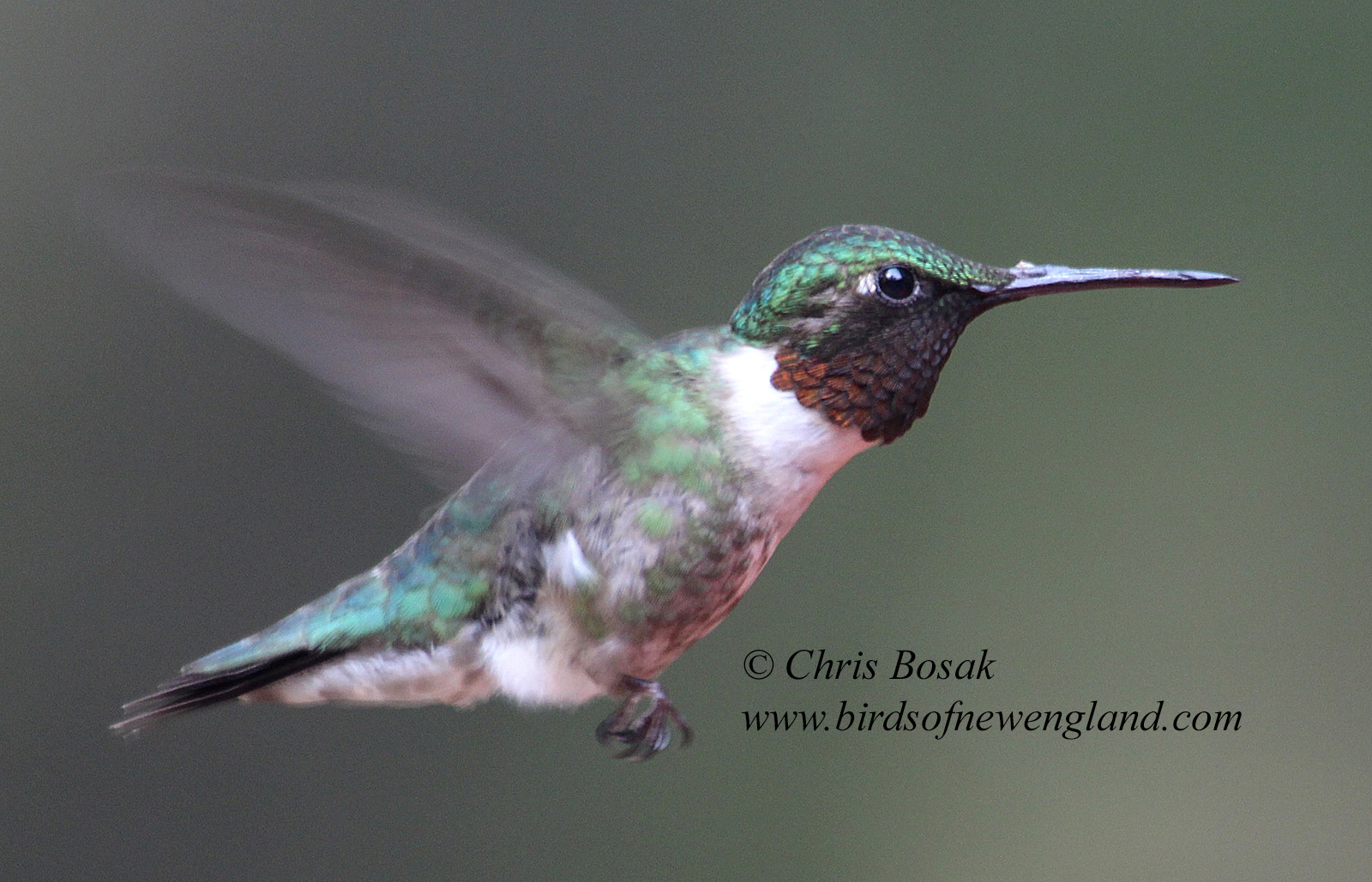
Photo by Chris Bosak Hummingbirds are migrating now and will be throughout the rest of the month.

When should I bring in my hummingbird feeders? It’s a common question and may be answered the same way as so many other questions may be answered: It depends.

The answer depends on your tolerance for changing the sugar water in the feeders and your patience for watching a feeder that may not receive any visitors. Hummingbirds started to migrate a few weeks ago and some have gone south already.

With migration under way, now is definitely not the time to bring the feeders in. Hummingbirds need to pretty much double their weight to make their arduous migration, particularly when they reach the Gulf of Mexico and fly the 500 miles without rest.

Sure, there are plenty of natural food sources for hummingbirds this time of year, but an easy meal at a feeder now and then gives the tiny birds a bit of a break. Patches of jewelweed are another favorite of hummingbirds and they are still blooming. Other than feeders, I think I’ve seen more hummingbirds at jewelweed (touch-me-not) patches than any other venue.

Continue reading
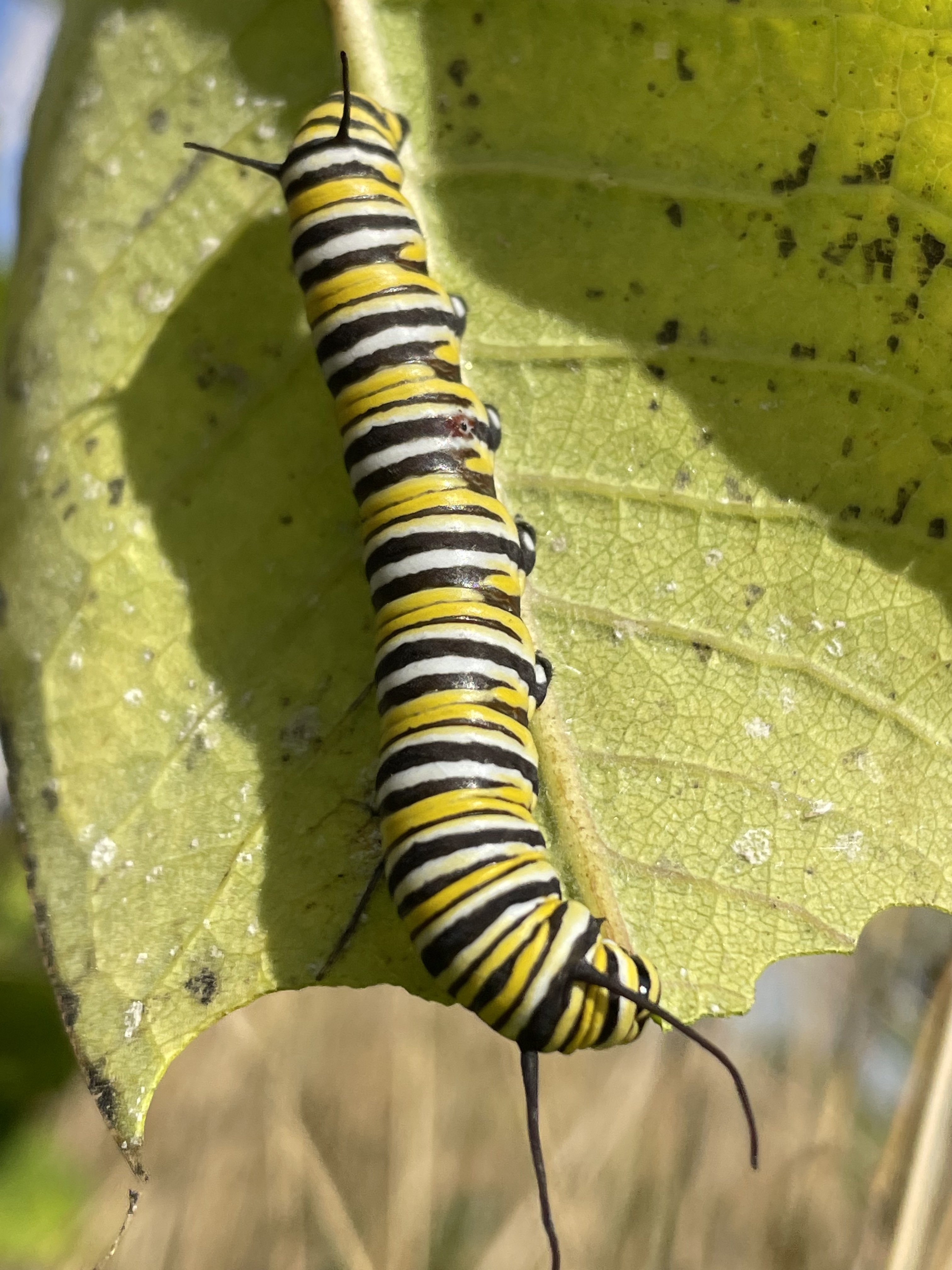
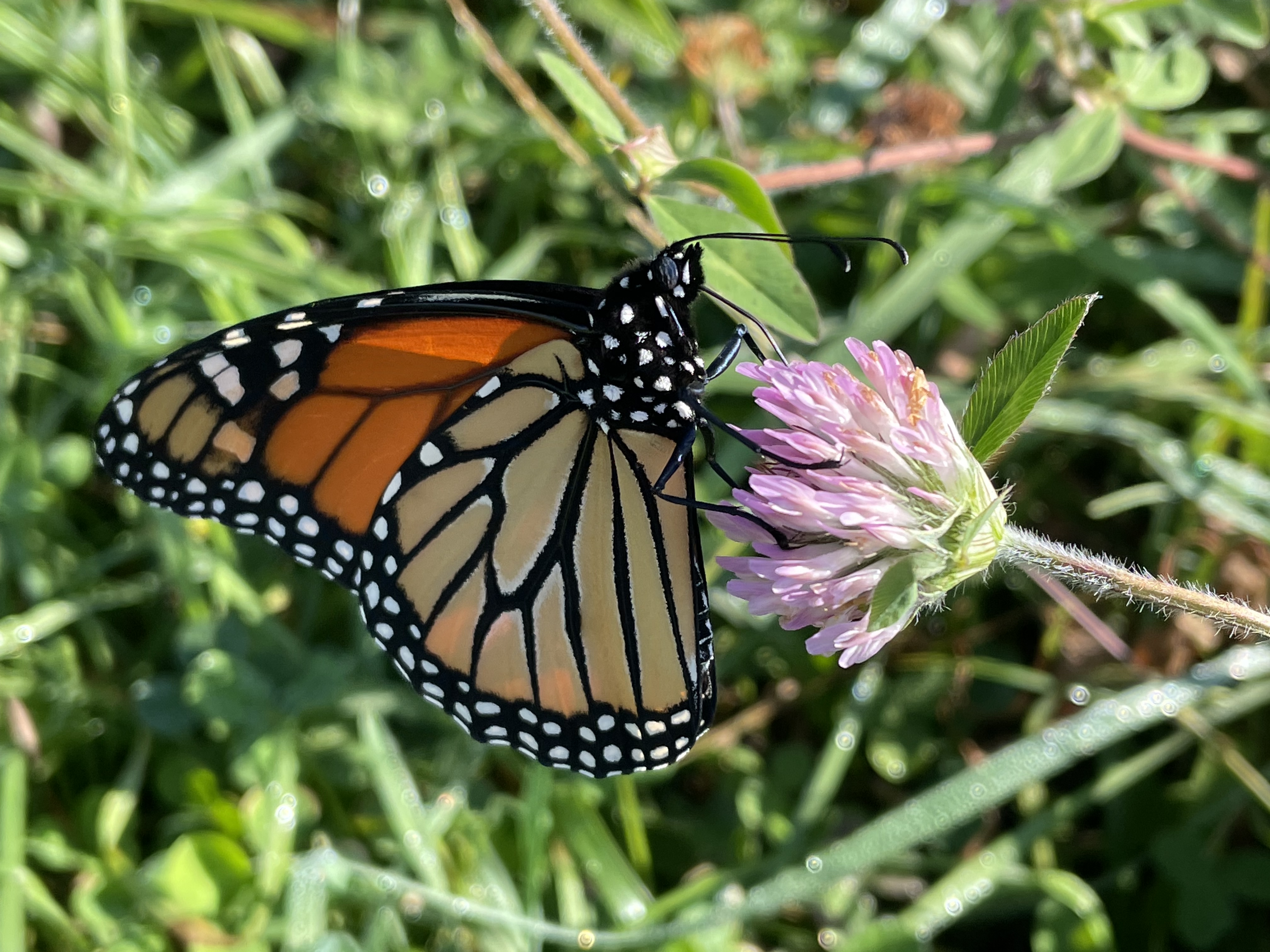
Future monarch (and a current one)

I always look at milkweed plants for monarch caterpillars. My success rate is about .001 percent, but today I got lucky and found one on a plant right next to the trail. Monarchs lay their eggs on the underside of milkweed leaves and the caterpillar eats the leaf when it hatches. Milkweed is toxic and the caterpillar becomes toxic to would-be predators.

There were a ton of monarchs flying around too, as seen below.

For the Birds: A dragonfly bonanza

Photo by Chris Bosak A green darner flies around a backyard in New England following a mosquito hatch in September 2021.

The sun was starting to set behind the marsh, casting a golden glow on the backyard.

In this magical light, we could see dragonflies by the dozens, perhaps hundreds, zipping around the yard. Looking closer, aided by the light, we could see hundreds, if not thousands, of mosquitoes, presenting themselves as tiny specks in the air. Looking even closer, we could see the dragonflies chase down and eat the mosquitoes. The mosquitoes didn’t stand a chance against these perfectly engineered predators.

I went out to try my luck at photographing a dragonfly in midair. It’s been an elusive shot in my catalog of nature photos. Even with the sheer numbers of dragonflies and the perfect evening sun at my back, the shot proved to be a challenge. I somewhat met the challenge, however. I wouldn’t say I nailed the shot as it’s not ideally composed, focused, exposed or any other type of technical photography term you can think of. But, for my purposes, it’s not bad. I’m not shooting for National Geographic or anything.

Continue reading

A few more yellowthroat photos

Photo by Chris Bosak A common yellowthroat perches on a branch in New England, July 2021.

Common yellowthroats are one of most familiar warblers we see in New England. While we are seeing many warblers pass through this time of year on their way south, yellowthroats remain one of the more common sightings. The male (pictured above) is easy to recognize with his black mask, but the female is a little more tricky, particularly in the fall when warblers are notoriously difficult to ID. Here are a few more shots to distinguish the female yellowthroat from other warblers passing through. Click here for a recent For the Birds column on yellowthroats.

Continue reading

For the Birds: An eagle on the edge

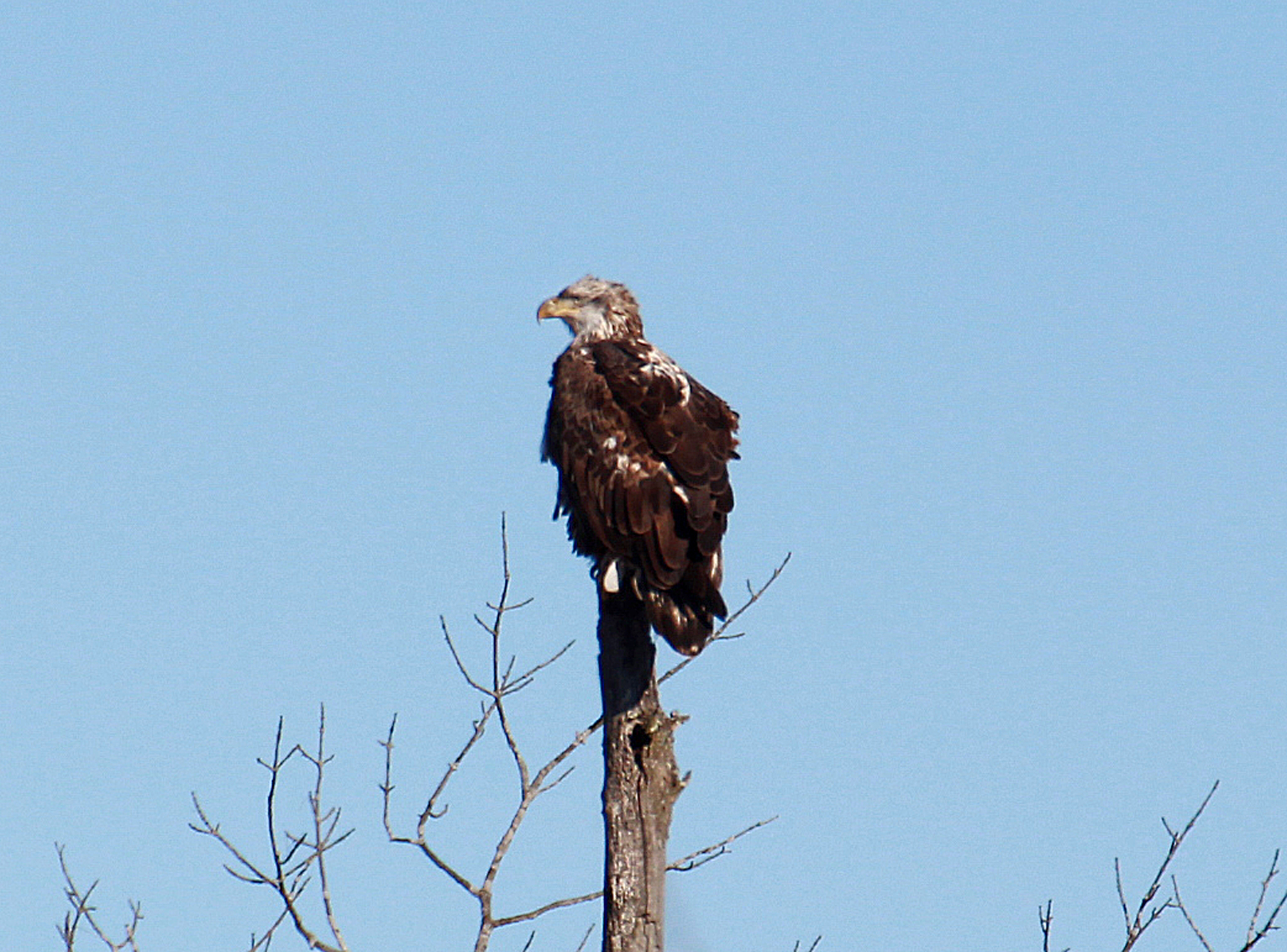
Photo by Chris Bosak A young bald eagle perches on a dead tree near Danbury Fair mall in Danbury, CT, March 2019.

It was an eagle. There was no doubt about that. I second-guessed myself only for a second because of where the sighting took place.

It was not on a remote lake in northern New England or on one of the islands in Long Island Sound. It was right along a highway.

We are all used to seeing hawks perched along the highway. In fact, when I drive to Pennsylvania a couple of times a year to visit family, I make it a point to count the number of red-tailed hawks I see perched in trees along Route 86. It’s usually between 10 and 15. Hey, it passes the time on a long drive.

I noticed from far away as I approached the scene that there was a bird perched in a tree overhanging a somewhat busy state highway. Even from a significant distance, I could tell it was not a hawk. The only question was whether it was an eagle or a vulture. It did not have the posture of a vulture, but rather the regal stance of an eagle.

Continue reading

For the Birds: Loving those berries

Photo by Chris Bosak A song sparrow eats berries at Dolce Center in Norwalk, Conn.

I had just discovered a new berry tree at work and thought to myself how great it would be to see the birds raid the tree when the berries ripened.

At the time, the majority of the berries were red with a few purple ones mixed in. It wouldn’t be long now, I figured, before they were all purple and the birds would be feasting on them.

About a week later, I went back to check out the tree and it was practically picked clean. Apparently, the berries ripened quicker than I thought they would, and the birds wasted no time in having their feast.

I missed the flurry of activity that had the tree stripped clean, but I did see a lone gray catbird fly in and out to grab a few of the remaining berries. At least I wasn’t completely shut out of the show.

Continue reading

For the Birds: The ‘forgotten’ birds

Photo by Chris Bosak A common yellowthroat perches on a branch in New England, July 2021.

Sometimes the residual birds get unduly forgotten when a bird walk features a highlight species. In other words, the other solid bird sightings get pushed to the back of the memory bank. Then, sometime after the excitement of the highlight species fades, be it hours, days or weeks, the other birds come back to you.

This happened to me the other week when a pair of male indigo buntings highlighted an evening walk. It had been a while since I had seen buntings, and I became singularly focused on them when recounting the walk.

As I looked through the photos of that walk, I was reminded of some of the other birds I had seen. Before I took untold numbers of photos of the bright blue indigo buntings, I had snapped a few photos of a common yellowthroat pair. I had completely forgotten about those birds until I started looking through the photos.

Continue reading

For the Birds: Indigo bunting brightens a summer evening

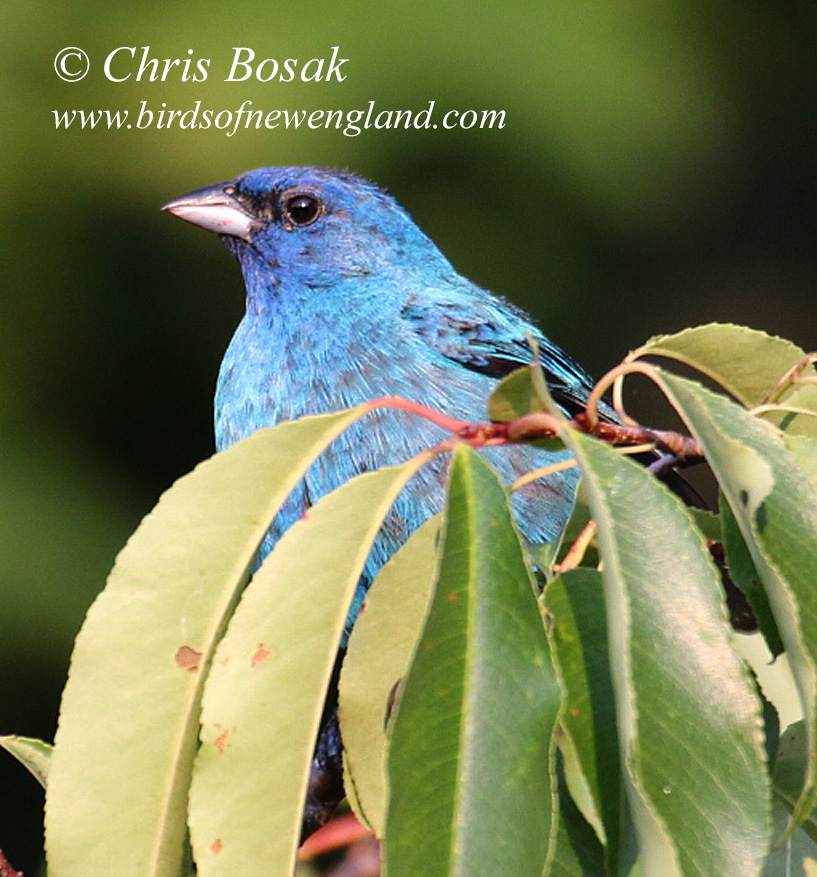
Photo by Chris Bosak An indigo bunting perches in a tree in New England, July 2021.

The song sounded familiar, but it had been months since I last heard it.

There is an indigo bunting around here somewhere I said to myself and instantly abandoned my plans for a long, strenuous walk. I knew I’d be at that spot for a while.

I couldn’t tell if the song was coming from the left or the right. It sounded like it was coming from both directions. I thought it was just because I’m getting old and my hearing was playing tricks on me.

But sure enough, there were two male indigo singing: one to the left of me and one to the right.

The bunting to the right was in the shade as the evening sun was dipping below the tree line. The bird to the left was illuminated in that magical evening light. I turned my focus to that bird.

Thankfully, the bird was fairly cooperative and even posed for a few photos in a berry tree. It didn’t eat the berries, but rather just used the tree’s branches for a vantage point.

It had been a few years since I was able to get photographs of an indigo bunting. Photographing any bird is enough to get my blood pumping, but a bird like an indigo bunting really gets the heart racing — especially when they are being cooperative.

Male indigo buntings are one of the more striking birds we see in New England, right up there with scarlet tanagers, Baltimore orioles and rose-breasted grosbeaks. Indigo buntings, like many songbirds, are sexually dimorphic, meaning the males and females look different. Also, like most birds that are dimorphic, the female is much duller than the male. The difference between the electric blue male and brown female is stark.

Continue reading

A few more bunting shots

Photo by Chris Bosak An indigo bunting perches in a tree in New England, July 2021.

The upcoming For the Birds column will provide more detail, but until then here are a few more shots of this beauty.

Photo by Chris Bosak An indigo bunting perches in a tree in New England, July 2021.