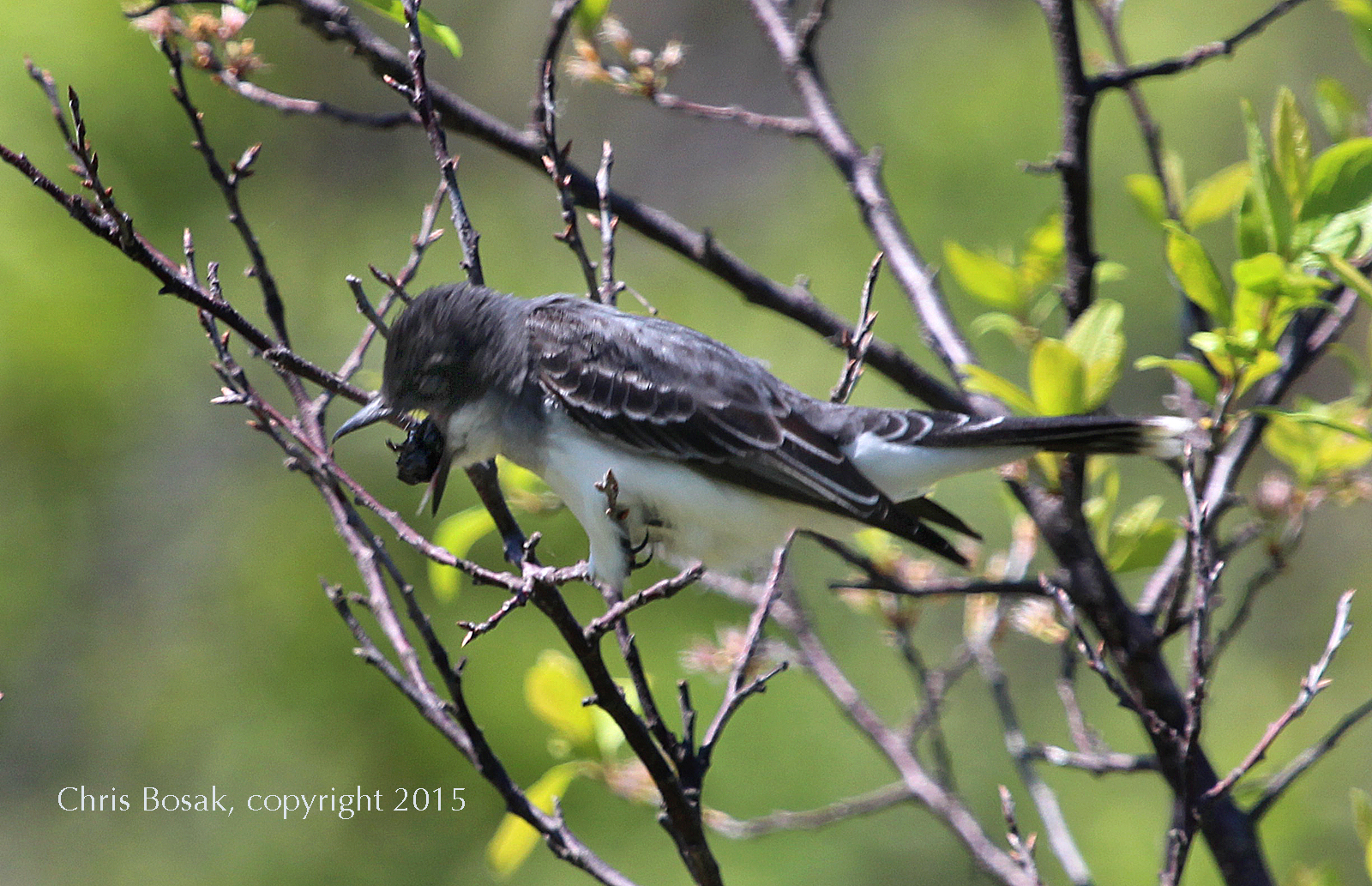
Eastern Kingbird expels a pellet (coughs up an exoskeleton ball)

Photo by Chris Bosak An Eastern Kingbird regurgitates a pellet in Stamford, Conn., May 2015.

Photo by Chris Bosak
An Eastern Kingbird regurgitates a pellet in Stamford, Conn., May 2015.

Ever eat an insect and notice how hard the outer shell, or exoskeleton, is?

I hope you answered no to that question. I certainly haven’t. But you can imagine that if you ever did bite into an insect it would be crunchy, kind of like eating a lobster without removing the meat from the shell first. You can also imagine that the exoskeleton would be difficult, if not impossible, to digest.

So how does that undigested shell come out? Everyone knows that owls regurgitate pellets of undigestible material, such as beaks, bones, feathers, claws and fur. Not as commonly known, however, is that many insectivores (things that eat insects) regurgitate pellets as well.

I was aware of this, but never witnessed it until the other day when I was watching an Eastern Kingbird. It was perched in a small tree at Continue reading

Two backyard favorites in one shot

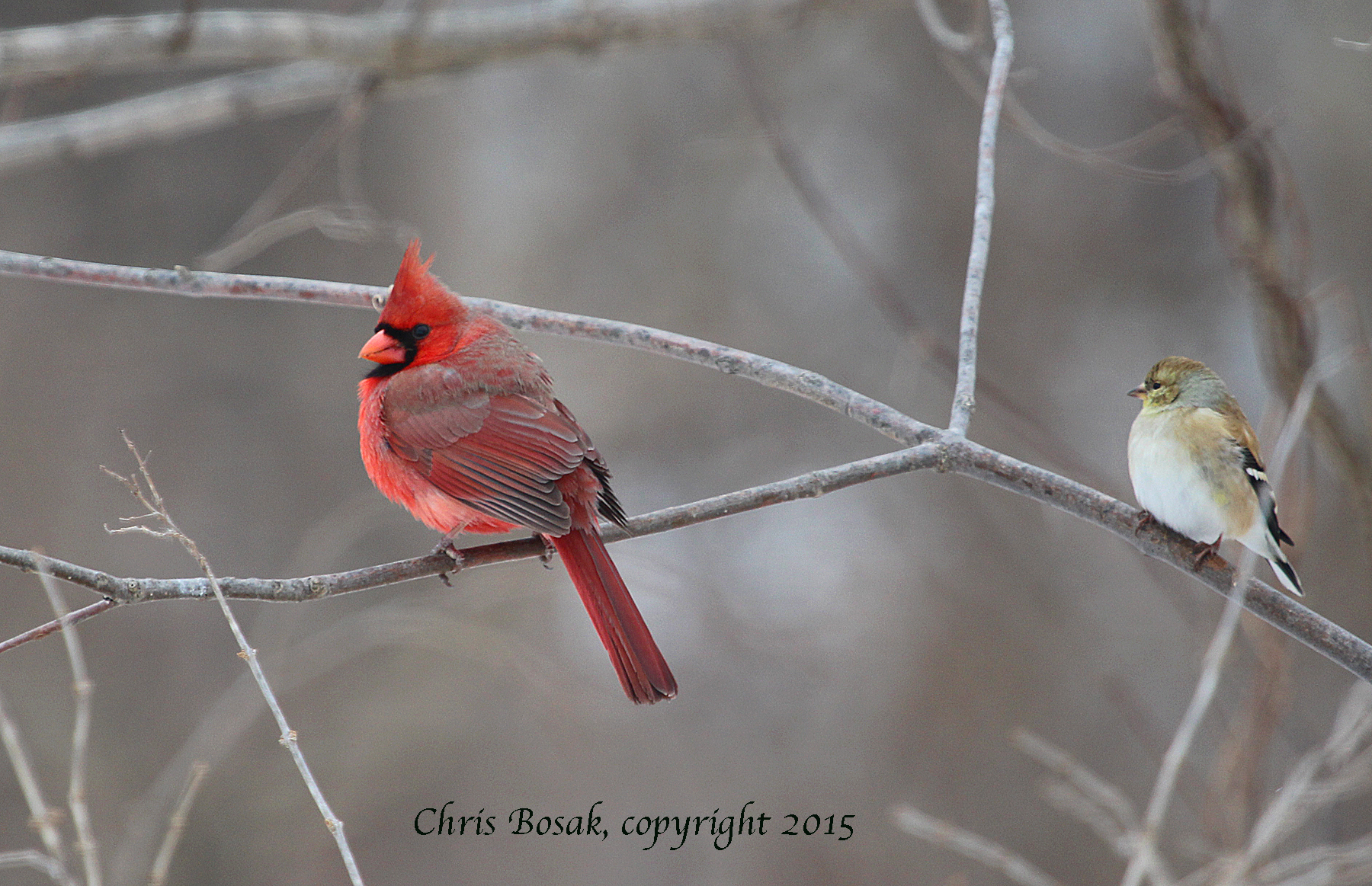
Photo by Chris Bosak A Northern Cardinal, left, and an American Goldfinch perch in a tree near a feeding station at Cove Island Wildlife Sanctuary in Stamford, Conn., in March 2015.

Photo by Chris Bosak
A Northern Cardinal, left, and an American Goldfinch perch in a tree near a feeding station at Cove Island Wildlife Sanctuary in Stamford, Conn., in March 2015.

You don’t always see cardinals and goldfinches perched near each other, but when you are watching a feeding station at which the birds are somewhat skittish, anything can happen. The usual assortment of birds were enjoying the feast at Cove Island Wildlife Sanctuary in Stamford, Conn., the other day, but other than occasionally being perched on the same feeder, the species generally kept away from each other.

However, the birds scattered every five minutes or so because of some unseen (by me anyway) force and sometimes the birds would find themselves perched next to an individual of another species.

I was focused on getting a photo of this cardinal, but noticed the goldfinch off to the right, so I decided to get them in the same frame. Why not?

A change of heart regarding House Finches

Photo by Chris Bosak A House Finch eats buds from a bush in Norwalk, Conn., Feb. 2015.

Photo by Chris Bosak
A House Finch eats buds from a bush in Norwalk, Conn., Feb. 2015.

I almost hate to admit it on this site, but I’ve never been a big fan of House Finches. Sure they are wild birds and look pretty with their reddish-pink feathers. But their eating habits at bird-feeding stations have long been a bone of contention with me. They perch on the feeder and gorge themselves for minutes on end. I prefer the grab-a-seed-and-go method employed by backyard favorites such as chickadees, titmice, and nuthatches. Come back as often as you need, as far as I’m concerned, but grab and go. Leave space and time for others.

But not House Finches.They fly in, perch, and sit there. Seed after seed goes into their belly and there they sit. Meanwhile, the chickadees and nuthatches sit on nearby branches waiting for a spot to open. House Finches aren’t even Continue reading

More Carolina Wrens (sorry, I can’t help myself)


Photo by Chris Bosak A Carolina Wren searches on the snow-covered ground for food in New England, Feb. 2015.

Photo by Chris Bosak
A Carolina Wren searches on the snow-covered ground for food in New England, Feb. 2015.

I know I just featured Carolina Wrens in a recent post, but I couldn’t resist posting a few more photos. I’ve seen these beautiful wrens on suet feeders and platform feeders, but I hadn’t seen them looking for food under feeding stations before. Severe weather can cause Continue reading

Quick quiz: Who’s got the seed?

A quick quiz for you as New England braces for another potential snowstorm coming up in the next few days.

There’s not much of the bird showing, but the bill may be a big enough clue. So what do you think? (Share this with your friends, too. See what they think?)

Something to do on a snowy day: Learn the difference between hairy and downy woodpeckers

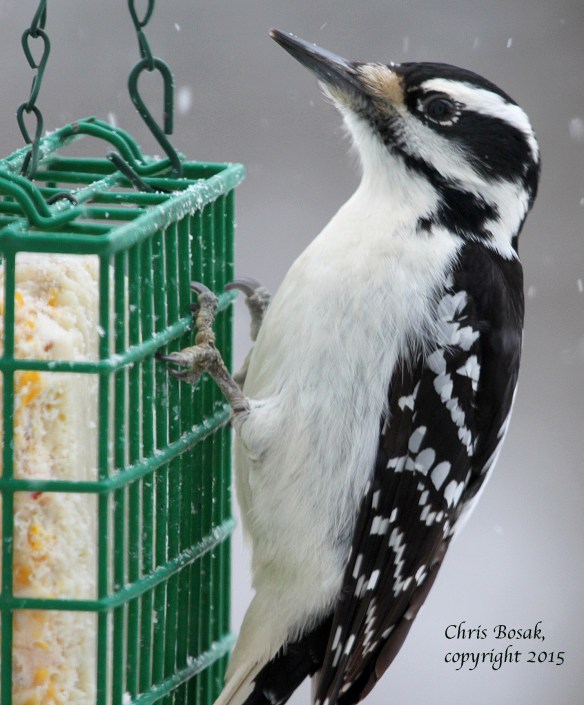
Photo by Chris Bosak A female Hairy Woodpecker clings to a suet feeder as snow falls in Jan. 2015.

Photo by Chris Bosak
A female Hairy Woodpecker clings to a suet feeder as snow falls in Jan. 2015.

If you live in New England you’re about to buried in snow so why not studies these photos and learn the differences between the hairy and downy woodpeckers. Beginning birders often confuse the two species. I know it took me a long time to be able to tell the two woodpecker species apart with confidence. Hopefully this posting will help some of you distinguish between the two.

The two species are hard to tell apart because they basically look exactly the same, hence the confusion. The major difference is the size. The downy is a dainty six inches, while the hairy is a beefy nine inches. That’s enough of a difference that you’d think it would be easy to tell one from the other. But if you’re new to this birding thing and don’t have a point of reference to judge size, it’s tough. I know, I’ve been there. Plus, like any birds, there can be size variations within a particular species. There can be smallish Hairy Woodpeckers and largish Downy Woodpeckers. So size can or can’t be a good way to tell them apart.

For me, the biggest difference is the size of the bill. In the most simple terms, downys have small bills and hairys have big bills. Beyond that, the bill of the downy just looks small and rather fragile. It isn’t fragile, of course, it’s quite strong. It just looks small and fragile. The bill of the Hairy Woodpecker, on the other hand, looks more sturdy and substantial. If one or the other lands on your feeder, check out the bill — dainty downy or hardy hairy.

Below is a side-by-side comparison. (Males of both species have a red patch on their heads. Females do not have have the red patch. Both birds below are females.)

Photos by Chris Bosak Side-by-side comparison of Hairy and Downy Woodpeckers' bills. Female Hairy on the left, female downy on the right.

Photos by Chris Bosak
Side-by-side comparison of Hairy and Downy Woodpeckers’ bills. Female Hairy on the left, female downy on the right.
A couple winter birds

Photo by Chris Bosak A female Downy Woodpecker perches next to a birdfeeder in New England, Jan. 2015.

Photo by Chris Bosak
A female Downy Woodpecker perches next to a birdfeeder in New England, Jan. 2015.

Yesterday (Saturday) coastal southern New England had its first significant snow of the year. And even so, it wasn’t that much of an event as we woke up to about four inches of snow and nothing else fell during the day (except some light rain off and on). But it was nice to see snow finally (I’m sure not everyone shares that opinion) and, for me, that always means checking out the feeding stations for photos opps.

I didn’t do so well in that department as the birds were surprisingly somewhat scarce. White-throated Sparrows were the most plentiful species, with 10 to 12 under the feeders at all times. A Downy Woodpecker showed up frequently, too. There were infrequent visits from cardinals, juncos and titmice. That’s about it. The Carolina Wren Continue reading

Carolina Wrens come a’singing — even in winter

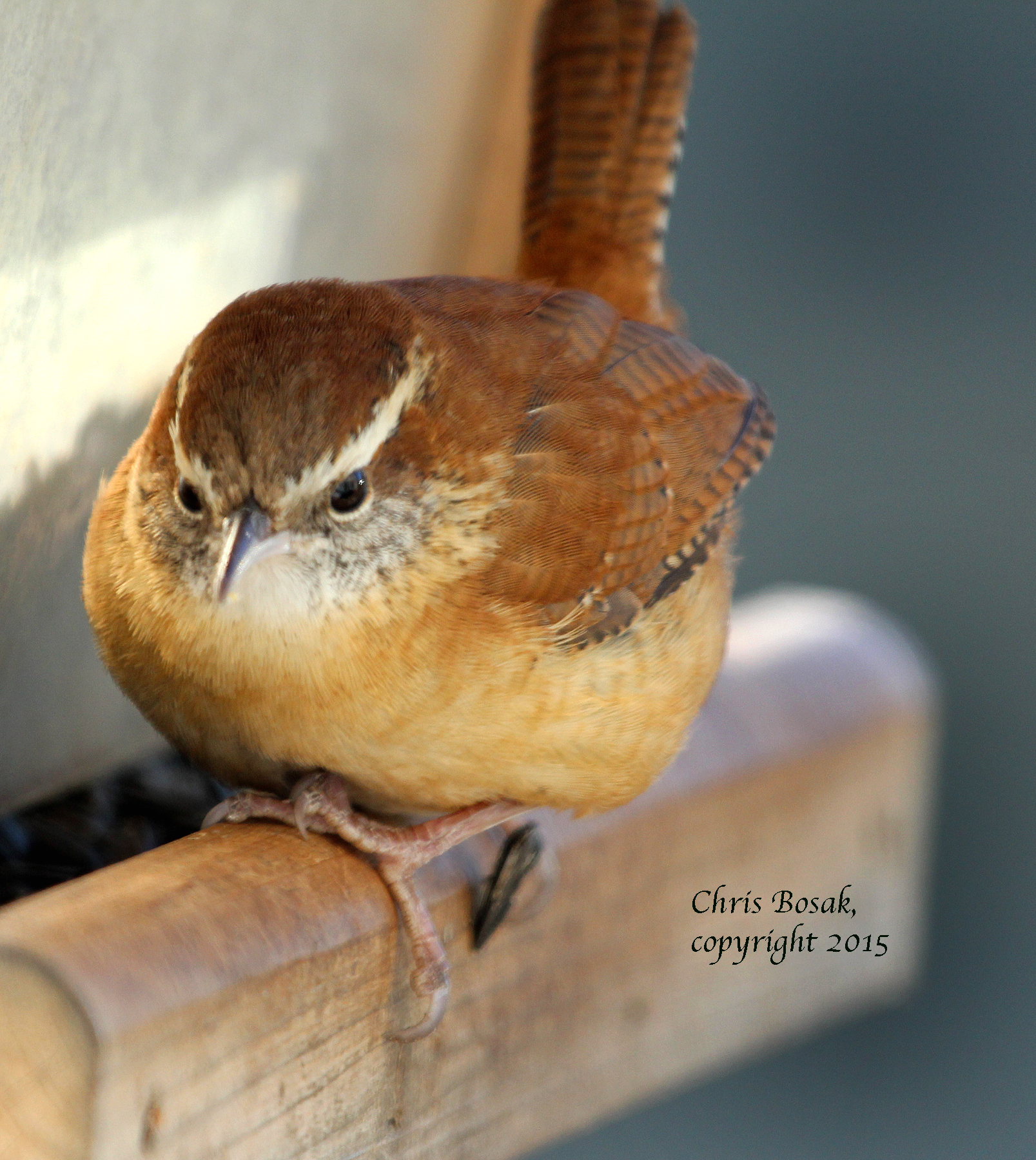
Photo by Chris Bosak A Carolina Wren perches on a feeder in New England in January 2015.

Photo by Chris Bosak
A Carolina Wren perches on a feeder in New England in January 2015.

I was sitting in my bedroom doing some work on the computer when I heard a familiar song behind me. It wasn’t coming from the clock radio. It wasn’t even that type of song. It was a bird song, of course, and it was being belted out richly by a Carolina Wren.

“Tea-kettle, tea-kettle, tea-kettle!” Loud and strong.

It was nice to hear the song. It’s been a long time since we’ve heard a lot of birdsong in New England. I’ve heard plenty of bird calls — non-melodic chips often coming from cardinals and White-throated Sparrows — but not a lot of songs. But this Carolina Wren was in full voice. Why? I’m not exactly sure. I’ve heard Carolina Wrens sing in the winter before, plenty of times. My guess is that it’s territorial posturing. That’s part of why birds sing in the spring, mostly over breeding territories. I think this wren was protecting his feeding station.

(Story continues below, with more photos, too.)

Continue reading

Clearing out my 2014 photos, take 7: Northern Cardinal

Photo by Chris Bosak A Northern Cardinal perches on a branch in New England in spring 2014.

Photo by Chris Bosak
A Northern Cardinal perches on a branch in New England in spring 2014.

Here’s my next photo in the series of 2014 photos that I never got around to looking at and posting.

Everybody loves Northern Cardinals. I took this shot in 2014, but to be perfectly honest, I don’t really remember the details. I found it in a random folder and only sort of remembered even taking the photo. Some days of shooting are like that: The action is so fast it’s hard to keep track of what you’re shooting. Other days, of course, not so much.

I believe I took this shot at Cove Island Wildlife Sanctuary, but it was definitely in 2014. Trust me on that one.

Eastern Towhee under feeder, nice start to 2015

Photo by Chris Bosak An Eastern Towhee searches a garden for food in Jan. 2015.

Photo by Chris Bosak
An Eastern Towhee searches a garden for food in Jan. 2015.

This weekend I was looking at the regular visitors to my birdfeeders, which in my case include Tufted Titmice, Black-capped Chickadee, Downy Woodpecker, Hairy Woodpecker and White-throated Sparrow (at least this time of year). Then I noticed another bird on the ground under the feeder: a male Eastern Towhee. Towhees are not typical feeder birds and this bird wasn’t necessarily around the feeder looking for sunflower seeds. It scratched under leaves and sticks in the garden for other seeds and any insects that may still be around. Towhees also eat berries during the winter.

Most towhees have flown south by now, but a few are still around trying to stick out the New England winter. I remember seeing several last winter, too.

I’ve been seeing more and more towhees over the last few years. Hopefully that means they are doing well overall as a species.

An Eastern Towhee in the garden in January: Not a bad way to start 2015.

Photo by Chris Bosak An Eastern Towhee searches a garden for food in Jan. 2015.

Photo by Chris Bosak
An Eastern Towhee searches a garden for food in Jan. 2015.