Photo by Chris Bosak
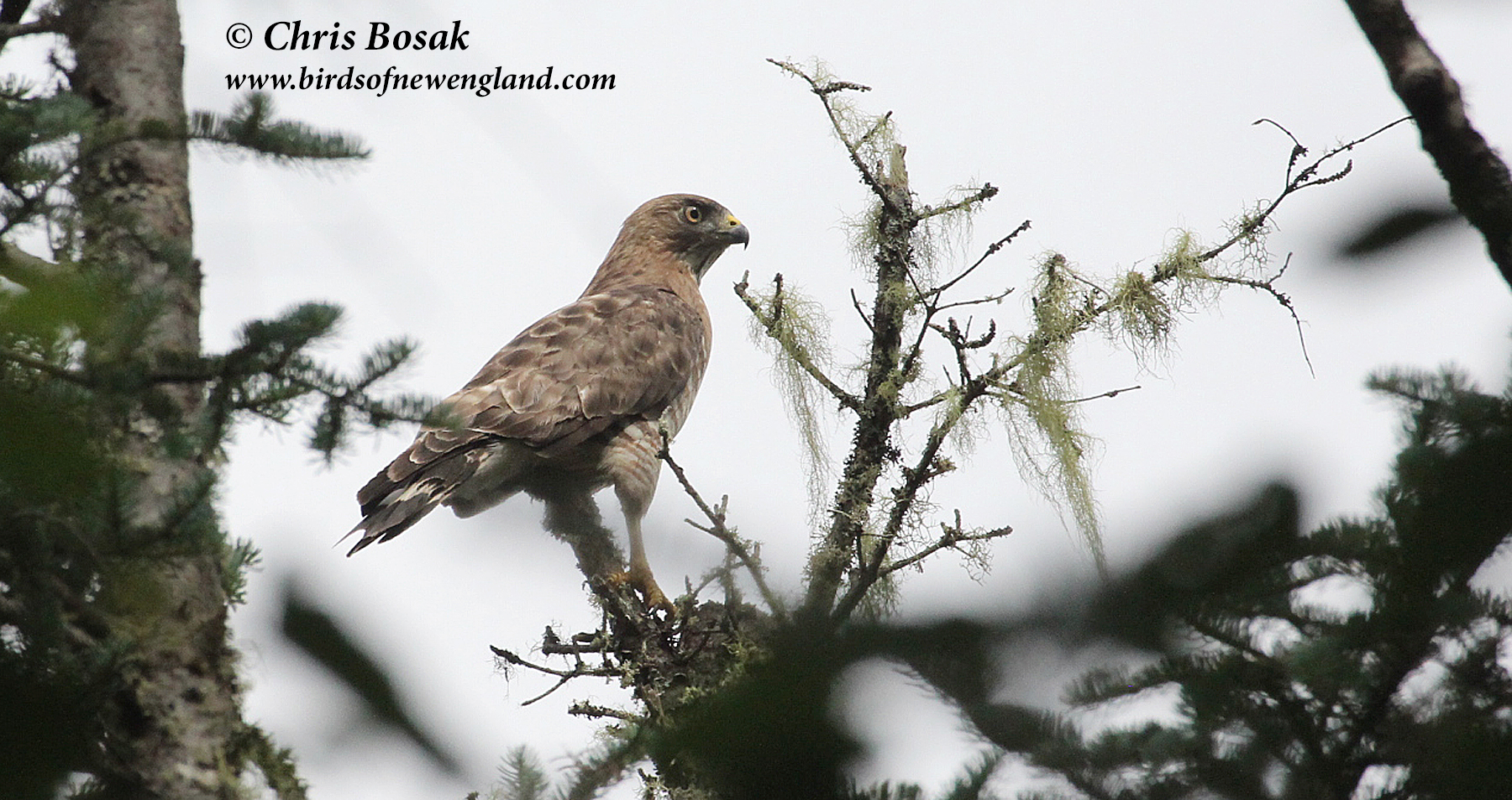
A broad-winged hawk perches in a tree in northern New Hampshire, July 2020.
The fall hawkwatching season is winding down. Raptor sightings at the various dedicated locations are slowing down, with only a handful of birds counted each day as November progresses.
It’s a good time, therefore, to check in to see how the various hawkwatching sites fared this year. New England has several popular sites, but Pack Monadnock at Miller State Park in Peterborough is New Hampshire’s most active and popular site. The hawk count is a project of the Harris Center for Conservation Education in Hancock.
Photo by Chris Bosak
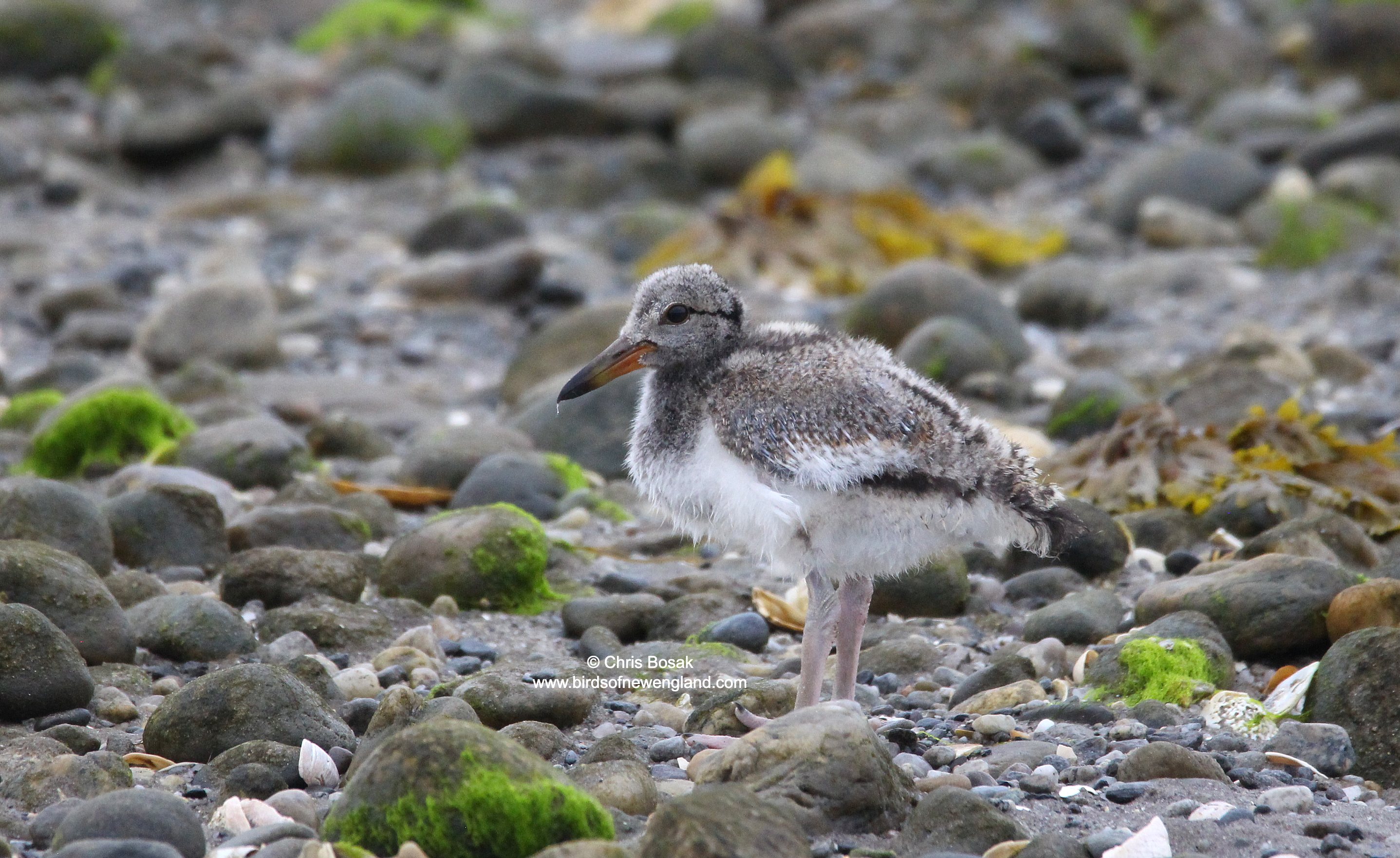
American oystercatcher chick, Milford, Connecticut, summer 2025.
The Cooper’s hawk I wrote about last week was a bit of an anomaly for me.
It’s not that I don’t see Cooper’s hawks often, but I typically see immature Cooper’s hawks. The one featured last week was an adult. Looking back through my photo collection, the vast majority of Cooper’s hawks I have photographed were immature birds.
With many birds, differentiating young birds from adults can be tricky as the time period between immature plumage and adult plumage is relatively short. With Cooper’s hawks, it’s easier as they retain their immature plumage into their second year. Bald eagles, similarly, do not obtain their classic white heads and tails until they are four or five years old.
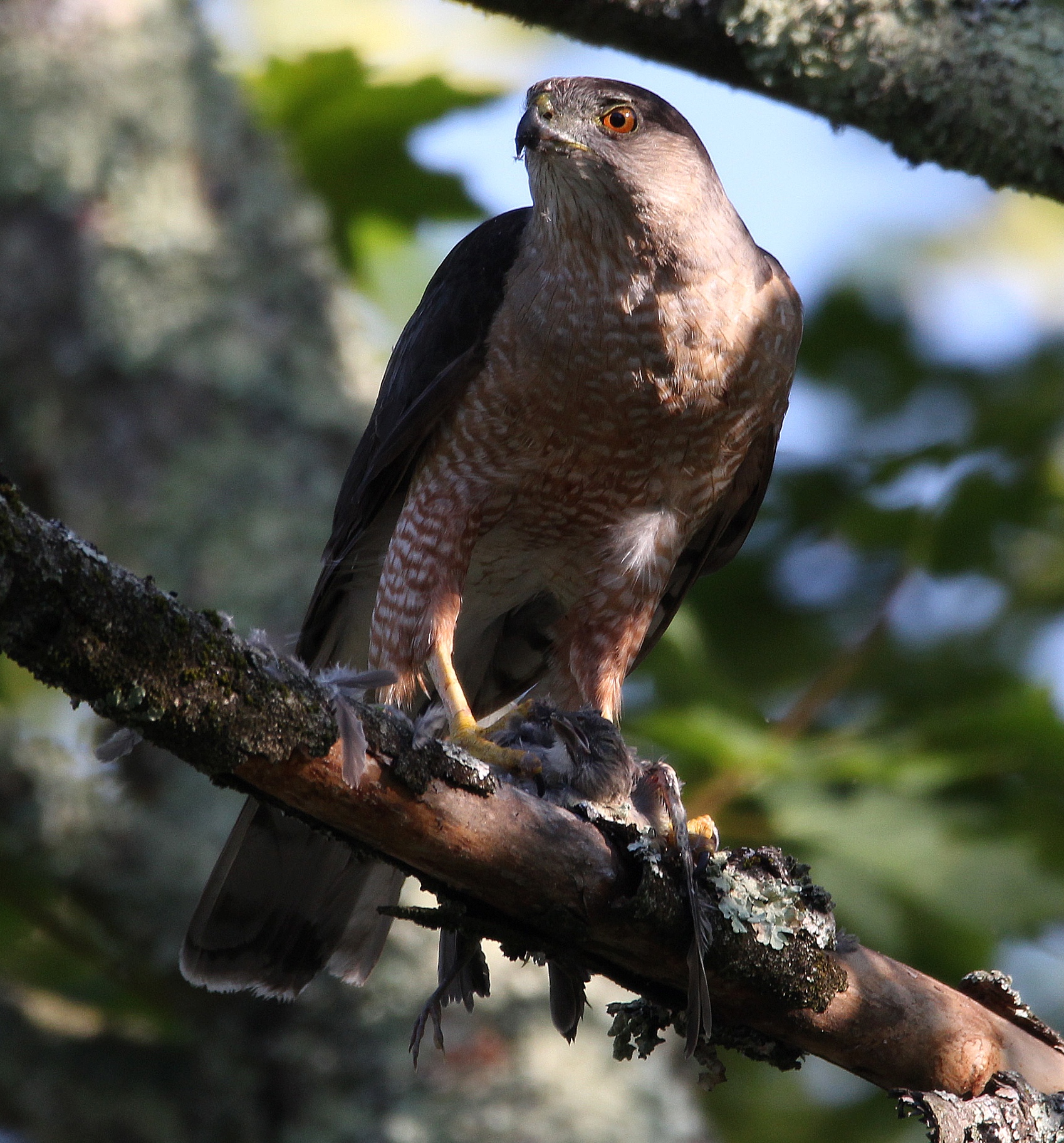
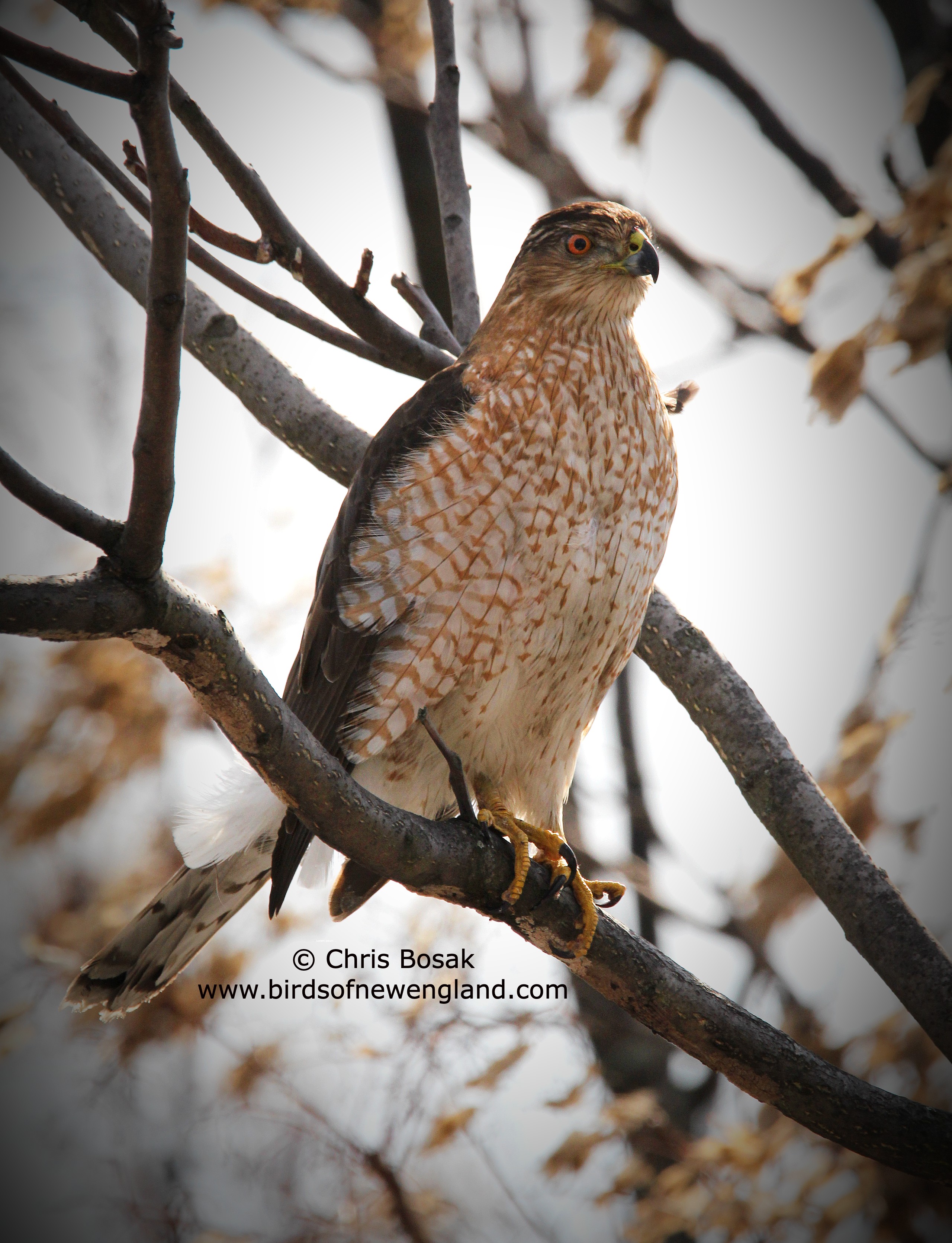
As immature birds, Cooper’s hawks (as well as closely related sharp-shinned hawks) are brown with tan-streaked white chests and bellies. As adults, they are blue-gray with reddish-streaked white chests and bellies. Immature Cooper’s hawks have yellow eyes, and adults have red eyes. Interestingly, ospreys are the opposite with adults having yellow eyes and immatures having orange-red eyes.
Photo by Chris Bosak – A Cooper’s hawk eats a meal in New England, summer 2025.
“One of the nice things about birdwatching is …”
I’ve started many sentences with that phrase over the years. The backend of that line may be finished in almost innumerable ways:
… everyone, regardless of age or skill level, can enjoy it.
… it can be done during any time of the day or year.
… no two days are alike.
… there is always something new to learn or discover, regardless of how advanced you are.
… each time of year brings its own delights.
For the purposes of this column, the sentence will read: “One of the nice things about birdwatching is that it can be done anywhere.” Not many hobbies can be enjoyed in the woods, in a canoe or kayak, at a local park, or sitting in the kitchen looking out the window with your morning cup of coffee.
Photo by Chris Bosak
Bald eagle in New England, March 2025.
I pulled into the small dirt parking lot at the reservoir to see what ducks were hanging around the dam. The water by the dam does not freeze, and there is always a good variety of waterfowl there all winter.
As I stepped out of the car, I noticed two large birds perched in a tree along the shoreline. I knew immediately they were much too large to be hawks. They must be eagles. Sure enough, it was one adult and one immature bald eagle. It takes eagles four or five years to get their signature white heads and tails. Immature eagles are, however, just as large and impressive as adults.
Of course, I was thrilled to see the bald eagle. However, I was not surprised. Bald eagle sightings have become increasingly common over the last several years as the population continues to rise.
The bald eagle’s recovery is one of the best conservation stories of the last several decades. The osprey recovery is equally exciting.
Photo by Chris Bosak
Adult Cooper’s hawk seen in Norwalk, Connecticut, January 2025.
I was walking along a short but windy trail in southern New England the other day in search of overwintering warblers. This short path is known for harboring these tiny songbirds during the winter, as it is adjacent to a water treatment center that features open water on even the coldest days.
I came around one of the many bends and jumped back as I flushed a large bird that was on the ground next to the trail. With my heart racing from the surprise, my immediate reaction was that it was a ruffed grouse. It flushed with the familiar exuberance and noise of a grouse, so my mind immediately went there. Ruffed grouse, however, do not live in that area of New England any longer, and the habitat wasn’t right for the popular game bird.
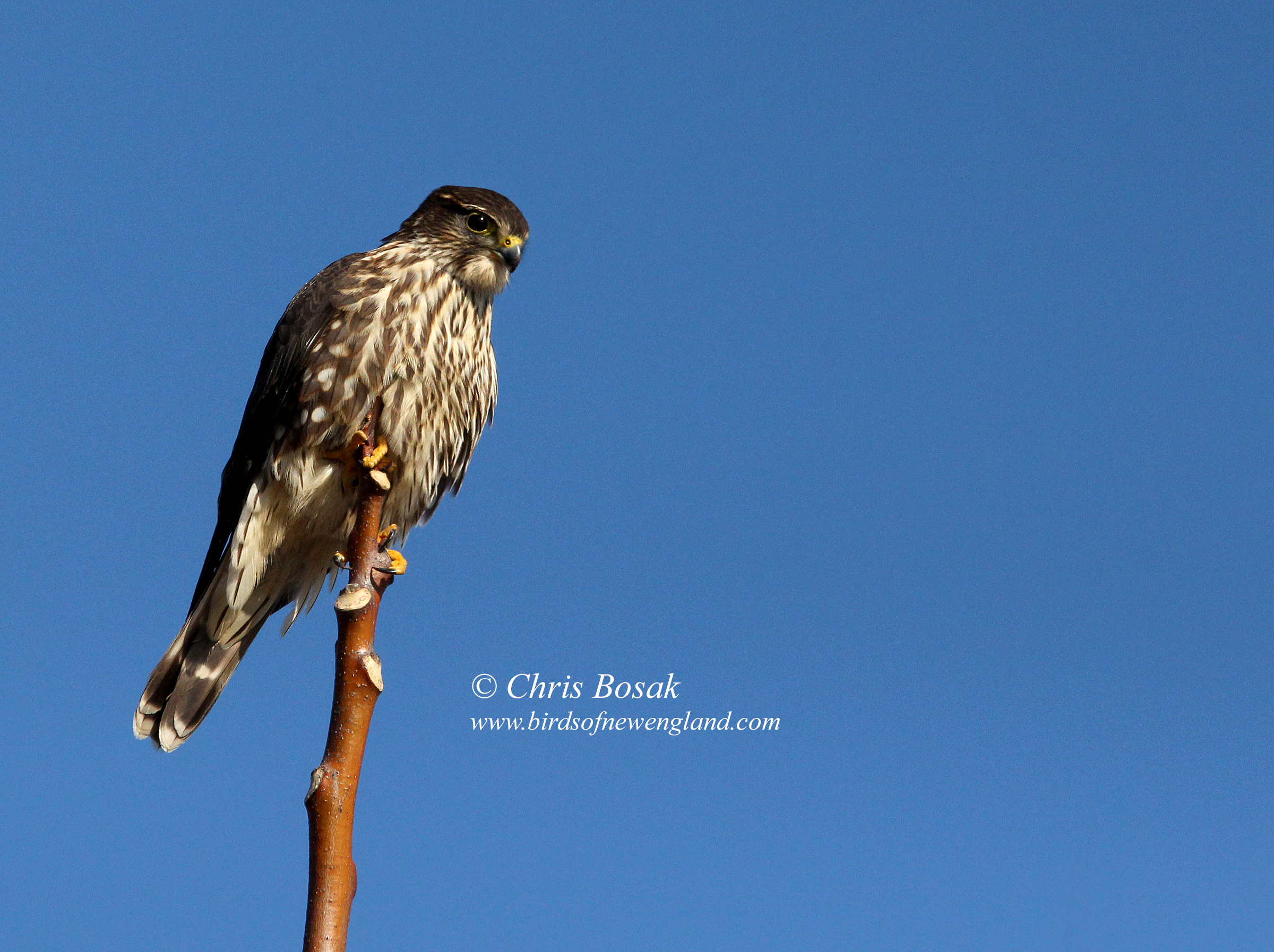
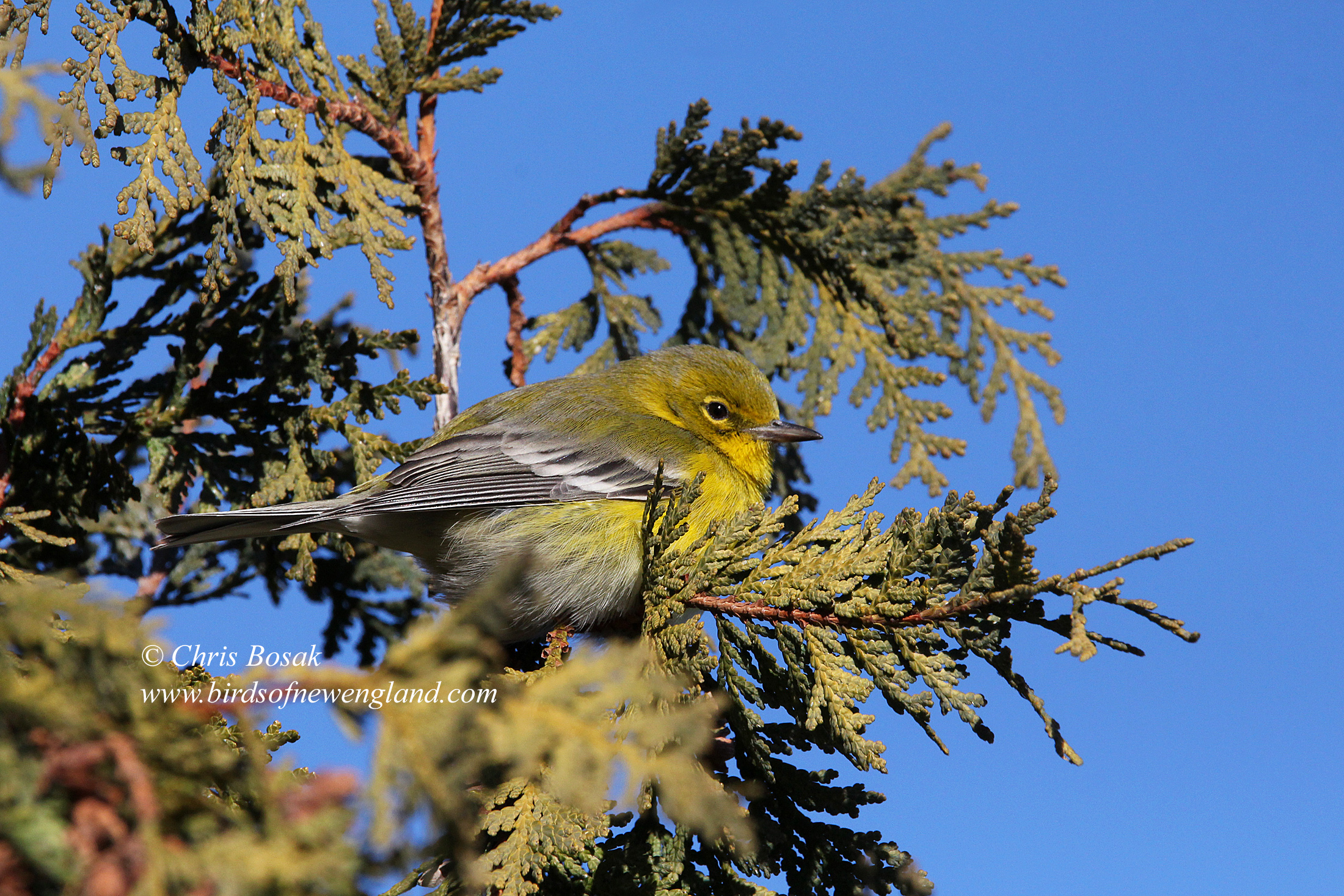
Photo by Chris Bosak – A merlin at Taylor Farm in Norwalk, CT, December 2024.Photo by Chris Bosak – A pine warbler at the esplanade in Norwalk, December 2024.
On Sunday (December 22, 2024), I participated, as usual, in the Christmas Bird Count and covered my usual area of coastal Norwalk (SW Connecticut). Instead of my usual birding partner Frank, I covered the area with Adam and Jo. It was 13 degrees when we started and didn’t seem to get much warmer as the day went on. In fact, the wind picked up and made it seem even colder. The things we do for the birds.
We had a successful day with plenty of highlights, including bald eagle, peregrine falcon, merlin, pipit, pine warbler, yellow-rumped warblerf and both types of kinglet.
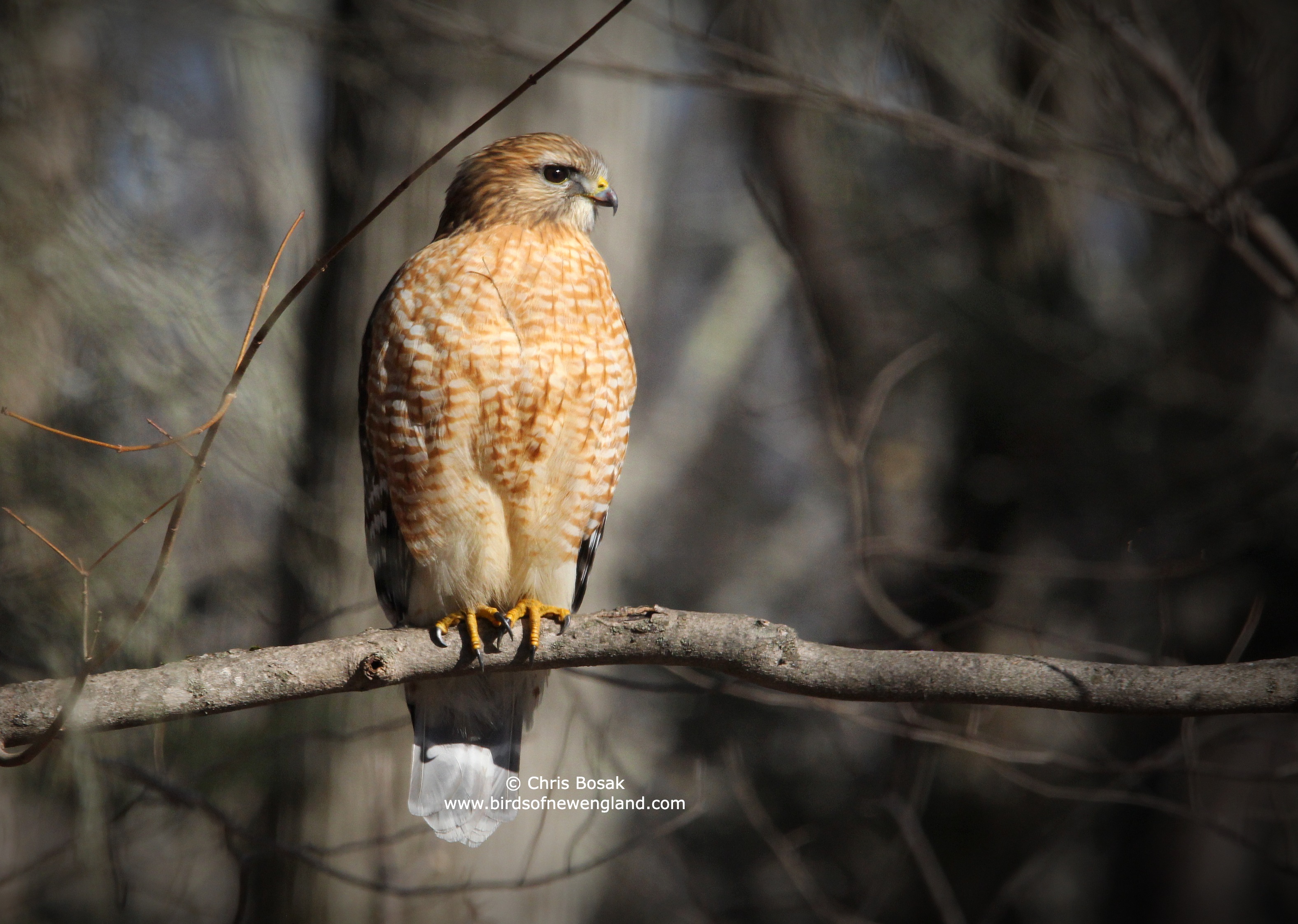
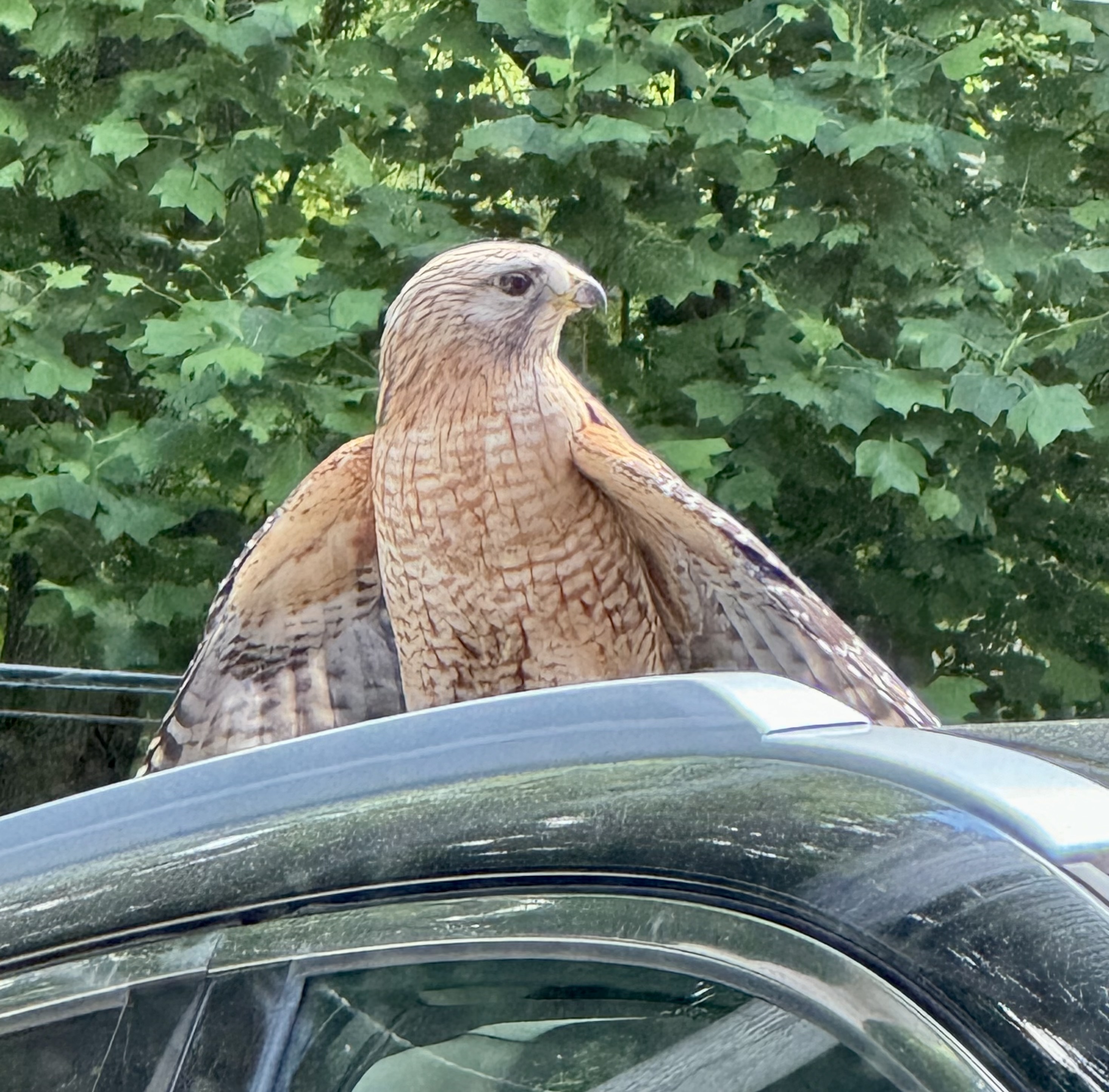
Photo by Chris Bosak – Red-shouldered hawk on car in parking lot in New England, May 2024.
Some birds have adapted to humans and what we have done to their habitat better than others.
Pigeons, house sparrows and mallards have obviously fared well and thrive in urban environments. Other birds, including many songbirds, have not. Why else would the populations of so many songbirds have decreased so dramatically over the last several decades?
An experience at work the other day got me thinking about how birds adapt to human interference. I was working in my office when I heard a co-worker calling my name in whispered urgency. I rushed out to see what the commotion was about and saw a red-shouldered hawk perched on top of an Infinity SUV right on the other side of the window.
The impressive bird of prey was a mere 12 feet away from the small crowd that had now gathered inside the building — urgent whispers have a way of drawing a crowd. Everyone broke out their phones and took pictures of the specimen. Red-shouldered hawks nest on the property at work, so seeing the bird was not unusual, but seeing it perched on a car was certainly different.
Photo by Chris Bosak
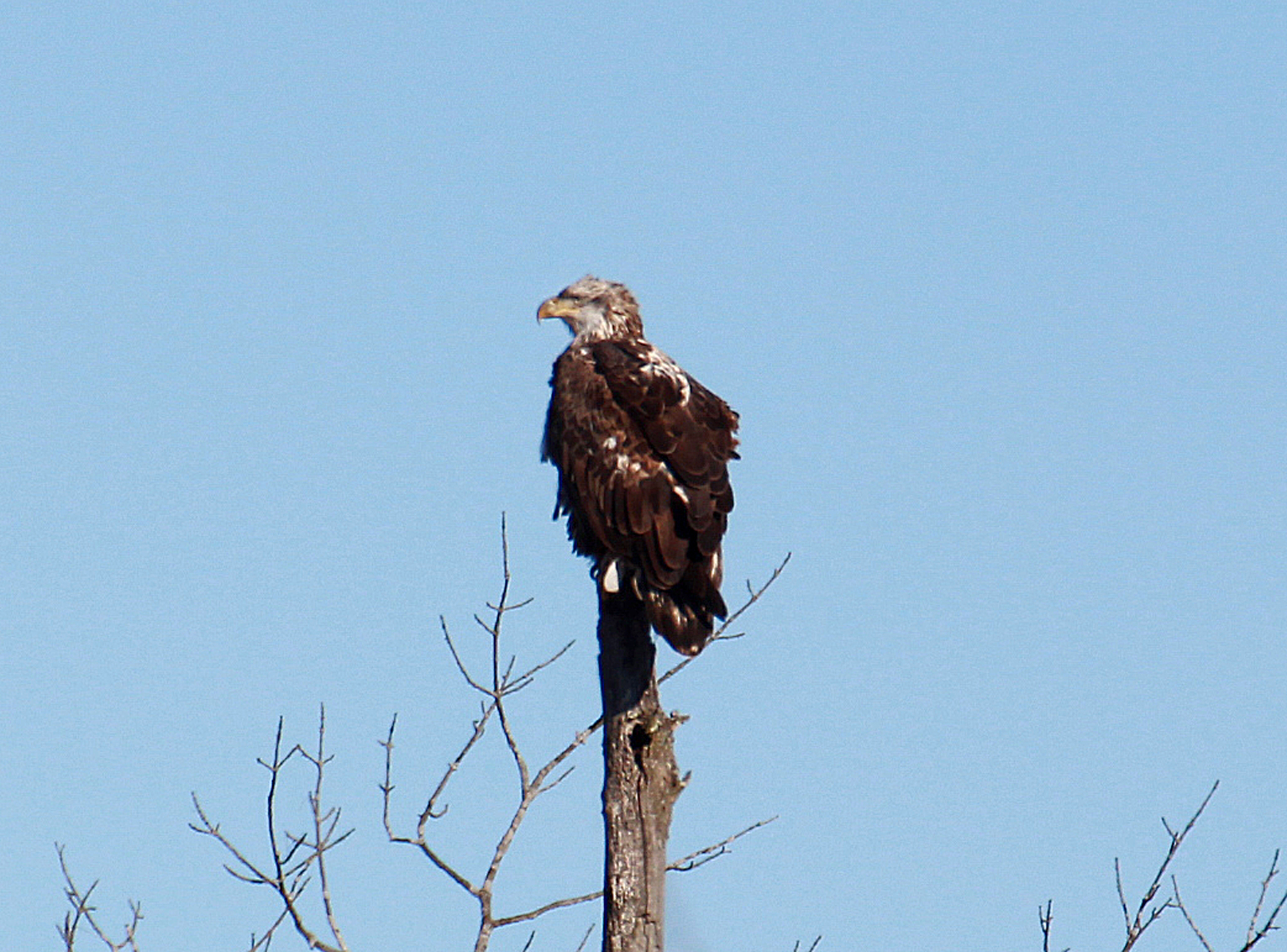
A young bald eagle perches on a dead tree near Danbury Fair mall in Danbury, CT, March 2019.
It was an eagle. There was no doubt about that. I second-guessed myself only for a second because of where the sighting took place.
It was not on a remote lake in northern New England or on one of the islands in Long Island Sound. It was right along a highway.
We are all used to seeing hawks perched along the highway. In fact, when I drive to Pennsylvania a couple of times a year to visit family, I make it a point to count the number of red-tailed hawks I see perched in trees along Route 86. It’s usually between 10 and 15. Hey, it passes the time on a long drive.
I noticed from far away as I approached the scene that there was a bird perched in a tree overhanging a somewhat busy state highway. Even from a significant distance, I could tell it was not a hawk. The only question was whether it was an eagle or a vulture. It did not have the posture of a vulture, but rather the regal stance of an eagle.


 Birds of New England.com