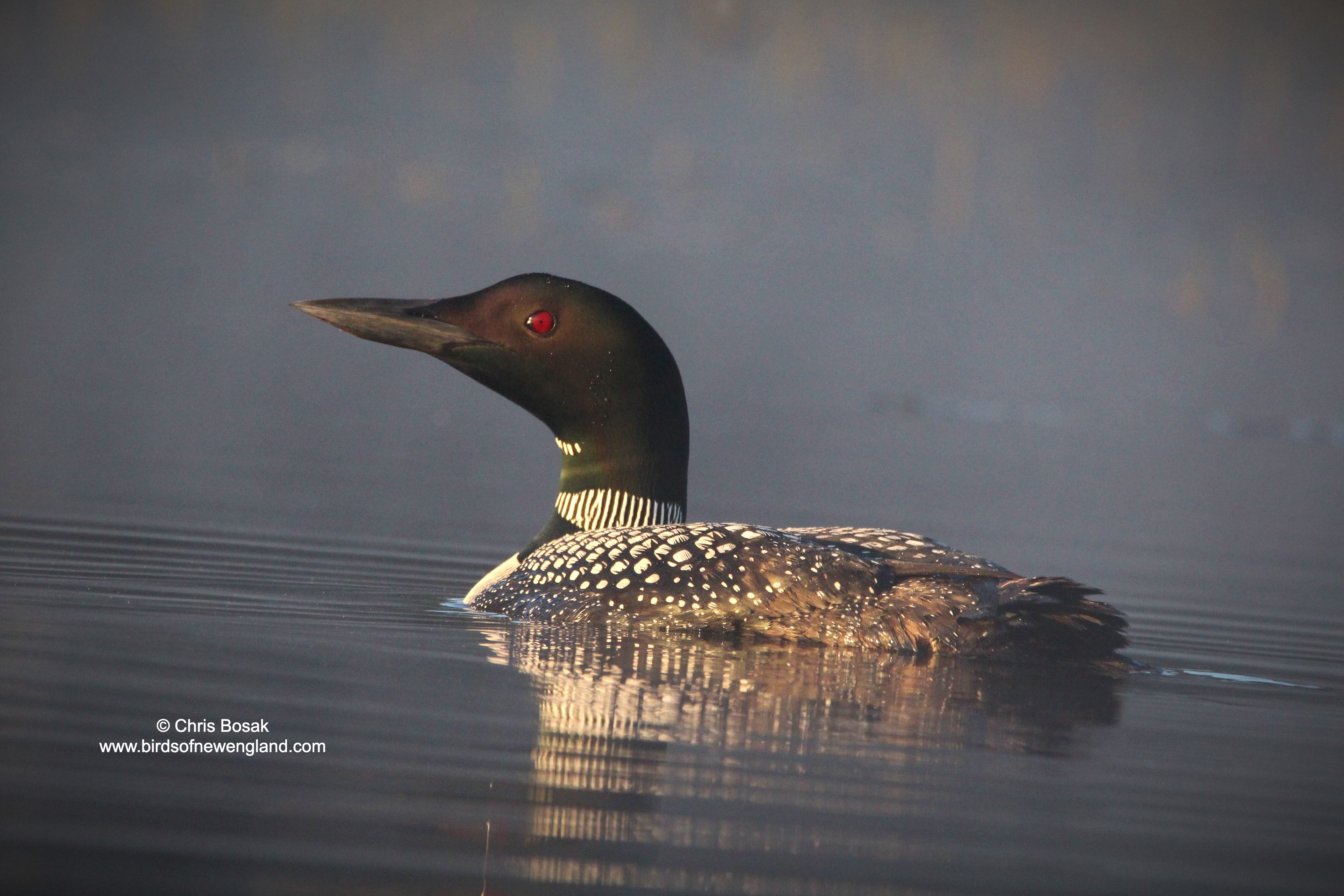
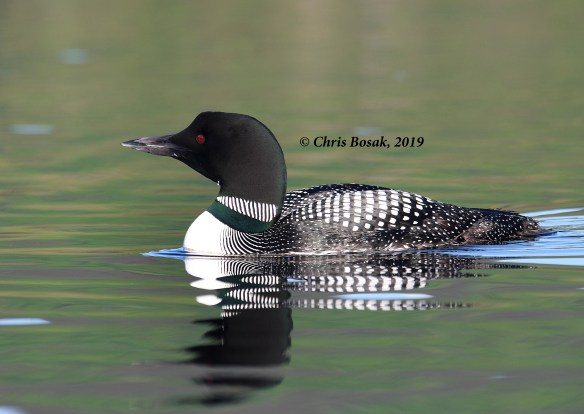
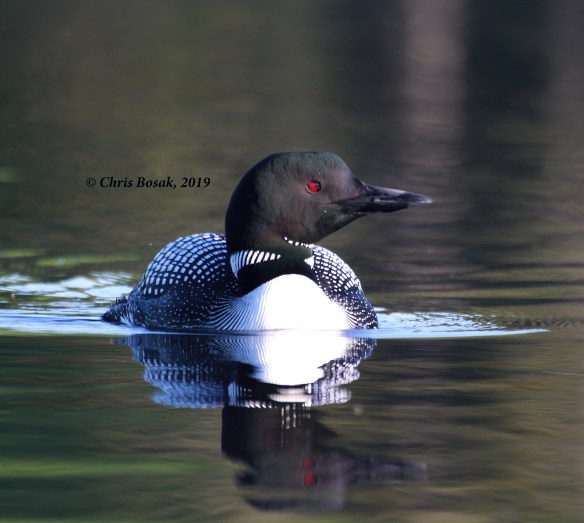
Photo by Chris Bosak A common loon rests on a pond in northern New Hampshire, summer 2026.
It was a scene you might see in the opening frames of a movie.
The mist was thick coming off the water, and the sunrise peaking over the distant mountain painted the eastern sky a brilliant orange. Tall pines marked the edge of the pond, and a pair of loons silently floated on the mirror-like water.
Heather and I slowly paddled toward the loons but kept a respectable distance so as to not disturb their morning routine, which seemed to be not much more than sitting still on the water. Neither one of the loons made any of their iconic sounds, but the scene was still quintessential New England regardless.
As we paddled east toward the rising and slowly brightening sun, belted kingfishers on either side of the pond rattled simultaneously, creating a stereo effect among the din of birdsong that filled the morning air. Based on what we heard, common yellowthroats, Swainson’s thrushes, red-winged blackbirds and red-breasted nuthatches were the dominant songbirds hiding in the thick woods.
Photo by Chris Bosak
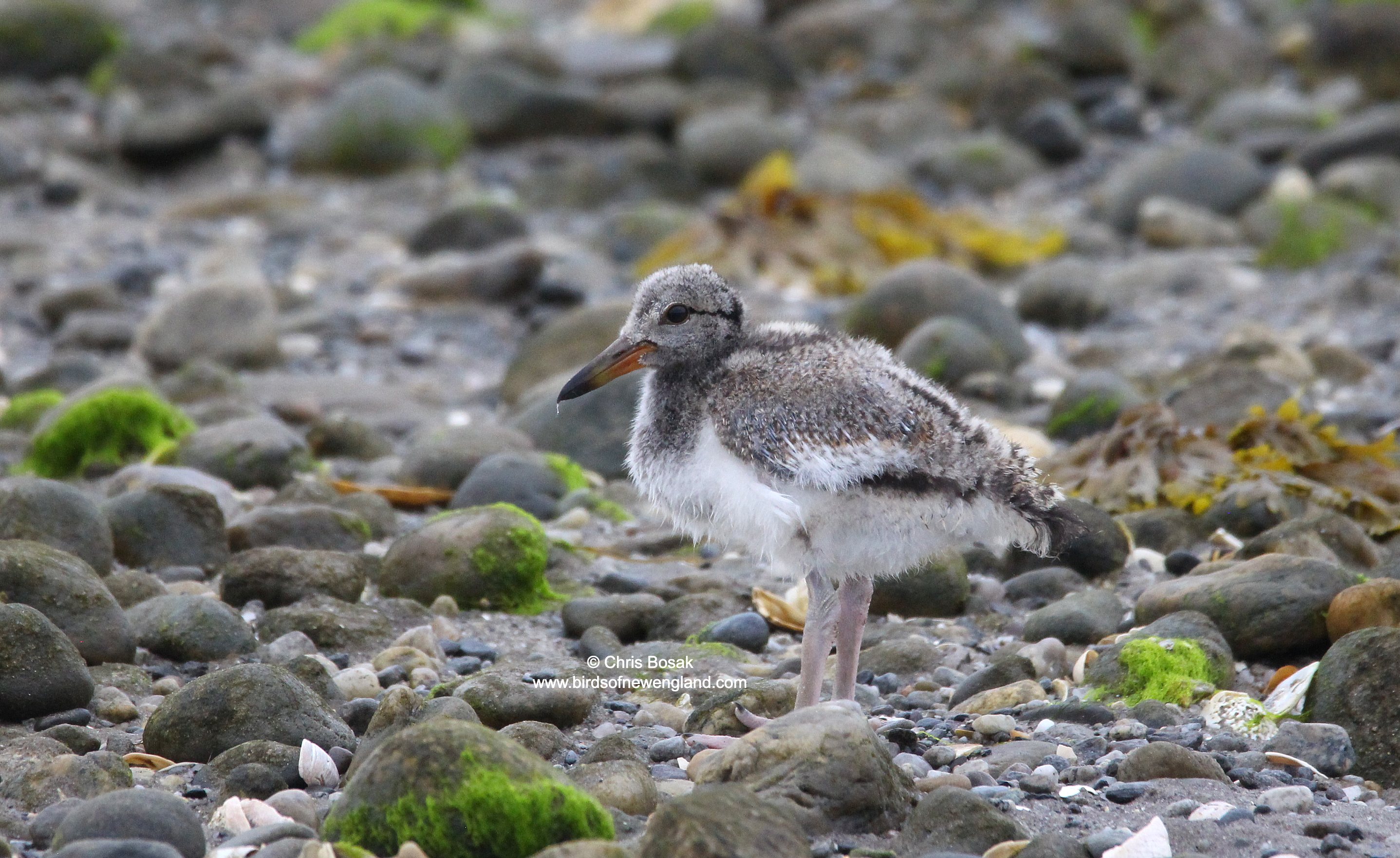
American oystercatcher chick, Milford, Connecticut, summer 2025.
The Cooper’s hawk I wrote about last week was a bit of an anomaly for me.
It’s not that I don’t see Cooper’s hawks often, but I typically see immature Cooper’s hawks. The one featured last week was an adult. Looking back through my photo collection, the vast majority of Cooper’s hawks I have photographed were immature birds.
With many birds, differentiating young birds from adults can be tricky as the time period between immature plumage and adult plumage is relatively short. With Cooper’s hawks, it’s easier as they retain their immature plumage into their second year. Bald eagles, similarly, do not obtain their classic white heads and tails until they are four or five years old.
As immature birds, Cooper’s hawks (as well as closely related sharp-shinned hawks) are brown with tan-streaked white chests and bellies. As adults, they are blue-gray with reddish-streaked white chests and bellies. Immature Cooper’s hawks have yellow eyes, and adults have red eyes. Interestingly, ospreys are the opposite with adults having yellow eyes and immatures having orange-red eyes.
Photo by Chris Bosak
A pair of loons at Second Connecticut Lake in Pittsburg, NH, June 2025.
It had been several years since I had been to Pittsburg, NH, a place I used to visit three times a year or more back in the day.
My visits gradually became more infrequent as I got older, gained work and family responsibilities and grew less inclined to make the long drive. Besides, moose sightings had become increasingly rare up there, while they used to be a sure thing. Moose had always been the main attraction for me and many others who visit there.
Even so, the area has retained a special place in my heart, and I often long to be there. I just wish I could teleport there with my truck, canoe and camping equipment.
Photo by Chris Bosak
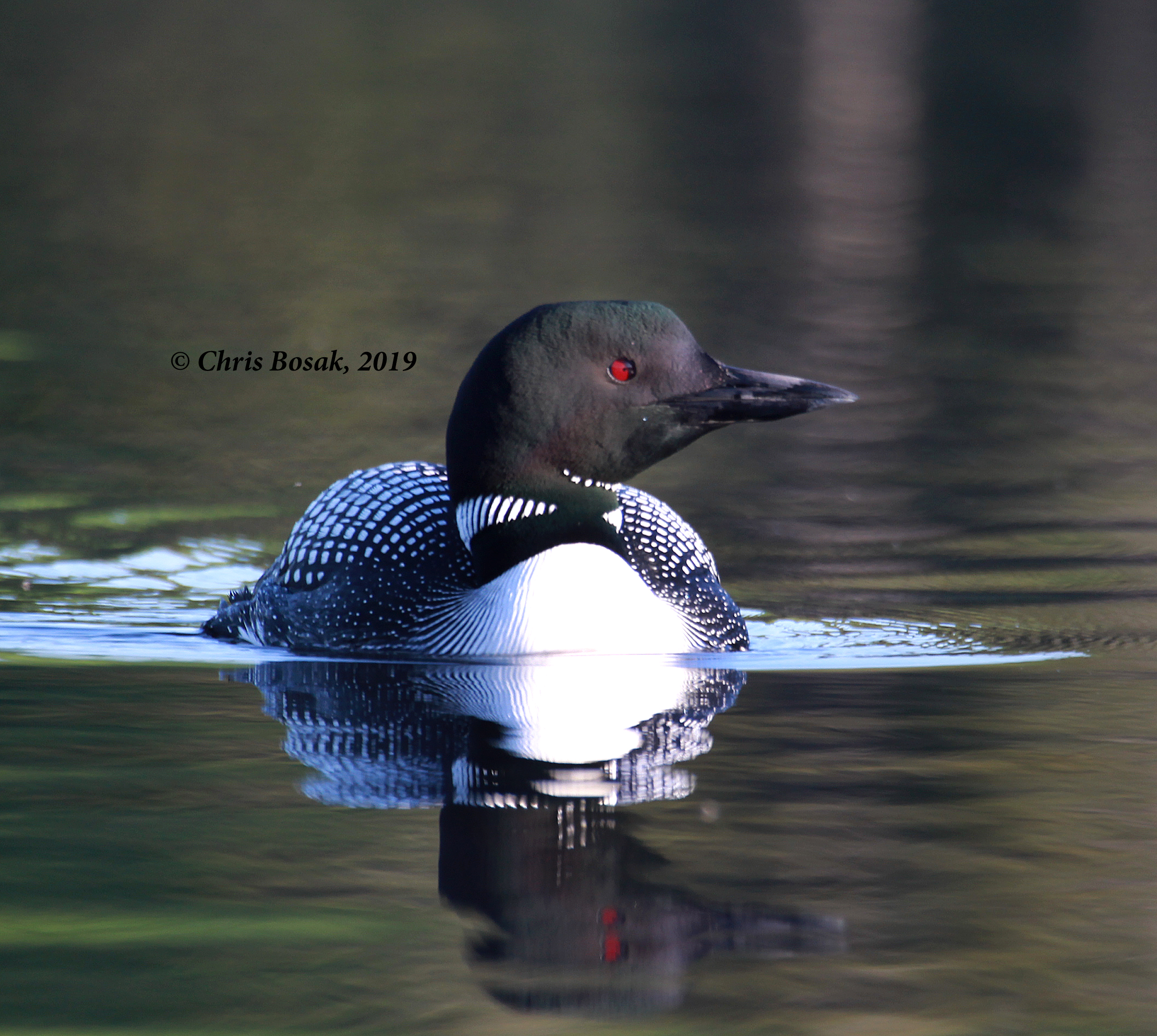
A common loon swims at May Pond in Pillsbury State Park in New Hampshire in June 2019.
The joke in many cities goes like this: If you don’t like the weather, wait a minute; it’ll change.
That certainly applies to northern New Hampshire — and all of New England for that matter — but I have come up with a similar saying about the upper reaches of the Granite State: If you don’t like the remote pond you’ve found, keep driving; you’ll find another one.
I’ve found countless gems of water far from civilization during my many travels to the Great North Woods just by picking a dirt road and driving. Sometimes it takes a little persistence — and a few hairy sections of “road” — but ponds are always there to find. And they’re always spectacular.
One pond typically doesn’t look very different from the next, but they all harbor their own secrets and wildlife surprises. To borrow another saying: They’re all the same, but different.
I found a great pond — maybe it was a bog or a fen, but I’ll call it a pond — a few weeks ago during a short trip to northern, N.H. I knew it was going to be great even before I parked the car and unleashed the canoe. I saw the loons right away.
Photo by Chris Bosak
A common loon swims at Grout Pond in Vermont, spring 2023.
The loons were the wildlife highlight of the trip, but the short camping trip had meaning beyond the birds and mammals that were seen.
It was the first trip my oldest son Andrew and I had taken in a few years. Andrew, now 20, is a reluctant birdwatcher as it is not a hobby of his, and he pushes back on my requests to take walks specifically to see birds, but he can identify several birds by sight and sound. (Wonder where that talent came from.) He does, however, like the outdoors and is always up for a camping trip. In fact, he initiated this outing and had been asking for several weeks to go camping.
We like to go camping when there are no crowds. That means either during the week or during the off season. In this case, it was both. We each took a Monday and Tuesday off work and left for Grout Pond in southern Vermont on a Sunday afternoon in early May.
We underestimated the time it would take to get to the site and it was already dark by the time we had arrived. We improvised by pumping up the air mattress and sleeping under the stars in the cab of the pickup. Thankfully, it was a dry night. It was, however, a cold night, it being early May in Vermont. The lows were in the mid-30s, but it was actually quite refreshing to sleep outdoors again.
Not surprisingly, I awoke before Andrew and took a walk down one of the trails near where we had parked the previous night. A broad-winged hawk immediately flew overhead and swooped in for a landing in a nearby dead tree. It was the start of a good wildlife watching day.
Andrew eventually woke up and, from the pond’s launch site, we eyed a spot along the pond to set up camp for a few days. I was to canoe to the spot with the majority of our equipment and Andrew was to haul the backpack to the site using the trail that runs along the pond. The plan worked well, and I was pleased that the canoe held up with me and our stuff in it. The 14-foot Radisson aluminum canoe had been hit by a fallen tree over the winter and sustained a good-sized dent at one of the ends. A little water seeped in, but overall, it was fine.
The few people who were there in the morning had packed up and left by the afternoon. Andrew and I now had the place to ourselves.
Photo by Chris Bosak
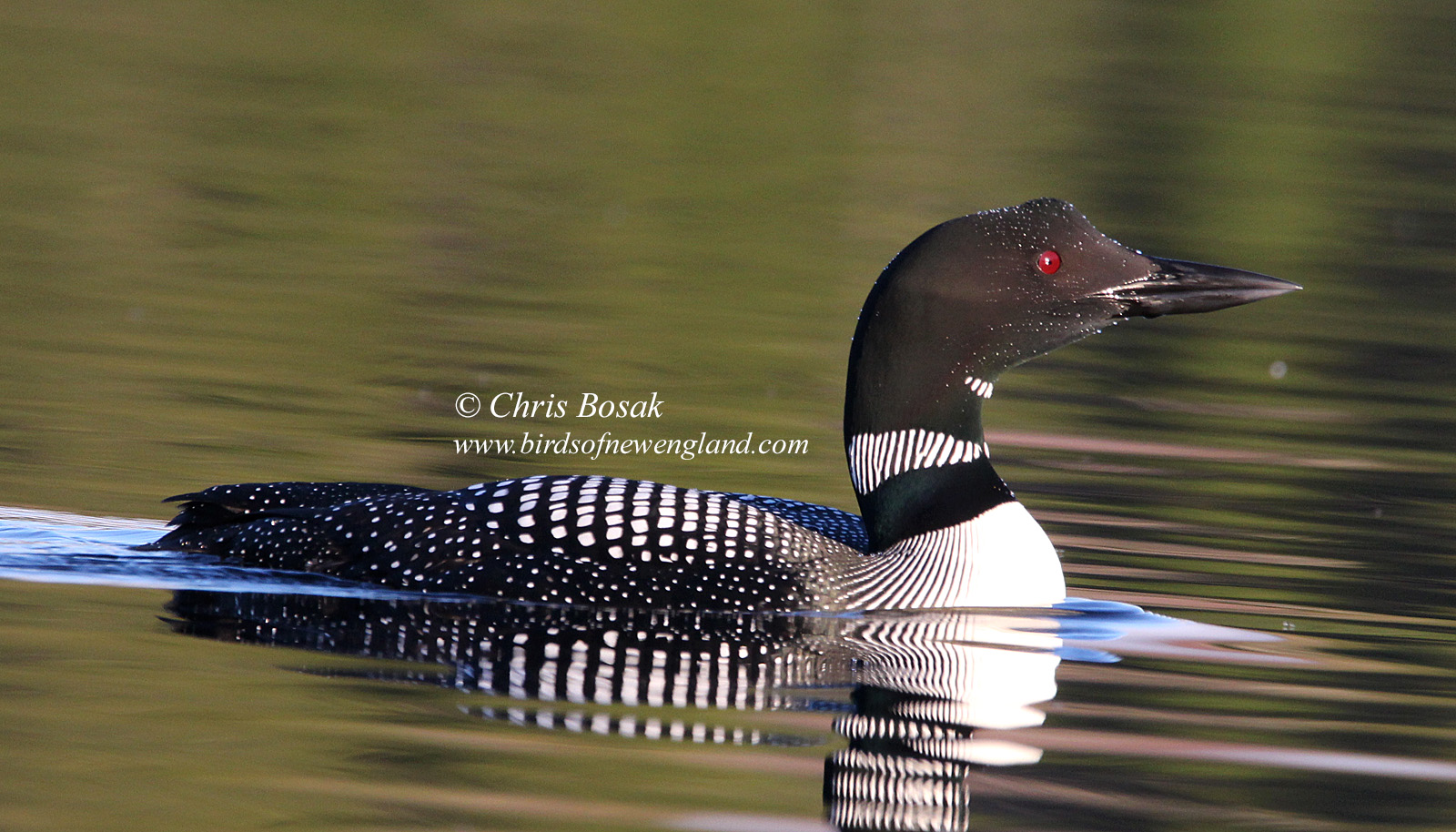
A common loon swims in a lake in northern New Hampshire, July 2020.Photo by Chris Bosak
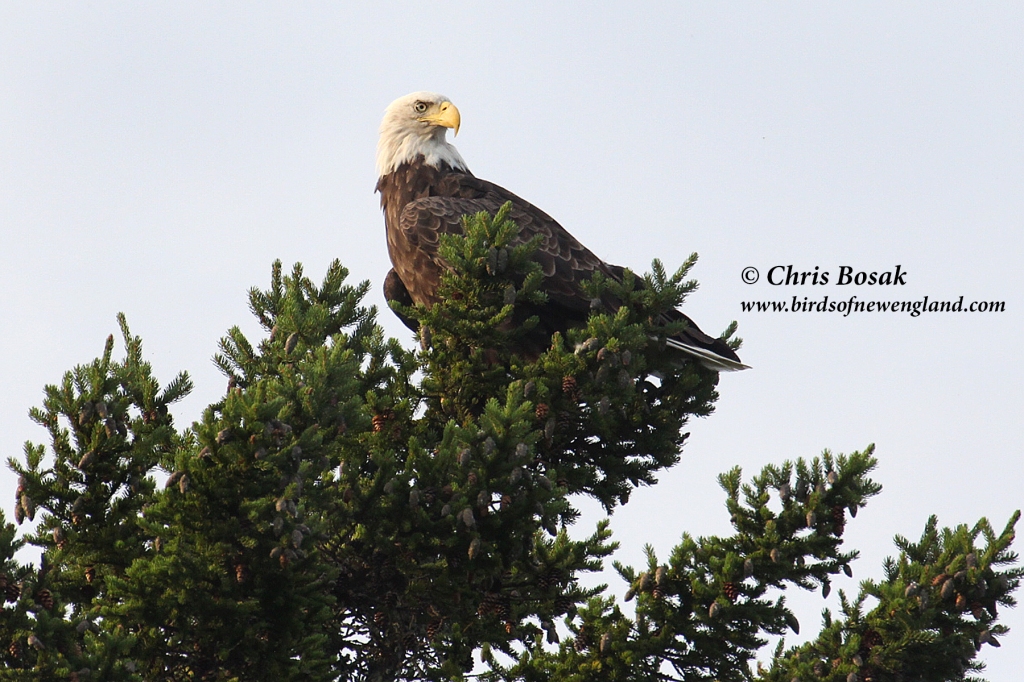
A bald eagle looks over a lake in northern New Hampshire, July 2020.
With work pleading with employees to use vacation time and half (or more) of the country pretty sketchy at the moment, I did what I’ve been wanting to do for years: take another summer vacation to northern New England — specifically northern New Hampshire and the boreal forest.
The trip started in Errol on Lake Umbagog and now continues in Pittsburg, which borders Canada. Here are a few photos I’ve managed so far. More to come — of course.
The main target is moose. New England’s largest mammal, however, is having a rough go of it of late. Here’s why.
Photo by Chris Bosak
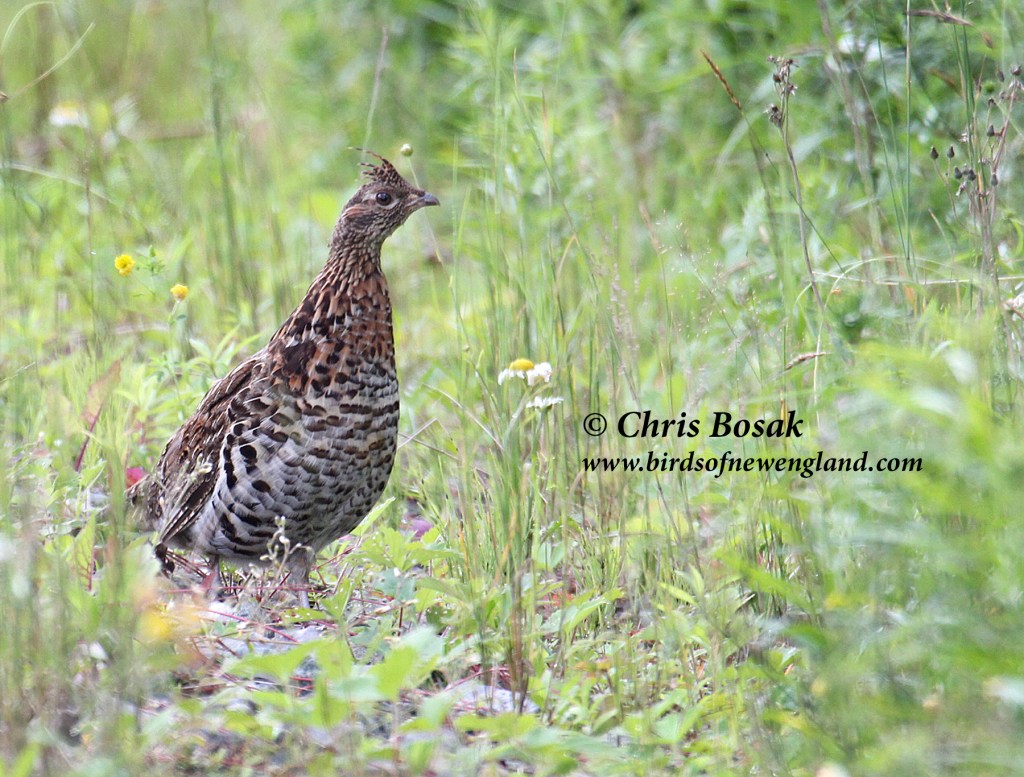
A ruffed grouse stands near a field in northern New England, July 2020.Photo by Chris Bosak
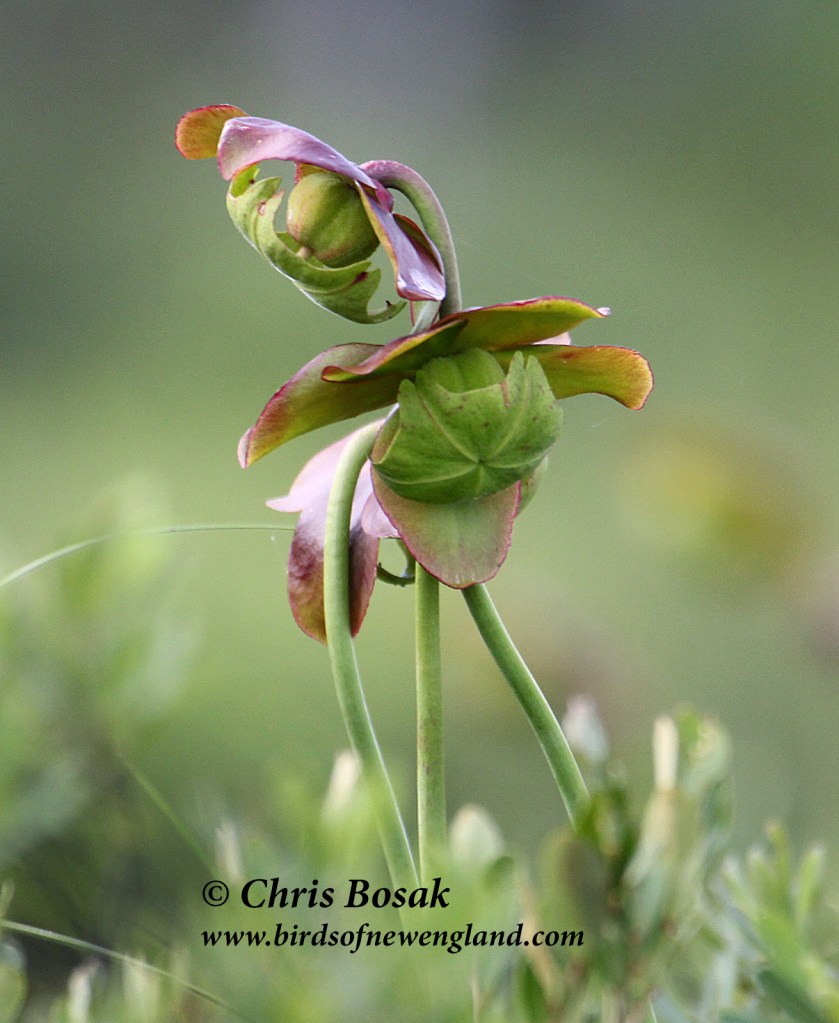
Pitcher plant at pond in northern New Hampshire, July 2020.Photo by Chris Bosak
A common loon swims in a lake in northern New Hampshire, July 2020.
Photo by Chris Bosak
A common loon swims at May Pond in Pillsbury State Park in New Hampshire in June 2019.
Stop posting photos of loons, said no one ever. So, to celebrate Father’s Day, BirdsofNewEngland.com presents a common loon bonanza. Every hour on the hour, a new loon photo will post. All photos were taken earlier this week at Pillsbury State Park in New Hampshire. Happy Father’s Day. Enjoy the loons.
Photo by Chris Bosak
A common loon swims at May Pond in Pillsbury State Park in New Hampshire in June 2019.
Stop posting photos of loons, said no one ever. So, to celebrate Father’s Day, BirdsofNewEngland.com presents a common loon bonanza. Every hour on the hour, a new loon photo will post. All photos were taken earlier this week at Pillsbury State Park in New Hampshire. Happy Father’s Day. Enjoy the loons.
Photo by Chris Bosak
A common loon swims at May Pond in Pillsbury State Park in New Hampshire in June 2019.
Stop posting photos of loons, said no one ever. So, to celebrate Father’s Day, BirdsofNewEngland.com presents a common loon bonanza. Every hour on the hour, a new loon photo will post. All photos were taken earlier this week at Pillsbury State Park in New Hampshire. Happy Father’s Day. Enjoy the loons.
Photo by Chris Bosak
Common loons swim at May Pond in Pillsbury State Park in New Hampshire in June 2019.
Stop posting photos of loons, said no one ever. So, to celebrate Father’s Day, BirdsofNewEngland.com presents a common loon bonanza. Every hour on the hour, a new loon photo will post. All photos were taken earlier this week at Pillsbury State Park in New Hampshire. Happy Father’s Day. Enjoy the loons.