
Photo by Chris Bosak
A Wood Duck swims at Wood’s Pond in Norwalk, spring 2016.
The other day I posted a few photos of female Wood Ducks and their chicks. Well, here are some more — some with the chicks and some Continue reading
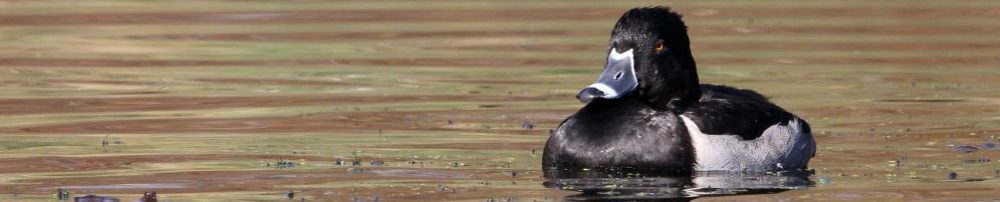
Photo by Chris Bosak
A Wood Duck swims at Wood’s Pond in Norwalk, spring 2016.
The other day I posted a few photos of female Wood Ducks and their chicks. Well, here are some more — some with the chicks and some Continue reading
Here’s the latest For the Birds column, which runs weekly in The Hour (Norwalk, Conn.) and The Keene (NH) Sentinel.
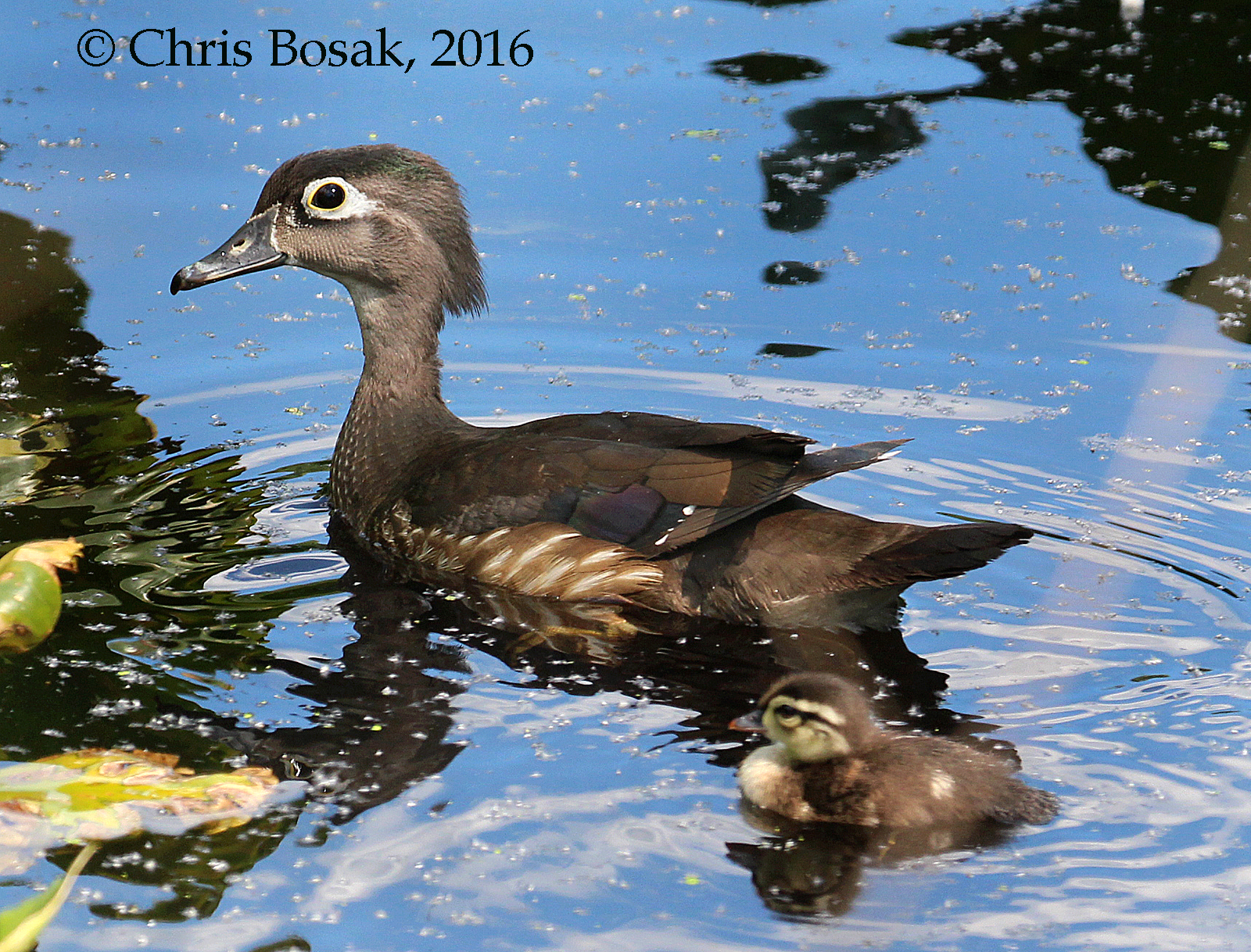
Photo by Chris Bosak
A Wood Duck mother swims with one of her babies at Woods Ponds in Norwalk, Conn., spring 2016.
The Mallards were scattered along the grass and I didn’t think twice about it. I’m used to Mallards being tame and not walking away, or even flinching, when someone draws near.
With many Mallards, even with babies in tow, they show little or no fear of humans. In fact, many even welcome the approach of humans as the ducks hope to get some food.

Photo by Chris Bosak
A Wood Duck mother swims with two of her babies at Woods Ponds in Norwalk, Conn., spring 2016.
But in this particular flock of ducks, two females and their babies quickly retreated to the nearby pond. These ducks weren’t Mallards at all, but rather they were Wood Ducks. Two female Wood Ducks and their babies were “hanging out” with the Mallards in the grass near the pond before I pulled into the parking lot.
While the Mallards in the group, which consisted of most of the birds, did not even bother to wake up from their midday nap, the Wood Ducks’ instincts told them to retreat.
But the scene was still extremely surprising to me. First of all, you don’t always see Wood Ducks hanging out with Mallards. And, second of all, Continue reading

Photo by Chris Bosak
Wood Duck drakes swims at Woods Pond in Norwalk, Conn., during an early April snow fall, 2016.
Another early-morning snow fall swept through parts of New England on Monday morning. Many people, I’m sure, cringed at the sight of more snow. As usual, my thoughts turned to photographing birds in the snow. It was an especially dark morning, but I managed to find and shoot some Wood Ducks at Woods Pond in Norwalk, Conn. Wood Ducks are Continue reading

Photo by Chris Bosak
A Green-winged Teal drake swims in a pond in a cemetery in Darien, Conn, March 2016.
Just like I was lucky to find a Northern Pintail a few weeks ago, I was lucky earlier today to find a Green-winged Teal drake. It was hanging out with a small flock of Mallards at the pond at Spring Grove Cemetery in Darien, Conn.
I’m loving this winter seeing all these not-too-frequently seen ducks.
The photos did not turn out as well as the pintail photos, but they are acceptable, I suppose. The teal was not as close as the pintail and Green-winged Teal are much smaller than pintails. In fact, Green-winged Teal are among the smallest duck we have in New England. Just like the pintail, Green-winged Teal are not frequent sightings throughout much of New England. They certainly aren’t rare sightings, but are not seen as much as species like Mallards, Hooded Mergansers or Wood Ducks.
It’s a beautiful, little duck, though. I love the shade of green on a Green-winged Teal. I also like the hint of green they show on their speculum (wing) when sitting on a pond. In flight, the speculum is fully exposed.
The bottom photo shows the size comparison with a Mallard. Notice how much larger the Mallards is.

Photo by Chris Bosak
A Green-winged Teal drake swims in a pond at a cemetery in Darien, Conn, March 2016.

Photo by Chris Bosak
A Mallard and Green-winged Teal swim in a pond at a cemetery in Darien, Conn., March 2016.

Photo by Chris Bosak
A Northern Pintail swims in a small pond in Danbury, Conn., Jan. 2016.
Here are some more shots of the cooperative Northern Pintail I spotted in a small roadside pond in Danbury, Conn., the other week. It’s a beautiful bird and this was the first time I’ve ever seen one so close. Enjoy the photos and thanks for your support of http://www.birdsofnewengland.com
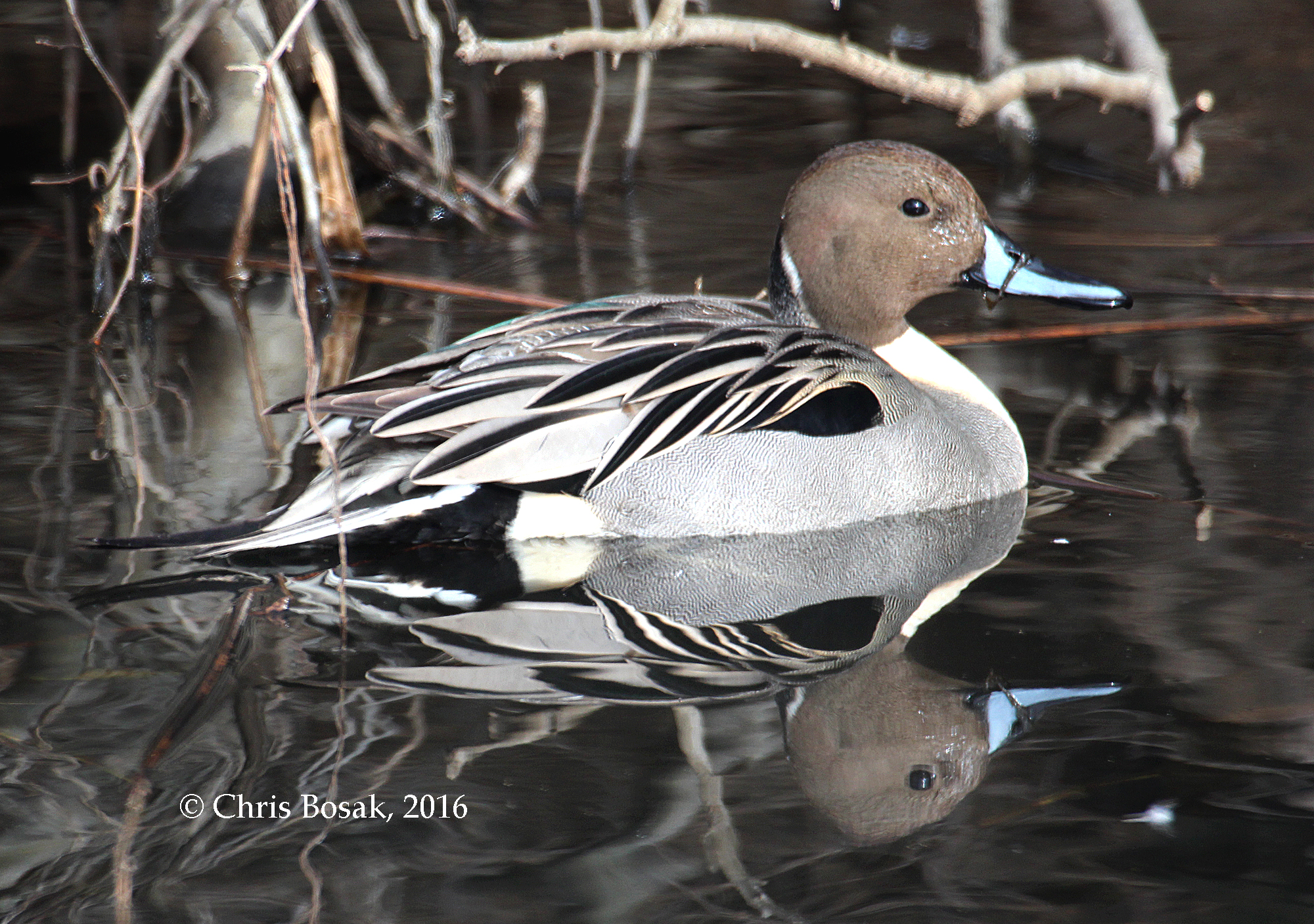
Photo by Chris Bosak
A Northern Pintail drake in a pond in Danbury, Conn., Jan. 2016.
Here’s my latest For the Birds Column about a Northern Pintail drake I saw last week. Exciting sighting!
…
These are the moments nature photographers hope for. Every once in a great while you come across a bird you really want to photograph and the subject is extraordinarily brave, cooperative and within reach of a zoom lens.
Sometimes you even have your camera handy when those moments come around.
Such was the case last weekend when I drove past a pond in Danbury. The pond was small and nearly butted up against the road. I glanced over at the pond, as I always do, and this time saw a most welcomed visitor among the usual Mallards. A lone Northern Pintail drake swam among the greenheads, appearing indifferent to the cars driving past on the fairly busy road.
I found the nearest safe place to turn around. I drove past the pond again, this time on the opposite side of the road, and confirmed my initial identification. I turned around yet again and pulled onto the shoulder as far as I could next to the pond.
The Mallards — two males and two females — and the pintail all stayed put and ignored me. I already had the passenger’s side window down and the radio turned off.
Actually having my trusty camera with me, I go that out and started photographing the duck.
The ducks went about their day and, despite …
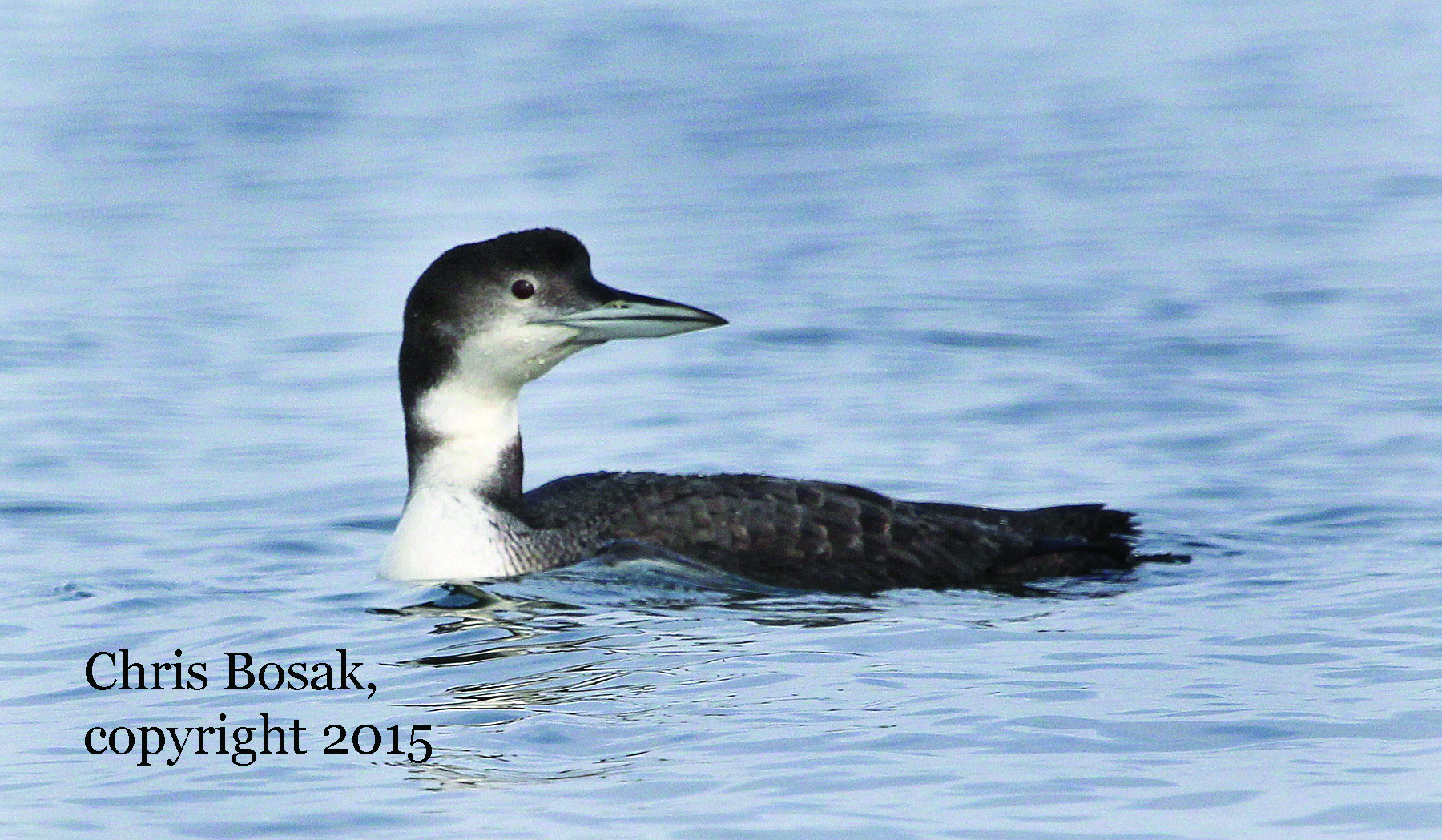
Photo by Chris Bosak
A Common Loon seen during a recent winter in Long Island Sound off the coast of Norwalk, Conn. Loons feature a more drab plumage in the winter.
Here’s my latest For the Birds column regarding Common Loons being a year-round New England bird. It was inspired by the release of a study that determined that loons are loyal to both summer and winter sites. Enjoy and thanks for checking out http://www.BirdsofNewEngland.com
…
Common Loons are a year-round New England bird. You won’t see them at the same place in the summer and winter, but they are true to our region. In the summer, head to the northern New England lakes and ponds and you’ll see loons. Those waters will be void of loons in the winter. In fact, there’s a very strong possibility that those waters will be frozen in the winter. But head to southern coastal New England in the winter, and you’ll see loons. Some loons head farther south for the winter months, but many spend their winters on Long Island Sound or off the Atlantic coast. As a bonus, these wintering grounds also play host to a fair amount of Red-throated Loons, too. But these waters are void of loons in the summer. So, unlike say, for instance, a Black-capped Chickadee, which can be seen

Photo by Chris Bosak
A baby mallard stays dry during a rainfall by huddling under its mother’s wing.
Here’s a tribute to all moms as Mother’s Day 2015 heads into the evening. This photo pretty much sums up a mother’s love: Take care of the children with no regard for yourself. It was raining on this day and about five little chicks all huddled under the mother Mallard’s wing for shelter. The mother coped with the rain, but the little ones were nice and dry.
If this photo makes you think of your mom, share it with her.
Thanks to all moms!
(Yes, I used this photo for an Easter posting last year, but I like it better as a Mother’s Day “card.”)

Photo by Chris Bosak
A pair of Long-tailed Ducks in transition plumage swims in Long Island Sound, April 2015.
Here’s a shot of a pair of Long-tailed Ducks transitioning from their mostly white winter plumage to their mostly dark summer plumage. Some birds looks the same year-round and some birds look different in the summer and winter. Most ducks (but not all) go through a few different plumages as the year goes on.
These Long-tailed Ducks (formerly Oldsquaw) will be heading to their Arctic breeding grounds soon. When they are along coastal New England in the winter, we see their white plumage. It’s one of the few birds, in my opinion anyway, that look more decorated in the winter than in the summer. Take the Common Loon for instance. It sports its famous black-and-white spotted plumage in the summer, but changes to a much more drab grayish plumage in the winter.
We are lucky to have many Arctic nesters spend their winters in New England. It’s interesting to see their plumage transitions, giving us a glimpse of what they look like when they are “up north.”

Photo by Chris Bosak
Long Island Sound is mostly frozen on Feb. 21, 2015, as shown by this scene from Weed Beach in Darien, Conn.
Birdwatching makes New England winters that much more bearable for me. I love the winter ducks that come down from the Arctic, Canada and northern New England and overwinter on Long Island Sound: Long-tailed Ducks, Bufflehead, Hooded Mergansers, Red-breasted Mergansers, Common Goldeneye and the like. Not to mention the other fowl like loons and grebes.
But it’s a little hard to watch ducks like this …
In my 16 years living near the coast of Connecticut I’ve never seen Long Island Sound be frozen. I’ve heard stories from oldtimers about Long Island Sound freezing over, but I’ve never seen it. Until now.
This morning (Saturday, Feb. 21, 2015) I brought my spotting scope down to Weed Beach in Darien, Conn., to check out the ducks. I didn’t even have to get the scope out of the car. Long Island Sound was frozen. Where kids swim in the summer and ducks swim in the winter, it was completely frozen. Ice as far as I could see. A small pool of water connecting Darien and Stamford and feeding Holly Pond was unfrozen and held a few Bufflehead and Red-breasted Mergansers, but that was it. The rest was ice.
Saturday was warm (relatively speaking, about 30 degrees) and Sunday is supposed to be even warmer (around 40), but Monday we are right back into single digits. We’ll see how the Sound reacts. I’d sure like to see my ducks again.
 Birds of New England.com