Photo by Chris Bosak A gray catbird with food perches on a branch in New England, summer 2019.
I heard what I was pretty sure was a scarlet tanager high in one of my oak trees. The thick foliage makes it nearly impossible to find anything up there. Even a brilliantly bright red bird like a scarlet tanager could easily be hidden from view.
I looked with my naked eye for several minutes, hoping to spot some motion to give away the bird’s location and identity. To my frustration, I couldn’t find a thing, even though I knew right where the song was coming from.
So, I figured I’d try scanning the area with my binoculars with the hopes of catching a glimpse of some bright red among the dark green leaves. Picking out a bird among thickly leafed-out treetops is usually a lesson in futility and humility.
But not this time.
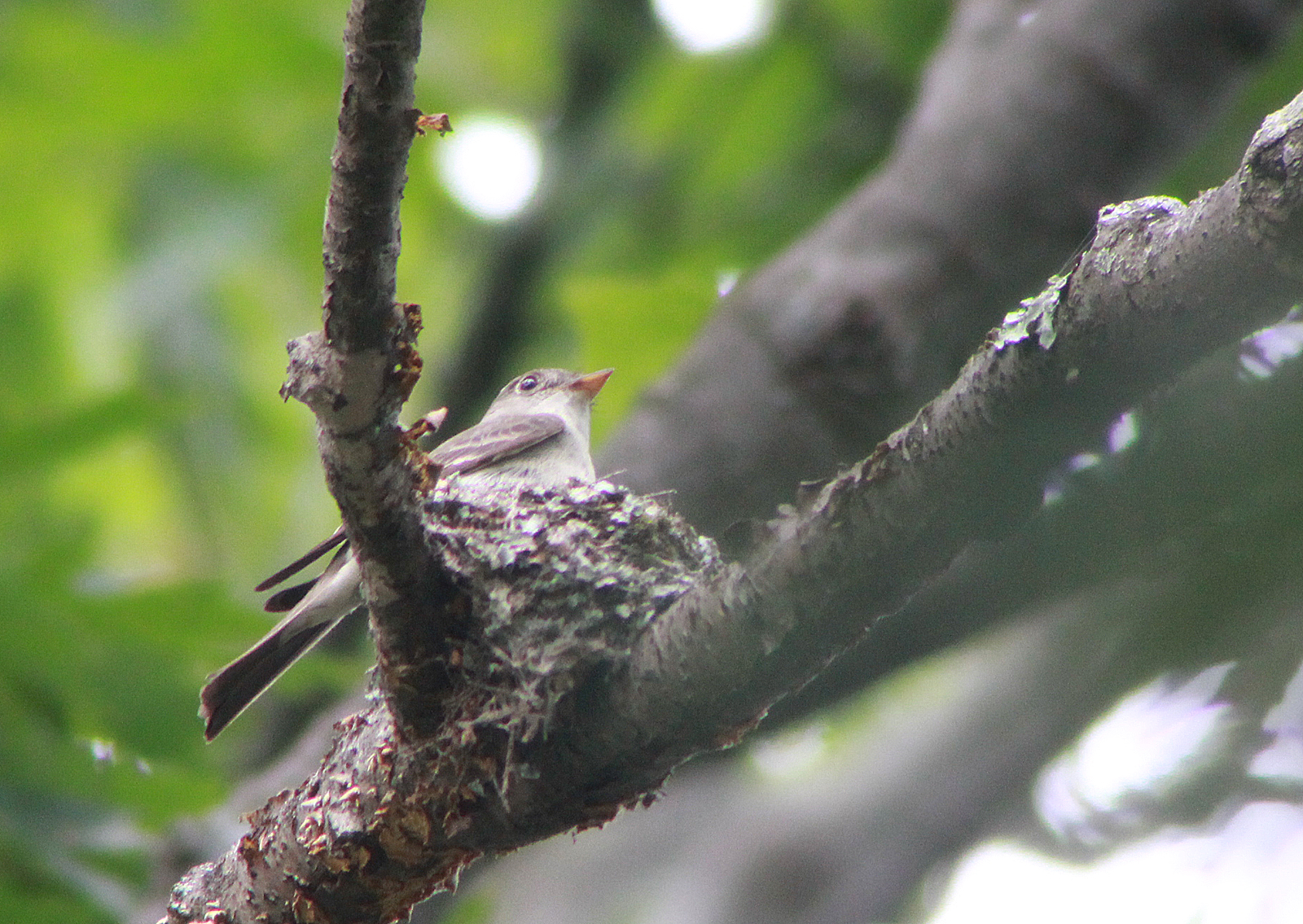
No, I didn’t find a scarlet tanager. I did, however, find the active nest of an eastern wood-pewee. Somehow, my binoculars trained themselves right on the spot. The small, cupped nest is built in the Y of a dead branch sticking out among the impenetrable foliage, about 40 feet high.
I watched the mother pewee for a few minutes before she flew off into the woods. I noticed a bright orange object in the nest. I assumed it was a mushroom of some sort because the dead branch is covered in a white fungus. With my binoculars, however, I discovered it was the mouth of a baby bird waiting to be fed.
Sure enough, about two minutes later the mother bird returned and a few other orange “mushrooms” appeared.
It was the first time I had ever found an active eastern wood-pewee nest Continue reading →
Last week I wrote about an adventure my son Will and I had freeing an eastern kingbird from fishing line. Will was fishing with some friends when he noticed a bird struggling frantically and dangling underneath a branch.
He ran to get me and we worked together to free the bird. There was still a lot of energy in the bird’s struggle, so I am guessing it wasn’t tangled for too terribly long. Otherwise, its struggling would have been less frequent and less energetic. Or even worse, it could easily have died if it had been there long enough without being noticed.
Unfortunately, death is an all-too-frequent result for birds that either become tangled, hooked or snagged by discarded fishing line. I recall years ago coming across the pathetic scene of a belted kingfisher dangling lifelessly above a small stream. Abandoned fishing line had snared the bird and no one found it until it was too late.
I also recall a few years ago seeing a red-throated loon with fishing line around its bill and head in Long Island Sound. This bird, however, was still alive and I even saw it catch a fish, so perhaps this bird’s situation had a better outcome. I had no way of catching the loon; I could only watch — hopelessly — from the shore.
Birds have a tough row to hoe to begin with in nature without having to deal with so many man-made obstacles. Windows, wind turbines, cell towers, cats, cars, and pesticides pose significant obstacles to birds worldwide. Loss of habitat, of course, is perhaps the most serious challenge we throw at birds. Add discarded fishing line to the mix and it’s yet another hindrance we add to decrease a bird’s odds of survival.
There are measures we can take to lessen this bird mortality. Decals on windows, keeping cats indoors, using only natural pesticides, and picking up discarded fishing line can all go a long way toward helping birds survive longer and increase their populations.
So, the next time you are out walking along a lake, river, or pond, and you see fishing line dangling from a nearby branch, grab it if it is in reach and discard of it properly. Whether it is your fishing line or not, go ahead and remove it and potentially save a bird from a horrible, slow death.
Photo by Will Bosak Kingbird rescue, Danbury, CT, 2019.
It started with a bird pooping on my forehead and finished with me tipping over the canoe in a mucky, heavily vegetated part of the lake. The adventure was well worth it, however, as we successfully untangled and freed an eastern kingbird from the death grip of abandoned snagged fishing line.
Photo by Will Bosak Kingbird rescue, Danbury, CT, 2019.
I was sitting in my home office writing away about something or another when I saw out the window my 12-year-old son sprinting up the road and turning onto the driveway. He was fishing with two of his friends at the nearby fishing hole so I briefly panicked that someone had gotten hurt; perhaps a barbed hook embedded in a thumb or something like that.
I opened the window and yelled down: “What’s wrong Will?”
“There’s a bird stuck on fishing line dangling from a tree,” he said. “Come help it. It’s freaking out. I feel so bad for it.”
I rushed to the car and drove to the spot, even though it’s literally only a few hundred yards away. Nagging tendonitis in my foot has prevented me from making that walk — or any other walk for that matter — for weeks now.
“I think if we go through the woods we can get to it,” Will said as he pointed out the bird.
I recognized the bird as an eastern kingbird. The white band at the tip of its tail gave it away.
“I don’t think so, Will. All that vegetation is growing from the water so we’ll never reach it from land. We can probably get it with the canoe.”
I hobbled back to the car as quickly as possible and fetched the canoe. I used only one strap around the middle of the canoe to fasten it to the car since I was going such a short distance.
Back at the fishing hole, Will hustled to help me get the canoe off the car and to the shore.
“I’ll sit up front, you sit in the back and paddle us to the bird,” I told Will.
“I’ll take photos, too, dad. Where’s your phone?”
Will got us into the weeds and immediately the frantic bird crapped right on my forehead above my left eye. I didn’t even notice it, but Will let out a huge laugh to let me know.
“Guys! The bird pooped on my dad’s head!” he called excitedly to his friends.
I didn’t care about it at the moment. I just wanted to help the bird, which was now even more frantic with us closing in on it.
I grabbed some sturdy stems and pulled us into the vegetation even more to prevent us from drifting as I was soon to have a knife and, hopefully, a bird in my hands. We stopped right below the bird. I stood up carefully and extended for the bird. It was just out of reach.
“Give me the paddle, Will.”
I used the paddle to pull down the branch a few inches. I grabbed it and pulled the branch, bird, and tangled mess of fishing line toward me. Wow, that’s a lot of fishing line, I thought to myself. With my free hand I used the knife of my trusty Leatherman to cut the line above the bird’s wing. I closed the knife, tossed it on the floor of the canoe, and sat down with the highly agitated kingbird in my hand. It bit at my hand and made me thankful that it wasn’t a great blue heron.
A length of fishing line immediately came free but there was still line wrapped tightly around the wing. I held the bird and pulled gently on the end of the line. Will used the knife to cut the line as close to the wing as possible.
I dug in a little more to make sure there wasn’t a hook stuck in the wing. The kingbird obliged by extended its wing to expose the wound. Thankfully, there was no hook and the remaining piece of fishing line that had held the bird captive fell to the floor of the canoe. The wound did not look serious and I breathed a sigh of relief that a hook was not involved.
Satisfied that the bird was free from all fishing line I opened my hand to see if it was able to fly. In about half a second the kingbird burst out of my hands and disappeared into the woods.
The kingbird was lucky. Lucky that Will went fishing that afternoon and was able to spot it. Lucky that we had a canoe handy to access the water. Lucky that it was tangled relatively close to the water instead of higher up and out of reach. Lucky it was only tangled and not hooked.
I looked around and noticed that the trees in the area were riddled with abandoned lines, bobbers, hooks, sinkers, and lures. Will steered me to them and I pulled down the ones that were in reach. I pulled down the tangle that had snared the kingbird and noticed the bird’s nest was in a branch about a foot above the twisted line.
Thankfully we were only a few feet from shore when I got a little too confident in my reaching and swamped the canoe. Swamped is a good term because we tipped over in thick, slimy aquatic vegetation. My legs felt for the bottom of the lake but only dug themselves deeper into a spaghetti bowl of slippery stems, roots and goodness knows what else.
Will, thankfully, had the wherewithal to immediately take my phone out of his pocket and toss it onto the shore. The phone was fine and Will scored points with his father for acting so quickly despite being dumped into a mucky mess.
We lumbered onto shore — me very gingerly on the uneven terrain — and dragged the half-full canoe onto land. Our legs were blacked by bits of partially decomposed leaves that fell into the water over the last several years.
Once on land we had little laugh and rejoiced as two kingbirds flew and chattered among the trees just off the shore.
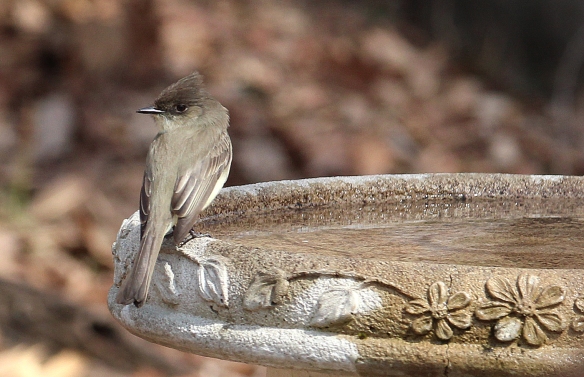
Photo by Chris Bosak An Eastern Phoebe visits a bird bath in Danbury, Conn., March 2016.
During the first spring at my house three years ago, I noticed a bird going back and forth under my neighbor’s lofted porch.
Closer inspection confirmed my suspicion that an eastern phoebe had a nest there. The mud-and-moss nest was built on an old row boat oar that hadn’t been used or moved in many years.
OK, a flat surface under a protected area, I thought as I plotted to create my own phoebe nest habitat for subsequent springs. I rummaged through the basement and found a rectangular piece of wood, approximately 14 inches by 18 inches. I nailed the wood to some of the 2x8s beneath my own porch. Even if the phoebes don’t use it, surely a robin would, I thought.
First spring, nothing. Second spring, nothing. Third spring, nothing. Three years and not even a stick placed on the platform.
But wait.
Not so fast on the third spring. April and May yielded nothing, but in early June I walked past the platform and noticed a small mud-and-moss nest on the wood. It wasn’t built on the main part of the platform, but rather an excess corner of the wood that jutted beyond one of the 2x8s. My dad would have called the excess “slop” because of its shoddy craftsmanship. But, hey, I wasn’t shooting for perfection, just good enough so a bird could build a nest. Besides, the slop turned out to be a fortunate “mistake.”
As of this writing, the nest holds five eggs. It is likely a second or third brood for this phoebe as they are one of the first birds to arrive in spring — usually by the middle of March.
But the news isn’t all good. Only four of the eggs are white phoebe eggs. A darker, mottled egg of a brown-headed cowbird is also in the nest.
Brown-headed cowbirds are brood parasites and lay their eggs in the nests of other birds, leaving the parental duties to the host bird. Phoebes are a common victim, as are other small birds such as warblers and sparrows. Brown-headed cowbird eggs typically hatch earlier than the other eggs and the baby cowbird grows at a faster rate. This makes the host bird work overtime to raise the cowbird, often at the expense of the other young birds.
Cowbirds do this because of their notorious nomadic nature.
So, just remove the cowbird egg, right? Not necessarily. The female cowbird monitors the nest and may destroy the nest altogether if the cowbird egg is disturbed — either by the host bird or human intervention.
An article I found on audubon.org brings up other legal and ethical questions. It used to be common practice to vilify cowbirds and everything they stood for. The no-good, lazy birds are destroying other birds and should be destroyed, was a common line of thinking — and still is for many people, I’m sure.
The Audubon article, written in 2018 by Amy Lewis, states that people shouldn’t interfere with nests that have cowbirds eggs. Firstly, it is illegal as per the Migratory Bird Treaty Act as cowbirds are native to the U.S. Though, technically, it is illegal to pick up a blue jay feather found on the ground, but not many people I know would hesitate to grab the feather.
The article, quoting several sources, also states that it is best to let nature take its course. Human feelings and morals should not interfere with something that has been going on in nature for hundreds of years.
It’s funny how research and science can change public opinion over time. Ten years ago I couldn’t imagine writing a bird column saying to leave cowbird eggs alone. I’m still somewhat on the fence about the whole thing as I imagine the phoebe under my porch working her tail off to raise a cowbird with possible grave consequences for her own babies.
But I will not interfere. I will watch the nest daily and see what happens. The first phoebe egg was laid on Tuesday, June 11. Another phoebe egg and the cowbird egg appeared on June 12. The phoebe laid another egg on Thursday and another on Friday. Photos of the eggs and nest may be found at www.birdsofnewengland.com.
That’s where we stand as of now. I’ll keep you posted.
Update: As of Friday, June 21, the nest remains with four phoebe eggs and one cowbird egg.
Photo by Chris Bosak A gray jay perches on the roof of a car in Pittsburg, N.H., November 2018.
Well, I did it again. Apparently I’ve been using the wrong name for a bird for the past year or so.
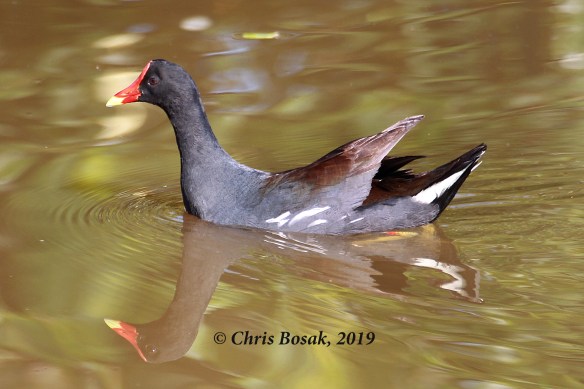
Recall a few weeks ago when I wrote about the common gallinule that had been seen near the Dillant-Hopkins Airport. Many people, myself included, initially referred to the bird as a common moorhen, the name previously used for the bird. In 2011, the American Ornithologists’ Union changed the name to common gallinule after splitting the species from a similar bird in Europe and Asia.
I’m not as far behind on this latest name change. In May 2018, just about a year ago, the union changed the name of the gray jay to the Canada jay. The handsome, bold bird of the north was historically called the Canada jay anyway, so it was really a change back to an old name.
I wrote a column back in November about a trip to Pittsburg, during Continue reading →
I’m heading to New Hampshire for a few days of camping. It’s been a while since I’ve paddled any lake, pond, or river in the Granite State and I’m looking forward to seeing what wildlife will be around. Of course, I’ll let you know when I return. In the meantime, here’s a For the Birds column from 2004 about this very subject …
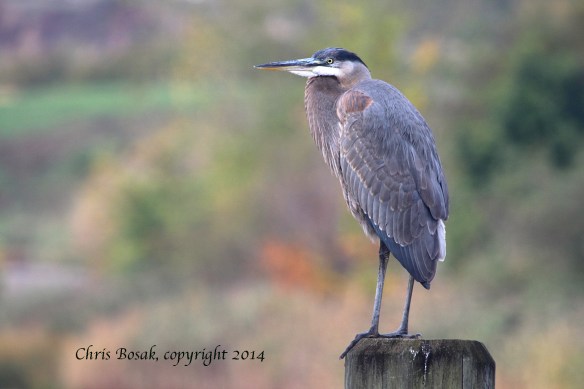
Photo by Chris Bosak A Great Blue Heron stands on a piling along the Norwalk River on Tuesday, Oct. 14, 2014.
A great blue heron lifted its skinny four-foot frame out of the water and used its six-foot wing span to carry it to another spot on the lazy river. It was spotted again around the next corner. A wood duck skulked into the vegetation and disappeared without a trace. Once a wood duck vanishes into the sea of huge green leaves, you can forget about seeing it again.
A muskrat braved a crossing at a swelled portion of the river, using its tail as a rudder. Marsh wrens proudly belted out their peculiar, almost comical, song.
Meanwhile, there were many constant companions. Red-winged blackbirds boisterously claimed various plots of the river’s edge as their own, dragonflies zigged and Continue reading →
Photo by Chris Bosak A Scarlet Tanager perches in a tree in Danbury, Conn., July 2016.
The sightings emailed in from readers have been so interesting that they have warranted being the topic of columns for several weeks in a row now. It’s creating a backlog of column ideas for me, but that’s a good problem to have. Besides, spring is the most active time for birdwatchers, so I shouldn’t be surprised.
A quick rundown of my own highlights as spring migration trails off and the birds get down to the important business of nesting:
I haven’t seen my rose-breasted grosbeaks in a few weeks. I’m hoping they are hunkered down on nests. I have, however, seen my ruby-throated hummingbirds Continue reading →
Here are the last two For the Birds columns, mostly focused on what readers have been seeing this spring.
Photo by Chris Bosak A male indigo bunting eats seeds from a platform feeder in Danbury, Conn., in May 2018.
If the past season was the Winter of the barred owl, this is the spring of the indigo bunting.
I’ve heard from numerous readers and friends throughout New England and even Canada about this bright blue bird visiting their backyards. The cause for excitement is obvious as it is one of our more colorful birds, flashing a brilliant blue plumage. The brilliance of the blue plumage is dependent upon the light.
It is also nice to hear that so many of these birds are around and delighting backyard birders in large numbers. Rose-breasted grosbeaks are another popular bird this spring. I’ve had limited luck with indigo buntings this spring, but for me, it’s been a banner year for rose-breasted grosbeaks. I’ve seen as many as three males in a tree overhanging my feeders. A female visits the feeders often as well.
It’s also been a good spring for warblers and nearly every walk last week yielded yellow warblers, common yellowthroats, black-and-white warblers, chestnut-sided warblers, American redstarts and yellow-rumped warblers.
I’m not the only birdwatcher enjoying a productive spring. Here’s what Continue reading →
Photo by Chris Bosak A common gallinule in Naples, Florida, April 2019.
Here’s the latest For the Birds column:
…
I brought up the subject of bird name changes last week. The column was about eastern towhees and how the ones we see here in the East were formerly called rufous-sided towhees.
I recently visited family in Florida and came across another interesting bird name change. Coincidently, it relates to a bird that paid a rare visit to Keene last week.
We were walking on a trail south of Naples and seeing many of the birds typically spotted in Florida. One of the more ubiquitous birds was the common moorhen. We kept hearing a rather strange bird, call so I took out my phone, launched my birding app and typed in “common moorhen” so I could find out what the bird sounded like.
Nothing came up. How could that be, I wondered. I know there is a bird called the common moorhen. I saw many of them the last time I was in Florida.
Phone service was spotty on the trail, so I couldn’t do an Internet search for common moorhen at the time. When we got back on the road I discovered why I couldn’t find common moorhen. The bird no longer exists as the common moorhen. The American Ornithologists’ Union split the U.S. bird from the similar marsh bird that is found in Europe and Asia.
The bird found overseas is called the Eurasian moorhen and the U.S. bird is now called the common gallinule. Florida has always had the purple gallinule; now Continue reading →
Photo by Chris Bosak Goldfinches at a feeder in Danbury, CT, April 2019.
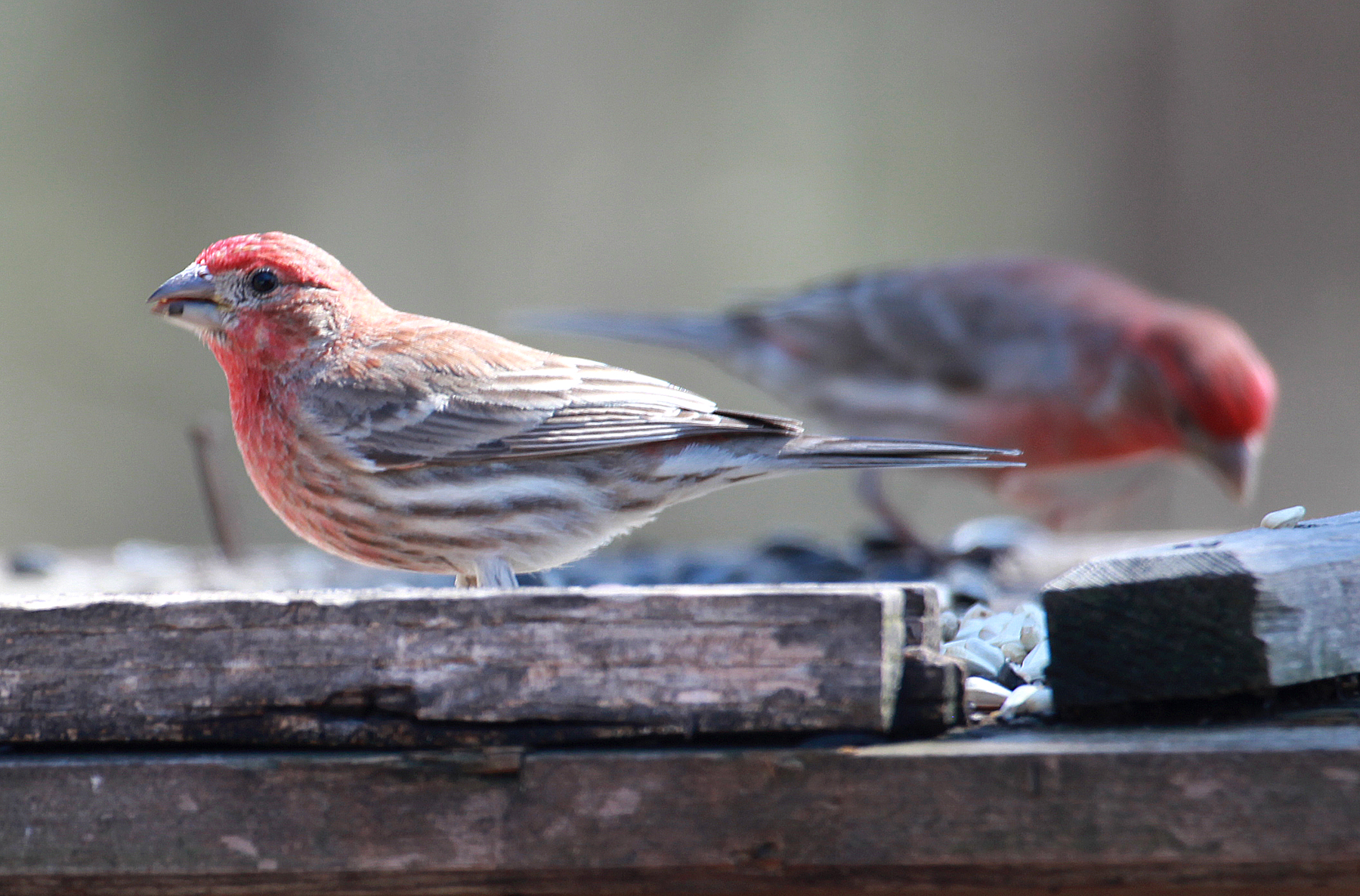
I’m laid up with a bum foot on this gorgeous New England spring day (grrrrrr) so tromping through the woods looking for warblers is out of the question. Some colorful visitors, however, have come to the feeders to keep me company. It’s been a finchy day with goldfinches (in bright summer garb) and house finches stopping by. I’m on the lookout for some purple finches.
Since I’m temporarily out of commission, let me know what spring birds you are seeing out there.
Photo by Chris Bosak
House finches at feeder in Danbury, CT, April 2019.


 I looked with my naked eye for several minutes, hoping to spot some motion to give away the bird’s location and identity. To my frustration, I couldn’t find a thing, even though I knew right where the song was coming from.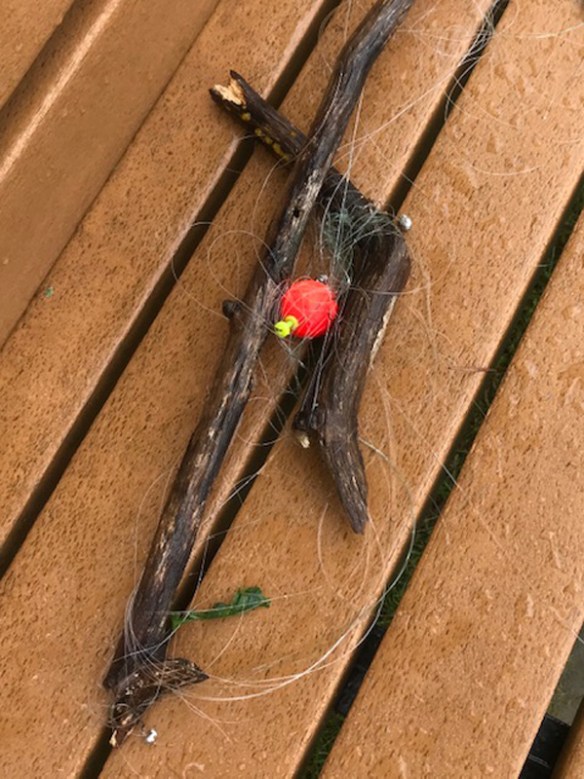







 Birds of New England.com