For the Birds: More sightings from readers

Photo by Chris Bosak
A Scarlet Tanager perches in a tree in Danbury, Conn., July 2016.

The sightings emailed in from readers have been so interesting that they have warranted being the topic of columns for several weeks in a row now. It’s creating a backlog of column ideas for me, but that’s a good problem to have. Besides, spring is the most active time for birdwatchers, so I shouldn’t be surprised.

A quick rundown of my own highlights as spring migration trails off and the birds get down to the important business of nesting:

I haven’t seen my rose-breasted grosbeaks in a few weeks. I’m hoping they are hunkered down on nests. I have, however, seen my ruby-throated hummingbirds Continue reading

Back to back For the Birds columns

Here are the last two For the Birds columns, mostly focused on what readers have been seeing this spring.

Photo by Chris Bosak A male indigo bunting eats seeds from a platform feeder in Danbury, Conn., in May 2018.

If the past season was the Winter of the barred owl, this is the spring of the indigo bunting.

I’ve heard from numerous readers and friends throughout New England and even Canada about this bright blue bird visiting their backyards. The cause for excitement is obvious as it is one of our more colorful birds, flashing a brilliant blue plumage. The brilliance of the blue plumage is dependent upon the light.

It is also nice to hear that so many of these birds are around and delighting backyard birders in large numbers. Rose-breasted grosbeaks are another popular bird this spring. I’ve had limited luck with indigo buntings this spring, but for me, it’s been a banner year for rose-breasted grosbeaks. I’ve seen as many as three males in a tree overhanging my feeders. A female visits the feeders often as well.

It’s also been a good spring for warblers and nearly every walk last week yielded yellow warblers, common yellowthroats, black-and-white warblers, chestnut-sided warblers, American redstarts and yellow-rumped warblers.

I’m not the only birdwatcher enjoying a productive spring. Here’s what Continue reading

For the Birds: Falling behind on name changes

Photo by Chris Bosak A common gallinule in Naples, Florida, April 2019.

Here’s the latest For the Birds column:

I brought up the subject of bird name changes last week. The column was about eastern towhees and how the ones we see here in the East were formerly called rufous-sided towhees.

I recently visited family in Florida and came across another interesting bird name change. Coincidently, it relates to a bird that paid a rare visit to Keene last week.

We were walking on a trail south of Naples and seeing many of the birds typically spotted in Florida. One of the more ubiquitous birds was the common moorhen. We kept hearing a rather strange bird, call so I took out my phone, launched my birding app and typed in “common moorhen” so I could find out what the bird sounded like.

Nothing came up. How could that be, I wondered. I know there is a bird called the common moorhen. I saw many of them the last time I was in Florida.

Phone service was spotty on the trail, so I couldn’t do an Internet search for common moorhen at the time. When we got back on the road I discovered why I couldn’t find common moorhen. The bird no longer exists as the common moorhen. The American Ornithologists’ Union split the U.S. bird from the similar marsh bird that is found in Europe and Asia.

The bird found overseas is called the Eurasian moorhen and the U.S. bird is now called the common gallinule. Florida has always had the purple gallinule; now Continue reading

Finchy Tuesday

Photo by Chris Bosak Goldfinches at a feeder in Danbury, CT, April 2019.

I’m laid up with a bum foot on this gorgeous New England spring day (grrrrrr) so tromping through the woods looking for warblers is out of the question. Some colorful visitors, however, have come to the feeders to keep me company. It’s been a finchy day with goldfinches (in bright summer garb) and house finches stopping by. I’m on the lookout for some purple finches.

Since I’m temporarily out of commission, let me know what spring birds you are seeing out there.

Photo by Chris Bosak House finches at feeder in Danbury, CT, April 2019.

For the Birds: Check those blotches carefully

Photo by Chris Bosak A Black-crowned Night Heron perches on a railing at a marina along the Norwalk River, Norwalk, Conn., spring 2016.
Photo by Chris Bosak
A Black-crowned Night Heron perches on a railing at a marina along the Norwalk River, Norwalk, Conn., spring 2016.

Birders have to follow through on the blotches in the distance.

Usually they end up being plastic bags or Mylar balloons stuck in trees, odd-looking knots on tree trunks or some other strange objects that look out of place. Sometimes, though, they end up being birds, which is why we birders have to do our diligence.

One summer morning while canoeing at Pillsbury State Park, I was excited to see a great horned owl sitting at the edge of the pond. Strange place for a great horned owl, I thought as I continued to slowly paddle in for a closer look.

I closed the distance substantially, and the owl remained at the pond’s edge, looking right at me. I slowly got my camera ready and continued drifting toward the large bird. I lifted the camera to my face and zoomed in, ready to capture my best owl images to date.

As I zoomed in I realized something rather embarrassing. My great horned owl was actually the top of a dead tree at the edge of the pond. This tree was a dead ringer for an owl, complete with ear tufts, eyes and rounded body.

I laughed out loud and was thankful no one else was around to witness my buffoonery.

My stories of mistaking plastic grocery bags for hawks along highway roads are practically endless. Mylar balloons are another oft-seen “bird” in the trees.

Last week, though, I was rewarded by following through on a blotch in the distance. It didn’t turn out to be a rarity or a new bird for me, but it was nice just the same to have a blotch actually turn out to be a bird — a black-crowned night heron, to be exact.

I was driving along one side of a pond in southern Connecticut when I stopped at a stop sign to turn right, away from the pond. As I glanced left to check for oncoming cars, I noticed something gray and upright at the far edge of the pond. I figured it was a stick or large piece of trash. I turned right and started driving away from the pond, but the possibility of the object actually being a bird kept nagging at me.

I hit the brakes, found the next safe place to turn around and returned to the pond. A stone wall prevented me from seeing the edge of the pond where I had previously seen the object. I parked, walked to the pond and found the black-crowned night heron standing in the same exact spot where I had seen it before.

I watched it for a couple of minutes as it stood deadly still, as all waders are so adept at doing. Finally it took two slow, careful steps and plunged its bill into the water. It pulled out a painted turtle and immediately returned the prey to the water.

I grabbed a few photographs — they all turned out lousy as the bird was in a heavily shaded area — and started to return to the car when something else caught my eye. It was a big white object on the far side of the pond. I knew immediately that this object was a great egret, not just a blotch.

As I walked toward the egret, I wondered how I missed it the first time I had driven by the pond. I stood behind a tree watching the impressive white bird stalk the pond’s edge as it lunged its head into the water. The egret caught a small sunfish — much easier prey for a bird to handle than a turtle — and adjusted the fish in its bill before finishing the meal.

I’ve seen plenty of black-crowned night herons and great egrets in my life, but I was happy to see the birds that day. I was glad my instincts paid off and convinced me to turn the car around.

Actually seeing real birds made up for a few of those plastic bag “bird” sightings that I’ve had over the years.

For the Birds: Merganser mania

Photo by Chris Bosak Hooded Mergansers swim in a small unfrozen section of water at Selleck's/Dunlap in Darien, Conn., in Feb. 2014.
Photo by Chris Bosak
Hooded Mergansers swim in a small unfrozen section of water at Selleck’s/Dunlap in Darien, Conn., in Feb. 2014.

Last week, I wrote about seeing three common mergansers on a small pond by a busy shopping mall. Mergansers are typically wary and I was surprised to see the fowl there.

The next day, I drove past Candlewood Lake — a large man-made body of water in southwestern Connecticut — and saw literally thousands upon thousands of common mergansers. The lake was still about half frozen and many of the unfrozen portions were covered with mergansers. Some of the mergansers used the icy edges as a resting spot; others swam in the rippling water.

That setting seemed to me to be a more appropriate spot for common mergansers than the mall-area one. It got me to thinking about the merganser family and their water preferences.

We have three types of mergansers in New England: common, hooded and red-breasted. Generally speaking, they all have different water preferences.

Common mergansers are usually spotted on large, freshwater lakes and rivers. Hooded mergansers favor smaller bodies of water and may be found on fresh or brackish water. Red-breasted mergansers may be found on large bodies of fresh, brackish or salt water.

I have yet to see all three mergansers sharing a common body of water, but I have seen hooded and commons together, and hooded and red-breasted mergansers together. All three are generally wary in nature. From my own observations, I find the common to be the most wary and hooded the most brave.

The hooded merganser is the oddball among them in terms of appearance. They are small ducks and the males are handsomely adorned with pewter sides, black backs and black-and-white heads and chests. Their heads are usually fanned to display a large white patch, but can also be flatted to show just a sliver of white. Female hoodeds are similar in size to the male but are duller in color and design.

Male common and red-breasted mergansers are similar in general appearance with dark green heads, red bills, large white bodies and black backs. There are obvious differences between them, too. The common is much larger and smoother looking. Red-breasted merganser males have spiky “haircuts,” light red breasts and slightly darker sides.

The females are slightly more difficult to differentiate. Female commons are larger, brighter and have a dark rusty head with a funky haircut. Female red-breasted mergansers have a funky haircut, too, but are smaller, darker and have duller, brownish heads.

All three merganser varieties have serrated bills for holding onto fish and other wiggly prey. Those bills have earned the family the nickname sawbill.

Ducks are one of my favorite types of birds to watch and mergansers are my favorite family of fowl. So far the spring migration has been a merganser bonanza. I hope it continues.

Photo by Chris Bosak
A common merganser swims in a pond in Danbury, Conn., March 2019.
Photo by Chris Bosak A female common merganser swims in a pond in Danbury, Conn., March 2019.
Photo by Chris Bosak
A female Red-breasted Merganser swims in Norwalk Harbor in this March 2014 photo.
Photo by Chris Bosak
Male red-breasted merganser.

For the Birds: Mergansers are back

Photo by Chris Bosak A common merganser swims in a pond in Danbury, Conn., March 2019.

I haven’t written about ducks in a long time. I used to write about them often because waterfowl are arguably my favorite type of bird to watch.

My budding interest in birdwatching became an obsession when I discovered a huge flock of common mergansers on Powder Mill Pond. The number of birds in the flock and the birds’ size and beauty fascinated me. I can’t believe that happened back in the 1990s. Time sure flies.

I’ve been a huge fan of ducks, especially mergansers, ever since. I have canoed hundreds of miles, spent hours behind blinds in swampy areas, and stood on many shorelines with my eye pressed against a spotting scope in search of ducks.

But for whatever reason, I just haven’t written about ducks lately. I guess none of my recent waterfowl experiences have captivated me enough to do so.

That is until the other day, when I saw a few common mergansers in a very unlikely place. Common mergansers typically favor large freshwater bodies, such as lakes, large ponds or wide rivers. Every so often, however, they may be spotted on much smaller bodies of water.

Not only was my recent sighting on a very small body of water, not even big enough to be considered a pond, but it was also in the shadow of a bustling shopping mall.

Danbury Fair is a mall in western Connecticut. It has a large, inaccessible marshy area behind it and a few very small ponds, if you can call them that, on the sides and in the front. It is a highly developed area, so a variety of wildlife does not thrive there.

It is, however, a fairly reliable place to spot birds such as great blue herons, belted kingfishers, mute swans, Canada geese, American and fish crows, and, of course, mallards. During spring and fall migration times some surprises can show up, which is what keeps me coming back to the spot, even for just a quick loop.

In the few years I have been drive-by birding at the mall, I have seen the aforementioned common species, as well as northern pintail, pied-billed grebes and hooded mergansers.

I associate common mergansers with more wild areas, so I was surprised to see two males and one female swimming in one of these tiny ponds with a steady stream of cars driving by on both sides. Two male hooded mergansers and a few mallards shared the pond.

I found a safe place to pull over in my car and checked out the scene through an open passenger’s side window. I grabbed a few quick photos but the ducks slowly swam away in the opposite direction and did not seem comfortable with the stopped car by the pond.

Common mergansers, I’ve discovered over the years, are quite wary and not at all tolerant of any perceived threat. I didn’t want to further stress them during migration so I quickly pulled out and joined the flow of moving cars.

It had been several years since I had seen common mergansers so close. I find them to be the most wary of New England’s three merganser varieties.

Breaking down the merganser varieties requires its own column because they are so different in many ways, but they also share some similarities. I guess you know what next week’s column will be about.

It sure is nice to be writing about ducks again.

For the Birds: Marching through winter

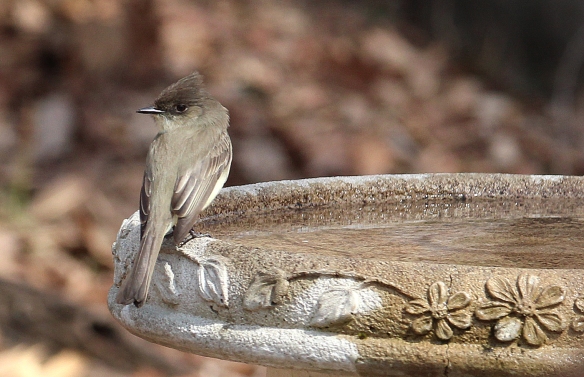
Photo by Chris Bosak An Eastern Phoebe perches on a branch in Selleck's Woods in Darien, Conn., in late March 2015.
Photo by Chris Bosak
Eastern Phoebes are one of the first songbirds to arrive in New England during the spring migration.

March can be a tough month for birders.

Winter is getting long and the season seems to be extending each year. It’s already been a snowy month this year, counting Sunday, and remember last March was ridiculously cold and snowy, even pushing into April.

March is also a time of anticipation for birders as the spring migration starts to pick up by the end of the month. Early red-winged blackbirds, for instance, began arriving in February, but March is really when the migration begins in New England.

April, of course, is when it heats up significantly before peaking in May. By the end of March, however, we can expect to see birds such as tree swallows, purple martins and hermit thrushes returning to our region.

To me, the surest sign of spring is the return of eastern phoebes in late March. The robin is still considered the traditional harbinger of spring even though many of them spent their winters in New England. I rejoice when I see the first phoebe perched on a branch in my backyard bobbing its tail endlessly.

March birding is not limited to the late-month migrants. American woodcock, with their amazing evening aerial displays, are a highlight species of the month. I’ve never had great luck finding woodcock. Maybe this will be my year. (I say that every year.) Also, ducks start moving north to open water in big numbers in March.

One of the best things about March birdwatching, however, is that it’s still winter and our winter birds are still around. Chickadees, titmice, nuthatches, cardinals, blue jays, mourning doves and woodpeckers still have the feeders to themselves, for the most part. Any winter finches that have come south to New England may still be around. I’m still getting dozens of pine siskins daily.

I noticed another sign of spring in the bird world the other day as a male American goldfinch with bright yellow splotches visited the tube feeder. The brightness stood out as a shade of yellow not seen in many months.

The barred owl barrage continues throughout New England, too, as reports pile up. A friend of mine had one visit a pine tree behind her unit in a condominium complex last week. The owl remained most of the day before disappearing in late afternoon.

March may be tough in terms of waiting out the winter and anticipating what is to come, but it offers much to the patient birder.

For the Birds: Joining the owl party

I’ve written about my barred owl sightings before, but here is the official column version …

Photo by Chris Bosak
A barred owl perches on a Welcome to New York sign on the border of Hoosick Falls, N.Y., and Bennignton, Vermont, in February 2019.

Two weeks ago I wrote a column about the Winter of the Barred Owl. A photo sent in by a reader from Westmoreland showing a barred owl perched on a feeder pole in his backyard accompanied the column.

A day or two after the column was published, I received two more photos of barred owls perched on feeder poles in the Monadnock Region. Yes, these handsome, large owls have been quite prolific throughout New England this winter.

At the time of that writing, however, I hadn’t yet seen any barred owls myself this winter. That all changed with a visit to my brother, who lives in Hoosick Falls, N.Y., a small town just over the border from Bennington, Vt.

My son Andrew and I had a day of skiing planned at Mount Snow, and figured Continue reading

Barred owls abound

After my latest bird column published in The Keene Sentinel this week, I received a few additional photos of barred owls from readers in SW New Hampshire. Funny how they are showing up on feeding poles so often.

Here is the column explaining the Year of the Barred Owl.

First (below) is the original photo I received and then two additional ones.

Photo by Bob Sullivan
This barred owl perched on a bird feeding pole and took several dives at a vole under the snow in Westmoreland, N.H.
Photo by Dale Woodward This barred owl was spotted on a feeder pole in February 2019 in Walpole Village, N.H.
Photo by Rick Allen This barred owl perched on a feeder pole in Swanzey, N.H., during February 2019.