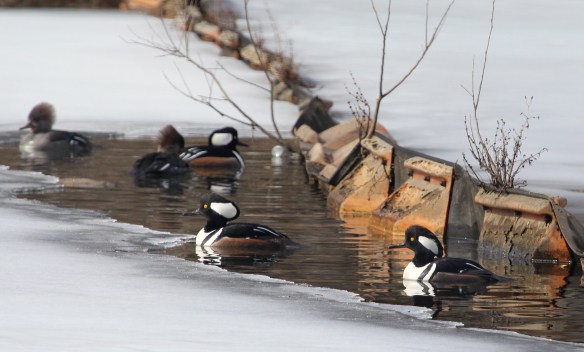
Photo by Chris Bosak Hooded mergansers in New England.
I have written extensively about the recent study that shows bird populations in North America have dropped by 29 percent over the last 50 years. While the news overall is concerning, the study did reveal some bright spots.
One piece of good news is that ducks appear to be increasing. Waterfowl are a favorite bird type of mine so this news was heartening. Give me a cool late autumn day, a large pond, a spotting scope and ducks swimming all around, and I’m as happy as a lark.
The duck population increase, in large part, is credited to wetland conservation efforts, much of which was and continues to be paid for by hunters. While this has worked exceptionally well for ducks, it hasn’t worked out quite as well for rails and other marsh birds. There is still work to be done in that area.
But let’s stay positive for this column. Preserving wetlands has led to increased duck numbers. No one can say more ducks is a bad thing.
It also stresses the importance of land conservation as a powerful tool in preserving our birds and other animals. While hunters, through the purchase of stamps and other fees, have contributed mightily to this effort, conserving land is something easily done by anyone. Support your local land trust or other conservation organization Continue reading →
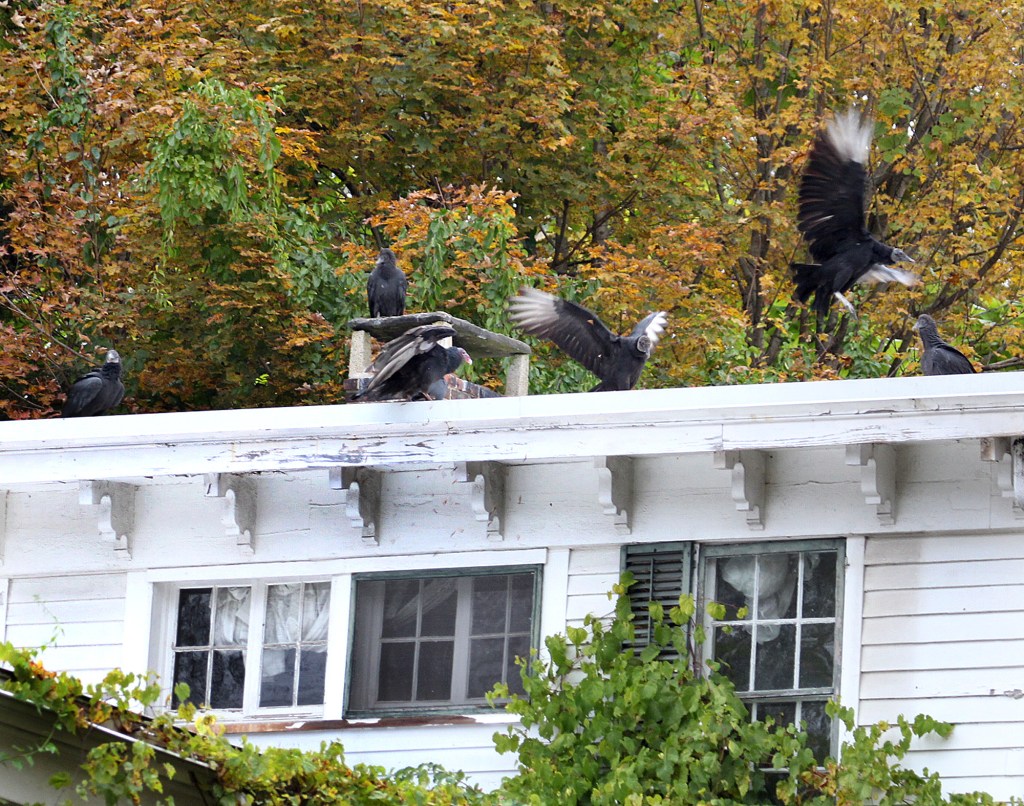
Photo by Chris Bosak Turkey and black vultures perch on the roof of a house in New England, fall 2019.
Savanna and I reached the overlook and watched a bald eagle soaring above a sizable flock of Canada geese. The geese knew they were too big to be a target for the huge bird of prey so they went about their day as usual on the river.
After a few minutes, the bald eagle landed on a half-dead tree along the shoreline and settled in on its perch overlooking the slightly rippling water. Before we left the spot, a gang of blue jays flushed a sharp-shinned hawk out of an evergreen. We tried to follow the small hawk’s path but quickly lost sight of it among the trees growing up from the side of the cliff.
We returned to the car and pulled out of the parking lot, listening as a Carolina wren and late-staying gray catbird sang from the nearby brush.
Then the outing took a creepy turn.
We soon passed a sign for a haunted village in another park nearby. It was midday and the haunted village wasn’t going to open for another week, but we decided Continue reading →
Here is the latest For the Birds column, which runs in several New England publications.
Photo by Chris Bosak
An osprey eats a catfish at Cayuga Lake State Park, October 2019.
Summer is hanging on, if only by a thread.
It’s always fun to see the nutty people who refuse to dig into their long-dormant jeans pile and insist on wearing shorts even when the temperature dips into the 40s. I see one of those yokels every time I walk past a mirror.
In the natural world, some flowers are still putting on a show, but it’s mostly the late bloomers such as goldenrod and asters. Some, but not many, traditional summer bloomers are toughing it out, but store-bought mums are the most commonly seen flowers these days.
The other day I walked past a pollinator garden and a monarch caterpillar stuck out like a sore thumb on the top of a milkweed plant. I hope the caterpillar does what it has to do quickly before the prolonged deep freezes come. It also made me think of all the fields that have been cut down already and I wonder how many monarch caterpillars lost their homes because of it.
Eastern phoebes, which are one of our first migrants to appear in spring with their late March arrivals, are still seen from time to time. I saw a few perched over a pond and bobbing their tails last week. The tangle of brush a few yards away from the pond was teeming with white-throated sparrows, however; a sure sign of fall and pending winter.
I had another exciting reminder of summer during a recent camping trip I took with some long-time friends. We were having breakfast at the picnic table when Wayne pointed to a distant snag and asked: “Is that a hawk or what?”
We grabbed the binoculars and trained them on an osprey eating a fish. We closed in on the dead tree for a closer look and noticed the bird was eating a fair-sized catfish. No blackened seasoning was necessary as the “fish hawk” tore through the skin and into the meat of the fish. Anyone who has ever caught a catfish knows how tough that skin is. The osprey didn’t struggle in the least.
I attended a presentation last week by Alan Poole, the author of two books on osprey. His latest book is “Ospreys: The Revival of a Global Raptor.”
Poole noted interestingly that an osprey has self-sharpening talons. The hard upper part of the talon, or claw, grows at a faster rate than the softer under part of the talon, leaving the large bird of prey with sharp claws at all times.
The osprey we watched did not push the timetable too far, but most ospreys in New England and nearby states have started their journey south by the end of September. Ospreys are not like most hawks and eagles whereby some individuals remain north throughout winter. All ospreys go south so to see one in October is a nice treat for a birdwatcher.
Poole noted that, while ospreys do mate for life, they go on separate migratory journeys.
Much of Poole’s presentation focused on the amazing comeback of the osprey population. After being nearly wiped out in the 1950s due to heavy pesticide use, the osprey has made a remarkable comeback and is now flourishing in North America and northern Europe, as well as on their winter grounds in South America and Africa.
The population turnaround is welcomed news considering the study released a few weeks ago that shows that North America has lost 29 percent of its birds in the last 50 years.
Poole concluded his presentation with this: “Ospreys are a good example that we can get things right if we pay attention and get organized.
Photo by Chris Bosak Tufted titmice gather near a container with coneflower during November 2018. Coneflower is a native plant that attracts birds.
The study released a few weeks ago that reported a 29 percent decline in the number of birds in North America since 1970 did not merely throw out some discouraging facts and leave it at that.
It also included many reasons why bird populations are decreasing, most notably habitat loss. There is not a whole lot the average person can do about habitat loss — other than plead with local officials to stop the development of critical habitat. But the authors of the study did include seven actions that we can all do to help improve birds’ chances of survival.
The actions are as follows: use native plants, avoid pesticides, keep cats indoors, make windows safer, do citizen science, reduce the use of plastic and drink shade-grown coffee. Now, let’s take a closer look at each of these actions.
Planting native flowers, bushes and trees gives birds and insects a source of food they have evolved with. It restores the natural balance of an area and limits the spread of invasive plant species. A simple internet search will yield dozens upon dozens of bird-friendly native choices for your garden and yard.
Pesticides should be avoided for much the same reason. Killing off insects, especially native insects, limits the food available for birds. Many birds rely on insects as the main part of their diet. This is particularly important during the nesting season as birds feed their youngsters and teach their fledglings how to hunt. If an area is void of insects, it is likely void of birds.
I know how difficult it can be to keep cats indoors. Most cats want to be outdoors and it’s hard to deny them that desire. My cat sneaks out on occasion when I have my hands full of groceries and the screen door closes too slowly, so I have work to do in this area as well. But it really is in the birds’ best interest to keep kitty inside. Feral cats? That’s another bigger problem.
If you have some particularly problematic windows that bird keep crashing into, consider buying decals to put on the outside of those windows. The decals are relatively unobtrusive and may be found at bird stores or online. The decals break up the scene that may otherwise be confused as an extension of the outdoors. Building windows? That’s a way bigger problem that many developers are starting to address with bird-friendly design.
Participating in citizen science projects such as the Great Backyard Bird Count, Christmas Bird Count and Project Feeder Watch gives important data to ornithologists that they use to track bird population trends. In fact, this data was a key source of information for the latest study.
There are several easy steps to take to reduce the amount of plastic used. Reusable water bottles, although many are made of plastic, greatly reduce waste. Filling a water bottle each morning instead of drinking two or three store-bought waters has a great impact over the course of time.
Similarly, reusable shopping bags reduce the need for the one-time use plastic bags. That also keeps those annoying bags out of trees, which I often mistake for birds from a distance.
Industrial-scale coffee plantations are an environmental nightmare as large swaths of land are clear cut on many birds’ winter grounds. Thankfully there are many bird-friendly, shade-grown options. Birds and Beans brand is based in New England.
Employing some of these strategies will help the birds that live in and around your property. It may seem like a drop in the bucket compared to the 2.9 billion birds that have disappeared in the last 50 years, but enough drops will eventually overfill a bucket.
Photo by Chris Bosak A European Starling in winter plumage perches on an old sunflower stalk, Dec. 2014.
The study released two weeks ago by the journal Science is worth another look.
As you recall from last week’s column, a collaboration of top bird and conservation organizations performed perhaps the most exhaustive study of the North American bird population and released the results two weeks ago.
The study, which reported a decline in the bird population of 29 percent or nearly three billion birds over the last 50 years, garnered significant attention in the media and science arena. The attention is well deserved as the results are quite shocking and put a number on the decline of birds, which we all knew was happening to some degree.
Most of the immediate media attention focused on the precipitous drop in bird populations and echoed the report’s call for significant action to be taken before it’s too late. That call to action is certainly appropriate and the report most definitely is a wake-up call to everybody on the planet. Some analysts, however, upon taking a deeper dive into the report’s number, see it as not the doomsday scenario that many are painting it to be. They acknowledge, for sure, that it is a big problem and steps should be taken to reverse the trend, but they say mass extinction is not imminent.
According to an article published by undark.org, a nonprofit organization that explores the “intersection of science and society,” the numbers inside the numbers show where much of the decline comes from. Citing a blog post by University of Maine macro-ecologist Brian McGill, the article states that a significant portion of the decline comes from invasive species. House sparrows and European starlings account for 15 percent of the net loss of birds.
On the other hand, if highly adaptable birds such as house sparrows and starlings are declining so much, then something is wrong.
Other sources in the undark.org story point out that most of the top 40 declining species are very abundant and an extinction is not around the corner. Taking the top 40 declining species out of the picture, more bird species are increasing rather than decreasing.
To me, the loss of three billion birds is significant regardless of the particulars. Look at it this way, if we’ve lost 29 percent of our birds, then instead of seeing 100 birds a day, we’d see 71 birds. That’s an oversimplification, of course, but paints a picture of how dramatic the decline is.
The research team, including the American Bird Conservancy, Audubon Society, Cornell Lab of Ornithology, Smithsonian Institute, U.S. Geological Survey and Canadian Wildlife Service, launched the website 3billionbirds.org after releasing the study. The site includes text, graphics and videos to augment the media coverage the report has already received. It also includes steps you can take at home to help save birds.
I’ll take a look at those steps in next week’s column. In the meantime (warning: spoiler alert), keep kitty inside and don’t spray your plants.
Here’s another classic For the Birds column, this one originally printed in the fall of 2007. Andrew was five, Will was two, the economy was starting to unravel.
…
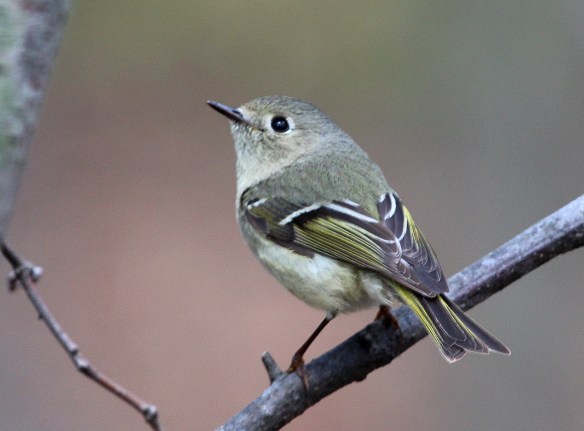
Photo by Chris Bosak A Ruby-crowned Kinglet perches in a tree at Selleck’s/Dunlap Woods on May 5, 2014.
We’re losing birds daily as the days get shorter and nights get cooler. That’s the pessimistic view.
We’re gaining birds daily, too, as the days get shorter and nights get cooler. I like that one better. I try to be a glass-half-full type of guy, even as my 401k plunges into the abyss.
Fall migration is a funny thing for birdwatchers in New England. We say goodbye until next spring to some birds, such as oystercatchers, ospreys, and hummingbirds; and hello to our winter birds such as white-throated sparrows, juncos, and ducks of all shapes and sizes. In the meantime, birds that nest north of here and winter south of here will pass through like a train in no particular hurry to reach its destination.
Now is the time to concentrate on those varieties. The kinglets, warblers and vireos of the bird world. Our summer birds have been with us for months. The winter birds will be here soon and stay with us until spring. The migrants are fleeting. That’s why they’re called migrants.
Kinglets are my favorite fall migrant to watch. A tiny bird that would easily fit in the palm of your hand, kinglets are energetic little bundles of joy. We have two varieties in New England: ruby-crowned and golden-crowned. For the most part they migrate through New England at different times, but I once watched from my kitchen window a ruby-crowned and golden-crowned sharing the same hemlock branch.
Kinglets are not shy and will often hunt for tiny insects within arm’s reach of any human patient enough to stand still long and learn its hunting pattern. They hunt high in trees, along the tops of average-sized bushes and even along the ground. I once watched a ruby-crowned kinglet hunt on a sandy beach a few autumn’s past.
Warblers are the jewels of the bird world in the spring. They are colorful, spritely and somewhat easy to identify if you can get a good look at them. In the fall, they are still sought after, but often painfully confusing for birdwatchers. The males of most species, resplendent in their breeding plumage in the spring, sport feathers that are dulled by age and the toils of summer by fall. First-year birds — mere helpless naked babies a few months ago — are passing through New England in their confusing neither-here-nor-there plumage.
I had an unfortunate warbler sighting last weekend. I was walking along a long road with my five-year-old, Andrew, and two-year-old, Will. First, let me clarify the walking situation. We had just spent a wonderful, but exhausting morning/early afternoon at an Aquarium in southern New England. We had to walk a fair distance back to the car, but the kids were in no mood to walk under their own power anymore — especially if sharks and seals were not involved — so I had Will on my shoulders and Andrew in my arms. I love them to death, but they are getting heavy.
Suddenly Andrew, who was facing backwards, says, “Daddy, you just walked past a bird.” Sure enough, there on the sidewalk was a dead black-throated blue warbler. I put the kids down and examined the bird. It was perfectly intact and likely either collided with a window or simply fell exhausted from the sky. Not that I particularly enjoyed that warbler sighting, but it did serve as an educational lesson for Andrew and Will, and was a mighty handsome subject at that. (It also gave me a little break from carrying two growing boys.)
Double-crested cormorants made for another educational lesson that morning. The cormorants were alive and well, and this lesson was actually fun — at least I thought so, anyway. Cormorants are large diving water birds. When they swim pretty much only their long necks are above the water, making them look like swimming snakes. There were about a dozen of them swimming under a railroad bridge in a river. It was Andrew’s job to first find them and then count them. The game could have gone on for hours as the diving cormorants became “new” birds each time they resurfaced. He got to about 30 before the game got old and we went back into the Aquarium.
Soon, the double-crested cormorants will be gone and great cormorants will take their place along New England’s coast for the winter. Also before long, waterfowl of many varieties will arrive in New England. Some will merely pass through and some will stay all winter.
The days are going to get even shorter and the temperatures are going to get a lot colder. Those ducks, however, will help us get through the winter. They always do.
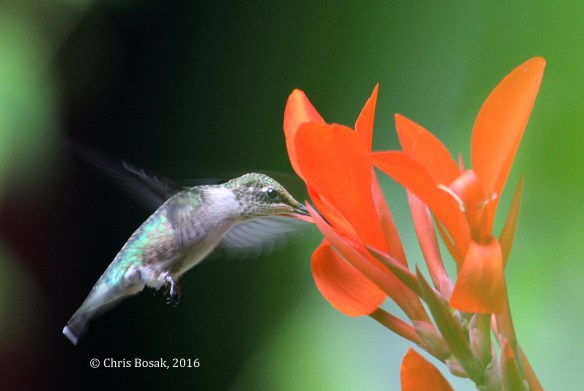
Photo by Chris Bosak A Ruby-throated Hummingbird sips nectar from Canna flower in Danbury, Conn., summer 2016.
I almost hate to say it but summer 2019 is nearly over.
I say “almost” because fall is up next and who doesn’t love a New England fall? In the bird world, it’s pretty much fall already, so really the calendar is the only thing standing in the way of autumn.
With that said, this seems like an appropriate time to reflect on this past summer. I had several birding and other nature highlights, most notably a camping trip to Pillsbury State Park in nearby Washington.
I was lucky enough while canoeing to share the main pond with three loons bright and early one morning. No matter how many times I experience it, I will always be in awe of the scene: sun peaking above the hills in the east, mist rising off the water and loons starting their day with a slow swim around their pond. A yodel or two from the loons completes the scene.
Such was the case at Pillsbury this summer, only instead of the usual one or two loons, there were three. It’s easy to see why the common loon is such an iconic bird in New England.
The bald eagles at Bashakill National Wildlife Refuge in N.Y. were another highlight.
The backyard highlight of the summer, echoing the highlight of the past few summers, was watching the hummingbird family that split their time between the feeders and flowers. This year, I had salvia, fuschia, sunflowers and rose-of-Sharon to offer. They enjoyed them all.
But mostly they drank from the feeders, as usual. I had to put three feeders out this year to mitigate the bickering among the tiny birds.
Recently, however, the visits by hummingbirds have slowed and it is not because of the wasps and black ants that try to take over the feeders. It’s because hummingbirds migrate in late August and early September. The adult males take off for points south first, followed by the females and first-year birds. I still see hummingbirds at the feeders, but the frequency has fallen and the birds are likely not “my” hummingbirds, but rather other south-bound migrants.
Which brings up the age-old question: Is it OK to feed hummingbirds in the fall or will they stick around and migrate too late if food is available? Studies have shown that hummingbirds are triggered to move south by the shortening of the days, not the weather or availability of food. In fact, an argument may be made that it’s beneficial to continue to feed them as these tiny birds essentially have to double their weight as they make their journey to Mexico and Central America.
The vast majority of the hummingbirds will be gone by the end of the month. By then, even the calendar will have yielded and fall will have its run of New England.
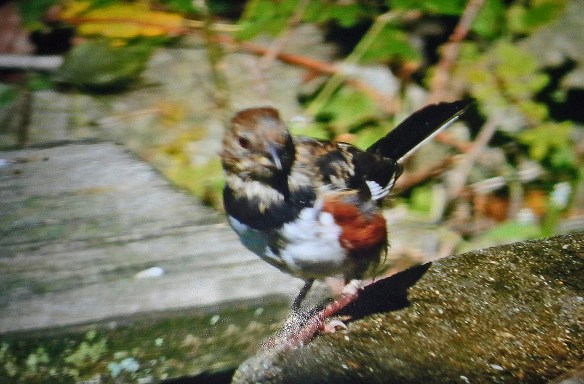
Photo by Elena Heiden A molting eastern towhee seen in Winchester, N.H., summer 2019.
I have written several times about the difficulties of bird identification in the fall. I have noted that males often lose their breeding plumage and look much more dull in the fall. The other day I spotted a male scarlet tanager in an apple tree. It looked nothing like the spectacular red-and-black bird that it looked like in the spring. Rather, it was a dirty yellow overall, but the dark wings gave it away as a tanager.
I have noted that first-year birds are heading south for the first time and haven’t reached adult plumage yet. Also, female birds, which often do not resemble males, are not quite as secretive as they are in the spring and are seen more often this time of year. What I failed to mention, however, is that late summer and early fall is also when many birds are going through a molting process. This only adds to the confusion of the challenging fall migration.
I was reminded of this when a photo came through from Elena of Winchester showing a very oddly plumaged bird. The rusty, or rufous, feathers on its side gave the bird away as an eastern towhee, but otherwise the bird looked nothing like the male or Continue reading →
Photo by Chris Bosak — The hawk migration is a highlight of the fall bird migration in New England.
There is more to the fall migration than hawk watches on top of mountains. Watching raptors effortlessly soar among the thermals is indeed the highlight of the fall migration, but everything from shorebirds and songbirds to waders and waterfowl move south in the fall as well.
The fall migration does not garner as much enthusiasm as the spring migration among most birders for many reasons, I believe.
The height of the spring migration is concentrated into a predictable three- or four-week period when you are assured of seeing many colorful songbirds. The fall migration is more spread out. It actually started in July with some shorebirds moving south and will Continue reading →
Here’s a For the Birds column from 15 years ago. Yes, I’ve been writing it for that long, and even longer. Enjoy …
Photo by Chris Bosak A Snowy Egret looks for food in Norwalk Harbor.
It’s funny how things that seem so difficult at the beginning eventually become so easy. It can be said of just about any hobby, but it certainly applies to birdwatching. I can remember struggling with differentiating great egrets from snowy egrets. It seems somewhat silly now. Great egrets are markedly larger, have yellow bills and black legs and feet. Snowy egrets, aside from being much smaller, have black bills and yellow feet. The differences are clear and obvious now. But, as a beginner, I saw only tall Continue reading →