Latest For the Birds column: Red-breasted Nuthatch right on cue

A Red-breasted Nuthatch perches near a birdfeeding station in Danbury, Conn., Oct. 2016.

A Red-breasted Nuthatch perches near a bird feeding station in Danbury, Conn., Oct. 2016.

Here’s the latest For the Birds column, which runs weekly in The Hour (Norwalk, Conn.), The Keene (NH) Sentinel and several Connecticut weekly newspapers.

I wrote three weeks ago about my affinity for the nuthatches we see in New England.

In the middle and southern parts of the region we see white-breasted nuthatches much more frequently than its smaller cousin, the red-breasted nuthatch. The latter variety, however, is seen more often in the northern reaches of New England.

The red-breasted nuthatch does show up at feeders in the middle and southern parts, especially in fall and winter, but not too often and in varying degrees depending on the year. In fact, the little birds will venture all the way to Florida during winter migration.

With that said, I was happy to receive an email from Dean a few days after that column appeared.

“You mentioned red-breasted nuthatches, which reminded me that I have not seen one in years,” Dean wrote from his Marlborough, Conn., home. “They are such cute little birds. Then two days after your article what shows up but an RBN at the feeder.”

A few days after Dean wrote me that email, I was sitting on my deck watching my feeders. It was an unending flurry of black-capped chickadees, tufted titmice, white-breasted nuthatches and downy woodpeckers. I got so tuned into seeing those species that it didn’t immediately register in my brain that a new arrival had appeared.

Continue reading

Latest For the Birds column: Owls come a’hootin’

Photo by Chris Bosak A young Barred Owl clings to a branch in the woods in Danbury, Conn., spring 2016.

Photo by Chris Bosak
A young Barred Owl clings to a branch in the woods in Danbury, Conn., spring 2016.

Here’s the latest For the Birds column, which runs weekly in The Hour (Norwalk, Conn.), The Keene (NH) Sentinel and several Connecticut weekly newspapers edited by Jerrod Ferrari.

….

Throughout my birding “career,” I haven’t had great luck with owls.

I get the occasional look at a great horned owl and have only slightly better luck with finding barred owls. I’ve had modest success with snowy owls along the Long Island Sound coast in certain winters, especially during that banner year a few winters back. Short-eared owls, long-eared Owls, saw-whet owls, even screech owls? Hardly a glimpse.

But this fall has been pretty good so far in terms of owling. Not that I’ve actually seen owls — even a single one — but I have heard plenty of them. It started about two weeks ago when I heard a barred owl in the woods while I was sitting on my deck at dusk.

Then, a few nights ago, I heard a great horned owl. I knew it was fairly close, but I couldn’t pinpoint exactly where it was.

Two nights later, I had a great night of owling, and I didn’t even have to leave my yard. I heard two great horned owls calling to each other, one of which was in my side yard. I didn’t see it, as it was pitch dark, but the sound was definitely coming from close by.

The owls hooted to each other all night. I know it was all night because I was up most of it worrying about my house cat that happened to get out that night. He picked a great night to get out — the night two great horned owls are scanning the neighborhood.

At one point that night, I heard a pair of barred owls in the distance, too. I had never heard any owls from my yard before, and now I was hearing two species in one night.

Barred owls and great horned owls have very different calls. Barred owls belt out a “Who cooks for you? Who cooks for you aaallll?” It’s loud and, quite frankly, creepy. It’s a great Halloween sound. Great horned owls are more subtle when they say “Who’s awake? Me too.”

Now back to my cat. Cubby makes a great escape once a week or so and gets out. Like most pets, it’s best not to chase Cubby as he just runs farther away if he feels pursued. Plus, he’s much too agile and fast to catch anyway. Typically, he’s back in a half hour or an hour. At night, his escapes are usually even shorter. But on this night, he didn’t come home right away. I took frequent walks around the yard with a headlamp on to try to find him. No luck. I gave up on that at about 3 a.m.

I couldn’t sleep with my cat roaming the neighborhood and the constant sound of great horned owls calling to each other. I was torn between this being an awesome night or a terrible night. I certainly appreciated the owl calls, but in the back of my mind I worried about Cubby.

I put my mind at ease by knowing that, yes, owls on occasion will take a cat, but it’s highly unlikely. They are looking for mice, chipmunks, rabbits or similarly small prey. A house cat, while certainly within reason for a powerful great horned owl, is not a desirable prey. Cats are larger than an owl’s normal prey, so owls don’t typically go after cats because of the risks involved.

My mind was at ease, but not totally — certainly not enough to fall into a deep sleep. I left the sunroom door open and sliding door to the kitchen open a few inches in the hopes that Cubby would come in. I had to gauge the width of the door opening carefully as raccoons have gotten onto the enclosed sunporch before to get at the bird food. Boy, they are messy.

Finally at 4:30 a.m., I was half asleep when a loud “meow” came from the kitchen. It was Cubby, and he was fine. I had no idea where he had been or if he saw or heard the owls. I was just relieved that he was back.

I closed the doors and finally fell asleep fully with Cubby curled up at the foot of the bed.

The owls kept hooting, and I kept enjoying it, even in my sleep. When I woke up a few hours later, the sun was up and the owls had quieted. I didn’t know if they had left, but I knew they weren’t calling anymore.

I have heard them on occasion since, but not every night. I’m not sure if they are looking for nesting sites or just checking out a new neighborhood for untapped food sources, but I’m glad them came along. They are welcome in my yard anytime. I just have to be more careful with Cubby’s great escapes.

Hummingbird stories, tips and suggestions from BoNE readers

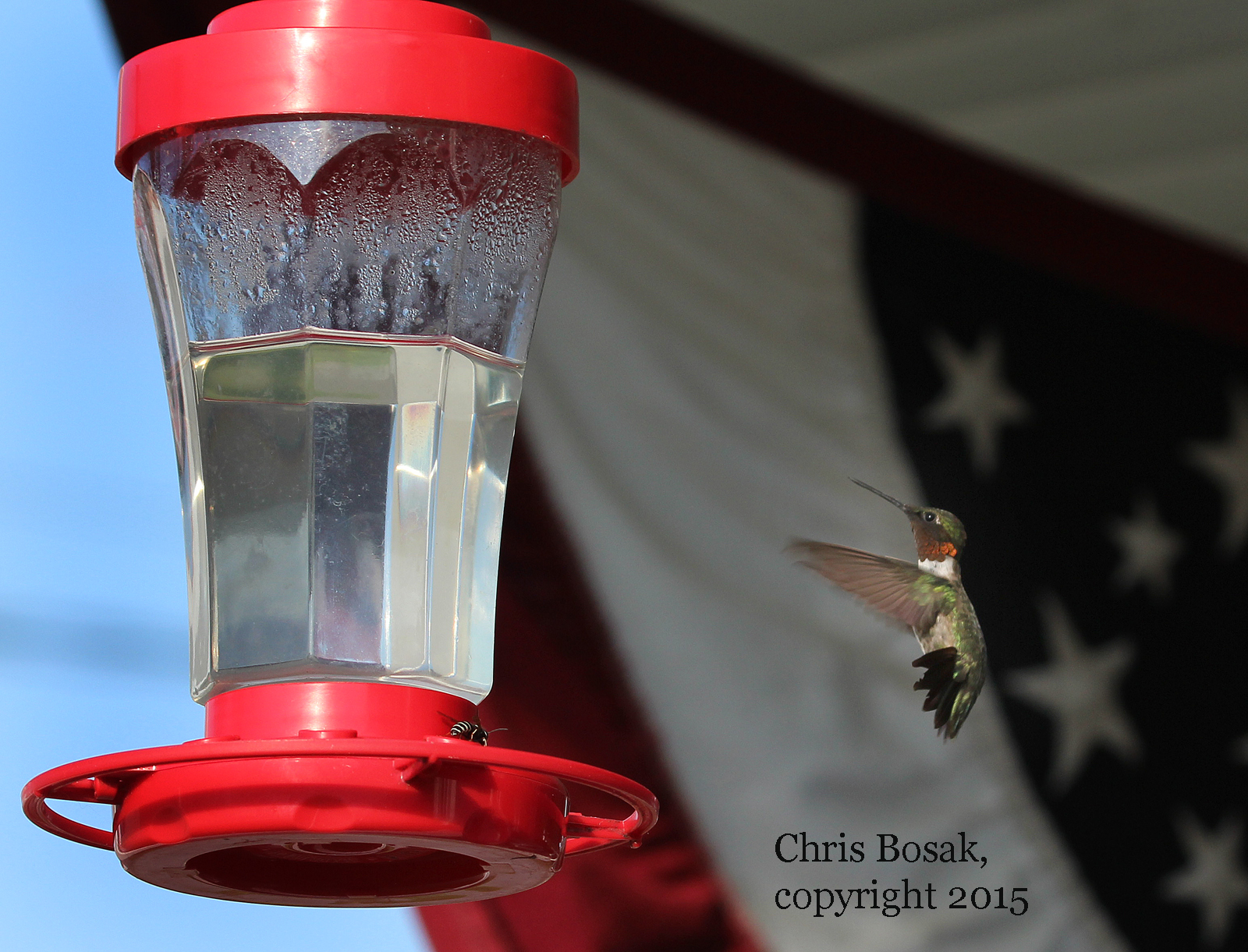
Photo by Chris Bosak A Ruby-throated Hummingbird hovers near a feeder in Danbury, Conn., summer 2016

Photo by Chris Bosak
A Ruby-throated Hummingbird hovers near a feeder in Danbury, Conn., summer 2016

The vast majority of the hummingbirds have gone south by now. But that doesn’t mean I can’t do another post on these spectacular tiny birds. I did a series of posts and bird columns on hummingbirds a few months ago and received a tremendous amount of feedback. So here, in no particular order or font, is a ton of information from Birds of New England readers. Thanks so much for your feedback and feel free to write any time. Siimply comment on this post or send me an email to bozclark@earthlink.net

From Marsha,

We live in condos on a large open pond surrounded by trees so it’s a perfect environment for the little birds, lots of open space to chase each other around and lots of areas to perch. I can’t seem to get them to come to my feeder (I have one and my neighbor has 3) but they do occasionally visit my hanging petunias and fuschias which I specifically hung knowing hummers are attracted to the tubular flowers. They are extremely entertaining to watch and I was very disappointed to learn that they were actually being aggressive toward each other and not playing. Oh well, I guess it can’t be Disney all the time…

From Joan,

I have a feeder hanging about 2 feet from the glass jalousies that enclose my breezeway and see these little guys every day.  I don’t have any flowers near them (my yard is very shaded) but there are some coleus plants below the feeder so perhaps they see those bright colors.  I also have a hairy woodpecker who drinks from the hummingbird feeder and I find that I must refill it about every 4 days since he is so thirsty!  He just hooks his feet over the edge where the base meets the clear upper part and drinks away.  There are 3 plastic flowers around the base of the feeder that the birds drink from and they are a couple inches apart but if one hummingbird is drinking, the other one won’t go to one of the other flowers and in fact, if there are two of them around at the same time, they dive bomb each other.  One of the hummingbirds that comes has the bright red spot on his throat and the other one looks like the one in your picture without the red throat.  I can be just inside the windows that are tilted out and they come bopping around right up to the window.  I love seeing them and know they won’t be around too much longer but then it will be time to start buying sunflower seed for all my other winged friends Continue reading

Latest For the Birds column: Gulls and ants?


A Herring Gull positions a clam for eating in Stratford, Conn.

A Herring Gull positions a clam for eating in Stratford, Conn.

Here’s the latest For the Birds column, which runs weekly in The Hour (Norwalk, Conn.), The Keene (NH) Sentinel and several Connecticut weekly newspapers.

We’ve all seen gulls eat clams at the beach. They rise into the air, clam in bill, and drop the mollusk onto the pavement.

If the shell doesn’t break, the gull goes a little higher the next time and drops the clam again. Eventually they get just the right altitude and the shell breaks to expose the good stuff inside. If they go too high the shell will shatter into a million pieces and splatter the meat into an inedible mess.

If the gull is lucky, it will get to eat the clam waiting for it on the pavement. If they aren’t lucky, a marauding gull will have come by and stolen the clam before the industrious gull could even make its way back down to the pavement.

But that’s just part of the gull’s varied diet. We’ve also all seen gulls eating fries, potato chips and other human junk food at the beach or in a parking lot.

But did you know gulls eat insects, too? Even insects as small as ants make up part of a gull’s diet. How can an ant satisfy the appetite of a large bird like a gull? An ant can’t, of course, but lots of ants can. Humans don’t open a container of peanuts and eat one nut. We eat them by the handful.

Continue reading

Latest For the Birds column: Loving the ‘regulars’

Photo by Chris Bosak White-breasted Nuthatch at backyard feeder, Oct. 2014.

Photo by Chris Bosak
White-breasted Nuthatch at backyard feeder, Oct. 2014.

Here’s the latest For the Birds column, which runs weekly in The Hour (Norwalk, Conn.), The Keene (NH) Sentinel and several Connecticut weekly newspapers.

The feeders went back up a few weeks ago. Nothing extraordinary has shown up yet, but it sure is nice to see the “regular” birds back.

My constant companions are nuthatches, titmice and chickadees. There is usually a downy woodpecker or two there as well, but they are not as reliable as the aforementioned birds.

I love seeing the nuthatches. I love the titmice and chick Continue reading

Latest For the Birds column: Fall brings beauty beyond birds

Photo by Chris Bosak Fall colors abound at a cemetery in Darien, CT, Nov. 2013.

Photo by Chris Bosak
Fall colors abound at a cemetery in Darien, CT, Nov. 2013.

Here’s the latest For the Birds column, which runs weekly in The Hour (Norwalk, Conn.), The Keene (NH) Sentinel and several Connecticut weekly newspapers.

….

The other day I woke up to a gray, drizzly day. The bright yellow birch leaves popped in contrast to the dark evergreen branches of the hemlocks.

The weight of the overnight rain and persistent drizzle was enough to cause hundreds of those leaves to break free from their boughs and sway their way to the ground. It was a sight to behold and merely a precursor of what autumn will show us over the next few weeks.

A bright yellow carpet now forms the first layer of color on the floor of the woods in my front yard. The leaves of the oaks and maples in that patch of woods will form subsequent layers.

I love fall in New England. I think just about every New Englander feels the same way. Yes, it means winter is coming next, but it also means a bird migration, pumpkin festivals, apple picking, cool dips in your favorite lake, Halloween decorations, no more mosquitoes and, of course, the aforementioned remarkable fall foliage.

Leaves take center stage during a New England autumn, but there are plenty of other natural wonders to amaze us in September, October and November. Many of these spectacles have nothing to do with birds, or animals of any sort for that matter.

I was driving my son Will home from his soccer practice last Friday and a brilliant harvest moon seemed to follow us from above the hills. It is full moons like that one that inspire so many poems, folktales, and legends about the moon. It had me on the roof trying to finally get a decent photo of a full moon. I failed again, but had fun trying and will try again on the next full moon.

Fall is a great time to walk around a meadow. The various daisies and milkweeds that dominate the meadows in the summer start to give way to goldenrod and purple asters. There’s nothing like cutting through a field covered in goldenrod. Whatever the background may be – barn, covered bridge, trees or pond — it is enhanced by the sweeping deep yellow shades of the goldenrod.

The moon, the leaves, the flowers … nature never fails to delight us in the fall.

Now you add in the animal kingdom. I’ve written in previous weeks about the spectacular hawk migration that takes place in the fall and the various songbirds that visit our yards on their way south. The meadows I mentioned before burst with life as butterflies and other insects can’t resist those goldenrod flowers as they fuel up for whatever winter has in store for them.

Fall is also my favorite time to visit moose country in northern New England. They are not easy find in the fall – sadly, they are never easy to find these days – but if you come across a bull moose with a fully grown set of antlers and have fall colors as the backdrop, it’s a scene you’ll never forget. I’ve seen it several times, but still get the itch to return up north every fall.

Even if the search for moose, or whatever might be your target, comes up empty, you’re still surrounded by those stunning colors nature grants us.

I know I’m preaching to the choir, but New England really is something special in the fall.
Latest For the Birds column: Hawkwatching primer

Photo by Chris Bosak An Osprey soars over the Norwalk River on Monday, Sept. 1, 2014.

Photo by Chris Bosak
An Osprey soars over the Norwalk River on Monday, Sept. 1, 2014.

Here’s the latest For the Birds column, which runs weekly in The Hour (Norwalk, Conn.), The Keene (NH) Sentinel and several Connecticut weekly newspapers.

A September would not be complete without a bird column on the fall hawk migration. For many, the hawk migration is the highlight of the fall season, despite there being many other birding options this time of year.
It’s hard to blame those people who feel that way. You can’t complain about spending a sunny, crisp fall day on the top of a mountain or other open area looking for hawks coming down from the north. Pick the right day and you may see hundreds of hawks making their way to their winter grounds.
The trick for many people, including myself, is figuring out which hawk is which from such a distance in the sky. I have gotten better over the years but certainly not to the level of the experts at the popular hawkwatching sites throughout New England. The experts, who are trained in this sort of thing, know the identification of the bird long before I can even see it out in the horizon.

The other trick to hawkwatching is picking the right day. Weather plays a big role in the fall hawk migration. Pick a day with a steady southerly wind and you’ll likely see very few hawks. Which hawk wants to battle a stiff headwind to start a thousand-mile (or more) journey.

But, pick a sunny day following a cold Continue reading

Latest For the Birds column: More on hummingbirds (again)

Here’s the latest For the Birds column which runs in The Hour (Norwalk, Conn.), Keene (NH) Sentinel, and several weekly newspapers on Connecticut.

Ruby-throated Hummingbird at Errol Hotel in Errol, NH.

Ruby-throated Hummingbird at Errol Hotel in Errol, NH.

The emails about hummingbirds kept coming, so I will roll out one more column on these tiny birds.

I used to have the worst luck trying to find hummingbirds, but this year has been an exception. I have consistently seen them at my feeder and out in the field, so to speak.

Now is the time to look for them among the many patches of jewelweed, or touch-me-not, that grow at the edges of New England’s woods. Even in years when I don’t see a lot of hummingbirds, I always seem to find them in late summer and early fall buzzing around the small orange flowers of jewelweed.

But enough about where I am seeing them. Hummingbirds are obviously a regional favorite as I have received several emails regarding the species over the last few weeks. In addition to what I included a few weeks ago, here’s a sampling of what people are saying about the smallest of birds. Continue reading

Latest For the Birds column: For some birds, humans are a rarity

Here’s the latest For the Birds column. This one’s a little different. Let me know what you think. Thanks for taking a look at http://www.BirdsofNewEngland.com.

Photo by Chris Bosak Yellow-rumped Warbler in Selleck's Woods, Darien, Conn., April 2014.

Photo by Chris Bosak
Yellow-rumped Warbler in Selleck’s Woods, Darien, Conn., April 2014.

Is it possible that the bird in your backyard has never seen a human before?

It’s not likely, but if there were ever a time for that happen, it’s during the fall migration.

If we were a little farther north in New England, the odds would be much greater. Even in the middle of New England, however, the possibility still exists — at least in my very unscientific estimation. The adult birds, those that flew through our region on their northern migration in the spring, have almost certainly seen humans.

But first-year birds, those born a few short months ago, who knows? Maybe you are the first human one is seeing.

It would take a relatively cautious bird species that breeds in the vast Boreal Forest of the northern U.S. and Canada. So a Gray Catbird or Baltimore Oriole passing through has likely seen plenty of humans already, having likely been born in the suburbs.

But one of any number of warbler, vireo or fly Continue reading

Latest For the Birds column: I always come back to the American Oystercatcher

An American Oystercatcher seen at Milford Point during the summer.

An American Oystercatcher seen at Milford Point during the summer.

It’s been far too long since I’ve written anything about one of my favorite birds, the American Oystercatcher.

Since they will be migrating to points south before we know it, I figured this is a good time to shine a light on these fantastic birds again.

Many birds make a statement with their plumage. Flashy colors or muted tones, their plumage is their most distinguishing feature. Other birds stand out from the crowd with other features: an owl’s large eyes; a heron’s long legs; a Northern Mockingbird’s incredible singing.

The American Oystercatcher makes a statement in many ways. It is large, especially by shorebird standards. It has beautiful brown, black and white plumage. Its noises are loud and conspicuous, able to be heard from distant beaches as the birds rest on off-shore islands.

Perhaps the most impressive feature of the oystercatcher is its bill. It is a thick, long, bright orange/red bill as strikingly beautiful as it is deadly. It is called an oystercatcher because that bill can open shells that other shorebirds can only dream of opening.

American oystercatchers’ eyes are a spectacle unto themselves. While many birds simply have black beads for eyes, the oystercatcher has large bright yellow eyes with a black dot in the middle. The eye is also surrounded by a thick bright red eye ring, similar to that of a wood duck’s.

I still feel that the American Oystercatcher is an underrated bird. Many people rarely see them, if at all, because oystercatchers are only seen around the shore. If you don’t visit the coast, you won’t see one. So it doesn’t even register on the radar of many people because they simply don’t see them. For many birders who do visit the coast frequently, they’ve seen plenty of oystercatchers so the thrill is limited when the see another one.

That, of course, has never been a problem for me. Like Great Blue Herons, Hooded Mergansers, Wood Ducks and countless other bird species, I get a thrill every time I see an American Oystercatcher.

Now that I don’t live near the coast anymore, I rarely see these most impressive birds. I miss a lot about coastal birding, but the American Oystercatcher is perhaps what I miss the most. I still see Osprey, cormorants, gulls and some shorebirds on my freshwater haunts, but not oystercatchers.

I’ll be back soon enough to see them again, I’m sure. I’d better hurry, though, the migration is already under way.