Latest For the Birds column: Hummingbirds are classic backyard entertainment

Photo by Chris Bosak A Ruby-throated Hummingbird hovers near a feeder in Danbury, Conn., summer 2016

Photo by Chris Bosak
A Ruby-throated Hummingbird hovers near a feeder in Danbury, Conn., summer 2016

Here’s the latest For the Birds column, which runs weekly in The Hour (Norwalk, Conn.), The Keene (NH) Sentinel and several Connecticut weekly newspapers.

..

The smallest of birds often provide the biggest entertainment.

I’m talking about hummingbirds, of course, and they are big, big on personality even if they are small in stature, weighing in at about an eighth of an ounce. Yes, a small fraction of an ounce, which is the smallest American standard of weight. Thank goodness for the metric system so we can put a whole number on this tiny dynamo. Hummingbirds weight about 2 or 3 grams, about the same as a penny. Not a handful of pennies or five pennies — one penny.
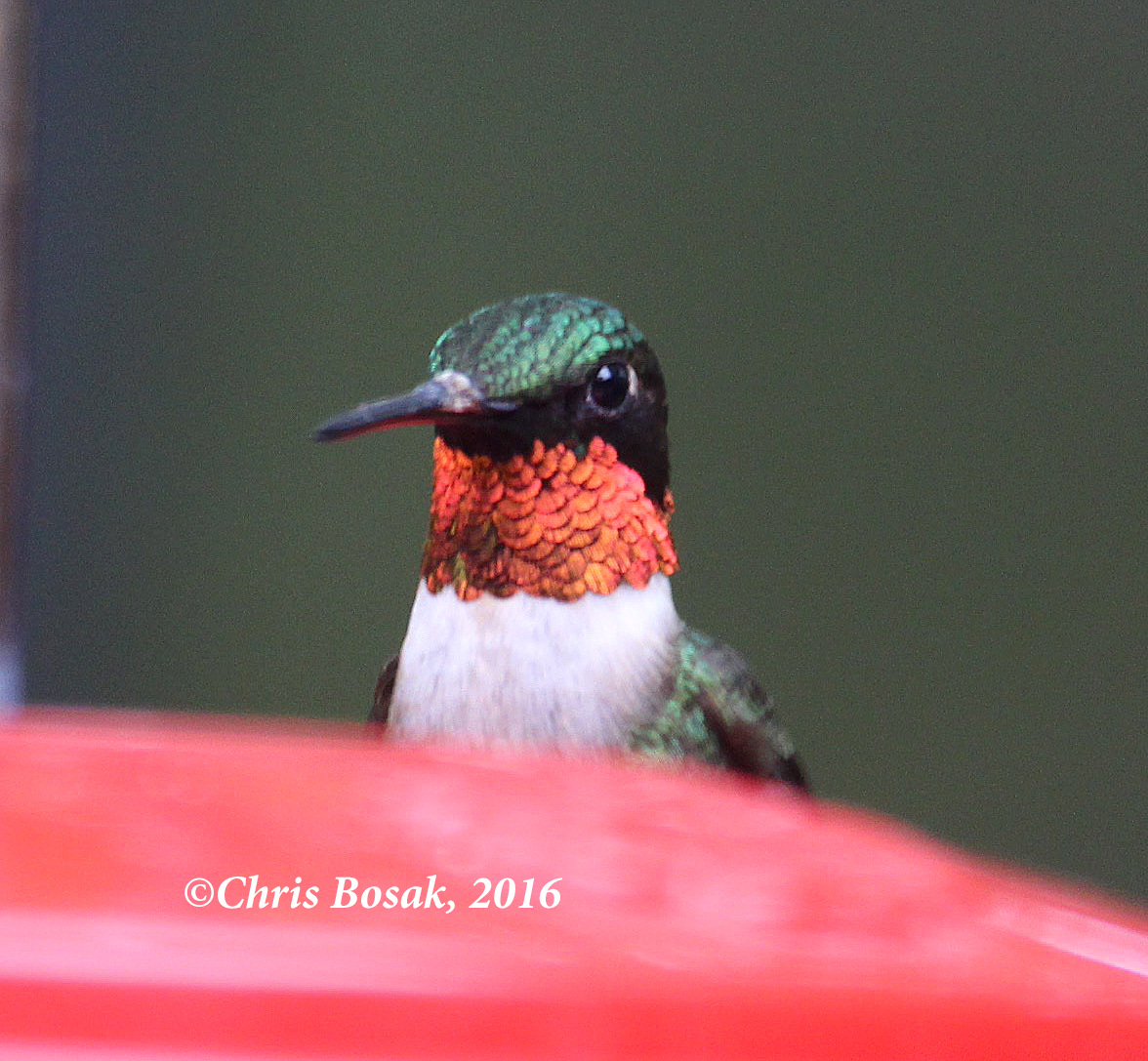
Photo by Chris Bosak A Ruby-throated Hummingbird eats at a feeder in Danbury, Conn., summer 2016

Photo by Chris Bosak
A Ruby-throated Hummingbird eats at a feeder in Danbury, Conn., summer 2016

I have been enjoying immensely watching hummingbirds this spring and summer at my backyard feeder and in the garden now that the flowers have bloomed – at least those that the deer didn’t get to. The only problem is that “my” hummingbirds are very territorial. Usually I see only one male at or near the feeder with the occasional female showing up, too. That was especially true this spring. They are not quite as territorial now, but are still very feisty toward other hummingbirds that show up.

It will be interesting to see what happens in the fall as last year the feeder was dominated by one female. She tolerated nothing from other hummingbirds, even those that dared fly over the house in the general vicinity of the feeder. Will the male remain and dominate, or will he fly off and the female dominate? Or will the male stick around and the female push him out? Or will they tolerate each other and share the sugar water, which is my hope. Or … OK, enough ors for now. As I said, we’ll see what happens.

If you don’t have hummingbirds that act like they own the feeders, you have a greater likelihood of seeing hummingbirds in late summer or fall because of simple mathematics. In the spring the adults pass through or settle in our area. In late sum Continue reading

Latest For the Birds column: Birds don’t always look like their field guide photos

Photo by Chris Bosak A young Wood Duck sits on a rock at Woods Pond in Norwalk, Conn., Julyh 2016.

Photo by Chris Bosak
A young Wood Duck sits on a rock at Woods Pond in Norwalk, Conn., Julyh 2016.

Here’s the latest For the Birds column, which runs weekly in The Hour (Norwalk, Conn.), The Keene (NH) Sentinel and several Connecticut weekly newspapers.

I’ll kick off this bird column with a baseball reference. Why not?

A Major League manager once said, and I’m paraphrasing here, “These guys aren’t doing what their baseball cards say they can do.” He meant that he had a group of players who had had great seasons in the past, but were underperforming that particular year.

Well, the same can be said for birds in field guides. I have mentioned in previous columns that you can’t always trust field guides, just like you can’t always trust the statistics on the back of a baseball card. Some of the newer guides, such as the ones by Sibley and Crossley, are much more trustworthy. The Peterson Continue reading

Latest For the Birds column: Up to the roof to get close to a Scarlet Tanager

Photo by Chris Bosak A Scarlet Tanager sings in a tree in Danbury, Conn., July 2016.

Photo by Chris Bosak
A Scarlet Tanager sings in a tree in Danbury, Conn., July 2016.

Here’s the latest For the Birds column, which runs weekly in The Hour (Norwalk, Conn.), The Keene (NH) Sentinel and several Connecticut weekly newspapers.

Thankfully the trees are fully leafed out. My neighbors probably would have started to wonder about me. Of course, that process likely started long ago.

I found myself standing on my roof, camera in hand, keeping an eye on a male scarlet tanager that was singing his heart out among the oaks.

I had noticed the brilliant red-and-black bird a few days before. I was writing at my computer at home when I spied him through the window eating berries from those ubiquitous wild raspberry bushes, which are really invasive wineberries from Asia. The bird was impossible to miss with that beaming red plumage that puts cardinals to shame. (No offense to our beloved cardinals.) The tanager was gone by the time I opened the front door for a better look.

Continue reading

Latest For the Birds column: Birding and Pokemon

Photo by Chris Bosak cGreat Egret in Central Park, NYC.

Photo by Chris Bosak
Great Egret in Central Park, NYC.

Here’s the latest For the Birds column, which runs weekly in The Hour (Norwalk, Conn.), The Keene (NH) Sentinel and several Connecticut weekly newspapers.

There I was, taking the train to New York City with the ultimate goal of visiting Central Park. It’s something I used to do fairly often during spring migration.

Central Park is a hub for birds, and therefore birders, in the spring. Only this time I wasn’t going birdwatching — not really anyway — I was looking for Pokémon characters.

Technically I wasn’t the one looking for them. I don’t know the first thing about the game or why it’s the hottest thing since the Hula hoop. I brought my boys down to Central Park as they got caught up in the Pokémon Go hysteria. I was there to keep my eye on them and maybe casually look for some birds along the way.

We arrived at Grand Central and started our walk down Fifth Avenue to Central Park. The excitement around the craze was palpable even as we were still far away from the park. It seemed that about half the people on the sidewalk had their phones in front them and were clearly playing the game. Once we arrived at the golden statue at the entrance to the park, it was clear that this was Pokémon Go central.

We lingered briefly before headed down a trail into the park. As I watched people stopping and pointing and getting excited about their finds it hit me — this craze shares a lot of similarities with birdwatching.

The fact that we were in Central Park, where I had done so much birdwatching before, only solidified my thoughts. Birdwatchers are a tightknit group that seek out rare finds, but also appreciate the common ones. I learned enough about the Pokémon Go game to realize that this is what all these people were doing as well – looking for rare characters, but also capturing ones they had already.

As I had that thought, I looked across “The Pond” and saw a Black-crowned Night Heron land on a fallen tree that was already occupied by a few Double-crested Cormorants. A Solitary Sandpiper hunted along the near shoreline. They were fitting sights to accompany that thought. Here I was getting excited about seeing a cool bird, while thousands of people around me were getting excited with their own finds. We were all outside, we were all walking, and we were all seeking.

I did an Internet search a few days after our trip and noticed that some others have made the same comparison. It is a bit of a stretch, but at the same time not really.

There are some glaring differences, of course, the most obvious and prominent being that the birdwatchers are looking for real, living things, while the Pokémon players are looking for computer generated images that randomly pop up on their phones.

Second, and perhaps most importantly, is the diversity of the people enjoying the hobbies. Pokémon drew literally thousands of people to Central Park and the people doing it were as diverse as the city itself. All ages and ethnicities. Male and female. A lot of families, too. They were all sharing a passion for the same thing.

Sadly, from my experience, birding is not so diverse. It is better than it was and some people are making it their mission to increase diversity in the hobby, but there’s long way to go. I don’t typically see a lot of families out birdwatching together either. I do on occasion, but it is a rate sighting indeed.

Another difference between birdwatching and Pokémon Go is that birding will have much more staying power. I am guessing here of course, but I can see this Pokémon Go craze being just another flash-in-the-pan fad. Birdwatching has been around for hundreds of years and will continue to be around for centuries to come.

Yes, Pokémon is vastly more popular at the moment but how long will it last? These games rarely flourish for the long haul. Remember Angry Birds? Great game, but who plays that anymore?

Years from now, maybe even mere weeks, no one will be talking about Pokémon Go. Birding, however, will be going strong.

Who knows? Maybe now that people are getting reacquainted with the outdoors more and actually discovering how wonderful it is to be outside, perhaps birding will win a few converts. Wouldn’t that be nice?

Latest For the Birds column: Maybe it’s a Black-crowned Night Heron

Here’s the latest For the Birds column. Thanks for supporting BirdsofNewEngland.com

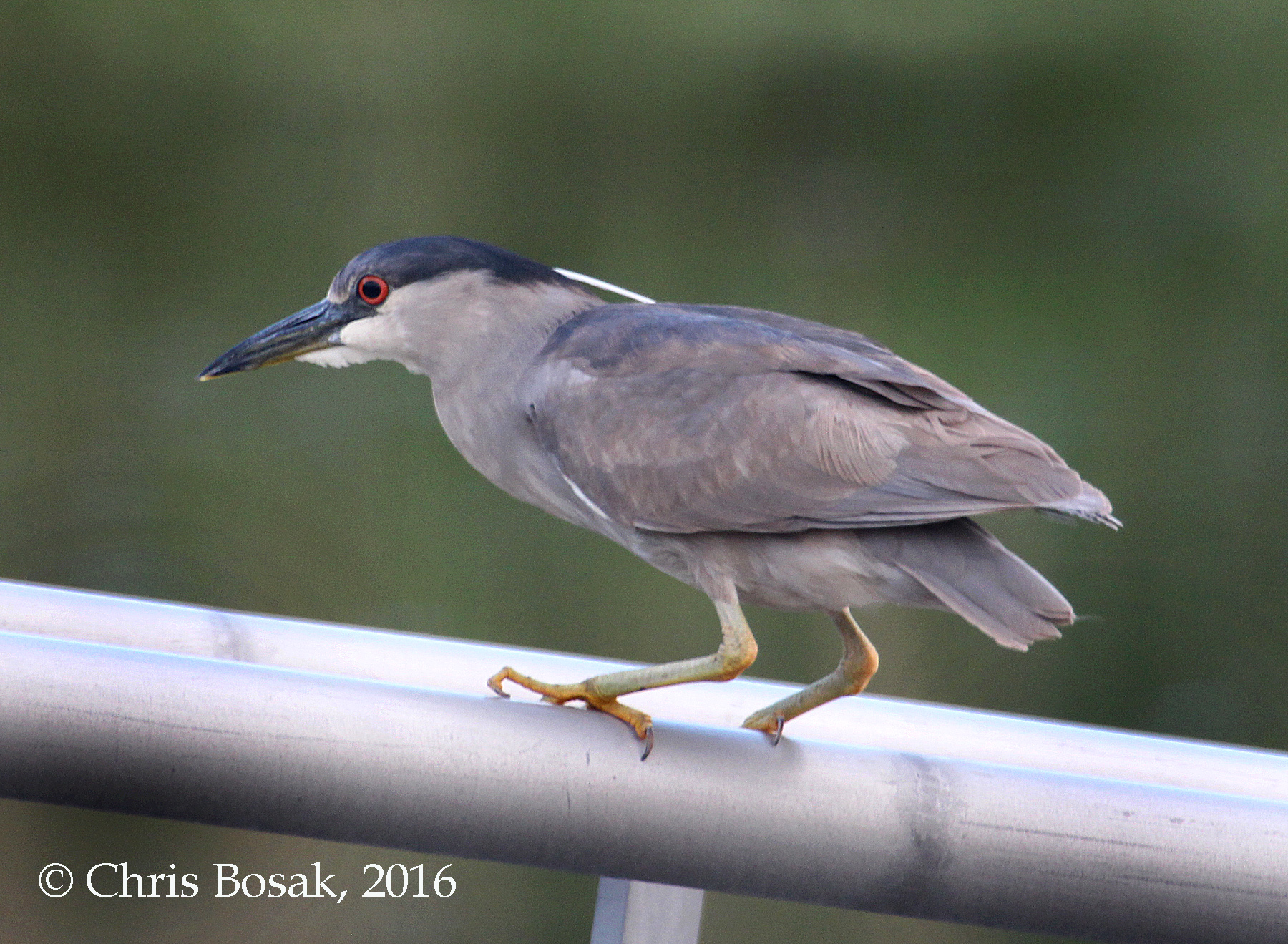
Photo by Chris Bosak A Black-crowned Night Heron perches on a railing at a marina along the Norwalk River, Norwalk, Conn., spring 2016.

Photo by Chris Bosak
A Black-crowned Night Heron perches on a railing at a marina along the Norwalk River, Norwalk, Conn., spring 2016.

I receive several “what type of bird is this?” requests. I like helping out in that way and look forward to opening the email when I see that in a subject line. I like the challenge that I know is coming.

Sometimes the identification is easy, especially when a photo is included. Sometimes the identification is more difficult, especially when there is no photo included and I’m going strictly on a text description. I like those challenges, too.

I’m amazed at how often the unknown bird turns out to be a black-crowned night heron.

I receive a letter from someone saying they saw a larger bird by the water that they had never seen before. The bird is described as being stocky, large, gray, short-necked or long-necked.

How can a bird be short-necked and long-necked at same time? Like all waders, black-crowned night herons sometimes stand with their neck outstretched and sometimes with their neck curled against their bodies, giving them a stocky appearance.

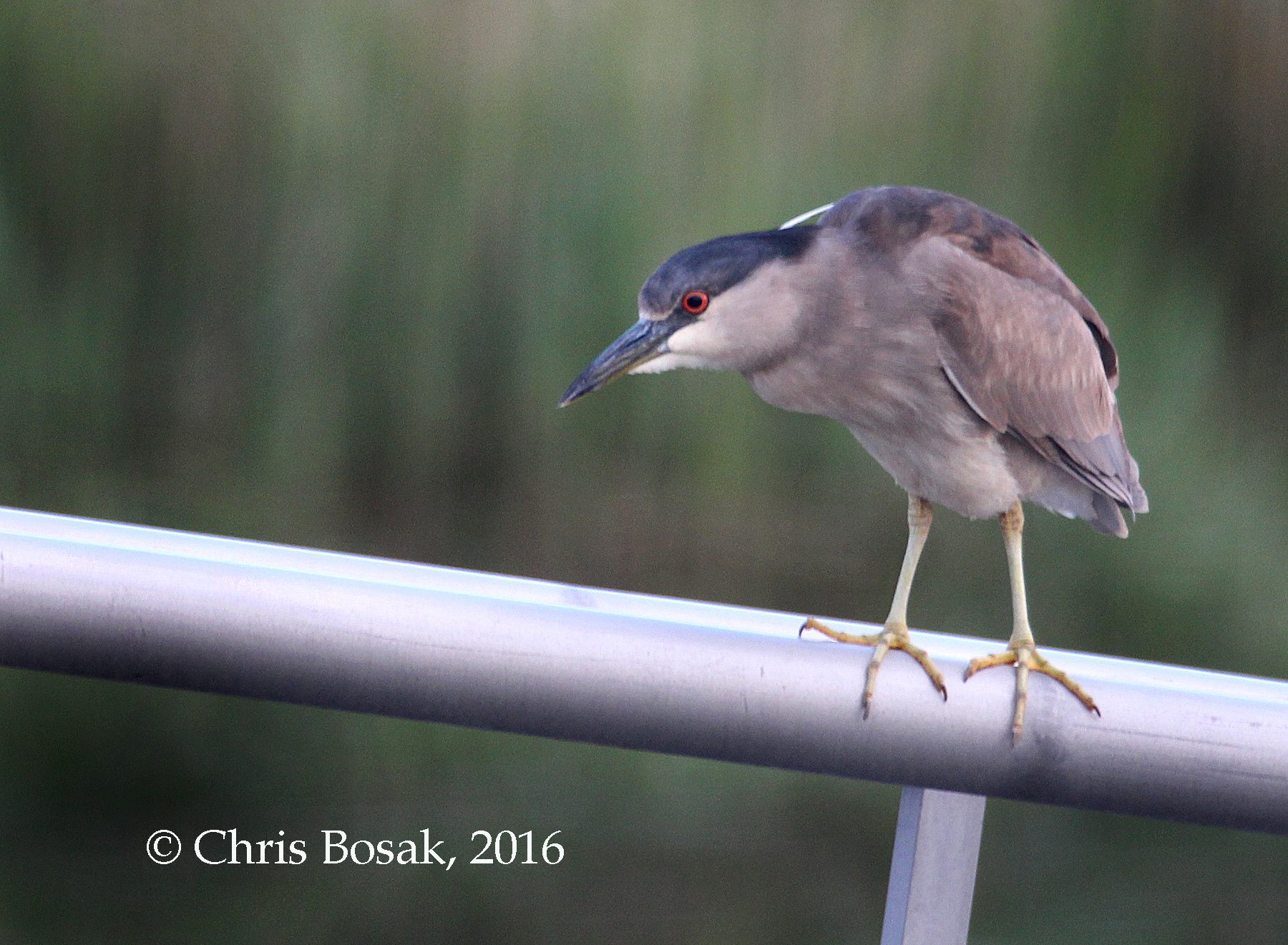
Photo by Chris Bosak A Black-crowned Night Heron perches on a railing at a marina along the Norwalk River, Norwalk, Conn., spring 2016.

Photo by Chris Bosak
A Black-crowned Night Heron perches on a railing at a marina along the Norwalk River, Norwalk, Conn., spring 2016.

Sometimes people recognize the black-crowned night heron as a heron. Sometimes they are mistaken for a duck. It’s a logical guess because the herons are always near water.

At dusk, black-crowned night herons can easily be mistaken for a gull, especially while in flight. They are about the same size as our larger gulls.

The black-crowned night herons is a stocky wader with gray-and-blue plumage and brilliant red eyes. Adding an element of confusion to the mix is that immature birds are just as big but have mottled brown plumage and orange or red eyes. Many field guides don’t include the immature plumage so it really leaves a beginning birder hanging.

I was fooled by this when I was a novice birder. I was taking a guided walk along a small river in southwestern New Hampshire when two large brown birds flew out of a tree overhanging the water. It was only a quick glimpse and I immediately thought they were green herons. What else could it be? I thought to myself.

“Two immature black-crowned night herons,” the leader of the walk said suddenly.

Wow, I thought. I didn’t even know they lived around here. In fact, in that recollection I’m probably giving myself too much credit. I likely had never even heard of black-crowned night herons at that point. This was long before I had become familiar with the birds of southern New England, along Long Island Sound, where black-crowned night herons are much more common.

It was on that same walk that I learned field guides can cause confusion in another way, too — by not including female plumage on the same page. We saw a group of about six large ducks on the river. They had dull white and gray bodies and light brown heads.

“Common mergansers,” the leader said.

I looked up “common merganser” in my field guide. I was confused. It showed a bright white bird with black markings, a dark green head and a red bill. Another birder in the group, more experienced than I was at the time, told me: “That’s the male in the field guide. Those are females in the river.”

It was the last day I used that field guide.

But back to the black-crowned night herons … I think another reason people don’t know them is that they are overshadowed by their taller, more ectomorphic cousins. Everyone knows great blue herons, but not everyone is familiar with black-crowned night herons, especially people who do not live near water. Black-crowned night herons are mostly seen around brackish water, but are also fairly common around freshwater.

Another point of confusion is that they are just as often seen perched in trees near water as they are actually wading in the water. Great blue herons, by contrast, are almost always seen either hunting in the water or flying. They are seen perched in trees on occasion, but not as often as black-crowned night herons. It is a sight to behold, however, when you do spot a great blue heron perched at the tip of a towering evergreen. Indeed, that was one of the sights that took me from a casual watcher of birds to an obsessed birdwatcher and photographer.

That sighting is unmistakable. Almost everyone would recognize a great blue heron perched on the top of tree. Not everyone would know a black-crowned night heron.

They are not a favorite bird to many people as, in addition to crabs and fish, they also eat young birds and bird eggs. The black-crowned night heron is worth getting to know, however. It’s an interesting and handsome bird that’s here to stay.

Latest For the Birds column: A ‘tame’ Green Heron

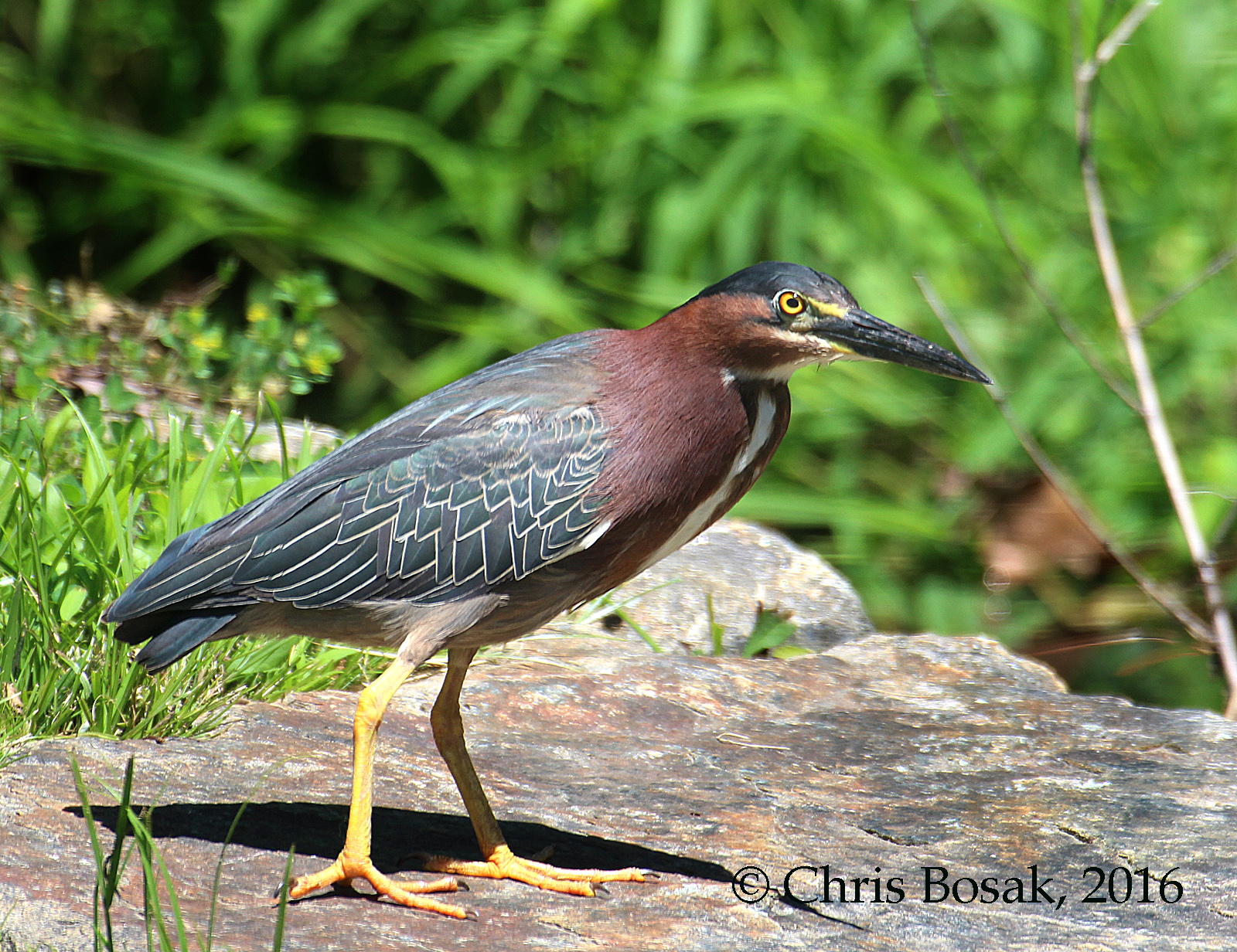
Photo by Chris Bosak A Green Heron stands on a rock in Darien, Conn., spring 2016.

Photo by Chris Bosak
A Green Heron stands on a rock in Darien, Conn., spring 2016.

Birds have different degrees of tameness. That is obvious, of course, by comparing different species.

In New England, the House Sparrow will hop around your feet eating dropped french fries. On the other hand, some birds are so shy you hardly ever see them.

In the backyard, Black-capped Chickadees will sometimes eat seeds right out of your hand, while Northern Cardinals fly away when you approach the Continue reading

Latest For the Birds column: Wood Ducks show a tame side

Here’s the latest For the Birds column, which runs weekly in The Hour (Norwalk, Conn.) and The Keene (NH) Sentinel.

Photo by Chris Bosak A Wood Duck mother swims with one of her babies at Woods Ponds in Norwalk, Conn., spring 2016.

Photo by Chris Bosak
A Wood Duck mother swims with one of her babies at Woods Ponds in Norwalk, Conn., spring 2016.

The Mallards were scattered along the grass and I didn’t think twice about it. I’m used to Mallards being tame and not walking away, or even flinching, when someone draws near.

With many Mallards, even with babies in tow, they show little or no fear of humans. In fact, many even welcome the approach of humans as the ducks hope to get some food.

Photo by Chris Bosak A Wood Duck mother swims with two of her babies at Woods Ponds in Norwalk, Conn., spring 2016.

Photo by Chris Bosak
A Wood Duck mother swims with two of her babies at Woods Ponds in Norwalk, Conn., spring 2016.

But in this particular flock of ducks, two females and their babies quickly retreated to the nearby pond. These ducks weren’t Mallards at all, but rather they were Wood Ducks. Two female Wood Ducks and their babies were “hanging out” with the Mallards in the grass near the pond before I pulled into the parking lot.

While the Mallards in the group, which consisted of most of the birds, did not even bother to wake up from their midday nap, the Wood Ducks’ instincts told them to retreat.

But the scene was still extremely surprising to me. First of all, you don’t always see Wood Ducks hanging out with Mallards. And, second of all, Continue reading

Latest For the Birds column: I knew there had to be Indigo Buntings there

Photo by Chris Bosak An Indigo Bunting perches in a tree in Ridgefield, Conn., spring 2016.

Photo by Chris Bosak
An Indigo Bunting perches in a tree in Ridgefield, Conn., spring 2016.

Did I make these sightings happen? Probably not, but it was pretty strange nonetheless.

I was checking out a new birding spot, Bennett Pond State Park in Ridgefield, that a few people had told me about. They told me about the pond, which had beaver and Wood Ducks, and told me how to get there. To paraphrase, they said: “Walk to the field, into the woods and you’ll get to the pond.”

I love ponds. They are perhaps my favorite habitat to explore, especially if there are swamps nearby, too. But the word that really stuck out to me was “field.” I know where plenty of ponds are, but fields are becoming a scarce resource these days. Just ask all of the bird species that are in peril because they rely on fields.

Of course I took the wrong trail to get to the pond. I read the trail map wrong (what else is new?) and ended up taking a very wooded trail. The trail was pleasant enough and I heard some good birds — Ovenbird, Veery, Wood Thrush, Worm-eating Continue reading

Latest For the Birds column: Like an old friend

Here is my latest For the Birds column, which runs weekly in The Hour (Norwalk, Ct.) and Keene (N.H.) Sentinel.

Photo by Chris Bosak A Blue-winged Warbler seen at Fairchild Wildflower Sanctuary in Greenwich, Conn., May 2016.

Photo by Chris Bosak
A Blue-winged Warbler seen at Fairchild Wildflower Sanctuary in Greenwich, Conn., May 2016.


It was like hearing from an old friend.

I used to visit a wildflower sanctuary in southern Connecticut fairly often, especially during the spring migration. It is a great place to find migrants such as Yellow Warblers, Bobolinks, Baltimore Orioles, Scarlet Tanagers, Eastern Kingbirds and, my favorite, Blue-winged Warblers. Not only do Blue-winged Warblers look striking (bright yellow plumage with long, thin black eye stripe), but they sound otherworldly, too. Well, maybe not otherworldly, but definitely not birdlike. They sound more like an insect — a big, buzzing insect that sputters its notes at the end.

It’s a sound I used to hear often when I visited the sanctuary. I made frequent visits there when I lived in nearby Westchester, N.Y. That was more than 10 years ago now. I hadn’t been back since.

Last week, however, the stars aligned to create the perfect scenario for a return visit. I was coming from Westchester and had about two hours to kill Continue reading

Latest For the Birds column: Goldfinch with conjunctivitis

Photo by Chris Bosak An American Goldfinch with Avian Conjunctivitis visits a birdfeeder in Danbury, Conn., April 2016.

Photo by Chris Bosak
An American Goldfinch with Avian Conjunctivitis visits a birdfeeder in Danbury, Conn., April 2016.

Here’s the latest For the Birds column, which runs weekly in The Hour (Norwalk, CT) and Keene (NH) Sentinel. I don’t always post my columns to this site, but this is an important topic so I figured I would. Thanks for supporting http://www.BirdsofNewEngland.com

I was stretched out on the lounge chair on the deck, binoculars and camera on one side, a fresh cup of coffee on the other. The sun was warm on this particular late morning. (The sun is that bright, hot thing in the daytime sky, just in case anybody forgot with all this gray, wet weather we’ve been having.)

Suddenly an American Goldfinch appeared out of nowhere. It didn’t attack the feeders from the flanks like the goldfinches and most other birds usually do. He flew right over my head and approached the feeders directly. His flight was awkward; not at all Continue reading