Photo by Chris Bosak
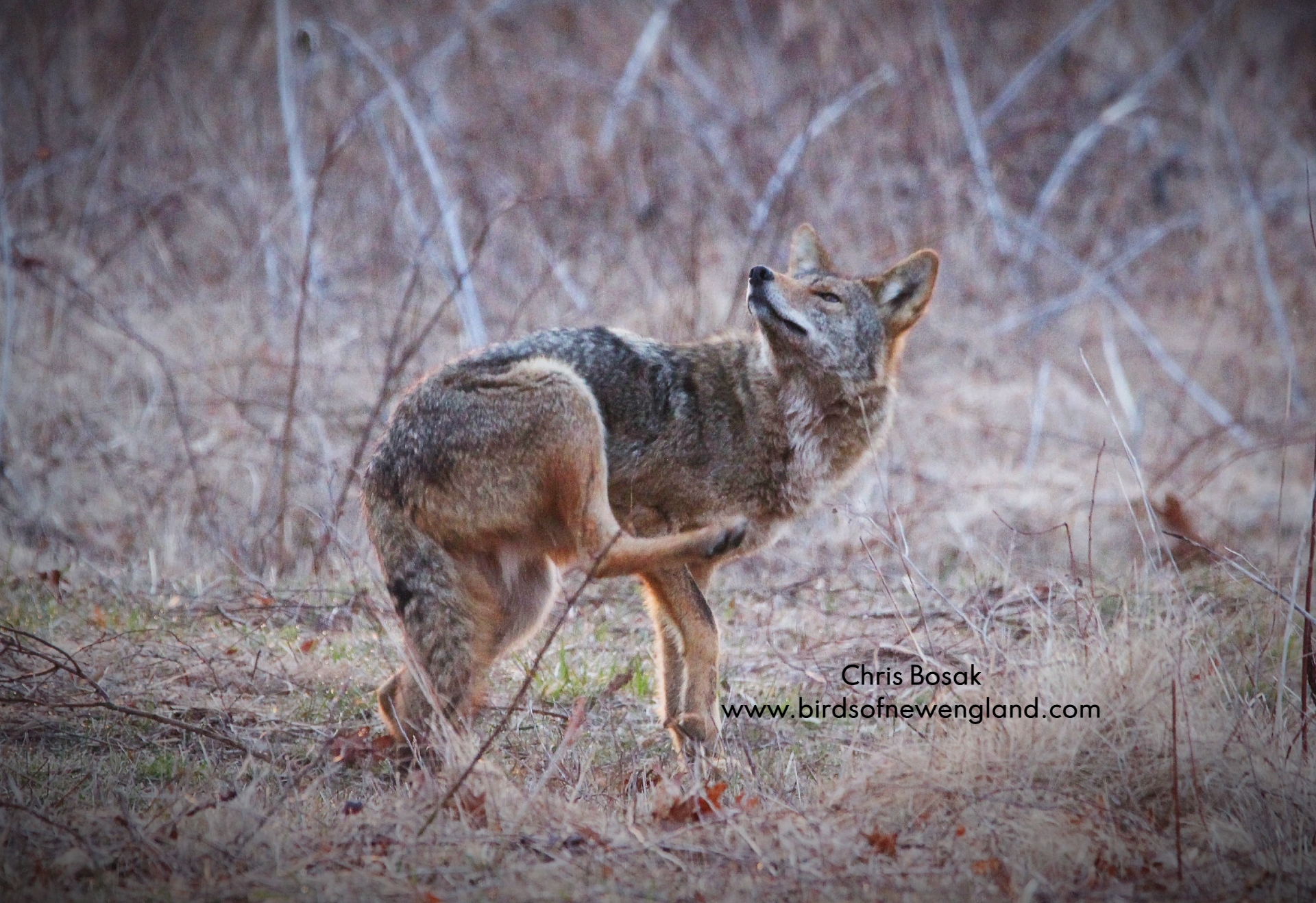
A coyote scratches itself in a field at Huntington State Park in Redding, Connecticut, March 2025.
This is the second column in the last few weeks where I end up writing about and using a photograph of an unintended subject because the primary target fell through.
A few weeks ago, you may recall, I wrote about a missed opportunity to photograph blue jays harassing a barred owl. The blue jays successfully drove off the owl before I could get into position for a photo. On the walk back to the car, I came across a flock of cedar waxwings eating berries and stopped to photograph them.
This time, the intended target was American woodcock, but I ended up coming home with more photos of my coyote friend. Late in 2024, I wrote about getting lucky and spotting a coyote in a field as I passed a small break in the thick, tangled, brushy border between the woods and field. I’m assuming this was the same coyote, as I spotted it in the same field very near where I had seen it before.
But first, my intended target. American woodcocks, or timberdoodles, have been a nemesis species of mine for many, many years. I’ve seen their evening aerial displays a few times, but I haven’t found one during the day when getting a photograph would be possible. The aerial displays come shortly after sunset when the evening light has faded.
Photo by Chris Bosak
Bald eagle in New England, March 2025.
I pulled into the small dirt parking lot at the reservoir to see what ducks were hanging around the dam. The water by the dam does not freeze, and there is always a good variety of waterfowl there all winter.
As I stepped out of the car, I noticed two large birds perched in a tree along the shoreline. I knew immediately they were much too large to be hawks. They must be eagles. Sure enough, it was one adult and one immature bald eagle. It takes eagles four or five years to get their signature white heads and tails. Immature eagles are, however, just as large and impressive as adults.
Of course, I was thrilled to see the bald eagle. However, I was not surprised. Bald eagle sightings have become increasingly common over the last several years as the population continues to rise.
The bald eagle’s recovery is one of the best conservation stories of the last several decades. The osprey recovery is equally exciting.
Photo by Chris Bosak
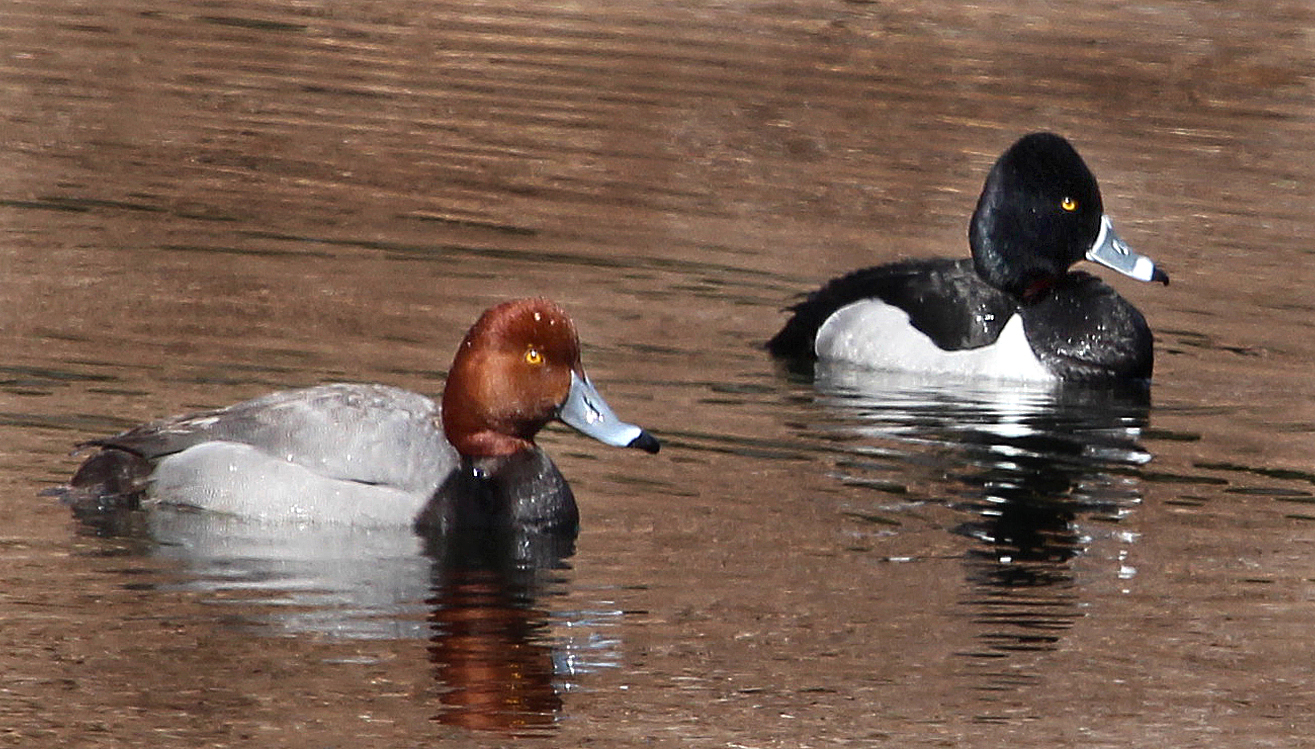
A Redhead swims alongside a Ring-necked Duck in Darien in March 2014.
It’s always good to know where a little open water exists.
Whether the water doesn’t freeze during the winter because of a dam, waterfall, fountain or otherwise, these spots are great for duck watching on even the coldest of days. In fact, the coldest days may be the best time to visit these spots, as very little open water exists elsewhere, and the ducks concentrate in these little oases.
I find it interesting when different species of ducks that usually are not found together congregate in these pools of open water. I’ve seen huge rafts of scaup on Long Island Sound and some large lakes throughout the Northeast. The ducks usually stick with their own kind on these large bodies of water. But when a freeze forces them to find open water, it is not uncommon to see scaups swimming among goldeneyes, buffleheads and redheads.
Photo by Chris Bosak
A cedar waxwing eats border privet berries in New England, February 2025.
Blue jays give and blue jays take away.
During a walk in the woods the other day, I heard a bunch of blue jays squawking up a storm. It was too loud and frantic to be simple alarm calls for a potential threat. This threat had to be real. The calls and squawks reached a fever pitch as more and more blue jays appeared onto the scene from all directions.
I knew it had to be a hawk or owl that had the jays all riled up. I just had to find it.
After a minute or two of peering into the thick hemlock branches, I noticed a large bird being harassed. The blue jays may have been smaller, but it was at least 15 to 1 in their favor. From my angle, the larger bird was still well hidden. I took a few steps to change my perspective, and my suspicions were confirmed that it was a barred owl.
Photo by Chris Bosak
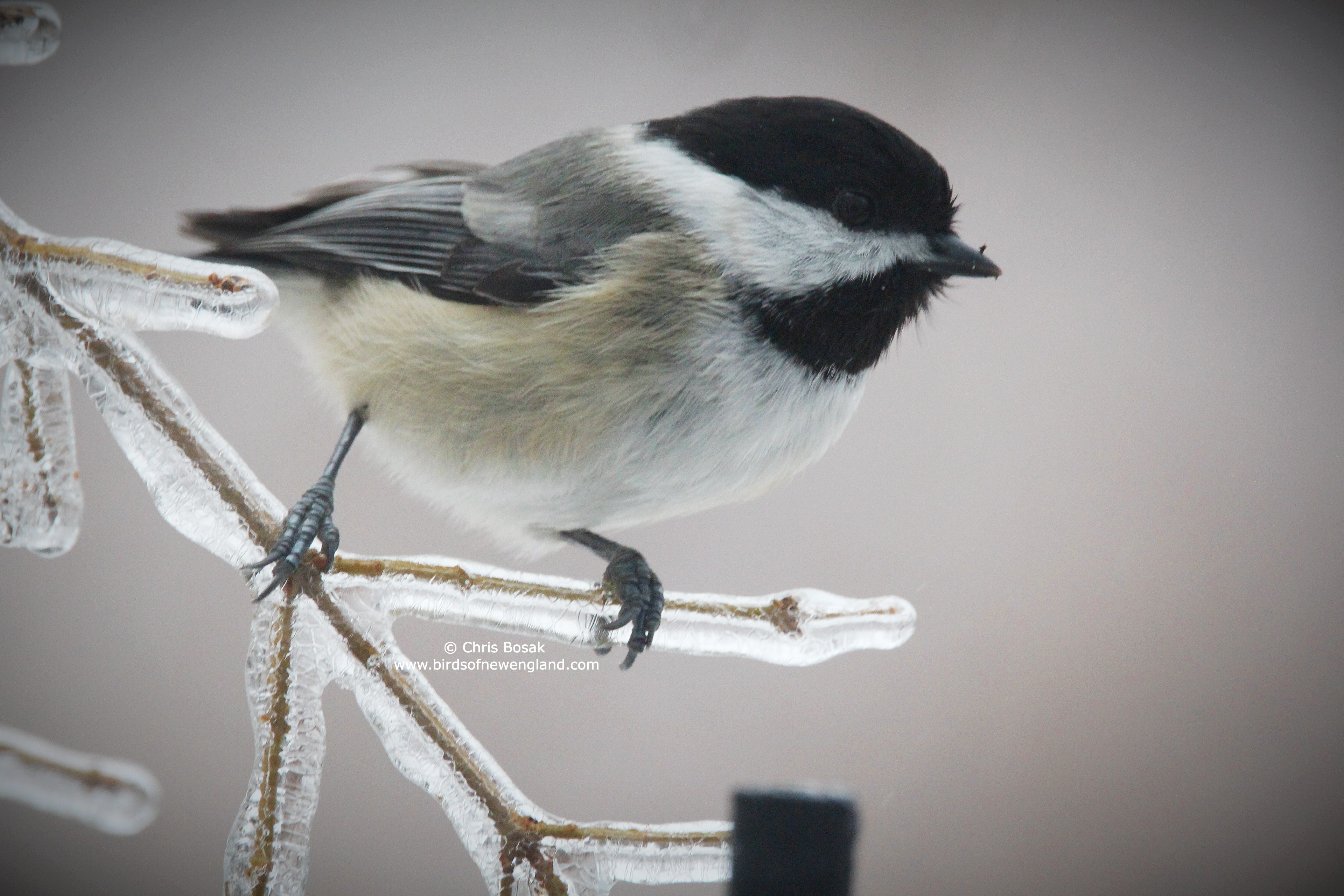
Black-capped chickadee perches on an icy branch, February 2025.
Every so often in New England, everything is covered in ice. I’m not talking about lakes and rivers freezing or icicles dangling from the edge of roofs. I’m talking about when literally everything outside is covered in ice. Every branch, every leaf, every pine needle, every blade of grass is sheathed in its own covering of ice.
It doesn’t happen often. Sometimes it’s once or twice a winter. Sometimes it’s once every couple of years. The conditions have to be just right.
The other week, the conditions were just right. A near-freezing rain fell hard in the evening, and, when the temperature dropped just a bit after the sun went down, it turned into freezing rain. By morning, everything was ice, including a slick covering on the remaining snow.
Photo by Chris Bosak
Male long-tailed ducks on Long Island Sound, February 2025.
You have to mix it up every once in a while. This goes for most things in life, but certainly for birdwatching.
The other day, I pulled into the parking lot of the state park where I do the majority of my walking and birding. I never got out of the car this time. I had a rare several-hour block to myself, and, as I pondered my options, the siren song of water kept calling me.
While I love walking at my local patch, and I know just where to look and what I might find, I was craving something different on this day. My patch is mostly woods with a few fields, like much of New England. It does have a large pond, but it has been frozen solid since December.
I backed out of the parking lot and headed to a reservoir a relatively short distance away. I knew at least some of the water would be unfrozen and undoubtedly holding some ducks. Open freshwater has been hard to come by this winter.
The reservoir, as it turned out, was mostly frozen as well. A small area near the dam was open, and that’s it. This oasis of unfrozen water was, however, a gathering place for a lot of waterfowl. Canada geese were, by far, the dominant species, along with mallards and mute swans. There were also a few buffleheads and ring-necked ducks, along with a lone male wood duck in his splendid breeding plumage. It had been a while since I had seen a wood duck, so that was the highlight of my visit to the reservoir.
Since I had gone that far already and still had time to spare, I figured I’d keep going and pay a visit to Long Island Sound. It wasn’t terribly far and, even though it’s almost always cold and windy in the winter, I knew a lot of ducks and other fowl would be there.
I arrived at the Connecticut state park, and Long Island Sound did not disappoint. I immediately spotted a huge raft of greater scaup and a few small groups of common goldeneye. The odd common loon popped up here and there as well. Common loons are a blend of dull whites and grays in their winter plumage, unlike their iconic black-and-white spotted summer plumage.
Canada geese were there in large numbers, of course, but a massive flock of brant flew past as well. There were also smaller groups of brant hugging the shoreline.
The highlight for me was the long-tailed ducks. Formerly called oldsquaw, long-tailed ducks are another species that look completely different in the winter than in the summer. Not that I’ve ever seen a long-tailed duck in the summer, as they breed well north of New England, but I’ve seen pictures. The male’s winter plumage is a mix of bright white, black and different shades of brown. The bill is dark with a pink patch in the middle. The female’s plumage is more modest with white and brown.
Many of the long-tailed ducks were relatively close to the shore, offering decent photo opportunities. Unfortunately, it wasn’t a great day for photos as it was very gray. Of course, gray can be good for photography as it eliminates harsh shadows, but this was a dull, dark, color-robbing gray. I did my best with the long-tailed ducks nonetheless.
The inland part of the park was good too, with Savannah sparrows, a northern harrier, fox sparrows and a large group of American tree sparrows.
The next day, I was right back at my patch enjoying a walk in the woods. I guess I needed a little change of pace, if only for one day.
The Atlantic coast is not terribly far for a day trip, and Long Island Sound is not that much farther. If the sea is calling your name and you have the time, pack up and go. Let me know what you see.
Photo by Chris Bosak
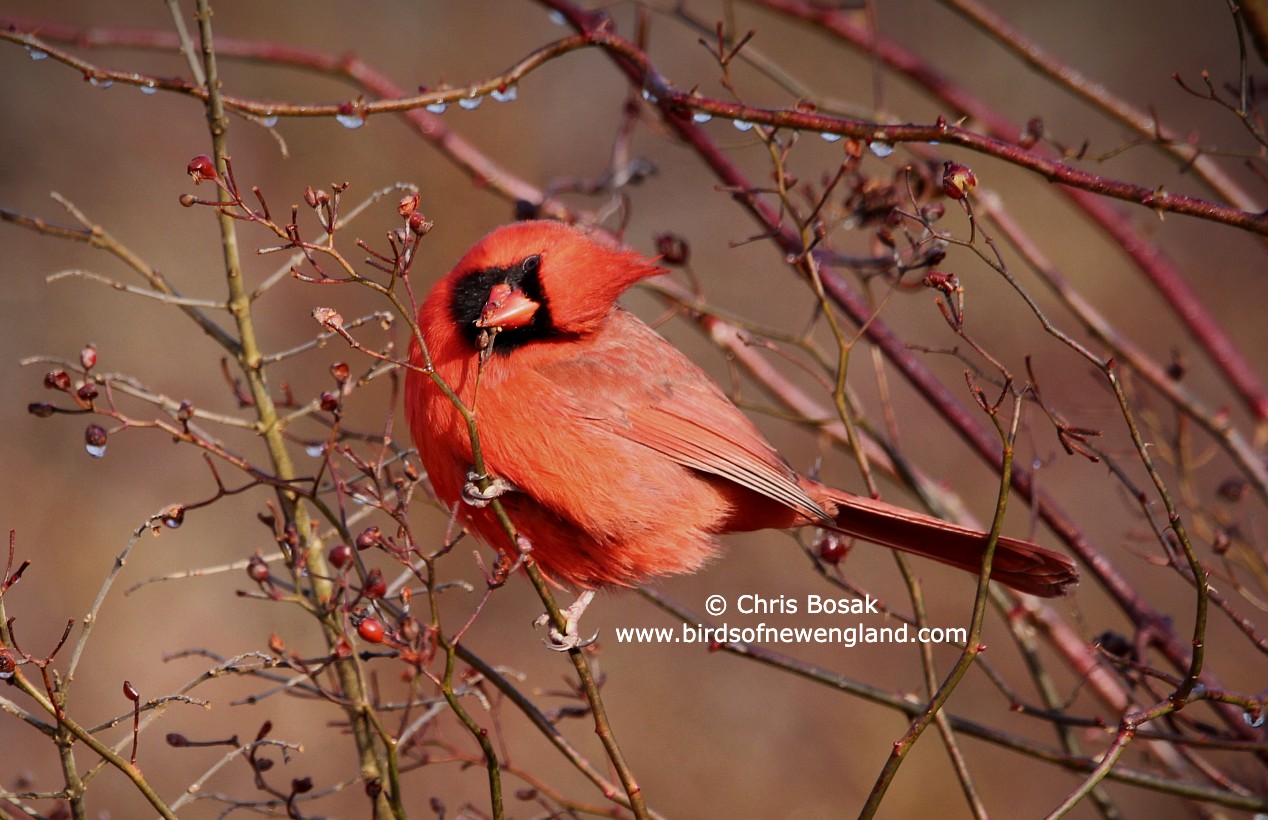
A cardinal eats berries in New England, January 2025.
I’ve seen a ton of robins this winter. On several occasions, I’ve seen them in big numbers attacking bushes and trees and stripping them of fruit.
I’ll always remember the first time I saw this spectacle. It was more than 20 years ago, and I was a relatively new birder. I walked into the woods and the trees were alive with bird life. Birds were darting from tree to tree all around me.
I was finally able to focus on a few and discovered that they were all robins. I was surprised because, at the time, I still thought of robins as spring and summer birds in New England. They are the harbinger of spring, aren’t they?
Photo by Chris Bosak
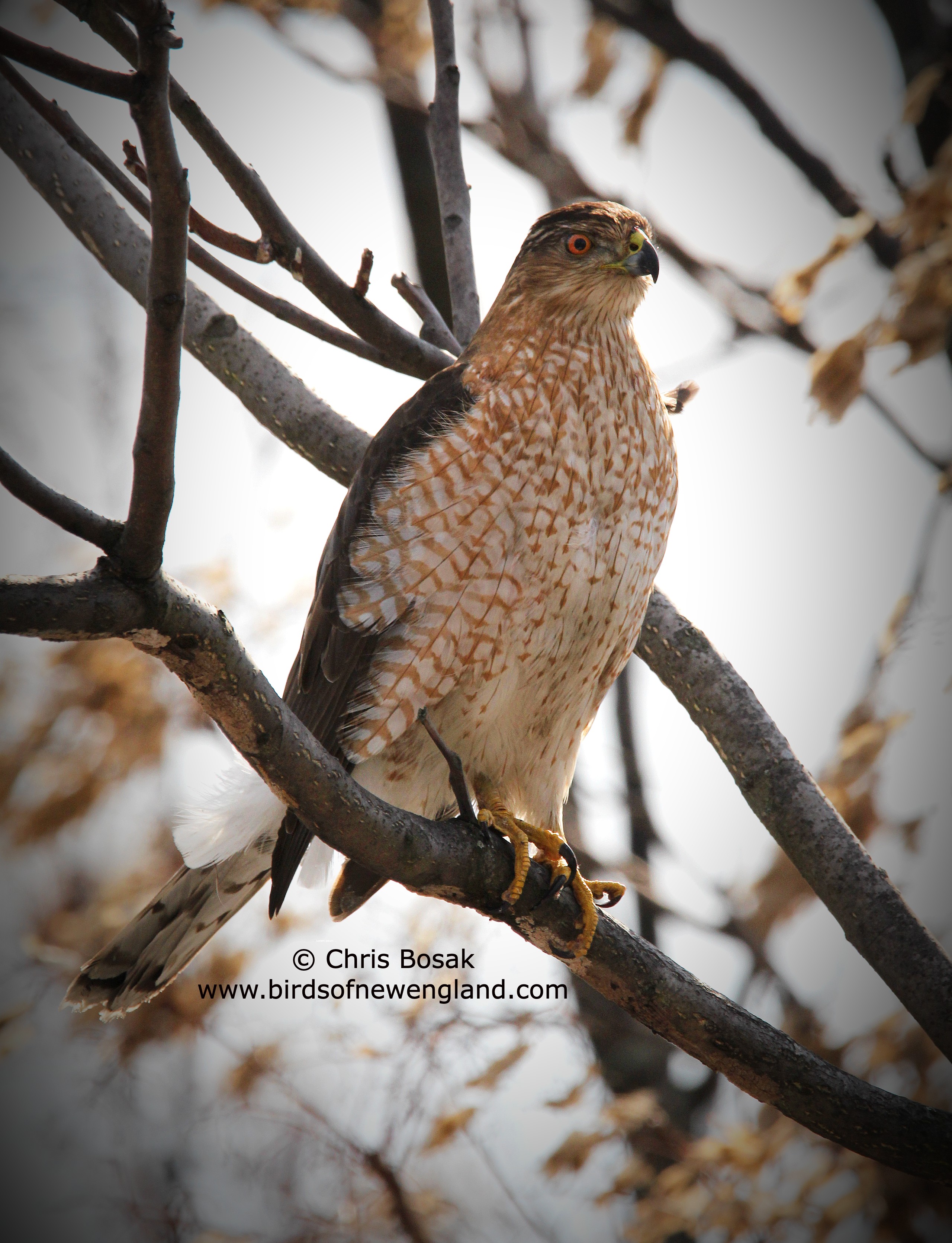
Adult Cooper’s hawk seen in Norwalk, Connecticut, January 2025.
I was walking along a short but windy trail in southern New England the other day in search of overwintering warblers. This short path is known for harboring these tiny songbirds during the winter, as it is adjacent to a water treatment center that features open water on even the coldest days.
I came around one of the many bends and jumped back as I flushed a large bird that was on the ground next to the trail. With my heart racing from the surprise, my immediate reaction was that it was a ruffed grouse. It flushed with the familiar exuberance and noise of a grouse, so my mind immediately went there. Ruffed grouse, however, do not live in that area of New England any longer, and the habitat wasn’t right for the popular game bird.
Photo by Chris Bosak
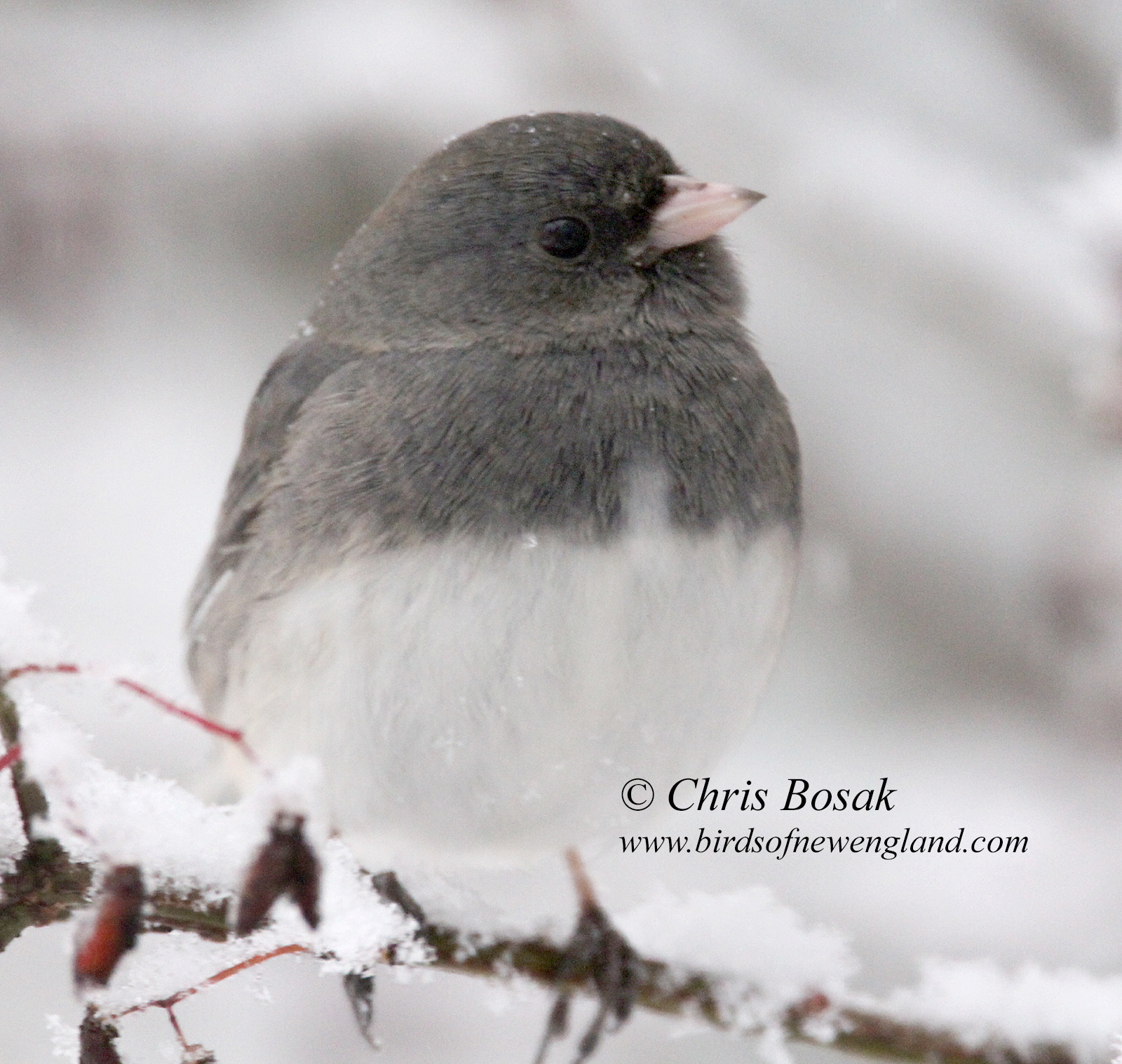
A junco perches on a branch after a snowfall in New England, January 2022.
If it weren’t for the American robin running away with the Bird of Winter title, the dark-eyed junco would be a serious contender.
The Bird of Winter is my very unofficial contest for the bird species seen in unusually high numbers during the winter. As I wrote a few weeks ago, the American robin is far and away the leader this winter, and I continue to see great numbers of robins nearly everywhere I go these days.
The dark-eyed junco, which has won the Bird of Winter title in years past, is making a strong case for honorable mention this year. I see them in my yard, at work, on my walks and all along the roadsides.
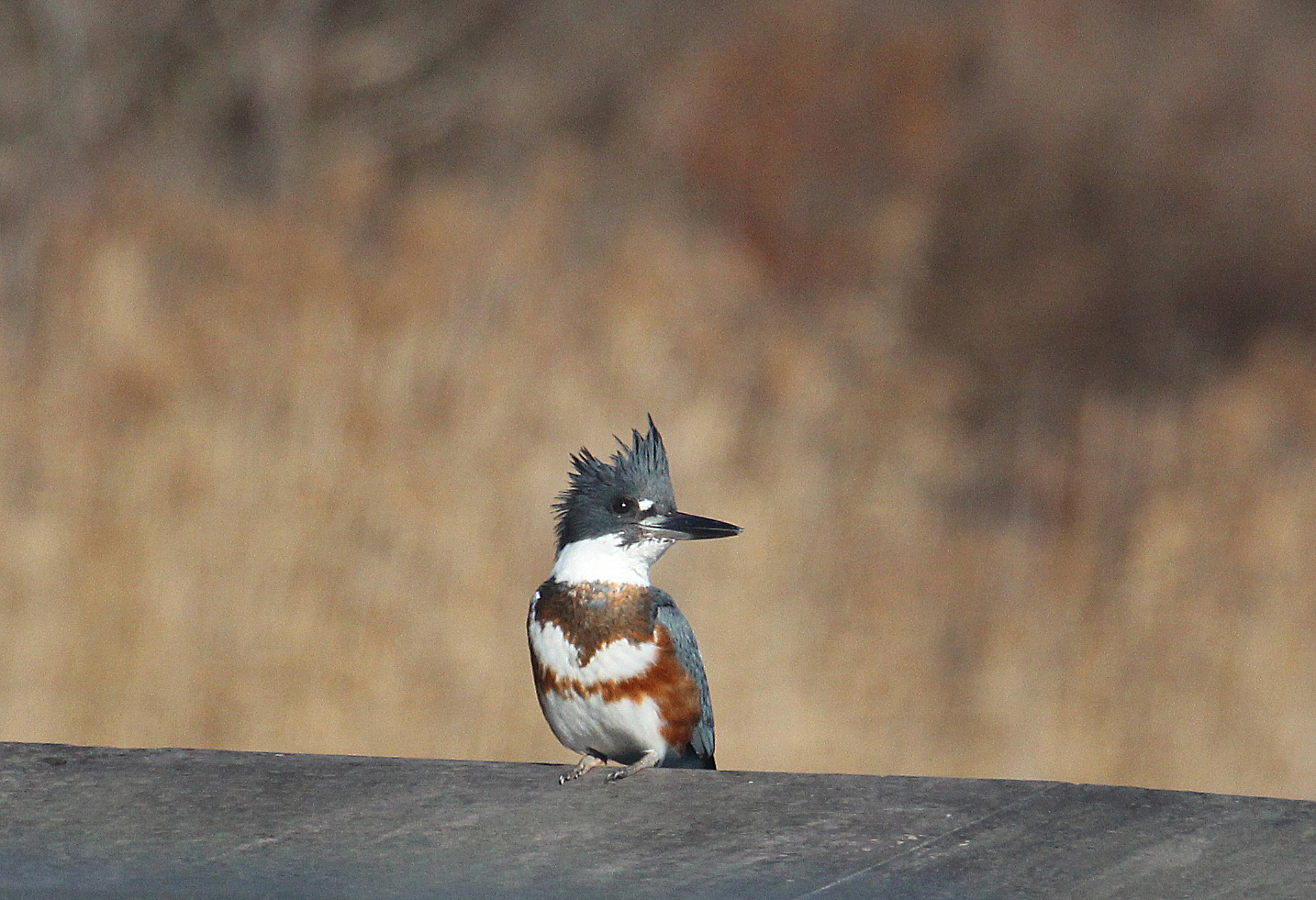
Photo by Chris Bosak – A Belted Kingfisher seen near the Maritime Aquarium at Norwalk on Sunday during the annual Christmas Bird Count.
What comes to mind when thinking of year-round birds in New England?
My guess is the first species that come to mind are songbirds such as black-capped chickadees, tufted titmice, or white-breasted nuthatches. The next birds that come to mind may be slightly larger, like woodpeckers, cardinals, blue jays, or mourning doves. Then it may eventually get to even larger birds such as red-tailed hawks, barred or great horned owls, mallards or turkey vultures.
Some people’s thoughts may veer off to less obvious year-round species such as eastern bluebirds and American robins, which many people may not realize are found in New England during the winter.
My bet would be that belted kingfisher would not immediately come to mind. It certainly would not have for me. I thought about that when I saw one the other day in a rather surprising place, and it reminded me that they are, indeed, year-round birds in New England.
I was walking to the cafeteria at work when I heard a familiar rattling call off to my right. Along the walkway, two consecutive small bridges span streams, one of which is small and often nothing more than a dried-up bed, and the other is a bit larger and flows meekly in dry times and mightily after heavy rains.



 Birds of New England.com