Photo by Chris Bosak – Bluebirds were a common sighting during a house- and dog-sitting experience in New England.
I agreed to house- and dog-sit for a friend recently. I had never been to the house before so when I parked in the driveway, I did what I always do upon visiting a house for the first time: evaluate the birding potential of the yard.
When I visit a home in a city or busy part of a suburb, I don’t expect much but remain optimistic. Sometimes I’m disappointed and sometimes I’m pleasantly surprised. If the house is in a rural area, I assume the best and expect to spend many enjoyable hours on the porch or deck listening to and watching birds.
This particular house was in “the country” and lived up to all expectations.
Photo by Chris Bosak A warbling vireo does what it does best: sing from a branch of a deciduous tree.
The U.S. Fish and Wildlife Service recently added a story on their website about the red-eyed vireo and mentioned, jokingly, that it is sometimes referred to as “the bird that doesn’t shut up.” The short post says the bird can sing more than 20,000 times per day and that their “incessant singing” makes up for their rather drab plumage.
I can’t dispute what the article says, as red-eyed vireos do indeed sing a lot, and I’ve heard them frequently throughout this spring and early summer. But this year, I’ve been more taken by the red-eyed vireo’s cousin, the warbling vireo.
Seemingly every walk I’ve taken this year from late April on has included a sighting of a warbling vireo. Well, maybe not always a sighting, but at least a hearing. It is usually the first bird I hear as I approach the woods. “Yup, another warbling vireo” has been a frequent refrain on my walks this year.
Photo by Chris Bosak
A blue jay perches on a branch in New England.
It’s no secret that Facebook is rife with links to a lot of really dumb articles. Many of the links are either clickbait or gateways to completely useless drivel.
I learned a long time ago to not even bother clicking on the links because they inevitably lead to disappointment. But, I came across an article on Facebook the other day that I just had to click on. The headline for the post read, “Why You Should Avoid Inviting Blue Jays into Your Yard.”
I know some people have issues with blue jays, but I had never seen an article devoted to keeping blue jays out of people’s backyards. I’ve seen plenty of articles on how to keep squirrels, bears, house sparrows and grackles away from feeders, but never blue jays.
Blue Jays are strikingly beautiful birds and native to the U.S. Why would anyone want to keep blue jays away from feeders?
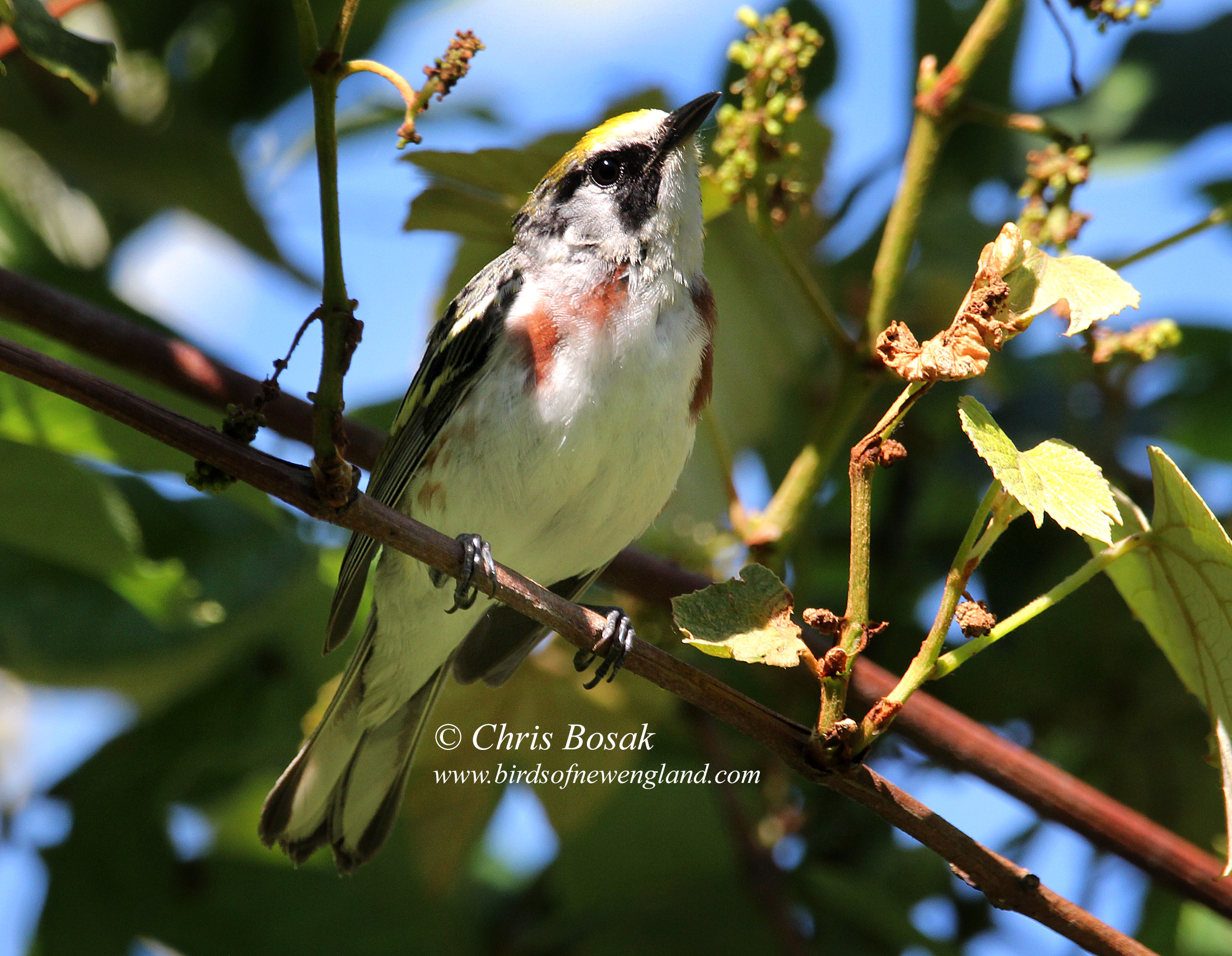
Photo by Chris Bosak – A chestnut-sided warbler perches in the brush in New England, spring 2024.
It was one of the better spring migrations I’ve had in a long time. I got out there more than in previous years and visited a greater variety of places.
The big week, of course, was the visit to Erie, Pennsylvania, during the peak of the migration season. I was there for my niece’s wedding but arrived several days in advance of the event to stay with my brother and visit Presque Isle State Park, a birding hot spot. We saw over 70 species of birds over the three separate visits.
I also hit my local New England spots several times a week during migration, starting in late March and going into June. It’s always interesting to see how the spring migration starts with a trickle of very few species and peaks with several dozen species all moving through at once.
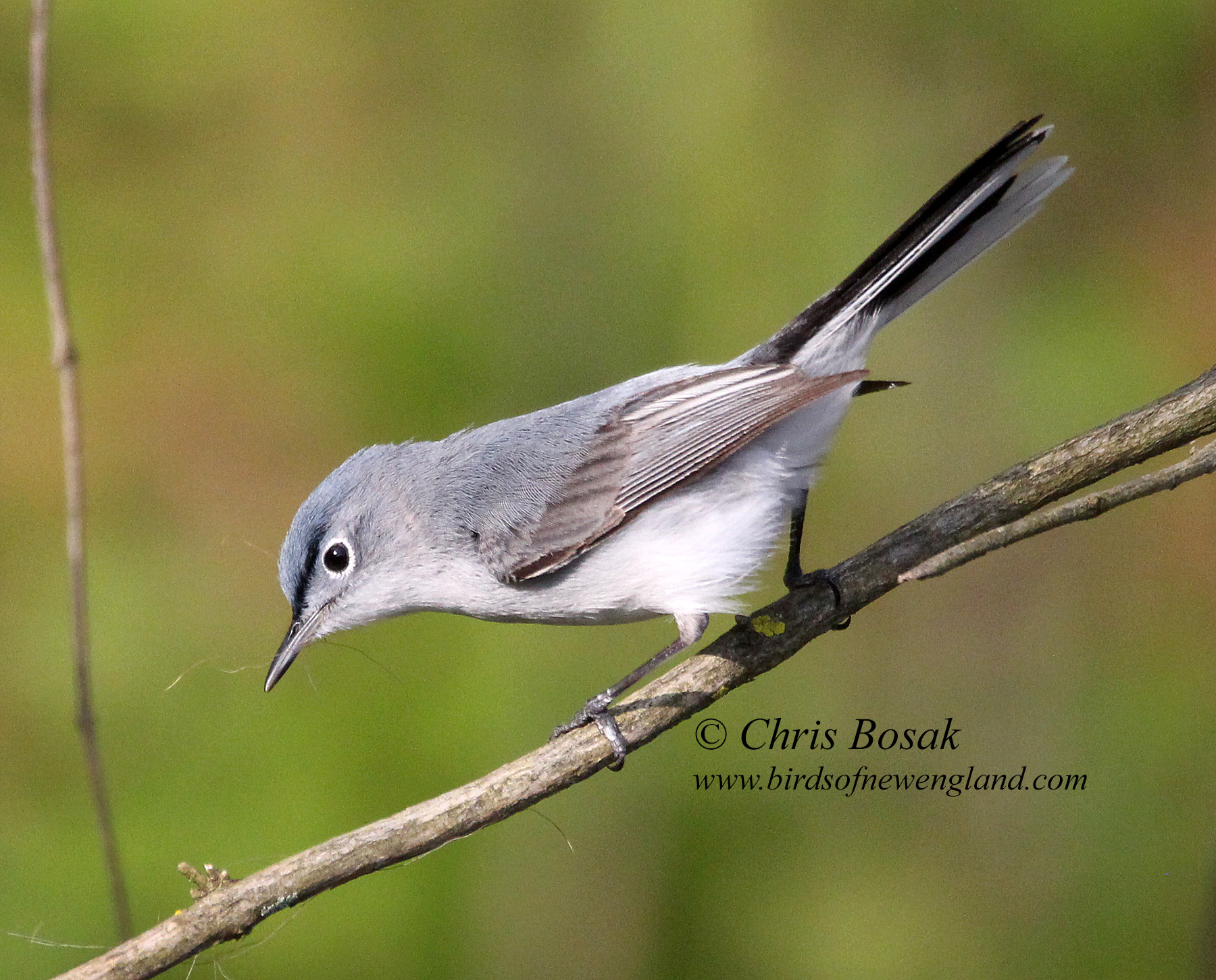
Photo by Chris Bosak – A blue-gray gnatcatcher collecting material for its nest, Presque Isle, 2024.
The birdwatching had already been fantastic as Baltimore orioles, gray catbirds, yellow warblers, and even bay-breasted warblers were overly abundant. The walk got even more exciting as we watched a blue-gray gnatcatcher fly back and forth from a branch to a bush about 30 yards away.
A nest must be up there, I thought, as we now watched two blue-gray gnatcatchers going back and forth to the branch. Blue-gray gnatcatchers are small migratory birds with blue-gray plumage, as the name suggests, long tail and white eye ring. A peek through the binoculars confirmed that a nest was on the branch. I was surprised that the nest had been built in the middle of a dead branch with very little cover from the leaves above.
It took binoculars for confirmation as blue-gray gnatcatchers are tiny birds of only four or five inches. Their nests are just as small as the birds themselves, even a bit smaller at only two or three inches wide.
Visions of warblers, tanagers, orioles and grosbeaks may dance in the heads of birdwatchers in May, but the woods and fields are filled with a myriad of other types of birds as well.
While birds such as vireos and flycatchers continue to fascinate (and confuse) me, it has been thrushes that have captured a large portion of my attention so far this spring.
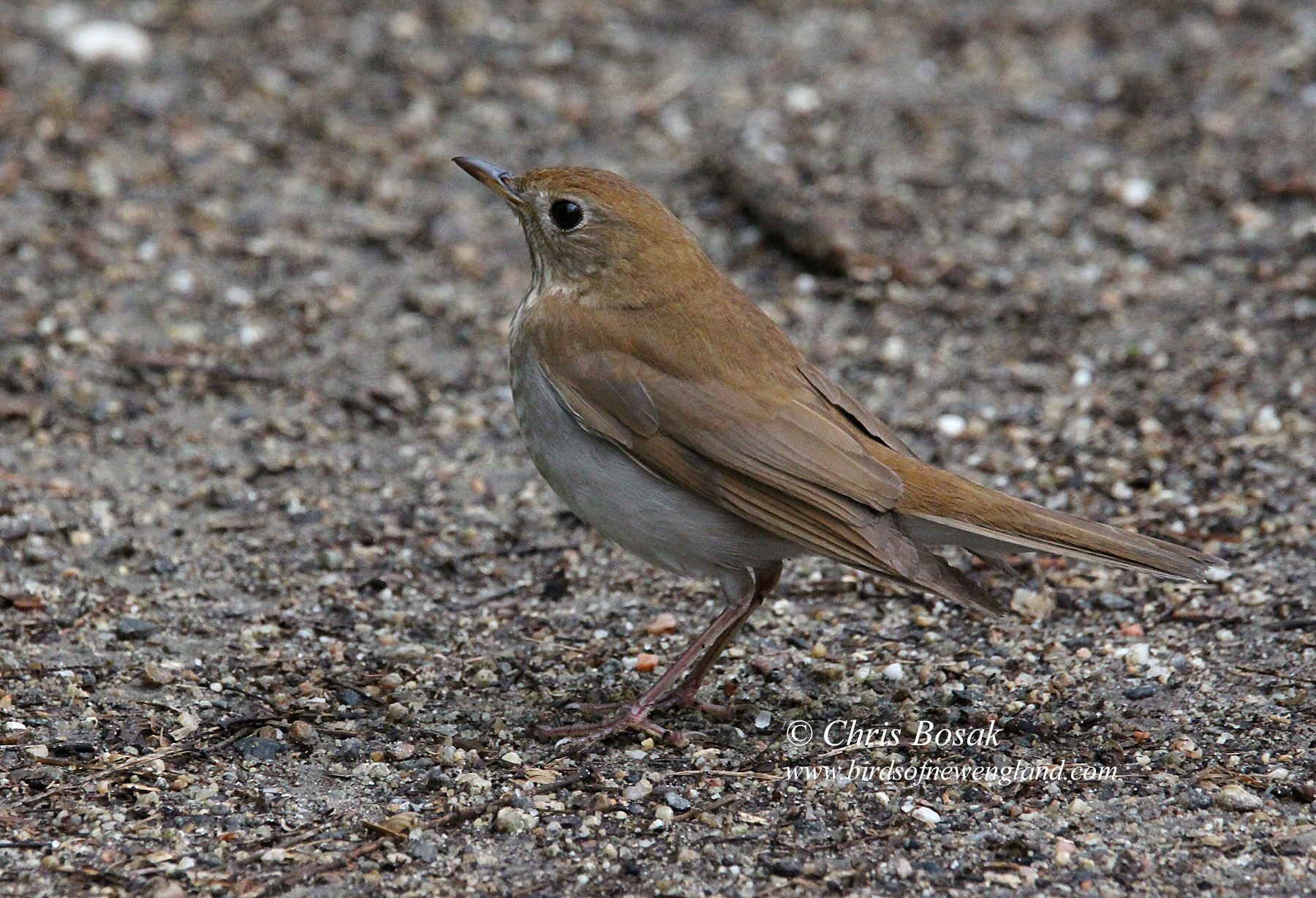
Wood thrushes in particular have been plentiful and conspicuous on my walks. By conspicuous, I mean I hear their flute-like songs several times as I wander through the woods. They can be amazingly difficult to find even as the song makes it seem like the bird is right in front of you. My actual find rate on wood thrushes is embarrassingly low — about on par with my batting average from my high school baseball days.
When I do find the bird, I can’t help but stand there and marvel at it. How can that awesomely musical song come from a relatively nondescript bird about seven inches long? Lang Elliot, who is well-known for his bird recordings, wrote: “The song of the wood thrush is undeniably one of the most beautiful of all forest melodies.”
Photo by Chris Bosak – A brown thrasher perches in New England, April 2024.
The Merlin app really came through this time.
I have written about the smartphone application that identifies birds by their songs and calls a few times before. I always stress, and I’m sure the app creators would agree, to confirm identifications by sight if you can find the bird.
The other day I was walking at a park, and the app showed that a brown thrasher was singing nearby. The app included a red dot by the species name, signifying that it is a rare bird to be seen where I was walking.
My immediate reaction, as a skeptic, was to not believe the app and assume it was a mockingbird instead. I have seen mockingbirds where I was walking several times. Brown thrashers are mimics like mockingbirds, so the misidentification would be understandable.
Photo by Chris Bosak
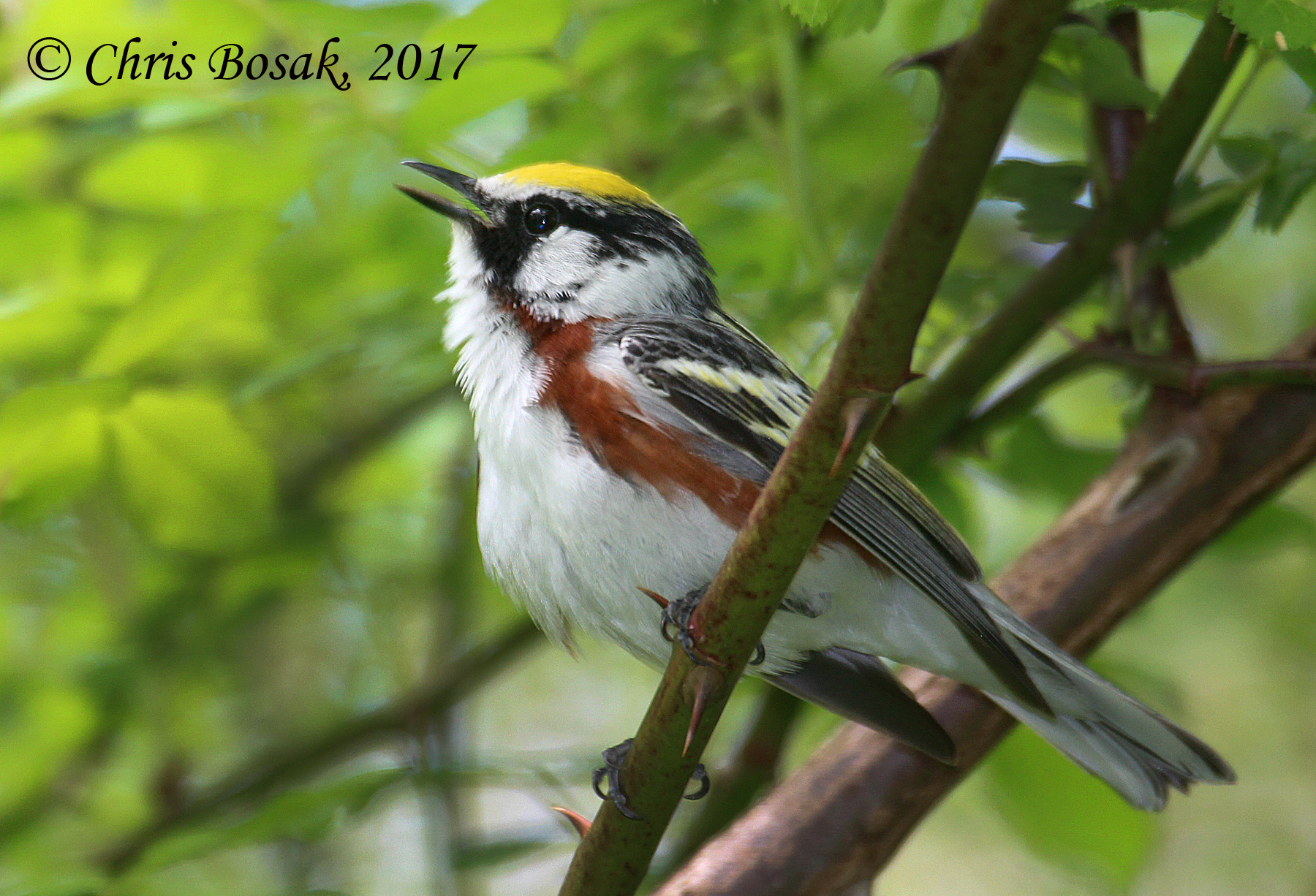
A chestnut-sided warbler sings from a lower perch in Ridgefield, Conn., during the spring of 2017.
I saw a yellow-rumped warbler, a few pine warblers and several palm warblers on my last bird walk. That can only mean one thing: time for my annual spring warbler column.
The aforementioned warblers are the earliest to arrive in New England in the spring. The rest will follow shortly.
But first, what is a warbler? A warbler is a small Neotropical songbird. Many are colorful but not all of them. Yellow is a common color among warblers, but white, black, orange, brown and tan are also found frequently on warblers. While some spend their winters in the southern part of the U.S., most migrate farther to Central or South America, or the islands south of the U.S. A few stragglers may be spotted in New England during the winter, but it’s not common.
Warblers breed throughout the U.S., mostly in the northern states and into Canada. By late September and into October, warblers do their southward migration. In April and May, they pass through the area again — this time in their fresh spring plumage.
Many warblers will remain in New England to raise families, and others will head farther north. Yellow warblers and common yellowthroats, for me anyway, are the species most commonly seen during the summer raising their families. I’ve also found the breeding spots of American redstart, ovenbird, pine warbler and a few other species.
The weather icons on my iPhone showed rain starting at 8 a.m. I figured that would give me about an hour of dry weather to look for some early spring migrating birds.
No such luck. The rain started even before sunrise so my hour of dry weather wasn’t going to happen. Instead of rolling over and going back to sleep (a very tempting option) or mindlessly scrolling through social media, I decided to head out into the rain anyway. OK, I did take a few minutes to do Wordle quickly before heading out.
The walk started in a light rain, and a lot of birds were out singing. Immediately, I heard robins, cardinals, blue jays, song sparrows and a field sparrow in the distance. Field sparrows have a very distinctive song that sounds like a ping-pong ball bouncing on a table with the time between bounces getting progressively shorter, just like a real ball would do.
As soon as I committed to a trail leading me farther into the woods, the rain picked up. It never turned into a downpour, but it was a good, steady rain. Thankfully, the temperature was a very manageable 55 degrees, so I just got wet instead of wet and cold. I like birdwatching in all types of weather, but a cold rain is probably the worst. Heavy wind is not much fun either, but I would take it over a cold rain.
Photo by Chris Bosak
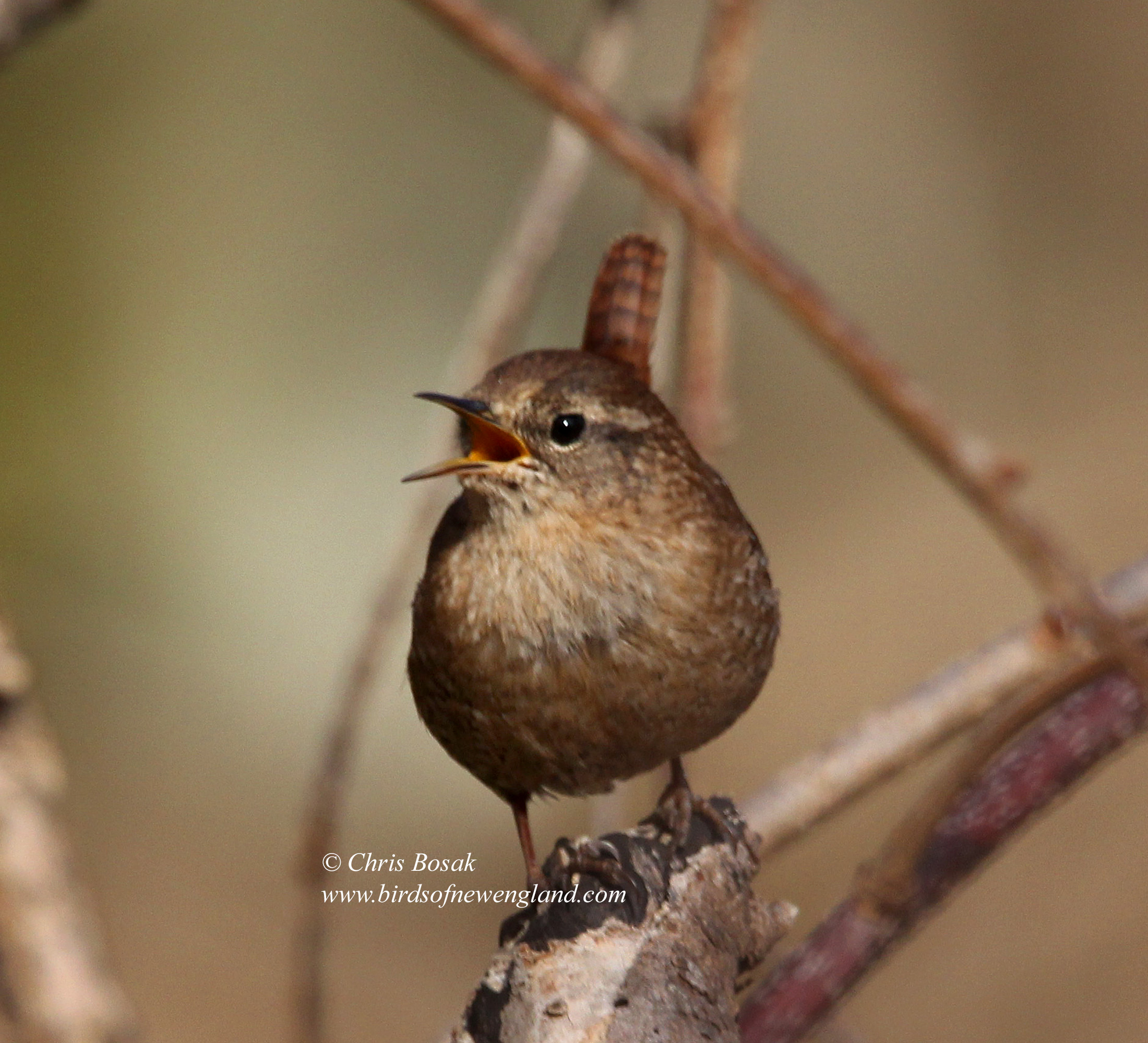
A winter wren sings from a perch in New England, March 2024.
The average person most likely would not understand my excitement. Anyone who has more than a casual appreciation of nature, including everyone who is reading this I’m sure, will get where I’m coming from.
From an outsider’s perspective, a winter wren is not much to get excited about. It’s a small brown bird – even smaller and more nondescript than a sparrow. Big deal.




 Birds of New England.com