Classic For the Birds: Neither summer nor winter

Here’s another classic For the Birds column, this one originally printed in the fall of 2007. Andrew was five, Will was two, the economy was starting to unravel.

Photo by Chris Bosak
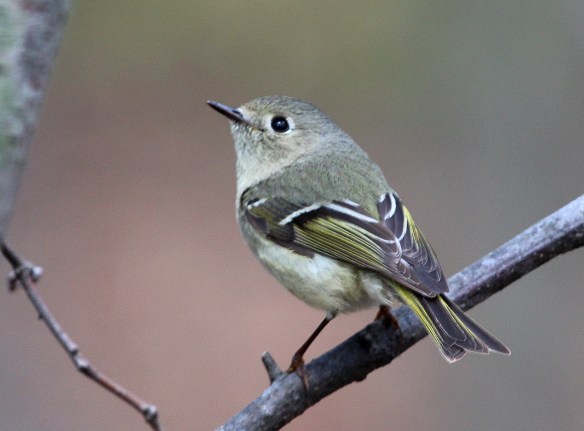
A Ruby-crowned Kinglet perches in a tree at Selleck’s/Dunlap Woods on May 5, 2014.

We’re losing birds daily as the days get shorter and nights get cooler. That’s the pessimistic view.

We’re gaining birds daily, too, as the days get shorter and nights get cooler. I like that one better. I try to be a glass-half-full type of guy, even as my 401k plunges into the abyss.

Fall migration is a funny thing for birdwatchers in New England. We say goodbye until next spring to some birds, such as oystercatchers, ospreys, and hummingbirds; and hello to our winter birds such as white-throated sparrows, juncos, and ducks of all shapes and sizes. In the meantime, birds that nest north of here and winter south of here will pass through like a train in no particular hurry to reach its destination.

Now is the time to concentrate on those varieties. The kinglets, warblers and vireos of the bird world. Our summer birds have been with us for months. The winter birds will be here soon and stay with us until spring. The migrants are fleeting. That’s why they’re called migrants.

Kinglets are my favorite fall migrant to watch. A tiny bird that would easily fit in the palm of your hand, kinglets are energetic little bundles of joy. We have two varieties in New England: ruby-crowned and golden-crowned. For the most part they migrate through New England at different times, but I once watched from my kitchen window a ruby-crowned and golden-crowned sharing the same hemlock branch.

Kinglets are not shy and will often hunt for tiny insects within arm’s reach of any human patient enough to stand still long and learn its hunting pattern. They hunt high in trees, along the tops of average-sized bushes and even along the ground. I once watched a ruby-crowned kinglet hunt on a sandy beach a few autumn’s past.

Warblers are the jewels of the bird world in the spring. They are colorful, spritely and somewhat easy to identify if you can get a good look at them. In the fall, they are still sought after, but often painfully confusing for birdwatchers. The males of most species, resplendent in their breeding plumage in the spring, sport feathers that are dulled by age and the toils of summer by fall. First-year birds — mere helpless naked babies a few months ago — are passing through New England in their confusing neither-here-nor-there plumage.

I had an unfortunate warbler sighting last weekend. I was walking along a long road with my five-year-old, Andrew, and two-year-old, Will. First, let me clarify the walking situation. We had just spent a wonderful, but exhausting morning/early afternoon at an Aquarium in southern New England. We had to walk a fair distance back to the car, but the kids were in no mood to walk under their own power anymore — especially if sharks and seals were not involved — so I had Will on my shoulders and Andrew in my arms. I love them to death, but they are getting heavy.

Suddenly Andrew, who was facing backwards, says, “Daddy, you just walked past a bird.” Sure enough, there on the sidewalk was a dead black-throated blue warbler. I put the kids down and examined the bird. It was perfectly intact and likely either collided with a window or simply fell exhausted from the sky. Not that I particularly enjoyed that warbler sighting, but it did serve as an educational lesson for Andrew and Will, and was a mighty handsome subject at that. (It also gave me a little break from carrying two growing boys.)

Double-crested cormorants made for another educational lesson that morning. The cormorants were alive and well, and this lesson was actually fun — at least I thought so, anyway. Cormorants are large diving water birds. When they swim pretty much only their long necks are above the water, making them look like swimming snakes. There were about a dozen of them swimming under a railroad bridge in a river. It was Andrew’s job to first find them and then count them. The game could have gone on for hours as the diving cormorants became “new” birds each time they resurfaced. He got to about 30 before the game got old and we went back into the Aquarium.

Soon, the double-crested cormorants will be gone and great cormorants will take their place along New England’s coast for the winter. Also before long, waterfowl of many varieties will arrive in New England. Some will merely pass through and some will stay all winter.

The days are going to get even shorter and the temperatures are going to get a lot colder. Those ducks, however, will help us get through the winter. They always do.

For the Birds: Get out there for fall migration

Photo by Chris Bosak A Red-tailed hawk at Weed Beach in Darien, Conn., January 2015.
Photo by Chris Bosak — The hawk migration is a highlight of the fall bird migration in New England.

There is more to the fall migration than hawk watches on top of mountains. Watching raptors effortlessly soar among the thermals is indeed the highlight of the fall migration, but everything from shorebirds and songbirds to waders and waterfowl move south in the fall as well.

The fall migration does not garner as much enthusiasm as the spring migration among most birders for many reasons, I believe.

The height of the spring migration is concentrated into a predictable three- or four-week period when you are assured of seeing many colorful songbirds. The fall migration is more spread out. It actually started in July with some shorebirds moving south and will Continue reading

A walk for the birds at Oak Hills

Some bird nerd with cool birdwatching peeps.

I’m a little late with this posting but better late than never. A few Saturdays ago I led a bird walk at Oak Hills Park in Norwalk. I was honored to be invited by the park’s Nature Advisory Committee to be the bird guide. Of course, I accepted because I love spreading the good word about birds and I have a soft spot for any volunteer organization that promotes nature appreciation and saves land.

As a bit of background, Oak Hills Park is mainly a golf course and the nature trails are on land that was once targeted to be cleared for a driving range. The Nature Advisory Committee now stewards that part of the property, which is valuable for birds and other animals — and plants for that matter. Case in point, during the walk we came across a box turtle in the woods. The box turtle is one of many animal species in decline because of loss of habitat.

The walk drew a large crowd and we saw many exciting birds. The highlight for many, myself included, was a very cooperative scarlet tanager, one of the most colorful and brightest birds we see in New England during migration. The red-bodied and black-winged bird flitted around and rested at eye level not far from the gathered crowd. I also pointed out over and over the sound of the Continue reading

Warbler Week: Common yellowthroat

Photo by Chris Bosak
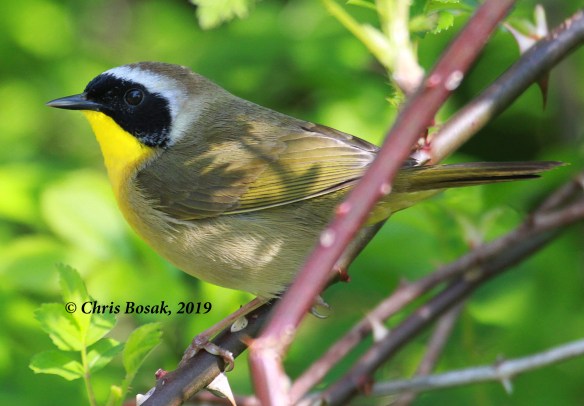
A common yellowthroat perches on a branch in Ridgefield, Conn., May 2019.

Aside from the yellow warbler, the common yellowthroat is perhaps New England’s most common and widespread warbler. The male is a handsome bird with a thin white “forehead,” thick black face mask and bright yellow throat and underparts. The rest of the body is olive and tan. Females are mostly olive and tan with a yellow throat. The loud “witchety-witchety-witchety” song often accompanies birders on spring and early summer walks. Yellowthroats prefer shrubby habitat and are usually found low in this habitat.

Photo by Chris Bosak
Female common yellowthroat

Warbler Week: Chestnut-sided warbler

Photo by Chris Bosak
A chestnut-sided warbler in Hardwick, Mass., May 2019.

I found this guy flitting among the low branches in the woods near my son Andrew’s school lacrosse field last weekend. I had an hour to kill before the game started and, of course, took a little walk in the woods. Towhees and ovenbirds provided the musical backdrop when this guy appeared right in front of me. The chestnut-sided warbler has always been one of my favorites ever since I saw my first one more than 20 years ago in Keene, N.H.

Chestnut-sided warblers breed throughout New England and nearby Canada. They winter in mixed flocks in Central America.

Photo by Chris Bosak
A chestnut-sided warbler in Hardwick, Mass., May 2019.

Kicking off Warbler Week

Photo by Chris Bosak A yellow warbler perches on a branch in Brookfield Conn., May 2019.

Last week may have been a better week to feature some of our more common warblers, but plenty of these beautiful little birds will be passing through or settling into New England this week as well. Each day this week I’ll feature a warbler or two with short text descriptions and, of course, photos. I’ll kick off Birds of New England’s Warbler Week here with a bonus post highlighting two of the warblers I’ve already posted about this spring.

Photo by Chris Bosak
A yellow warbler sings from a perch in Brookfield Conn., May 2019.

The yellow warblers are one of the most commonly seen warblers in New England. They start arriving in early May and nest throughout the region. They are most likely to be seen in brushy areas near woods. Their “sweet sweet sweet I’m so sweet” song is a common song heard throughout spring and summer.

Yellow warblers make a strong case for capitalizing bird names, which is something I go back and forth on. Whenever I capitalize names, however, it is usually the style of the publication for which I am writing to not capitalize and the capitalization is changed anyway. But consider this: Many warblers have yellow featured prominently in their plumage so there are many bird species that may be considered on some level to be yellow warblers. But there is only one Yellow Warbler and the capitalization makes it clear that that’s the bird I’m talking about.

Yellow warblers are all yellow with brown/rusty streaks on its chest and sides.

Photo by Chris Bosak
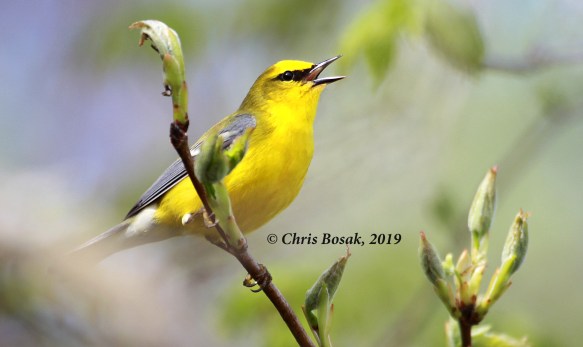
A blue-winged warbler sings from a perch in Brookfield, CT, May 2019.

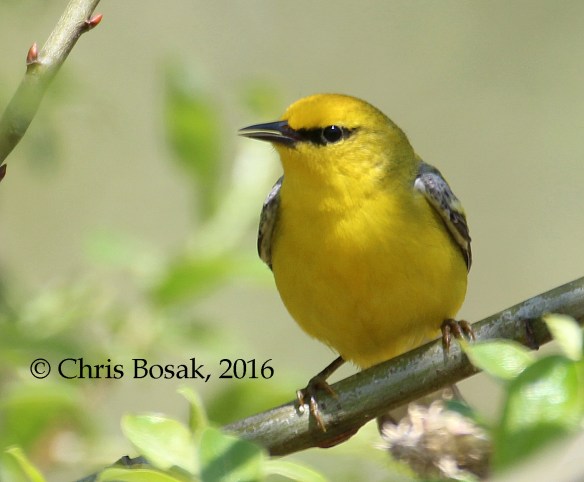
Blue-winged warblers are also common and widespread throughout New England. Their insect-like song “buzzzz-beee” is another common sound during a spring walk. They also favor shrubby areas near woods. In my estimation, they are one of the more distinctive looking warblers with bright yellow plumage and thick black eye streak.

Here’s a shot from 2016.

Photo by Chris Bosak A Blue-winged Warbler seen at Fairchild Wildflower Sanctuary in Greenwich, Conn., May 2016.

A nice spring bird walk (aren’t they all?)

Photo by Chris Bosak
A bobolink perches at the end of a branch in Brookfield, CT, May 2019.

I checked out Happy Landings, an open space of fields and shrubby areas in Brookfield, Connecticut, after dropping off my son Will at middle school the other day. With its huge fields, the protected space is a rare haven for bobolinks in New England. There should be more such field habitat. Anyway, I wanted to see if the bobolinks were back and sure enough, they were — along with plenty of other birds. Take a look …

Happy birding and let me know what you see out there this migration period.

Photo by Chris Bosak
A yellow warbler sings from a perch in Brookfield Conn., May 2019.
Photo by Chris Bosak
A yellow warbler perches on a branch in Brookfield Conn., May 2019.

Continue reading

More towhees and a warbler

Photo by Chris Bosak A yellow warbler perches on a branch in Ridgefield, Conn., April 2019.

A recent walk in block 91A (my area of the Connecticut Bird Atlas) yielded even more eastern towhees than my walk last week. At one point I saw a female eastern towhee carrying a lump of straw in her bill. Good sign!

Later in my walk, after seeing a beautiful coyote cross the trail and disappear into the woods, I saw my first yellow warbler of the year. Yellow warblers are one of the more ubiquitous warblers in New England as they both migrate through and stay to breed Continue reading

A little towhee time before warbler season

Photo by Chris Bosak An eastern towhee perches on a branch in New England, April 25, 2019.

My foot was feeling up for a short, relatively non-taxing walk yesterday (Thursday) so I grabbed a walking stick and hit a trail. The aching foot enhanced the walk in one fashion as it made me slow down and take in all the sights and sounds of the spring New England woods. Too often when I walk I’m rushing to a destination or point of interest (pond or open field) and don’t take the time to fully absorb all that is around me. Not that I’m hoping the foot keeps hurting, but that was the silver lining in this latest bout of tendonitis.

It was still a bit early for a big warbler count — blue-winged and black-and-white were the only warbler species I found — but eastern towhees were numerous. I’ll expand on the eastern towhee in an upcoming post, but this large sparrow is one of my favorites. The calls and songs of the towhee filled the edge of the woods and I noticed several pairs, which bodes well for a strong breeding season (hopefully.) Above is the male eastern towhee and below is the female. The female is duller in color, but still a striking bird.

Photo by Chris Bosak A female eastern towhee perches on a branch in New England, April 25, 2019.

Warbler watch is on

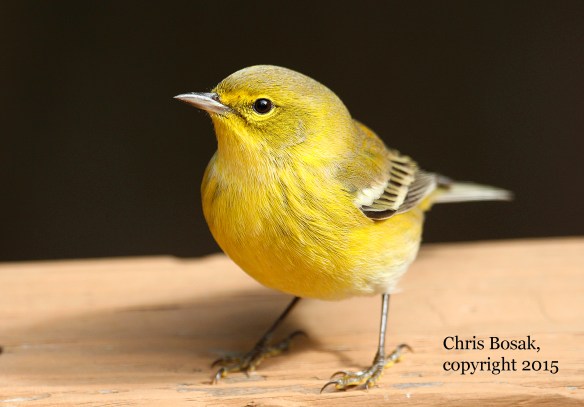
Photo by Chris Bosak A Pine Warbler sits on a deck railing in New England this fall.

The early warblers started arriving in New England a week or two ago. Pine warblers and palm warblers are typically the first two species to make their way back this far north and, sure enough, both are back now. This post includes photos of both species so you know what you’re looking for. (Above is the pine warbler; below is the palm warbler.)

The spring warbler season is the highlight of the year for many birdwatchers. It will pick up gradually over the next week or so and then erupt from late April through the middle of May. At the height of the warbler migration, a New England birdwatcher can see between 20 and 30 warbler species in a single day. (It would take some effort, of course, but it’s very possible.)

I’ll post frequently about warblers over the next few weeks and, hopefully, have plenty of fresh warbler photos to share. In the meantime, practice up with this link from AllAboutBirds.org — it includes various warblers and their songs.

Photo by Chris Bosak Palm Warbler