Photo by Chris Bosak An eastern bluebird scans a yard in Danbury, CT, March 2019.
I thought it was going to be the winter of the junco again, but it’s looking more and more like the winter of the bluebird.
Last year was the winter of the barred owl. As you recall, barred owls were being seen in great numbers all throughout New England. Experts had conflicting theories on why so many of these beautiful owls were being seen, but there is no denying that more than usual were found. On one trip to visit my brother in upstate New York, I found two barred owls. The second owl was perched atop a Welcome to New York sign on the Vermont border.
Several years ago, Christmas Bird Count results were teeming with huge dark-eyed junco numbers. Whereas there are usually hundreds of juncos in a particular count area, there were thousands that year. I dubbed it the winter of the junco and have been on the lookout for similar anecdotal phenomena since then.
Who can forget the winter of the snowy owl a few years back? I can recall robins and pine siskins being highlighted in previous winters.
As I drive to work every day, one stretch of a particular road often has a large flock of juncos. They scatter as I drive by; their white-outlined tails giving away their i Continue reading →
Photo by Chris Bosak A rose-breasted grosbeak eats safflower seeds from a feeder in Danbury, Conn., May 2019.
I promise, here’s the last 2019 birding highlight that didn’t make my Top 10 list. This usually does make my yearly Top 10 list, but other highlights nudged it out this year. Last year was another great year of feeding birds and watching birds in my back yard proved to be a highlight once again. So here’s to those backyard feeder birds. OK, now on to 2020.
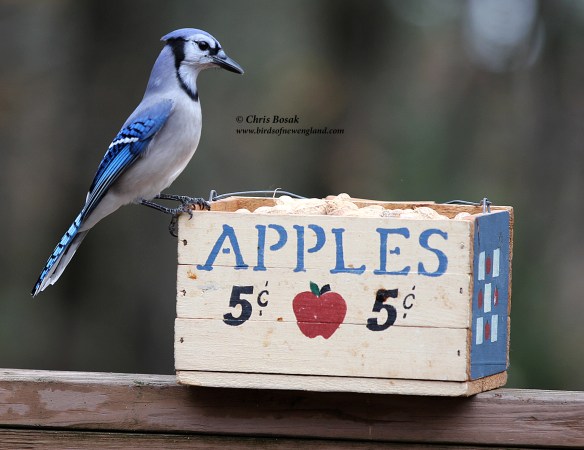
Photo by Chris Bosak A blue jay checks out a box for peanuts in New England, fall 2019.
Photo by Chris Bosak
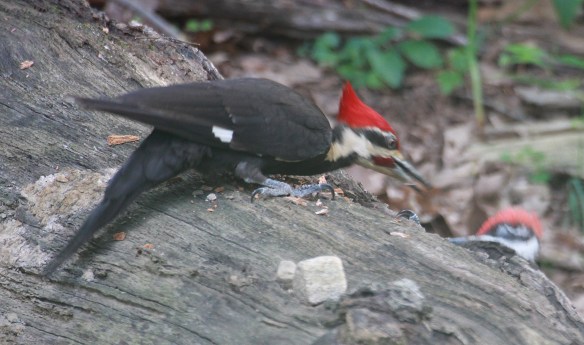
A young pileated woodpecker knocks on a fallen tree trunk as it looks for insects, Danbury, Conn., summer 2019.
I couldn’t let this 2019 birding highlight go unrecognized. I, like everyone else, love any pileated woodpecker sighting. This sighting was in my backyard and featured a male adult teaching a young pileated how to look for food. Here’s the original post with more information.
Photo by Chris Bosak
An osprey eats a catfish at Cayuga Lake State Park, October 2019.
Here’s another 2019 highlight that could have easily made my Top 10 list, which I posted a few days ago. During an early September camping trip with three college friends in the Finger Lakes region of N.Y., we were treated to a sighting of an osprey eating a catfish. Wayne noticed the spectacle first and pointed it out to the rest of us as we were, coincidentally, having our breakfast.
Later in the day, we walked to the nearby beach and saw a few snow geese. It seemed early for snow geese sightings, but I didn’t complain as they are hard to come by in New England.
More leftover highlights to come …
Photo by Chris Bosak
Snow geese at Cayuga State Park in Seneca Falls, N.Y., fall 2019.
Photo by Will Bosak
Kingbird rescue, Danbury, CT, 2019.
Here is the latest For the Birds column, which runs in several New England newspapers.
It’s time for my favorite column of the year. This is the time when I look back on the past year and give my top 10 birding highlights. Every year, I struggle to narrow it down to 10, but I will do my best and perhaps put a few honorable mention moments on my website in the next few days.
10. I visited my brother in Naples, Fla., in April and, of course, birds were everywhere. Waders such as egrets, herons, limpkins, and ibis were the dominant species. We have our fair share of waders in New England, for sure, but they are more numerous and more brave in the Sunshine State. I enjoy my visits to Florida, but always long for New England when I’m away.
9. A solid bald eagle sighting has to make this list. A summer canoe trip to the Bashakill Wildlife Management Area in Wurtsboro, N.Y., yielded just that. We saw the female and male, but the young eagles that locals said were around escaped us. The comeback of the bald eagle is a great conservation story. I hope it continues.
8. One last sighting outside of New England … Last winter was the Year of the Barred Owl, or so it seemed. People were seeing barred owls all over the place, day and night. My son and I were driving to Hoosick Falls, N.Y., last February to see another one of my brothers when, about half an hour shy of our destination, sure enough we saw a barred owl perched on a wire hanging over Route 22. The next morning, we saw another barred owl perched on a Welcome to New York sign. The photo was taken from the Vermont side of the sign so, technically, it was a New England sighting.
7. The Christmas Bird Count is always on this list somewhere. My CBC birding partner Frank and I found 52 species, totaling nearly 2,000 individual birds. The birds, the camaraderie, and feeling of doing good for conservation make the Christmas Bird Count a special event each year.
6. This year, after many years of procrastination and talking myself out of it, I tried my hand at selling some of my photography as Christmas cards. I was a vendor at a few craft fairs and did pretty well. The selling part was great, but talking to people about the photography and turning them on to birds was the real highlight. I’ll try again next year and try to figure out how to sell them online.
5. This spring, small flocks of common mergansers made their home for a few days at a small pond adjacent to a nearby shopping destination. I love my common mergansers and my sightings are typically of huge flocks hundreds of yards away. To see a few up close and personal was an unexpected treat, if only for a few days.
4. Barred owls were not the only species garnering attention last winter. Pine siskins were plentiful throughout New England and farther south and I certainly played host to more than my fair share. They stuck around for a long time, too, and visited daily in rain, sleet, snow and sun.
3. I started a new job a few months ago and, of course, I figured out a way to feed the birds out the window near my desk. I found a large, curled oak leaf, rested it on the flat top of a yew bush, and threw in some shelled sunflower seeds. I fill it daily and watch the juncos, white-throated sparrows and song sparrows partake.
2. I was sitting at my computer, probably writing a bird column or something, when my youngest son, Will, came charging up the driveway and into the house. He had been fishing with some friends at the nearby lake. “Dad, there’s a bird stuck on fishing line. I feel so bad for it.” I put the canoe on the car and rushed to the lake. An eastern kingbird tangled in fishing line was dangling helplessly from a tree over the water. Long story short, Will and I paddled out to the bird, untangled it and set it free. The full story, including when Will and I swamp the canoe in mucky water and the bird poops on my head, is archived on my website. Visit www.birdsofnewengland.com and put “kingbird” into the search field. I was proud that Will felt compelled to leave his friends and come get me to help a bird in despair.
1. The top highlight of the year is a morning I spent with three loons at Pillsbury State Park, near Lake Sunapee. The three-day camping trip was marred with rain on two of the mornings, but the middle morning featured a beautiful sunrise and mirror-like water with fog lifting. I saw the loons in the distance and stopped paddling. Eventually, they worked their way over to me and gave me fantastic views. Patience certainly paid off that morning.
I hope everyone had a terrific 2019. Best wishes for an even better 2020. I look forward to sharing more bird stories in the year to come.
Photo by Chris Bosak
A common loon swims at May Pond in Pillsbury State Park in New Hampshire in June 2019.
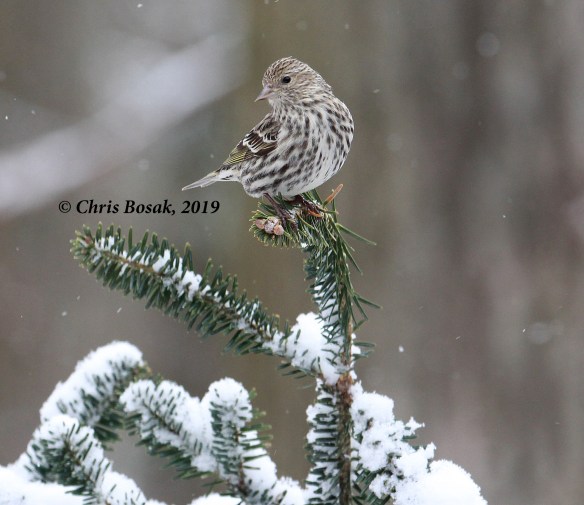
Photo by Chris Bosak A pine siskin perches on the top of an evergreen in Danbury, CT, March 2019.
Happy holidays everyone and thanks for checking out http://www.birdsofnewengland.com this year. I hope to do more exciting things with this site in the year to come. Merry Christmas!
Photo by Chris Bosak A black-capped chickadee grabs a sunflower seed from a Christmas decoration during the winter of 2016-17 in Danbury, Conn.
A few weeks ago I wrote about the perfect Christmas gift being a membership or donation to a local land trust or other conservation organization. Some of those memberships even come with physical goodies such as stickers, newsletters or magazines.
So now that all those gifts have been granted, it’s time to take a quick look at some more gift ideas for the birdwatcher on your list. These gifts can go under the tree and are guaranteed to put a smile on the face of your birder.
What you get a birdwatcher, as with any hobbyist, depends on their skill level and what they have already. Birdwatchers need a good pair of binoculars, but chances are they already have good optics. If you know them well enough to know what binoculars they are using and know they could use an upgrade, that gift would certainly be appreciated immensely.
Speaking of optics — and now we will jump right to the most expensive gift — consider getting your birder a spotting scope and tripod. Spotting scopes come in a huge range of prices, but you really want to avoid the super cheap ones as they do not do very well for birdwatching. Good scopes start at a couple hundred dollars and go up to several thousand dollars. Don’t forget a good tripod, too, as a scope is pretty much useless without a tripod. That’s another hundred bucks or more.
Now let’s get to the gifts that are more practical and do not have as many zeros on the price tag.
A good bird feeder is always a thoughtful gift. So are birdhouses. Birdhouses serve the dual purpose of attracting birds (hopefully anyway) and being a nice decoration for the yard. I liked the look of one birdhouse I received so much that I kept it inside for a long time on a shelf as a decoration to go along with my modest decoy collection.
When possible, get your feeders, houses, and other bird gifts from a local business. Even the franchise stores such as Wild Birds Unlimited are owned by local people who would love your business.
Birding apparel is getting more popular and many companies make clothes exclusively for birdwatchers. Wunderbird has a nice line of sweatshirts, long sleeve T-shirts, and short sleeve T-shirts that are designed for birders. The apparel features several pockets for your binoculars and other gear. Similarly, Big Pockets has vests and other apparel designed for outdoorspeople.
Bird and wildlife art also make for good gifts. There is the traditional art such as photographs or paintings for the wall, and also not-so-traditional art such as decoys and Christmas ornaments. I know my tree is covered with mostly bird ornaments and my boys razz me about it every time we break out the Christmas boxes.
Field guides or other books about birds are also welcome. There are tons of bird books out there, both old and new, that are highly informational and entertaining. A few print magazines about birds are hanging in there in this electronic age and a subscription would be a gift that gives all year.
Speaking of the electronic age, iTunes gift cards are a good idea if your high-tech birder would rather have his or her field guides and other birding information on the phone. I will admit, I’m not a techie by any means, but I do like having a field guide on my phone while I am birding in the field.
There are plenty of other ideas that I didn’t get to. A few bags of Birds and Beans coffee, anyone? It’s funny. For a hobby that requires very little in the way of equipment, there are certainly a lot of ways to spoil your birder.
Photo by Chris Bosak A beach cluttered with brant is a good thing. A website cluttered with ridiculous ads is not a good thing.
You may have noticed less clutter on this site lately. With it being the holiday season and all, I decided to turn off the automated ad program to give my readers a more enjoyable and less frustrating experience. That, and I wasn’t making any money off of them anyway.
But I am happy to be back to publishing a blog/website free of automated ads. They pervasive on the Internet these days and serve little purpose other than bogging down one’s online experience. I kept them on my site for about eight months and I have to admit I cringed every time I opened the site and saw one of those ridiculous ads competing for space with my bird photos. No more! Away with you, automated ads!
I can’t promise ads are gone forever from birdsofnewengland.com, but if I do bring them back, they will be targeted static ads that I sell and approve myself. Now, if I only had a talent for selling … Oh well, I’ll figure it out. Happy holidays everybody. Enjoy your http://www.birdsofnewengland.com ad-free.
A bonus For the Birds on this Thanksgiving. Happy Thanksgiving everybody.
photo by Chris Bosak Wild turkeys in New England.
It is the giving season. Not only for presents under the tree but also for charitable giving during the holiday season — not to mention before the year ends for tax purposes. Sorry, had to add in that bit of practicality.
It’s also the time of year to be thankful, what with Thanksgiving coming up in a few days and all. Like every year, I am thankful for the joy that birds and nature bring to my life on a daily basis. We are lucky to live in New England where we get to fully experience the intensity of each season. The winters are cold, the summers are hot, the autumns are crisp and breathtaking, and the springs are sometimes slow to arrive, but totally worth the wait as the flowers bloom and birdsong fills the air.
Each season also has its bird highlights and there is never a dull moment in the woods or otherwise in the field with binoculars around your neck. Even the dead of winter has its rich rewards for the birdwatcher.
My hope, and I would guess yours, too, is that it stays that way. An often-cited study released recently shows that nearly 30 percent of North America’s bird population has disappeared in only the last 50 years. Many nonprofit organizations make it their mission, or at least part of their mission, to save birds. So, since it’s the giving season, here are a few suggestions on where to direct your charitable giving, if you are so inclined to donate to conservation efforts.
There will be no birds — or at least very few — without suitable habitat. Local organizations such as land trusts make it their mission to protect land. They have other conservation and ecological reasons for wanting to protect open space in addition to helping birds, but that is certainly one of their main objectives.
Land trusts do not have a political agenda and they don’t support a million programs that you may or may not agree with. They simply want to protect land. Most land trusts have a very small budget and many are run entirely by volunteers. You know your money is going to the cause at hand, not to a CEO making triple figures.
The other nice thing about land trusts is that the land is saved in perpetuity. It will not be wildlife habitat one year and a condo or a strip mall the next. It will always be habitat.
Do an Internet search to find the land trust nearest you. Chances are there is one that serves the town you live in.
There are other state and local conservation organizations, of course, that do great work. Again, a simple Internet search will help identify some you may want to support.
On the national level, organizations such as the Cornell Lab of Ornithology, American Bird Conservancy, Audubon Society and American Birding Association all have birds at the heart of their mission. Check their websites to see what comes with a membership as many offer newsletters, magazines, course discounts, and other benefits. Hunting organizations such as Ducks Unlimited, National Wild Turkey Federation, and Pheasants Forever also do outstanding work for habitat preservation.
There are other conservation groups, such as Sierra Club and Nature Conservancy, that are also worthy of a look as you consider your charitable giving this year.







 Birds of New England.com