Kicking off Vulture Week

Photo by Chris Bosak  A turkey vulture sits on a hill in Danbury, Conn., fall 2017.

Photo by Chris Bosak
A turkey vulture sits on a hill in Danbury, Conn., fall 2017.

It’s Vulture Week — a totally made-up celebration concocted by http://www.BirdsofNewEngland.com — so this week I’ll post photos of New England’s vultures and include some facts and/or stories about these birds.

There are two kinds of vultures in New England: turkey vulture and black vulture. Turkey vultures are one of New England’s largest birds with a wingspan of 67 inches (about 5 and a half feet). Black vultures, which are becoming more common in New England, are slightly smaller with a wing span of 60 inches. (Other wing spans: bald eagle, 80 inches; great blue heron, 72 inches; red-tailed hawk, 49 inches, American robin 17 inches; black-capped chickadee, 8 inches.)

More tomorrow …

For the Birds: Brown creeper highlights the fall

Here is the latest For the Birds column, which runs in several New England newspapers.

Photo by Chris Bosak A Brown Creeper finds food at the base of a tree during a cold snap in February 2016, Danbury, Connecticut.

Photo by Chris Bosak
A Brown Creeper finds food at the base of a tree during a cold snap in February 2016, Danbury, Connecticut.

The fall migration is miraculous when you consider the thousands of miles birds fly from their breeding grounds to their winter havens. It’s also miraculous in its ability to stir excitement into the hearts and bones of otherwise completely normal adult human beings.

Well, “completely normal” may be pushing it with some birders I’ve come across, but you know what I mean.

Take the other day for instance. I was relaxing on the patio toward the end of a long day when a sight literally lifted me off my seat and drew me closer.

Bald eagle? Brown pelican? Some sort of rare bird not seen in generations?

No, it was a brown creeper. Brown creepers are just as their name suggests they are. For one, they are indeed brown. For another, they creep. They creep up trees looking for insects hidden among the bark. When they reach a point where they think they’ve exhausted a tree’s food supply, they fly quickly to the bottom of the nearest tree and start the creeping all over again.

Continue reading

Protect habitat: CT Migratory Bird Conservation Stamp available


2017 Connecticut Migratory Bird Conservation Stamp, featuring canvasbacks on the Thames River and painted by Mark Thone.

2017 Connecticut Migratory Bird Conservation Stamp, featuring canvasbacks on the Thames River and painted by Mark Thone.

Here’s a press release from Connecticut DEEP:

The Connecticut Department of Energy and Environmental Protection (DEEP) announced today that Connecticut Migratory Bird Conservation (Duck) Stamps can now be bought through the Online Sportsmen Licensing System (www.ct.gov/deep/SportsmenLicensing) by individuals interested in supporting the conservation and purchase of wetland habitats in Connecticut. Migratory bird hunters are required to purchase a Connecticut stamp to participate in migratory bird hunting seasons. However, other licensed hunters (who participate in other hunting seasons), licensed anglers, and Connecticut residents are encouraged to purchase a Connecticut Migratory Bird Conservation Stamp to provide much needed funding to conserve wetland habitat, thus benefitting a myriad of native fish and wildlife.

“The Connecticut Migratory Bird Conservation Stamp Program is a great example of how conservation works – concerned citizens paying into a program that Continue reading

More turkey talk III

photo by Chris Bosak

photo by Chris Bosak

It’s the big day so why not end this series of turkey photos with a shot a nice, big tom turkey? Happy Thanksgiving and thanks for supporting http://www.BirdsOfNewEngland.com

More turkey talk II

photo by Chris Bosak

photo by Chris Bosak

Since it’s almost Thanksgiving I figured, why not? As in, why not post a new photo of a turkey each day until the big day. Here’s Wednesday’s photo.

More turkey talk

photo by Chris Bosak

photo by Chris Bosak

Since it’s almost Thanksgiving I figured, why not? As in, why not post a new photo of a turkey each day until the big day. Here’s Tuesday’s photo.

For the Birds: It’s turkey time

Here is the latest For the Birds column, which runs in several New England newspapers.

Photo by Chris Bosak Wild Turkey in New England, Jan. 2013.

Photo by Chris Bosak
Wild Turkey in New England, Jan. 2013.

Somehow, it’s time for Thanksgiving already. It feels like yesterday that we were welcoming 2017 — by the way, how did those resolutions turn out?

And here we are at turkey time.

Speaking of turkey time, as I often do at this time of year, I will focus this column on the wild turkey.

Thanks to the work of fish and wildlife departments from several states, the wild turkey is a fairly common sighting throughout New England again. The native bird was abundant throughout New England when the first settlers arrived, but the forests were cleared for farming and the turkey was extirpated from the region in the 1800s.

After a few failed attempts, reintroduction programs in the 1970s and 1990s successfully brought the bird back to New England. The wild turkey again thrives in our region.

I have seen turkeys a few hundred feet from Long Island Sound at a park in southern Connecticut, and I have seen them on camping trips to Pittsburg, N.H., near the Canadian border. They are abundant everywhere in between, too.

Continue reading

A snow photo to get us ready for winter

After watching a few snowy college football games yesterday, I figured I’d get us ready for the white stuff by throwing in a few photos from years past. Today is warm and windy in New England, but that can change at any moment …

Photo by Chris Bosak A Dark-eyed Junco looks for seeds the day following a snow storm in New England, Jan. 2016.

Photo by Chris Bosak
A Dark-eyed Junco looks for seeds the day following a snow storm in New England, Jan. 2016.

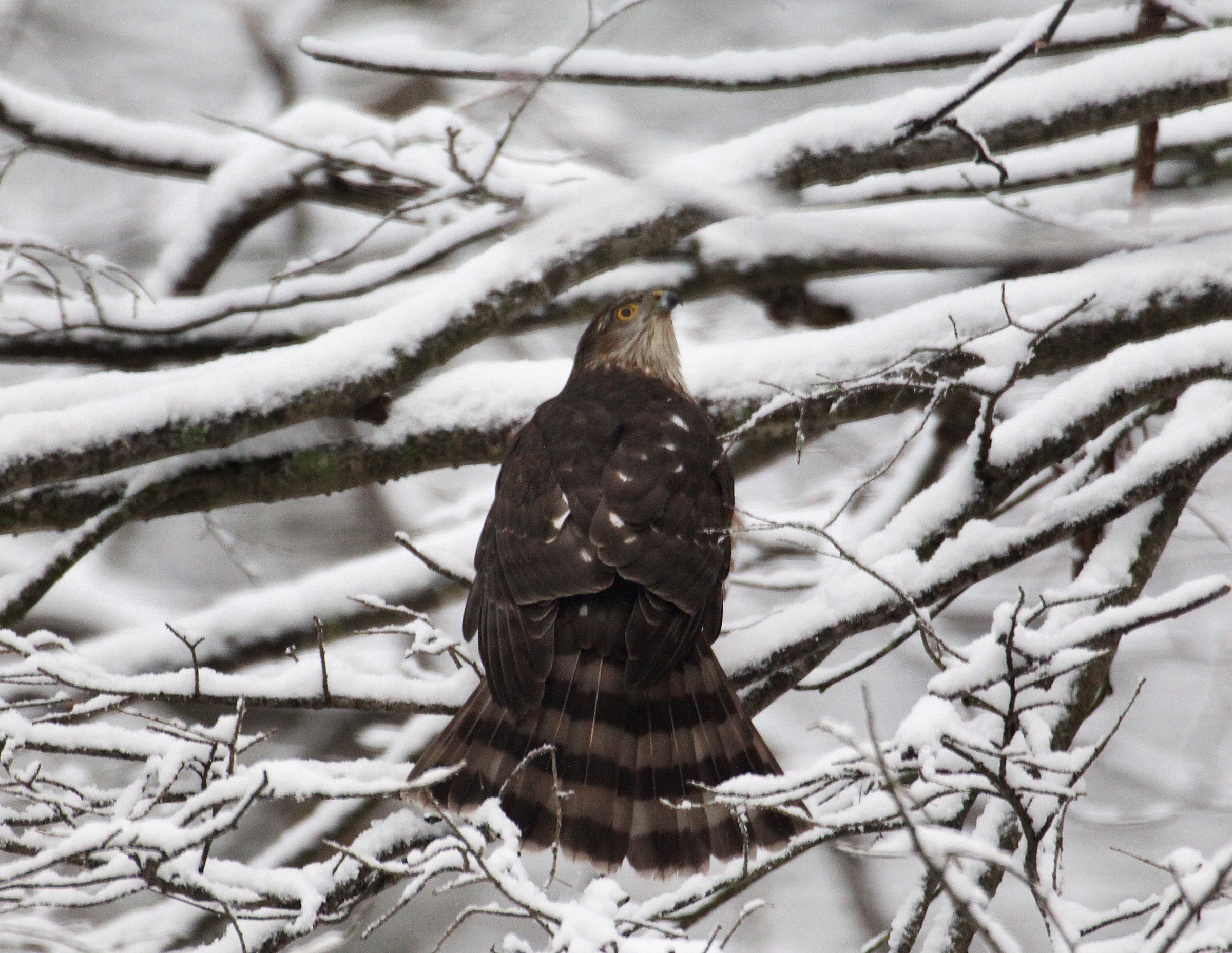
Photo by Chris Bosak A young Cooper's Hawk eats a squirrel in southern New England in Feb. 2015.

Photo by Chris Bosak
A young Cooper’s Hawk eats a squirrel in southern New England in Feb. 2015.

Continue reading

For the Birds: Not so colorless afterall

Here is the latest For the Birds column, which runs in several New England newspapers.

Photo by Chris Bosak A male Northern Cardinal in Stamford, Conn., March 2015.

Photo by Chris Bosak
A male Northern Cardinal in Stamford, Conn., March 2015.

Oak leaves, at least the ones in my yard, turned directly from green to brown and fell in droves during the windy days of the past week.

The trees are largely bare, most of the flowers that survived the fall have now perished in the year’s first frost and big, brown oak leaves cover many of the open spaces in the region.

There’s not a lot of color to be seen these days, except for evergreens and the occasional blue sky.

But, there are always the birds. Late fall and throughout the winter is when we need the birds the most to brighten our fading landscape. Luckily, plenty of colorful birds remain with us while the fair-weathered New England creatures — including migrant birds, butterflies and dragonflies — have taken their cheerful hues south.

Chickadees, titmice, nuthatches and downy woodpeckers may not be the most dynamic birds in terms of color but fall and winter is their time to shine. The subtle oranges on the titmice and chickadees, the gray-blue backs of the nuthatches, and the red on the heads of male downeys seem to be noticed more as the number of bird species we see at our feeders dwindles.

Even the white throat and yellow lore – the region between the eyes and nostrils — of a white-throated sparrow appears to glow brighter during these days.

Continue reading