Purple Martins arrive in New England

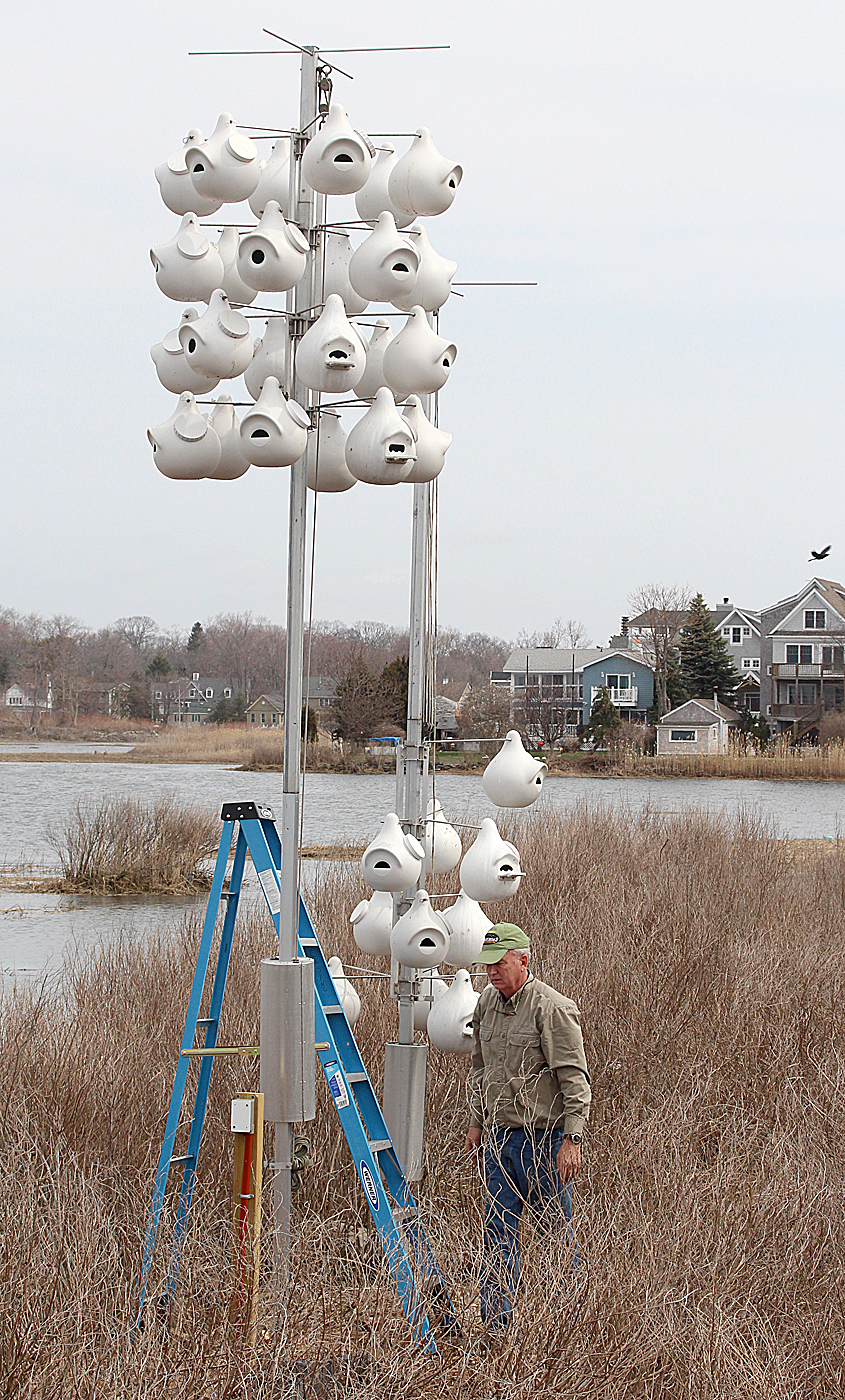
Contributed photo Milan Bull, Senior Director of Science and Conservation at Connecticut Audubon, sets up the Purple Martin gourds at the Coastal Center at Milford Point on Monday, April 14, 2014.

Contributed photo
Milan Bull, Senior Director of Science and Conservation at Connecticut Audubon, sets up the Purple Martin gourds at the Coastal Center at Milford Point on Monday, April 14, 2014.

It’s Purple Martin season in New England! Last week I ran into David Winston and Patrick Duggan putting up the Purple Martin gourds at Cove Island Park in Stamford. On Monday, after finishing my volunteer Piping Plover monitoring duties at the Coastal Center at Milford Point (CT), I ran into Milan Bull of Connecticut Audubon putting up the gourds there.
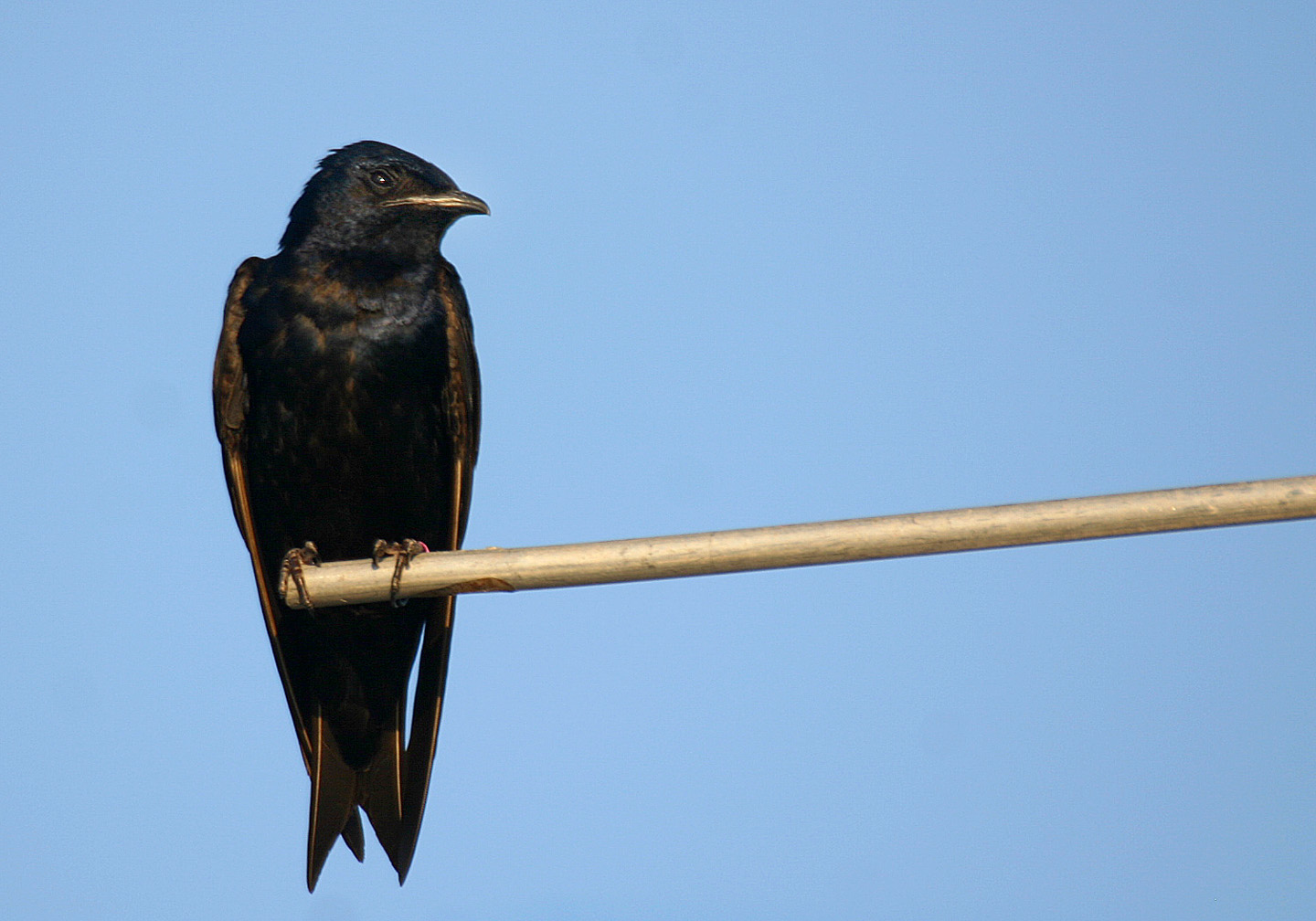
Purple Martin at Cove Island in Stamford.

Purple Martin at Cove Island in Stamford.

The Purple Martins had already arrived and many perched on the poles as Milan worked underneath to get the gourds ready. I even got my hands dirty and helped him out a bit (of course, he was nearly done by the time I got there.)

Purple Martins will return to the same site year after year, so if you were successful in getting Purple Martins last year, get your gourds or houses up soon. If you were not successful last year, or are trying for the first time this year, you can get the houses up now, or wait a few weeks. Younger birds seeking to start a new colony will arrive throughout the next several weeks, or even months. Just keep an eye on the gourds or houses for House Sparrows. Remove the nests if House Sparrows take up residence.

I’m far from an expert in attracting Purple Martins, so for more detailed information about Purple Martins, I’ll refer you to this site: http://www.purplemartin.org/

Thanks for visiting http://www.birdsofnewengland.com

David Allen Sibley talks about the Ivory-billed Woodpecker

In 2005, a bird sighting in Arkansas caused major waves in the birding world. It pitted experts against experts and beginners against beginners. The potential sighting was of an Ivory-billed Woodpecker, a large woodpecker long believed to be extinct. The sighting came along with a rough video, but not a clear enough one to answer any questions definitively. In fact, the video only separated the sides even more.

One of the skeptical experts was David Allen Sibley, who visited The Hour offices last month and I couldn’t resist asking his thoughts on the subject. The alleged sighting came in 2005, but the debate still rages on. Here are Sibley’s thoughts on the matter.


Just a few gratuitous Killdeer photos

Photo by Chris Bosak A Killdeer at a cemetery in Darien, CT, April 2014.

Photo by Chris Bosak
A Killdeer at a cemetery in Darien, CT, April 2014.


I’ve always liked Killdeer. They depend on large, flat open spaces to lay their eggs. As that habitat disappears, Killdeer have proven to be very resourceful. I’ve seen Killdeer nests (really just a small depression in the ground) in places such as parking lots, ball fields and cemeteries. These guys I photographed this week at a cemetery in Darien. I have plenty of Killdeer shots already, but I couldn’t resist.

To add in one fact about Killdeer to make this post at least a little informative — they are one of the species that will use the “broken wing” tactic to keep predators away from their eggs and young. As a predator (or unwitting human) approaches the nest, the parent will walk away from the eggs to divert the attention. To keep the interest of the predator the adult Killdeer will pretend it has a broken wing and limp along the ground. When the predator is sufficiently away from the nest, the adult will fly away, leaving the predator dumbfounded and hungry.

One more quick fact: Killdeer are shorebirds, and are indeed found along the shore at times, but are usually found far from the shore.

Thanks for visiting http://www.birdsofnewengland.com

Photo by Chris Bosak A Killdeer at a cemetery in Darien, Conn., April 2014.

Photo by Chris Bosak
A Killdeer at a cemetery in Darien, Conn., April 2014.

Some ducks still hanging on in southern New England

Photo by Chris Bosak Greater Scaup in Norwalk Harbor, March 2014.

Photo by Chris Bosak
Greater Scaup in Norwalk Harbor, late March 2014.

April, for me anyway, is a bittersweet month for birdwatching. I love watching ducks, so the period from when the “winter ducks” arrive in fall to the time they depart in the spring is perhaps my favorite time of year for birdwatching. Well, that time in spring is approaching. The ducks _ other than mallards and a few others _ will soon depart southern New England for their breeding grounds up north.

The flip side of that, of course, is that the songbirds, shorebirds, birds of prey and other spring migrants will be here soon (if they haven’t arrived already.)

I’ve been seeing fewer and fewer ducks at my normal haunting grounds over the last week or so. Remember my post last week when a Redhead shared a pond with Hooded Mergansers, Ring-necked Ducks and Wood Ducks? Well, that pond is now vacant. No winter ducks or any other ducks for that matter. I’m sure the mallards and hopefully some Wood Ducks will return. But the other ducks will likely not be seen there for another seven or eight months.

Long Island Sound and its harbors are slowing down, too, but not shutting down. I saw a few Long-tailed Ducks, Bufflehead, Red-breasted Mergansers and Greater Scaup on a recent visit to Norwalk Harbor _ but not in the numbers that I saw them just a few weeks ago. In a few more weeks, only a few straglers will be left _ until next fall, that is.

Mourning Dove sitting on nest

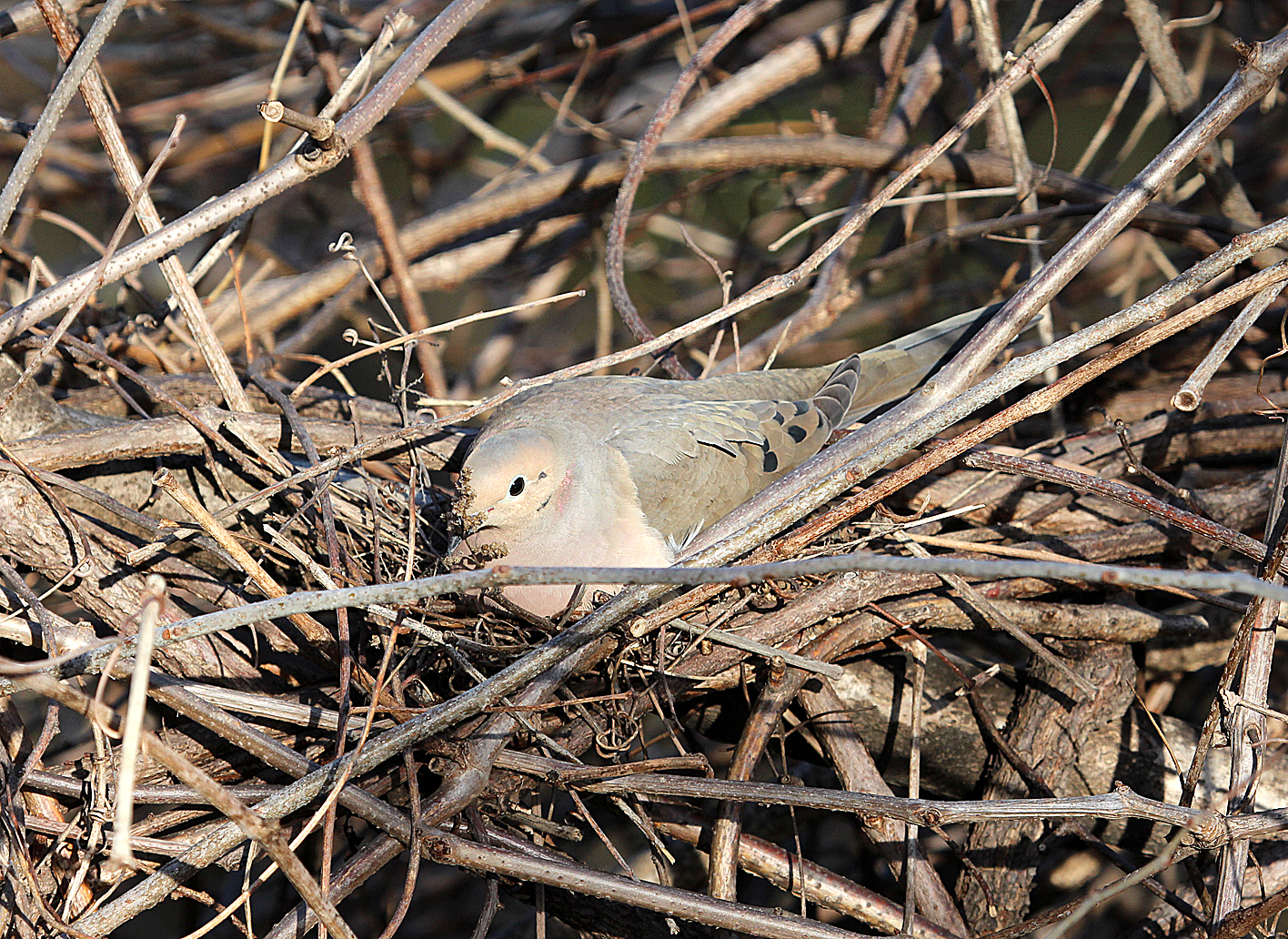
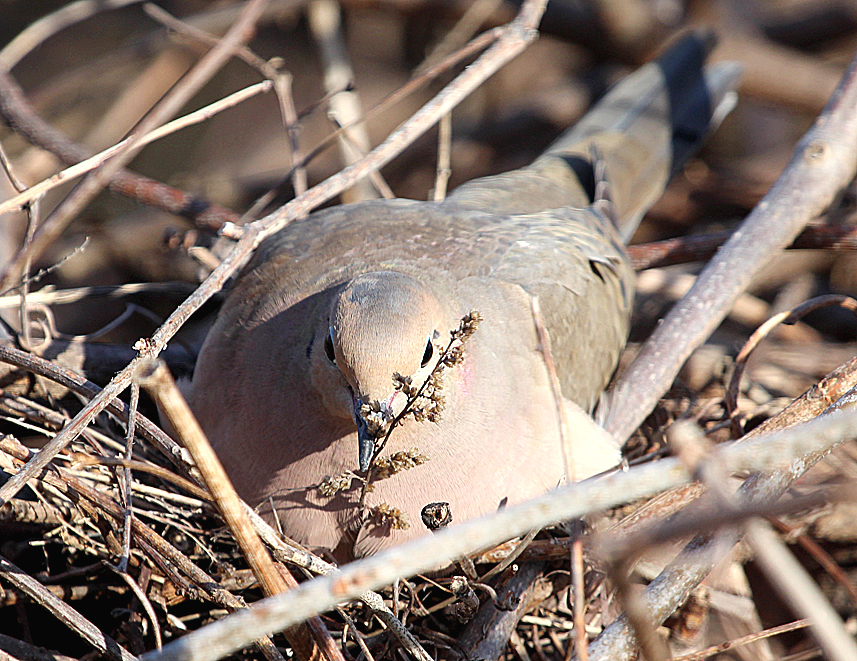
Photo by Chris Bosak A Mourning Dove sits on a nest at Oyster Shell Park in Norwalk, CT., April 1014.

Photo by Chris Bosak
A Mourning Dove sits on a nest at Oyster Shell Park in Norwalk, CT., April 1014.

I came across the Mourning Dove during a quick walk through Oystershell Park in Norwalk, Conn., this morning. Yes, despite the late start to spring weather, the birds are right on time with their nesting.

Photo by Chris Bosak A Mourning Dove sits on a nest at Oyster Shell Park in Norwalk, CT., April 1014.

Photo by Chris Bosak
A Mourning Dove sits on a nest at Oyster Shell Park in Norwalk, CT., April 1014.

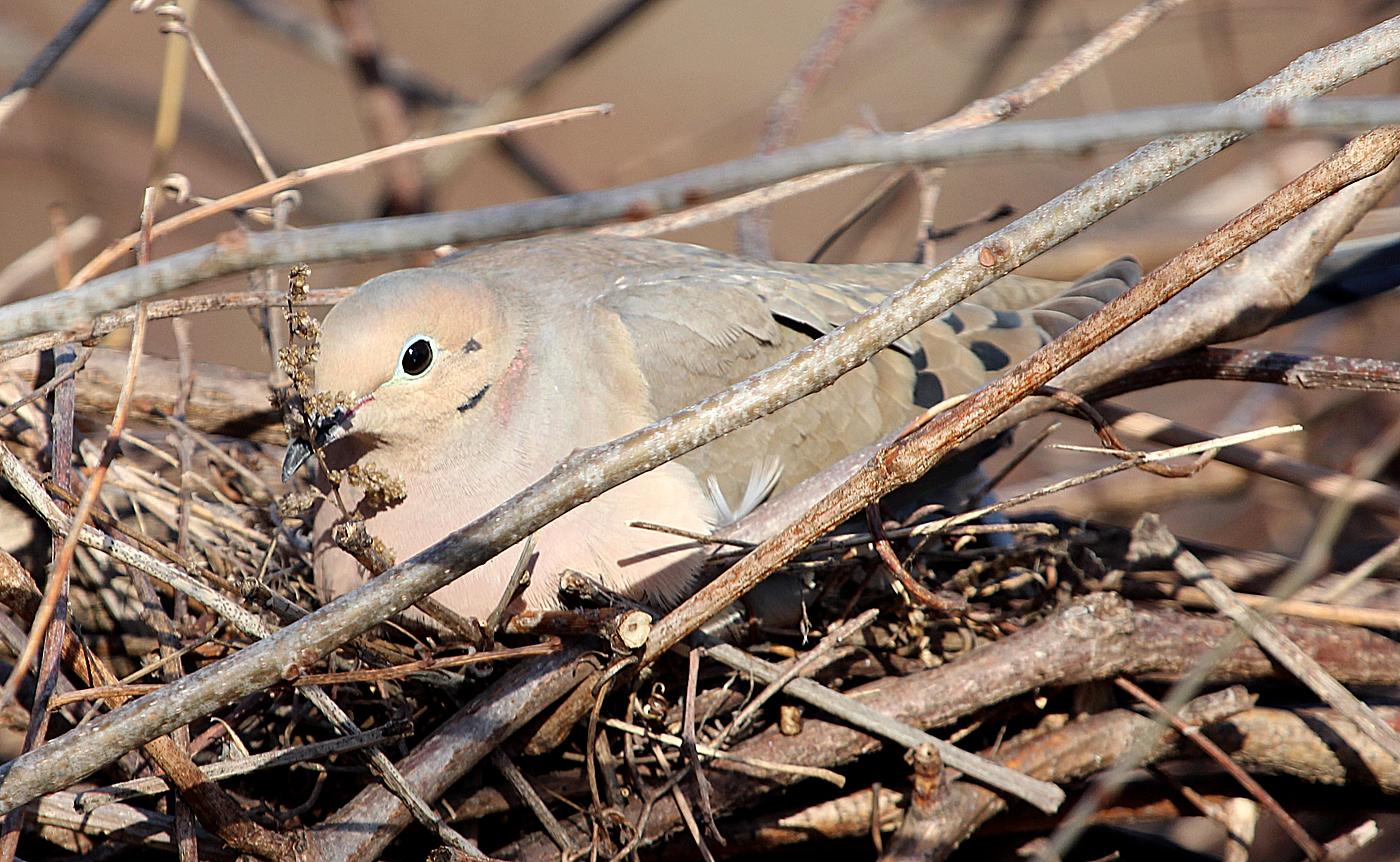
Check out the camouflage nature of this nest. The tangled, twisted sticks and vines are colored similarly to the dove itself. Amazing that birds can do these things. I did not approach too closely and allowed the bird to remain comfortable on its nest.

Have a bird nesting on your property? Grab a photo and send it along. I’ll use it on my “reader submitted photo” page. Remember to give the birds space and not to be intrusive — they have an important job to do. Send photos to bozclark@earthlink.net

Photo by Chris Bosak A Mourning Dove sits on a nest at Oyster Shell Park in Norwalk, CT., April 1014.

Photo by Chris Bosak
A Mourning Dove sits on a nest at Oyster Shell Park in Norwalk, CT., April 1014.

Help to track hummingbirds _ from Audubon

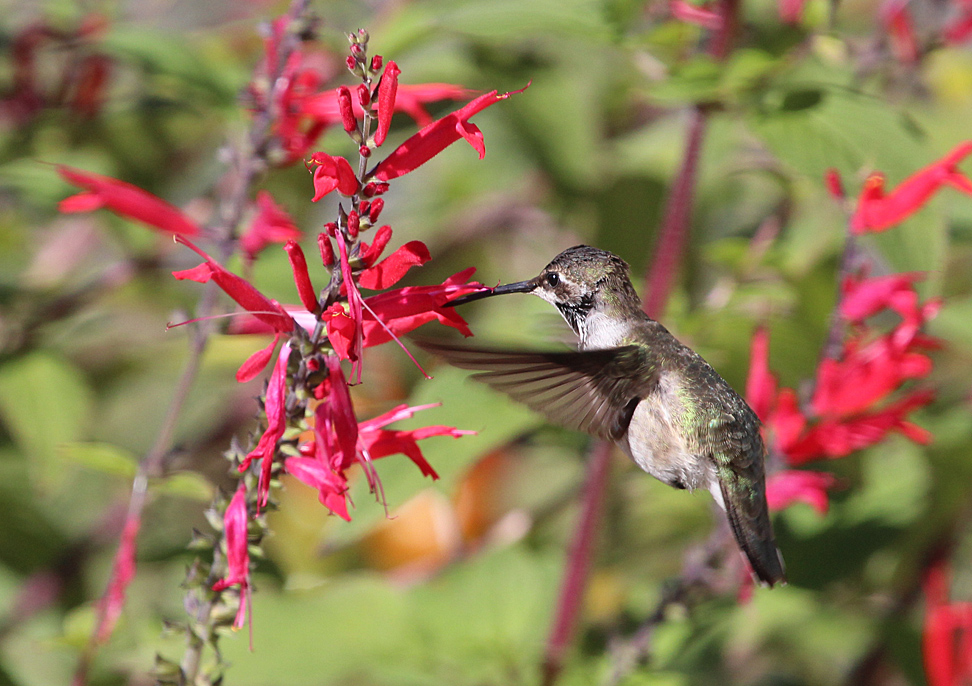
Photo by Chris Bosak A Black-chinned Hummingbird visits flowers this fall in Fairfield. Black-chinned Hummingbirds are native to western U.S. This was the first one recorded in Connecticut.

Photo by Chris Bosak
A Black-chinned Hummingbird visits flowers this fall in Fairfield. Black-chinned Hummingbirds are native to western U.S. This was the first one recorded in Connecticut.

Shamelessly copied straight from an Audubon Society press release (The photo is mine at least):

Audubon Invites Volunteers to Help Track Hummingbirds This Spring

NEW YORK, NY (April 1, 2014) – With spring officially upon us, the National Audubon Society invites birders and nature enthusiasts across the country to help track the health of hummingbird populations with Audubon’s Hummingbirds at Home app. This citizen science project utilizes the power of volunteers to compile data at a scale that scientists could never accomplish alone.

Every spring, numerous hummingbirds migrate long distances and must eat several times their weight in nectar daily to stay alive. Hummingbirds visit our yards every year, looking for nectar from our gardens and feeders. As flowers bloom earlier because of warming temperatures, the impact on hummingbirds which rely on nectar could be significant. The degree Continue reading

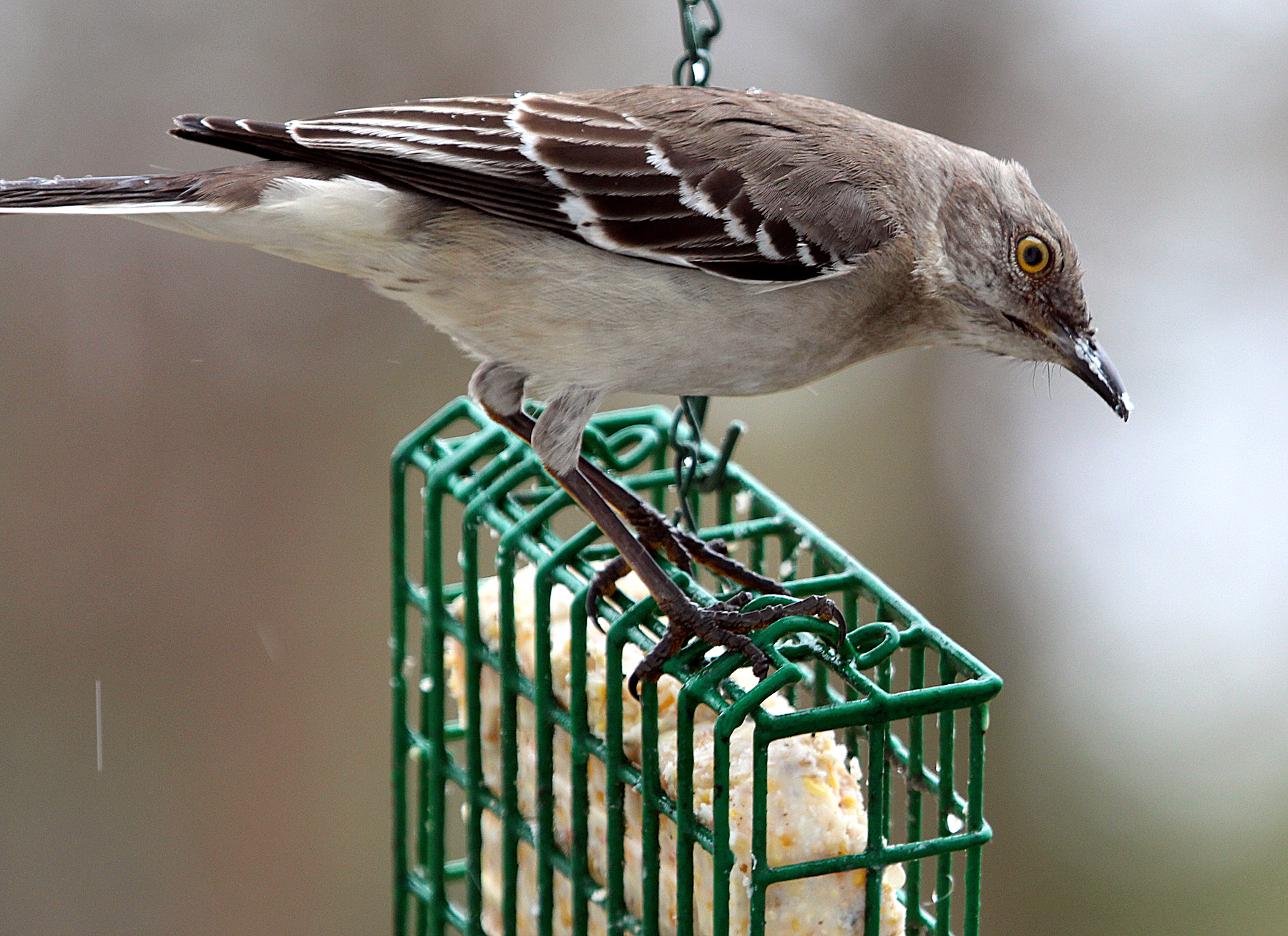
Mockingbirds are liking the suet

Photo by Chris Bosak A Northern Mockingbird visits a suet feeder as snow falls in March 2014 in Stamford, CT.

Photo by Chris Bosak
A Northern Mockingbird visits a suet feeder as snow falls in March 2014 in Stamford, CT.

It’s not often that I see Northern Mockingbirds at my feeders. I see them often enough, just not at the feeders. But for the past week or so, a pair of mockers have been regular visitors to the suet cake feeder. They split time with a pair of Downy Woodpeckers that has been visiting all winter.

Mockingbirds will begin their incredible singing performances soon. They will perch somewhere (often a very conspicuous spot) and sing their hearts out, going over their repertoire over and over. As its name suggests, the song is a long string of other birds’ calls. Personally, I always hear mockers include the Carolina Wren’s “tea kettle” song in their mix.

Have a mockingbird story? Feel free to comment. Thanks for visiting http://www.birdsofnewengland.com

David Allen Sibley talks about the Snowy Owl irruption

Photo by Chris Bosak A Snowy Owl flies across the beach at The Coastal Center at Milford Point in early March 2014.

Photo by Chris Bosak
A Snowy Owl flies across the beach at The Coastal Center at Milford Point in early March 2014.

I’ll post parts of my David Allen Sibley interview throughout the next few weeks. Here he talks about the great Snowy Owl irruption of winter 2013-14.

Why it’s called a Ring-necked Duck (even though ring-billed would make more sense)

Photo by Chris Bosak Ring-necked Duck in Darien, March 2014.

Photo by Chris Bosak
Ring-necked Duck in Darien, March 2014.

It took years for me to start calling this duck by it’s proper name: Ring-necked Duck. I would invariably blurt out “Look, Ring-billed Duck.” But, unlike the Ring-billed Gull, this bird is not named for an obvious ring around its bill.

Instead it is named after a hardly-noticeable ring around its neck. Conditions, including the posture of the duck, need to be right to even see the neck ring. The ring around the bill, however, is obvious in most conditions, unless the duck is sleeping with its bill tucked into its back feathers. Even the female, which is mostly brown in color, has a ring around her bill. (She also has a faint ring around her neck.)

So why Ring-necked Duck? Ornithologists in the 1800s named many birds by studying dead specimens. Apparently with the bird so close the chestnut colored neck band is more obvious, so it was named as such. It doesn’t make a lot of sense to the average birder (like me) in the field, but it is what it is. The above photo shows both the ringed neck and ringed bill of the beautiful duck.

Ring-necked Ducks are seen throughout New England, mostly in fresh-water ponds and lakes, from late fall through early spring.

Photo by Chris Bosak A pair of Ring-necked Ducks rest at a pond in Darien, March 2014.

Photo by Chris Bosak
A pair of Ring-necked Ducks rest at a pond in Darien, March 2014.

An interview with David Allen Sibley

Example of Sibley guide's second edition.

Example of Sibley guide’s second edition.

David Allen Sibley, the renowned birdwatcher and field guide author/artist, was kind enough to grant me and The Hour an interview about his recently released second edition of The Sibley Guide to Birds. I picked him up at the train station, drove to The Hour offices in Norwalk, and did the interview. I was hoping for some time to do some birdwatching, but alas, time was tight and it just didn’t happen. Not really anyway (read the column ((link attached)) for more details.)He sat down with The Hour photographer Erik Trautmann and me and I fired a bunch of random birding questions at him. We started, of course, with the field guides but then, as my interviews normally do, we headed off in all kinds of directions.It was a great time and I’m glad David took the time to do the interview in our office. Click here for the column and accompanying video of a portion of the interview. I will add to this website more audio of the interview in the coming days.

Thanks for visiting http://www.BirdsofNewEngland.com