Photo by Chris Bosak A red-bellied woodpecker stands on a deck railing next to salvia blooms in New England, September 2020.
A few years ago I purchased a few bunches of coneflower late in the season and they made for a perfect setting for bird photos on my deck in the fall. This year, the salvia I purchased early this spring has grown enough to make a nice setting for birds eating seeds off the deck railing. The hummingbirds like the salvia too! Click here for one of those coneflower photos. Click here for some hummingbird drinking from salvia shots.
I’ll post a few more salvia shots tomorrow.
Photo by Chris Bosak A black-capped chickadee eats sunflower seeds near salvia blooms in New England, September 2020.
Photo by Chris Bosak
A ruby-throated hummingbird hovers around salvia blooms in New England, September 2020.
The hummingbirds that haven’t flown south yet will likely do so soon. Here are a few shots of “my” hummingbirds that are still hanging around.
Photo by Chris Bosak
A ruby-throated hummingbird hovers around salvia blooms in New England, September 2020.Photo by Chris Bosak
A ruby-throated hummingbird hovers around salvia blooms in New England, September 2020.
Photo by Chris Bosak A Bald Eagle flies over Little Merganser Lake in Danbury, Conn., Sept. 2016.
There have been a few mornings recently that have felt an awful lot like fall. Cool temperatures, low humidity, the occasional falling leaf.
The bird world is following suit in New England, ever so slowly. I’ve seen a few passing warblers in the backyard over the past few weeks and the hummingbirds are feeding with an added urgency to fatten up for their journey south.
I’m not trying to rush the end of summer, and we still have a few weeks until it is officially over. The end of August and beginning of September is a fun transition time in the bird and nature world. A walk through a New England meadow this time of year yields butterflies, dragonflies and all sorts of crazy-looking insects that make you think of summer. Then, you notice the goldenrod in bloom and a hawk soaring overhead reminiscent of fall.
The fall migration starts as early as July when young shorebirds work their way southward along the New England coast. It really begins in earnest in the middle of September when the hawk migration gains a head of steam. September is when a visit to a hawk Continue reading →
Photo by Chris Bosak
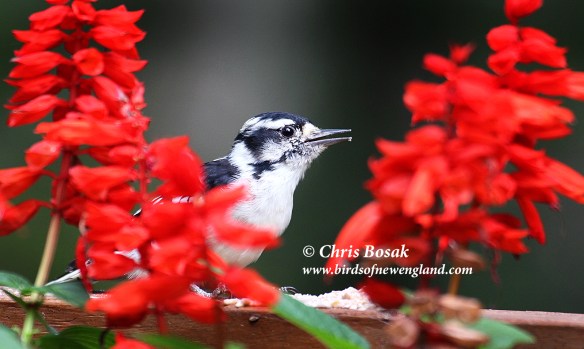
A downy woodpecker grabs seeds amidst salvia in New England, September 2020.
Here’s a random happy bird photo to kick off your Labor Day Weekend. It’s a female downy woodpecker between salvia stalks. Salvia is an annual that is good for attracting hummingbirds with their red, tubular flowers. Have a great long weekend!
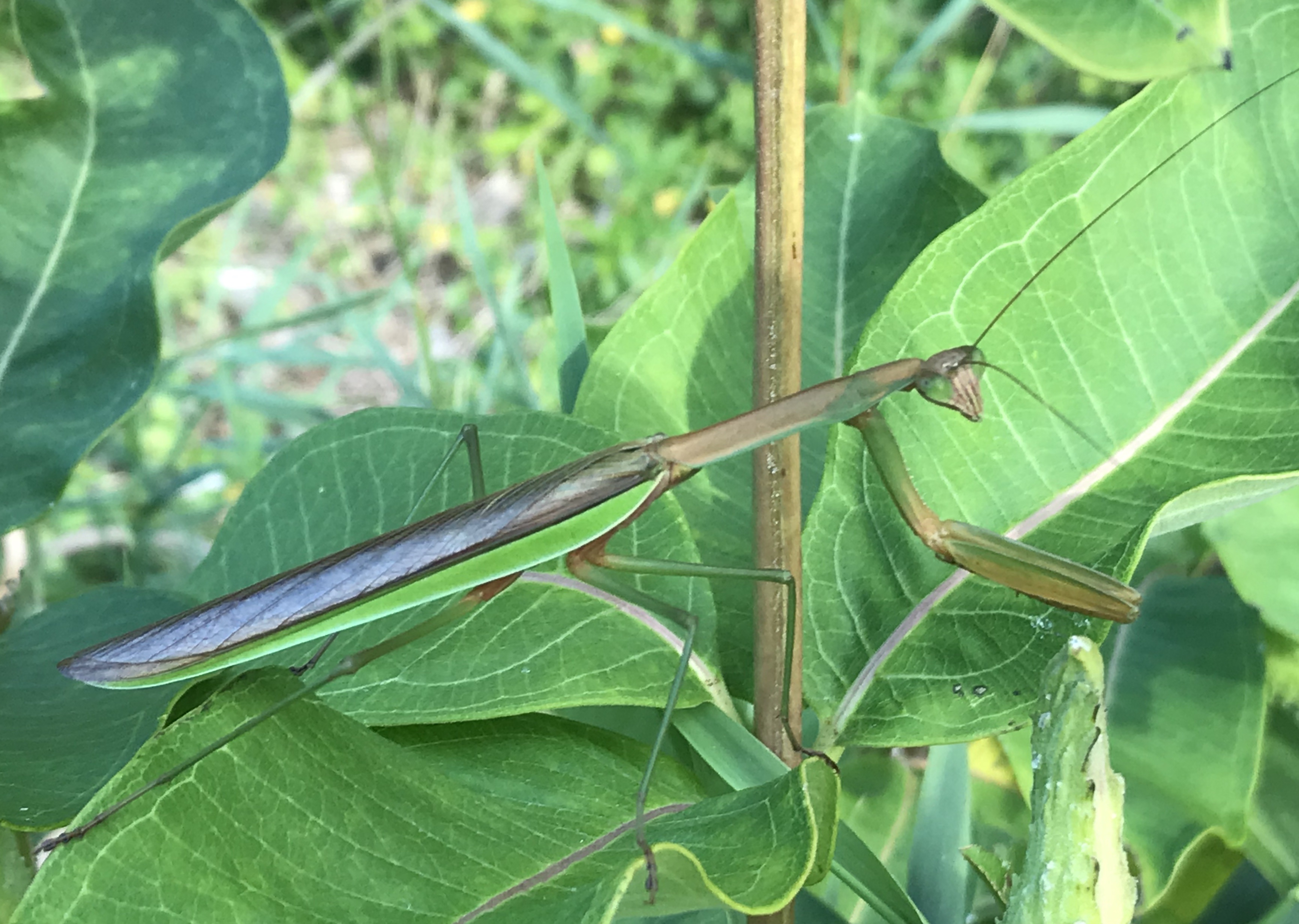
I was checking milkweed plants for monarch caterpillars and came across this instead. I’ll take it. I’ve seen a lot of Facebook posts lately featuring praying mantises. I guess it was my turn.
Photo by Chris Bosak
An American goldfinch looks for seeds atop a coneflower in New England, summer 2020.
There are few things more satisfying to the backyard birdwatcher than having a bird eat seeds or fruits from something planted by the birdwatcher’s own hands.
Well, that’s my opinion anyway and it was made clear the other day when a small flock of American goldfinches descended upon my small patch of purple coneflowers for a late afternoon meal.
That opening statement comes with some qualifications, most importantly if you want the birds to be eating the seeds or fruits. I don’t know why anyone would mind birds eating seeds from a flower garden. I also don’t know why anyone would mind birds eating fruits from, say, dogwood trees, crabapple trees or winterberry bushes.
If, however, the fruit is being grown for human consumption, such as cherries or blackberries, then I can understand how there would be frustration on the part of the gardener.
I used to live in an apartment owned by a family that grew some fruits and vegetables on the property. Year after year, the cherries never got to see the light of the kitchen as birds, mostly starlings, ate the fruits before they were ready to be picked. My landlord was mighty frustrated and tried everything to prevent it from happening. He tried noise deterrents and scary-looking balloons, but the starlings were unfazed by it all.
So, yes, there are exceptions to my opening statement, but edible fruits aside, I stand by it. I always get a thrill in late summer or early fall when the goldfinches perch precariously atop the coneflower and pick out the tiny seeds. As the fall progresses, I can usually find a few kinglets (ruby-crowned and golden-crowned) among the sedum.
Sunflowers are great for attracting birds, which makes sense since the best and most versatile feeder food is sunflower seeds. Goldfinches and downy woodpeckers are the most reliable customers when I grow sunflowers.
I love any hummingbird sighting, but there is something more satisfying about seeing one feed from a plant growing in the garden or hanging near the deck than drinking from a feeder.
I’ve never had much luck growing berries, but one house I used to live in had a wild black cherry tree in the front yard. I used to love to watch the robins attack the tree every fall. I would always hope cedar waxwings would come too. To my knowledge, they never did and the robins did a pretty good job of stripping the tree of all its fruits.
Planting native flowers, bushes and trees is a welcomed trend among homeowners and landscapers. It is helping birds, pollinators and other native wildlife even as we continue to take away their natural habitat.
It is exciting to see these plants come back year after year. It’s even better when you see the plants supporting other native wildlife.
Photo by Chris Bosak
An American goldfinch looks for seeds atop a coneflower in New England, summer 2020.
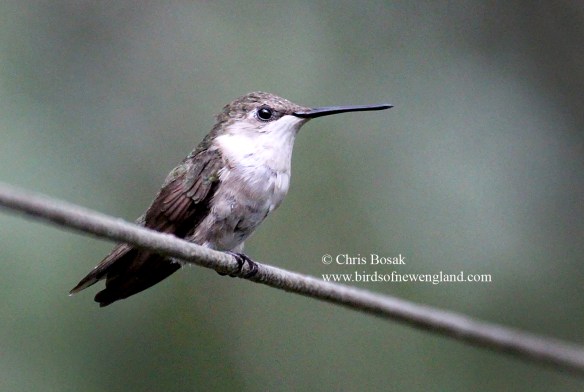
Photo by Chris Bosak A female ruby-throated hummingbird sits on a rope in a backyard in New England, August 2020.
I wasn’t the only one who enjoyed watching the hummingbirds ignore the stormy weather of Aug. 4 and visit the feeders. As you’ll recall, last week I wrote about the tiny birds going about their day as usual as rain fell and wind whipped all around.
I heard from Deb from Royalston, Mass., who said her hummingbirds “had no problem with the fierce winds and rain. All this year’s babies are there now, so we had more than a dozen.” She said it was hard to count them there were so many. I, of course, had only one visit my feeder that day as it was a dominant female who “owns” the feeder.
Jill from Keene wrote: “I too was amazed during the storm the hummingbirds seemed unfazed.” Jill also had a peaceful gathering of hummingbirds and sent me a few photos showing six of them on the feeder at once.
“They did not fight much at all and it was eerily quiet as I usually have several swooping and ‘chirping’ noisily,” Jill added.
A few days later, Jill wrote to say: “The peaceful dinner party was really an anomaly, as they are back to fighting and chasing each other!”
Photo by Chris Bosak
An American goldfinch looks for seeds atop a coneflower in New England, summer 2020.
I don’t have a lot of garden space on my property as it is predominately shaded. I do have a few sunny spots and I wasted no time in planting some native perennials, including coneflower. The goldfinches come every year when the flower heads start to die off. The goldfinches started arriving this week and have returned daily. There will be more photos of the goldfinches coming up soon, I’m sure.
Photo by Chris Bosak
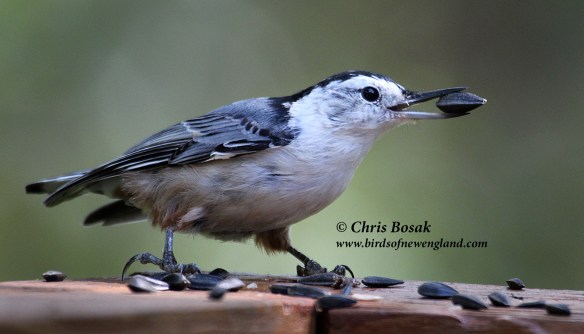
A white-breasted nuthatch grabs a sunflower seed from a deck railing in New England, August 2020.
I feel like I’ve taken this photo 100 times, a nuthatch with a seed in its bill. Here are a few more. I find white-breasted nuthatches to be very photogenic and rarely pass up an opportunity to capture them on film — well, you know what I mean.
Photo by Chris Bosak
A white-breasted nuthatch grabs a sunflower seed from a deck railing in New England, August 2020.