It looks like an overgrown mosquito and causes fear among many people who find these menacing-looking giants in their homes. But, alas, crane flies are as gentle as they come. They can neither sting nor bite. They can make it difficult to sleep as they flitter around your walls and ceiling at bedtime, but don’t worry, they won’t attack you in your sleep. In fact, they aren’t even capable of attacking as many species do not even have mouth parts. So, no, they don’t eat mosquitoes either as many people believe. And they certainly aren’t mosquitoes, despite their uncanny resemblance.
Photo by Chris Bosak
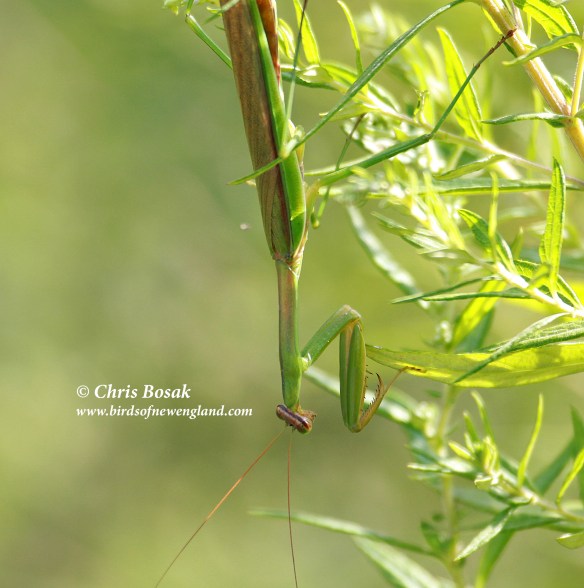
Praying mantis at Highstead in Redding, CT, summer 2019.
The insect world is rife with fodder for Birds of New England’s Stranger Things series. It doesn’t get much stranger than the praying mantis, a beloved insect that is not seen often enough.
It had been a few years since I had seen one, in fact, but a recent walk at Highstead in Redding, Connecticut, yielded three of the beauties. The first one got my attention as it flew across the meadow path and landed on a goldenrod stalk that was bursting with September color. I can’t remember the last time I saw a praying mantis in flight. It’s hard to miss as they are quite substantial insects, regardless of their skinny frame when not flying.
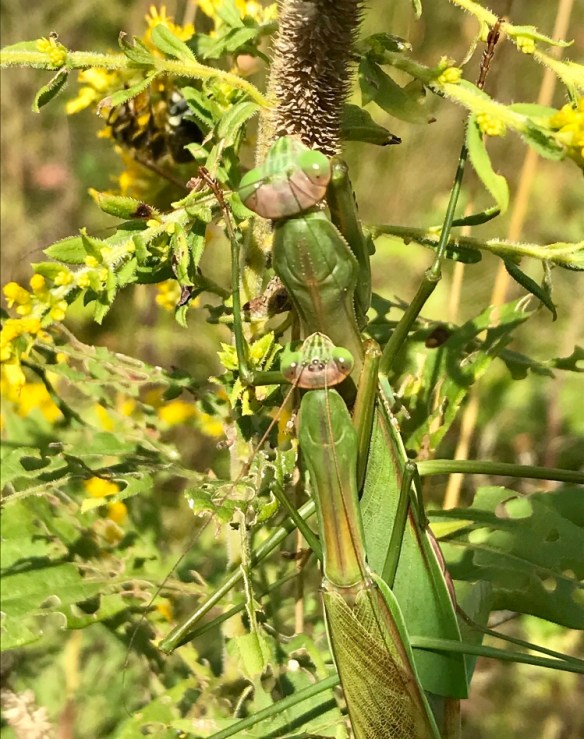
The second and third mantises I saw were on top of each other, literally. These ones were on a goldenrod stalk as well. One of my favorite things about September is the proliferation of goldenrod in New England’s meadows.
The praying mantis is so named because it looks as if it is praying when it’s waiting for food. Check out the bent front legs held together in the photo above.
Praying mantises are excellent hunters with an oversized, triangular head and large compound eyes. They are green, brown or a combination of those colors, making them hard to find for both prey and predators. Another great adaption utilized by mantises are the spikes front legs for capturing and holding prey.
Mantises eat crickets, moths, other insects, and, allegedly, hummingbirds. I’ve never seen this, but I’ve read it enough to include here. They also sometimes eat each other. Yes, sometimes the female eats the male after mating. I don’t know if that was the case with these two. I didn’t stick around to find out.
Photo by Chris Bosak Praying mantises in Redding, CT, summer 2019.
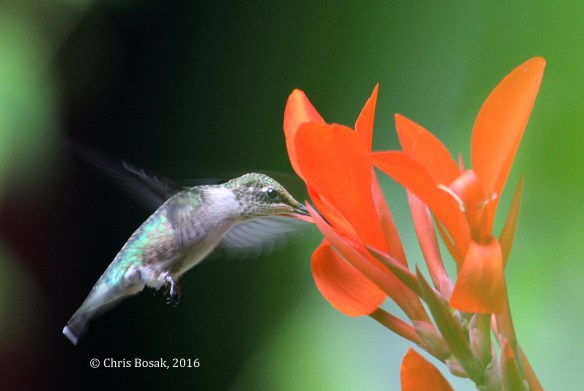
Photo by Chris Bosak A Ruby-throated Hummingbird sips nectar from Canna flower in Danbury, Conn., summer 2016.
I almost hate to say it but summer 2019 is nearly over.
I say “almost” because fall is up next and who doesn’t love a New England fall? In the bird world, it’s pretty much fall already, so really the calendar is the only thing standing in the way of autumn.
With that said, this seems like an appropriate time to reflect on this past summer. I had several birding and other nature highlights, most notably a camping trip to Pillsbury State Park in nearby Washington.
I was lucky enough while canoeing to share the main pond with three loons bright and early one morning. No matter how many times I experience it, I will always be in awe of the scene: sun peaking above the hills in the east, mist rising off the water and loons starting their day with a slow swim around their pond. A yodel or two from the loons completes the scene.
Such was the case at Pillsbury this summer, only instead of the usual one or two loons, there were three. It’s easy to see why the common loon is such an iconic bird in New England.
The bald eagles at Bashakill National Wildlife Refuge in N.Y. were another highlight.
The backyard highlight of the summer, echoing the highlight of the past few summers, was watching the hummingbird family that split their time between the feeders and flowers. This year, I had salvia, fuschia, sunflowers and rose-of-Sharon to offer. They enjoyed them all.
But mostly they drank from the feeders, as usual. I had to put three feeders out this year to mitigate the bickering among the tiny birds.
Recently, however, the visits by hummingbirds have slowed and it is not because of the wasps and black ants that try to take over the feeders. It’s because hummingbirds migrate in late August and early September. The adult males take off for points south first, followed by the females and first-year birds. I still see hummingbirds at the feeders, but the frequency has fallen and the birds are likely not “my” hummingbirds, but rather other south-bound migrants.
Which brings up the age-old question: Is it OK to feed hummingbirds in the fall or will they stick around and migrate too late if food is available? Studies have shown that hummingbirds are triggered to move south by the shortening of the days, not the weather or availability of food. In fact, an argument may be made that it’s beneficial to continue to feed them as these tiny birds essentially have to double their weight as they make their journey to Mexico and Central America.
The vast majority of the hummingbirds will be gone by the end of the month. By then, even the calendar will have yielded and fall will have its run of New England.
I get tons of eastern towhee shots in the spring. They are perhaps the most prolific bird at a park I frequent in mid April and early May. The sightings die down dramatically in the summer, but I did manage to get this guy to sit still long enough for a photo in July.
Photo by Chris Bosak A common yellowthroat perches in a tree in Ridgefield, CT, summer 2019.
Yesterday, I featured the American redstart in this series. Today, it’s another warbler without the word “warbler” in its name. The common yellowthroat is one of the more commonly seen warblers in New England. They breed throughout the region and are therefore seen from late April into the fall. Pictured is a male with its bandit-like eye mask. Females are a duller yellow and lack the distinctive markings of the male.
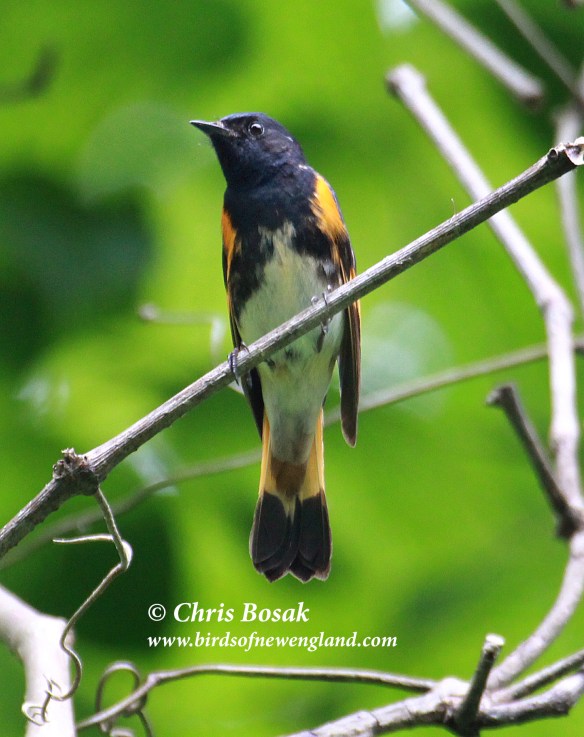
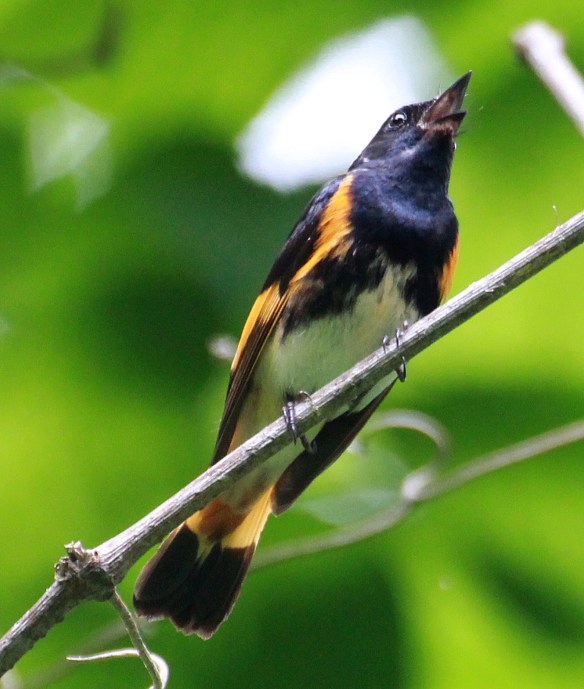
Photo by Chris Bosak American redstart in Ridgefield, CT, summer 2019.
As summer draws to a close and fall takes over, this post will start a short series of photos that I took over the summer, but never got around to publishing. I photographed this male American Redstart in my block of the CT Breeding Bird Atlas. Click here for more information on the CT Breeding Bird Atlas.
Photo by Chris Bosak American redstart in Ridgefield, CT, summer 2019.
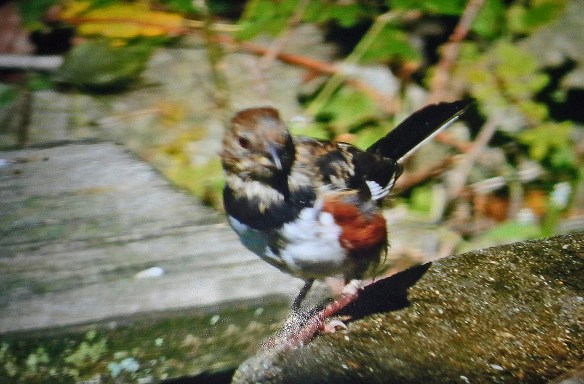
Photo by Elena Heiden A molting eastern towhee seen in Winchester, N.H., summer 2019.
I have written several times about the difficulties of bird identification in the fall. I have noted that males often lose their breeding plumage and look much more dull in the fall. The other day I spotted a male scarlet tanager in an apple tree. It looked nothing like the spectacular red-and-black bird that it looked like in the spring. Rather, it was a dirty yellow overall, but the dark wings gave it away as a tanager.
I have noted that first-year birds are heading south for the first time and haven’t reached adult plumage yet. Also, female birds, which often do not resemble males, are not quite as secretive as they are in the spring and are seen more often this time of year. What I failed to mention, however, is that late summer and early fall is also when many birds are going through a molting process. This only adds to the confusion of the challenging fall migration.
I was reminded of this when a photo came through from Elena of Winchester showing a very oddly plumaged bird. The rusty, or rufous, feathers on its side gave the bird away as an eastern towhee, but otherwise the bird looked nothing like the male or Continue reading →
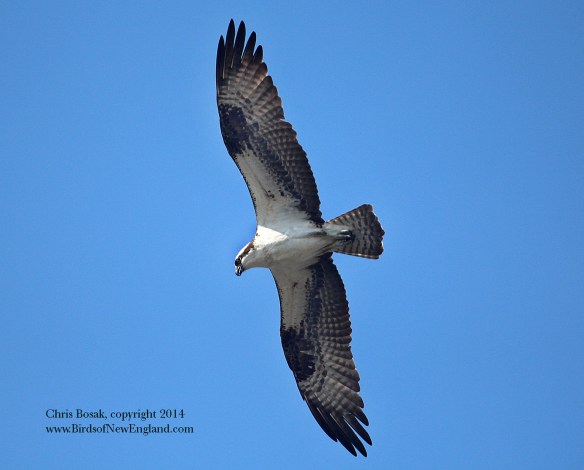
Photo by Chris Bosak An Osprey soars over the Norwalk River on Monday, Sept. 1, 2014.
Here is a For the Birds column from circa 2003 …
Birdwatchers are used to looking up. Most of the birds we see are flitting among the trees, perched on branches, flying overhead, or otherwise above eye level. (Ducks and other water birds are an obvious exception.)
Now is the time many birdwatchers really look up, as in look to the sky. High, high in the sky where, literally, the eagles soar. But it’s not only eagles birdwatchers look for in the fall. It’s vultures, osprey, falcons and about a dozen types of hawks that pass through New England on their way south for the winter.
It’s hawk watch time — the time when birders flock to mountains, coastal areas and other open places that afford sweeping views of the sky. The hawk migration actually started in early September and will continue into November.
The peak season depends on your perspective. Broad-winged hawks pass through en masse in mid-September when birders can see groups (kettles) of more Continue reading →
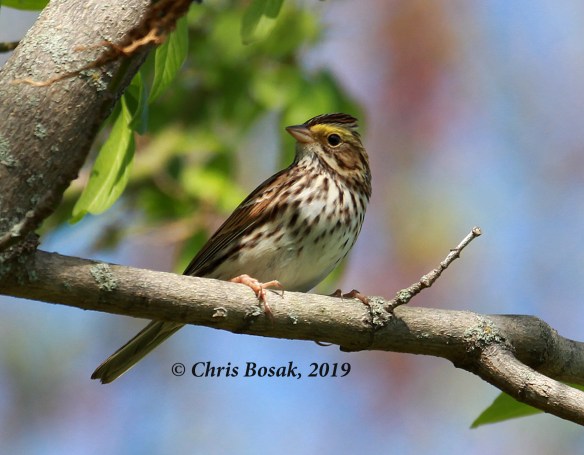
Photo by Chris Bosak A Savannah sparrow perches in a tree in Brookfield, CT, May 2019.
Those who guessed savannah sparrow were right! Look for these streaked sparrows this fall migration in open areas, including farmland, fields and marshes. They are often found on the ground. The yellow on the head is not always as prominent as seen in these photos. Sparrows can be tricky, which is why many birders simply lump them into the LBJ (little brown job) category. Take your time and study the patterns, bills and anything else that stands out (eye ring?) in your bird to increase your chances of a positive ID.
Here are some more photos of that savannah sparrow. Thanks for supporting Birds of New England.
Photo by Chris Bosak A Savannah sparrow perches in a tree in Brookfield, CT, May 2019.Photo by Chris Bosak A Savannah sparrow perches in a tree in Brookfield, CT, May 2019.







 Birds of New England.com