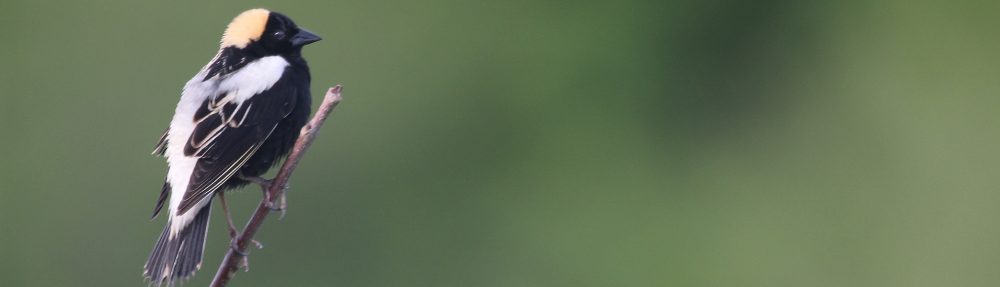
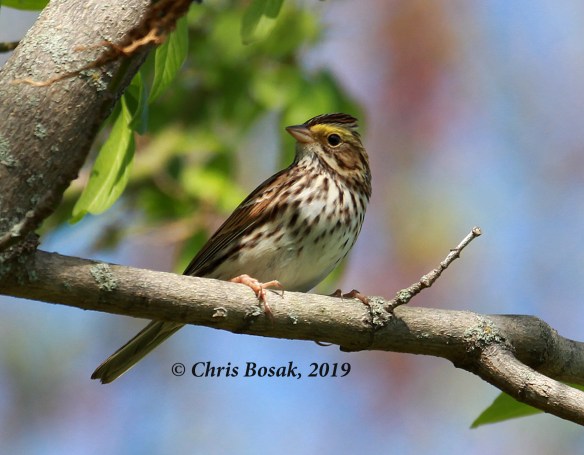
Photo by Chris Bosak A Savannah sparrow perches in a tree in Brookfield, CT, May 2019.
Those who guessed savannah sparrow were right! Look for these streaked sparrows this fall migration in open areas, including farmland, fields and marshes. They are often found on the ground. The yellow on the head is not always as prominent as seen in these photos. Sparrows can be tricky, which is why many birders simply lump them into the LBJ (little brown job) category. Take your time and study the patterns, bills and anything else that stands out (eye ring?) in your bird to increase your chances of a positive ID.
Here are some more photos of that savannah sparrow. Thanks for supporting Birds of New England.
Photo by Chris Bosak A Savannah sparrow perches in a tree in Brookfield, CT, May 2019.Photo by Chris Bosak A Savannah sparrow perches in a tree in Brookfield, CT, May 2019.
Here’s a quick quiz to kick off your Labor Day Weekend (even though it’s a day late for that). Labor Day is the unofficial end of summer, which means it’s time to transition into fall. With that in mind, keep your eyes to the sky, woods, brushy areas and fields for fall migrants. There will be many sparrows around and they can be tricky in the fall. This quiz will help get you ready for those LBJs. Email or comment with your response. As usual, there is no prize associated with a correct answer, only the joy of playing along with a BirdsofNewEngland quiz. Thanks for joining in.
I was pulling weeds the other day when I noticed a snake slither out from the greenery. It didn’t go far, however, and I found out why when I looked down. It had already injured a pickerel frog and wasn’t about to let the meal get away. The rest is documented in the video below.
Fair warning: If you love frogs or don’t like seeing the harsh side of nature, don’t hit the play button. You’ve been warned.
Photo by Chris Bosak — The hawk migration is a highlight of the fall bird migration in New England.
There is more to the fall migration than hawk watches on top of mountains. Watching raptors effortlessly soar among the thermals is indeed the highlight of the fall migration, but everything from shorebirds and songbirds to waders and waterfowl move south in the fall as well.
The fall migration does not garner as much enthusiasm as the spring migration among most birders for many reasons, I believe.
The height of the spring migration is concentrated into a predictable three- or four-week period when you are assured of seeing many colorful songbirds. The fall migration is more spread out. It actually started in July with some shorebirds moving south and will Continue reading →
With many schools throughout New England opening this week, I figured it would be appropriate (and fun) to explore the region’s smartest birds.
We all know crows and other members of the corvid family (blue jays and ravens among them) are intelligent birds, but what other species have the gift of intellect? Parrots, of course, can learn and repeat human phrases, but they aren’t exactly New England birds.
I think an argument can be made that all birds are smart because they utilize various strategies to survive in the natural world. According to various sources (which will be named appropriately) found using simple internet searches, however, here are New England’s honor students. As a disclaimer, this is an utterly unofficial list and not to be used in Continue reading →
Here’s a For the Birds column from 15 years ago. Yes, I’ve been writing it for that long, and even longer. Enjoy …
Photo by Chris Bosak A Snowy Egret looks for food in Norwalk Harbor.
It’s funny how things that seem so difficult at the beginning eventually become so easy. It can be said of just about any hobby, but it certainly applies to birdwatching. I can remember struggling with differentiating great egrets from snowy egrets. It seems somewhat silly now. Great egrets are markedly larger, have yellow bills and black legs and feet. Snowy egrets, aside from being much smaller, have black bills and yellow feet. The differences are clear and obvious now. But, as a beginner, I saw only tall Continue reading →
Photo by Chris Bosak A bald eagle at Bashakill NWMA, summer 2019.
Here is the latest For the Birds column …
There is something magical about seeing bald eagles. Thankfully, that magic is being felt more and more lately as the eagle population has rebounded dramatically over the last few decades.
Not long ago, bald eagles were rare sightings. You pretty much had to visit a place where you knew they were nesting or overwintering to see them. Now, bald eagle sightings — especially flyovers — can come from almost anywhere. Last winter, I saw a young bald eagle perched on a snag within a few hundred yards of a busy shopping mall in New England.
A few weeks ago, I took a canoe ride at the Bashakill National Wildlife Refuge in New York and saw two adult bald eagles. I spoke with a man in the parking lot after the ride and he said the pair had fledged two young eagles that year. Scenarios like that becoming more and more common, which is terrific news.
The bald eagle rebound may not be as striking as the osprey recovery, but it’s very impressive nonetheless. According to the American Eagle Foundation, the species was nearly extirpated from the lower 48 states and only a handful of pairs nested in 1963. From 1963 to the early 2000s, the bald eagle population rose gradually, but steadily. The last five years, however, have seen steep climbs in the eagle population to the point where there are now nearly 15,000 nesting pairs in the lower 48. Alaska, for the record, has more than 30,000 nesting pairs.
New Hampshire has seen a similarly dramatic increase in recent years. I remember canoeing on Lake Umbagog not that many moons ago and seeing the state’s only known nesting pair. A few years later I met up with Meade Cadot of the Harris Center and others to inspect a new eagle nest on Nubanusit Lake. It was an exciting time.
As of 2017, according to N.H. Fish and Game, there were 59 territorial pairs in the state and 38 of those were successful in fledging young that year. Since 1988, 427 bald eagle chicks have fledged from nests in the state.
In somewhat recent memory, New Hampshire has gone from one nesting pair to 59. That’s dramatic and those involved with the recovery on the federal, state and local levels deserve a lot of credit. Because of the impressive recovery, bald eagles were removed from the state’s threatened and endangered lists in 2017.
Similarly, the bald eagle has been delisted from protective acts on the national level. In 1995, the bald eagle status changed from endangered to threatened. In 2007, it was removed from the Endangered Species list.
Which brings us to the news that broke last week about the changing of the Endangered Species Act, an important piece of legislation that has been protecting animals in peril since 1973. The changes essentially put a price tag on the habitat needed to save certain species. If land needed for an endangered turtle, for example, was deemed to be extremely valuable as a drilling or logging site, then the land could potentially be used as such.
I don’t like putting a price tag on animal species and I don’t like politics being involved with decisions on whether or not to protect an endangered species. I can foresee money winning out and crooked politicians getting rich in the majority of these cases, even as the announcement made last week said decisions will be made solely on the “best scientific and commercial information regarding a species’ status.”
I do, however, understand the need for upgraded and additional infrastructure as the U.S. population grows. I can also see how Washington would want to take a look at the Endangered Species Act and make modifications to match today’s needs, but the changes announced last week reek of fraud potential. Money talks, after all.
The Endangered Species Act has helped to save many animals, some of which were on the brink of extinction. The majestic bald eagle is among them. I’m not against opening up the books to make modifications to the Act, but I hope any changes truly reflect the words of U.S. Secretary of the Interior David Bernhardt, who said: “The best way to uphold the Endangered Species Act is to do everything we can to ensure it remains effective in achieving its ultimate goal—recovery of our rarest species.”
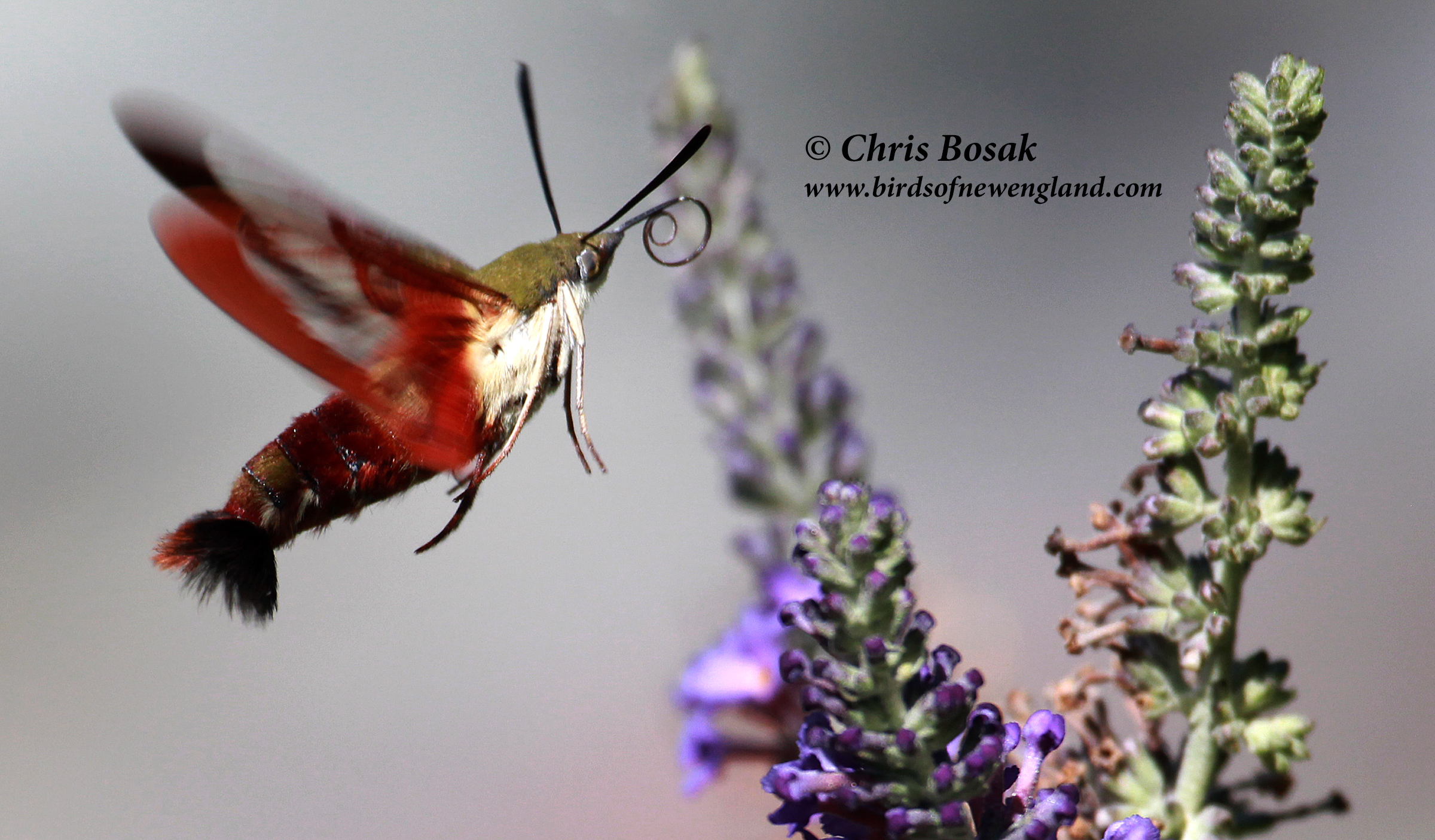
Photo by Chris Bosak A hummingbird moth sips nectar from a butterfly bush in New England, summer 2019.
I’ve been seeing a lot of photos and videos this summer of these fascinating creatures on Facebook and other social media. Many of the posts include the question: What is this???
No, it’s not a hummingbird, even though it resembles one, creates a humming sound with its wings and hovers around flowers like a hummingbird. It is a hummingbird moth, so named because … well, you can figure that out, I’m sure. Although it’s hard to tell without a side-by-side comparison, hummingbird moths are smaller than hummingbirds. A hummingbird moth is about two inches long and a hummingbird is a bit longer than three inches, but also much more bulky.
Look for hummingbird moths at the same flowers you’d expect to see butterflies and hummingbirds. Butterfly bush is a backyard favorite for hummingbird moths.
A hummingbird moth sips nectar with its long proboscis, a tongue-like sucking organ, which can be double the length of the moth. The photo below shows the proboscis rolled up.
Photo by Chris Bosak A hummingbird moth sips nectar from a butterfly bush in New England, summer 2019.
I’m a big “fun facts” guy. Thankfully, the internet is filled with these interesting tidbits of information.
You could find amusing information on just about anything you can think of: politics, art, sports, human biology, libraries, history. You name it, it’s out there on the web.
The animal world, of course, is no exception. Fun facts abound on the internet about earthworms, cicadas, robins, moose, musk ox, and countless other fascinating members of the animal kingdom.
I wrote recently about a few hot-weather walks I took through New England meadows. I focused that column primarily on butterflies, but I want to turn the attention to another common sighting I had on those walks: dragonflies.
These large insects have fascinated people for as long as people have been fascinated by things. Dragonflies can arouse amazement, fear or curiosity in humans. For me, it’s a combination of amazement and curiosity. I used to fear them when I was a kid due to a lack of understanding about them. They may be intimidating-looking, but they are as harmless as they come in the insect world — at least the ones we have in New England. (See, I snuck in a fun fact without even setting it up.)
OK, now for the set up: Dragonflies arouse curiosity in people for many reasons, such as their menacing appearance, aerial acrobatics, and ability to eat copious amounts of mosquitoes. Here are some other facts about dragonflies that you may or may not have known previously.
Dragonflies have two eyes, but each compound eye is made up of up to 30,000 ommatidium, or facets. The eyes make up most of a dragonfly’s head.
Dragonflies can fly in any direction and can hover for long periods of time. They can also fly upwards of 30 miles per hour.
That flying ability makes dragonflies excellent hunters, eating large amounts of small flying insects, but they can also be the hunted. I’ve seen birds such as green herons and purple martins snatch dragonflies out of the air.
Dragonflies are insects and therefore have six legs, a head, thorax and abdomen. They also have four wings, and the fore wings and hind wings are controlled separately, hence their awesome aerial abilities.
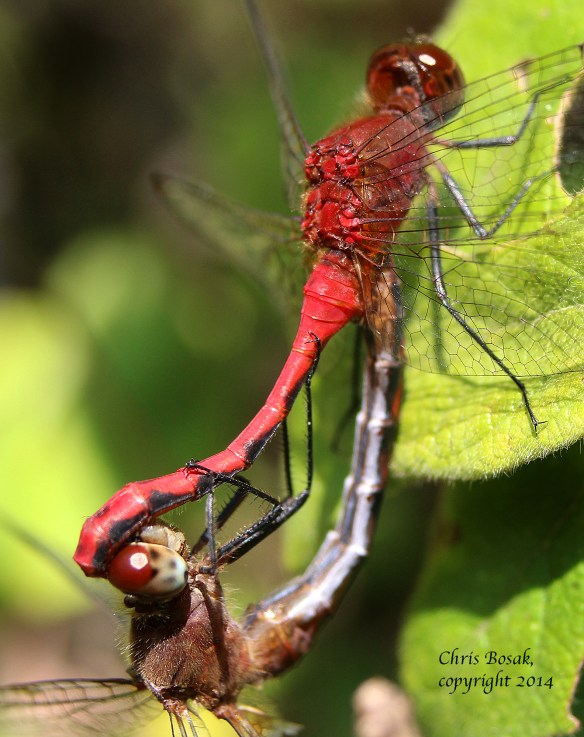
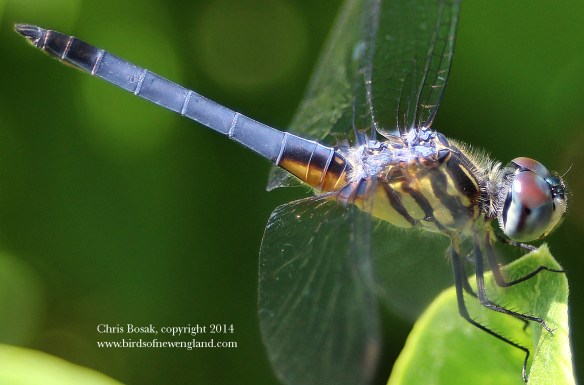
Dragonflies can be monomorphic (male and female look alike), dimorphic (male and female look different) or polymorphic (much variety even among males and females.) The most common colors for dragonflies in New England are blue and green, but there are also red, amber and white dragonflies here.
There are only a handful of dragonfly families that occur in New England (such as skimmers and darners), but there are about 200 species among those families in our region. The largest dragonfly in New England is the green darner, which is more than three inches long.
Dragonflies live all over the world, although most live in warm climates.
Eggs are laid in or near water and larva live for about a year in the water. After emerging, dragonflies live for only a few months as adults, if they are not eaten by something else sooner than that.
A group of dragonflies is called a swarm. They are multi-generational migrants, meaning the ones that fly south are not the same ones that return north.
Dragonflies make for interesting photo subjects. They often return to the same perch over and over, making it easier on photographers.
What’s your story about dragonflies? Let me know at the email address below.