
Here’s the final ice shot from my walk on the frozen pond the other day. Hopefully tomorrow I’ll have some snowy bird photos to share.

Here’s the final ice shot from my walk on the frozen pond the other day. Hopefully tomorrow I’ll have some snowy bird photos to share.

With a winter storm expected to hit New England this evening, here is another ice shot from my walk on the frozen pond the other day. I’ll post one more later tonight. Be safe and enjoy the snow tonight!
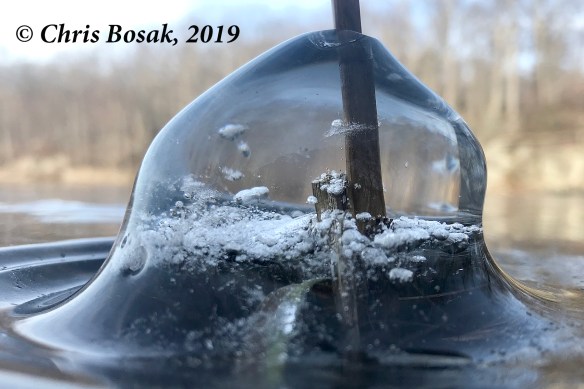
The walk yielded no birds except for a raven making strange noises overhead. No matter, the ice kept me busy.
The following photos were taken at the beaver pond (what I like to refer as Little Merganser Lake) at Lake Waubeeka in Danbury, Connecticut. We’ve had cold Continue reading

Most birdwatchers I know have a self-reliant, practical side. They don’t necessarily long to live off the grid in a small cabin in the wilderness, hunting for their food and cutting down trees to stay warm, but there is a hint of that spirit in a lot of us.
Luckily, there are many do-it-yourself projects for birdwatchers that may be done in the comfort of our heated, electrified, and well-stocked homes. The projects will save a few bucks (no pun intended) and result in that satisfaction only a good DIY activity can deliver.
The easiest project is making your own hummingbird food. It is inexpensive and requires almost no skill. In other words, perfect for someone like me.
Simply mix four parts water with one part sugar and you’ve got hummingbird food. I usually double the recipe to eight cups of water and two cups of sugar so it lasts longer. I like to bring the water to the point at which it is about to boil then turn off the heat and add the sugar. Most of the sugar will dissolve itself in the hot water, but a minute or two Continue reading
Here’s a short video of the Northern Bobwhite I saw last fall.

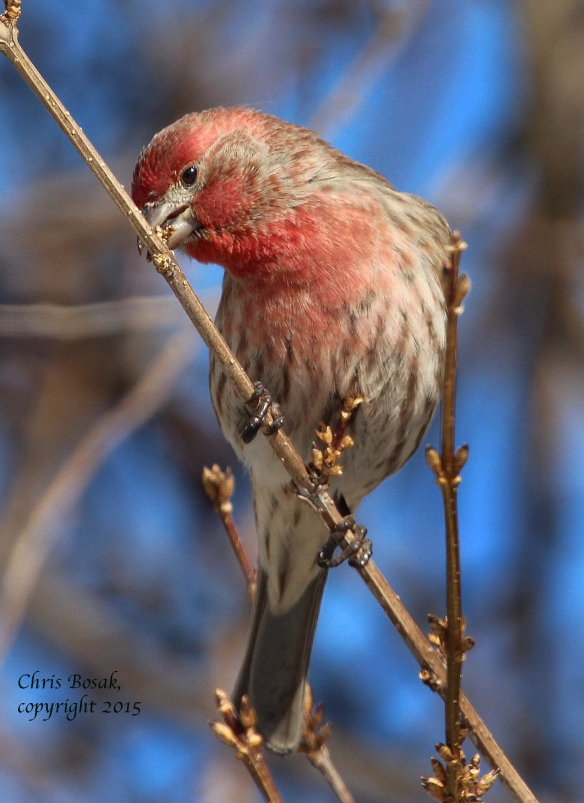
I noticed right away that this bird looked different. How can you not notice a bird without a tail?
This house finch has been visiting my feeders (Nyjer and sunflower seeds) for a few days now. Any variety of things could account for his missing tail, but the most likely reason is a close encounter with a predator (cat, hawk, fox, etc.)
I’ve seen house finches with avian conjunctivitis and I even had one get its head stuck in a tube feeder, but I’ve never seen a tail-less house finch before this. Not to worry, though, the feathers will grow back soon.
For the sake of comparison, here’s a “normal” house finch.
Here’s a For the Birds column I wrote a few years ago. Seems appropriate with a cold, gusty wind blowing today.

One of my favorite times to watch birds is when the snow is falling. Not a driving snow with icy temperatures and high winds, but an otherwise rather pleasant day with frozen crystals falling from the sky and covering everything with a fresh coat of white.
I do not shy away from taking walks to look for birds when the snow is actively falling, in fact I thoroughly enjoy walks at such times. But I also enjoy very much watching the activity at the feeders during snowfalls.
As long as the snow is not falling at too fast a rate, the birds will continue coming to feeders. Indeed, during light and moderate snowfalls the birds may be seen at higher-than-usual numbers at backyard feeders.
I will often grab my camera, open a window, pull up a seat and capture images of the hungry birds as snow falls and collects around them. I could do that for hours. Heating bills be damned. The usual suspects such as Northern Cardinals, Downy Woodpeckers, Black-capped Chickadees, Tufted Titmice and White-breasted Nuthatches are typically seen in high numbers during snowfalls. It’s also a great time to see birds such as Carolina Wrens and Dark-eyed Juncos.
But what about when it’s a heavy snowfall? I mean, right in the middle of the worst of it? Birds are scarce then. Wouldn’t you be, too?
Where are the birds then? Most humans are holed up at home or work or some other place of shelter. Birds do pretty much the same thing. Whether their shelter is an evergreen bough, a patch of thick brush, a bird house, an old nest hole in a tree, or even under the snow, birds do their best to stay out of the harsh weather.
Birds don’t have the luxury of a thermostat to crank up during these times. They don’t need artificial sources of heat, however. They have several natural defenses against the cold. One such defense is to puff up their feathers to trap warm air within their down feathers. This keeps the cold air away from their bodies. It’s the same principle as us putting on a jacket (especially a down-filled one.)
Depending on the species, they may also huddle together for warmth, often holing up together in a birdhouse. That’s why it’s important to keep your birdhouses up all year and to clean them out after the nesting season. Some birds, such as grouse, will even use the snow to their advantage by burying themselves into the snow for shelter. Those birds are insulated by the snow and out of the elements. The danger with that strategy is sometimes snow will turn to ice and a hard surface may form on the top of the snow.
Birds also know beforehand when a storm is coming. Sensing a change in air pressure, the birds build up their fat reserves to use as energy during the storm. That, obviously, makes the time leading up to harsh weather a good time for us to watch feeders, as well. Food, eaten beforehand, is important to birds’ survival of storms.
So make sure your feeders are well stocked this winter and offer a variety of foods in different feeders. I’m sure more snow is coming before too long.
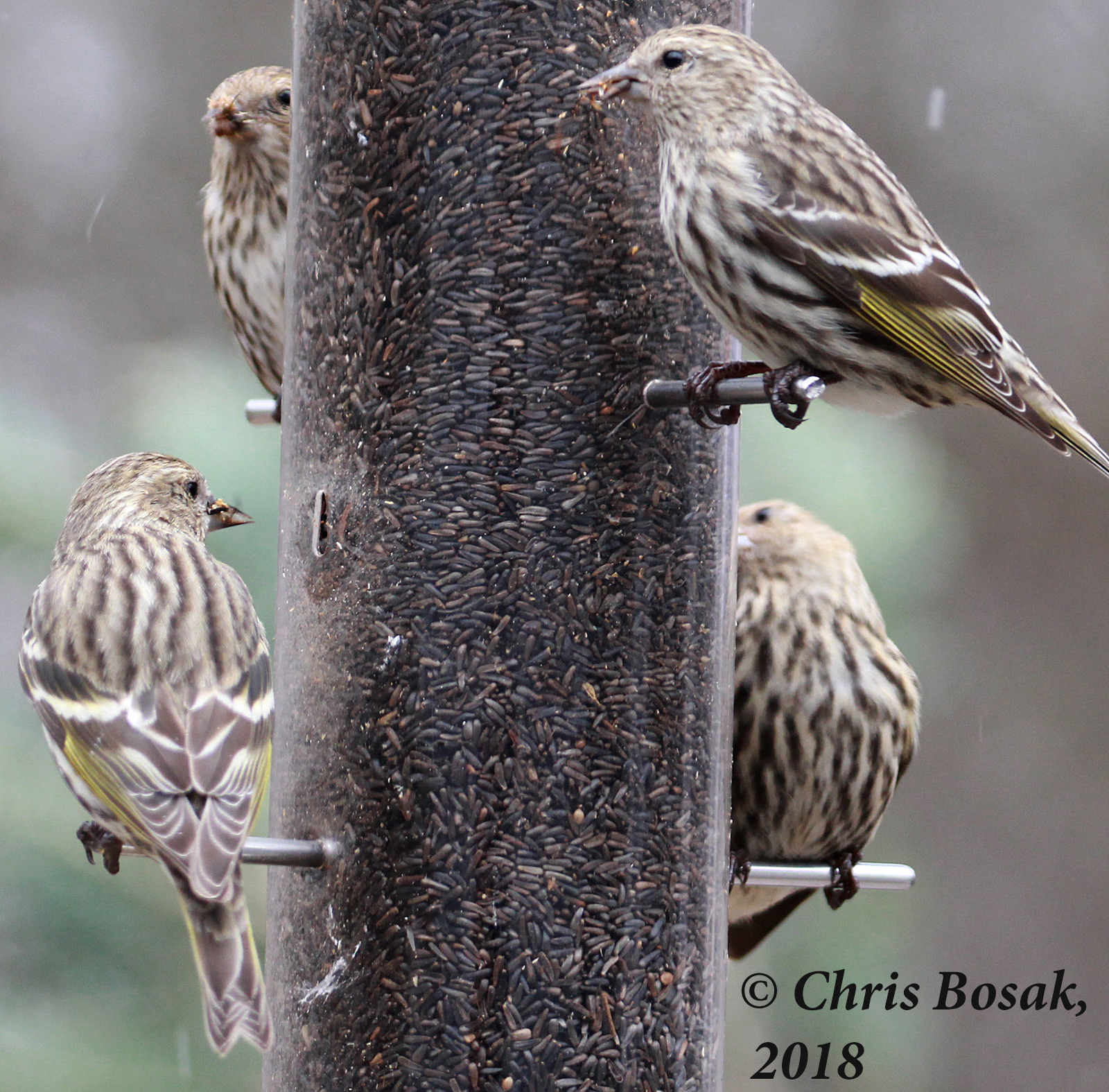
The pine siskins showed up on the last day of November and haven’t left. They may not be the same siskins as the originals (in fact they probably aren’t), but today I looked out at the feeders and saw about a dozen of the small finches. For me personally, this has been the best year yet for siskins. For more information about siskins and their irruptive nature, click here.
Speaking of irruptive species, I still haven’t seen any evening grosbeaks at my feeders. Several New England residents have reported seeing flocks of the large, handsome bird, however. (Large relative to siskins anyway.) One such lucky birdwatcher is Stephanie from Marlow, N.H., who shared some great photos. They may be found on the “Reader submitted photos” page on the menu above, or by clicking here.
In the meantime, here’s another siskin photo …


What better way to kick off 2019 than with a few vulture photos! I couldn’t resist passing up the spot again. A DMV pull-off area is a magnet for vultures because that’s where the deer carcasses are unloaded. Makes sense, right? I wrote about this at more length in this post from late 2017. Click here to read that post.
Long story short, it’s not an area I should be pulling my passenger car into, but I drove past the other day and saw an inordinate number of vultures. So I circled back to the highway for a closer look. They were nearly all black vultures with only a very few turkey vultures. I grabbed a few photos (and maybe a quick video) and went on my way. If you look closely, they’re actually kind of cute.

My latest For the Birds column releases my personal top 10 birding moments for 2018. Recapping the previous year is my favorite column to write each late December or early January. This year, instead of blasting out the top 10 all at once I’m going to spread it out and reveal two each day, starting today (Jan. 1, 2019.) This post will include Nos. 2 and 1. This is the finale!
Feel free to comment or send me an email with some of your 2018 birding or nature highlights.
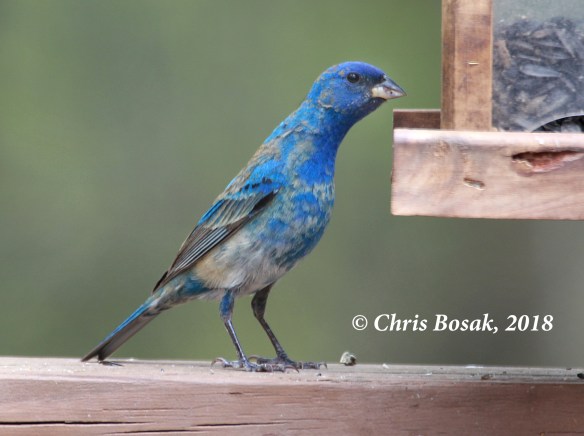
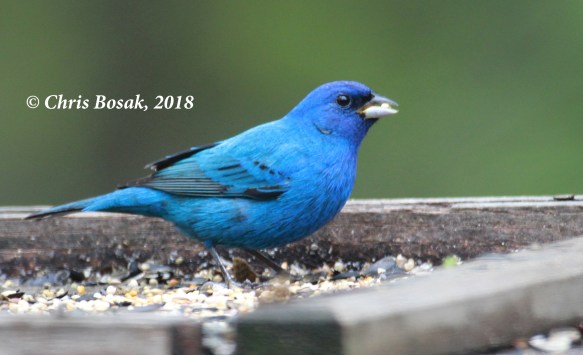
2. Indigo bunting at feeder. I had two visit, actually. One was a male in a blotchy transition plumage and one was an adult male in its splendid bright blue coat. I knew these sought-after birds visited feeders, but this was a first for me.

1. Gray jays. An early November trip to Pittsburg, N.H., yielded some interesting bird sightings, such as bald eagles, ruffed grouse, and an evening grosbeak. The highlight for sure, however, were several small groups of gray jays that ate seeds right from our hands.
Of course, the big highlight of the year was continuing to be able to share my outdoor adventures through this column and my website. Thanks for your support in 2018 and I can’t wait to see what 2019 has in store. Also, feel free to share your nature highlights of 2018.
 Birds of New England.com