Photo by Chris Bosak
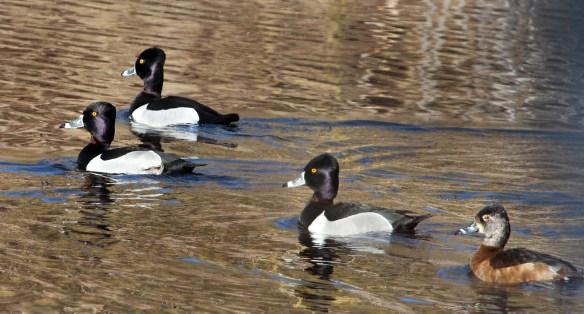
Ring-necked Ducks swim at Selleck’s/Dunlap Woods in Darien, March 2014.
In my last post about getting out there to check out the ducks before they are gone for the summer, I listed a bunch of ducks that winter throughout New England, but breed farther north. I left off that list Ring-necked Duck. It just didn’t come to mind when I was compiling the list. Sure enough, the next day I went out for a quick bird walk and the only ducks I saw were Ring-necked Ducks. I immediately thought: Hey, I don’t think I mentioned Ring-necked Ducks in that last post.
So, finally getting its due, here you have the Ring-necked Duck, a very handsome duck that spends its winters here in New England (and well south, too) and breeds in northern New England and into Canada. As you can see from the photo, a more apt name might be Ring-billed Duck, but the scientists who named it likely had a dead specimen in hand and the ring around its neck — which is difficult to see in the field — was more visible. It took me years to stop calling it Ring-billed Duck, but I eventually got used to it.
Also, as you can see from the photo, the species is sexually dimorphic: the males and females look different. All ducks seen in New England are sexually dimorphic with the males often brilliantly colored and females usually more dull in color.


 Birds of New England.com