Latest For the Birds column: Be prepared for snowstorms by filling birdfeeders

Photo by Chris Bosak A Brown Creeper finds food at the base of a tree during a cold snap in February 2016, Danbury, Connecticut.

Photo by Chris Bosak
A Brown Creeper finds food at the base of a tree during a cold snap in February 2016, Danbury, Connecticut.

Here is the latest For the Birds column, which runs weekly in several New England newspapers. (Note the date of the Great Backyard Bird Count has passed for this year.)

When I know a major snowstorm is coming, I want to be well prepared.

That does not include a trip to the grocery store to buy milk, bread, bottled water or any other essentials like that. That stuff I can get after everything is plowed or dug out — usually the next day.

For me, being prepared means making sure my camera batteries are charged, lenses cleaned and storage card emptied. It also means making sure the feeders are full before the storm hits. Perhaps I’ll add a few special treats for the birds in preparation for the snow.

The latest predicted snowstorm did not disappoint. It was supposed to start overnight, and it did. Thankfully I had filled the feeders before going to bed. I woke up to several inches of fresh snow and nonstop action at the feeders.

Juncos were the most prolific bird of the day. They typically hang around the ground seeking seeds, but with snow covering the ground, they perched on feeders alongside the chickadees, titmice and nuthatches.

It was a great storm, and the snow fell all day. Other than a snowshoe hike with the boys, I kept an eye on the feeders most of the day. Nothing too unusual showed up, but the falling snow made for a spectacular scene.

Several New Hampshire readers sent me photos of the birds they saw that day. A collection is available on my website, www.birdsofnewengland.com. If you took any bird photos that day and haven’t shared them with anyone yet, feel free to send them to me at bozclark@earthlink.net. I’ll add them to collection for the world to see.

Speaking of sharing bird sightings, the 20th annual Great Backyard Bird Count is coming up this weekend, taking place Friday, Feb. 17 to Monday, Feb. 20. It is your chance to contribute to a data base of winter bird sightings. The data is used to track bird populations and identify potential problems before they become irreversible.

All it takes is 15 minutes (or longer, of course) of counting birds and entering your checklist online at www.birdcount.org. You can count the birds alone or with a group, in your backyard or in the woods, for 15 minutes or all four days. It’s that easy. Checklists must be submitted online, however.

“The Great Backyard Bird Count is a great way to introduce people to participation in citizen science,” Gary Langham, the Audubon Society’s vice president and chief scientist, said in a news release. “No other program allows volunteers to take an instantaneous snapshot of global bird populations that can contribute to our understanding of how a changing climate is affecting birds.”

The project is growing quickly. In the first year, 13,500 checklists were submitted from the U.S. and Canada. Last year, nearly 164,000 checklists were submitted from more than 100 countries.

It’s a fun project, too, and a good way to introduce children to the joys of birdwatching and citizen science.

Get out there and count.

Latest For the Birds column: Keep an eye out for rarities

Here is the latest For the Birds column, which runs in several newspapers in New England.

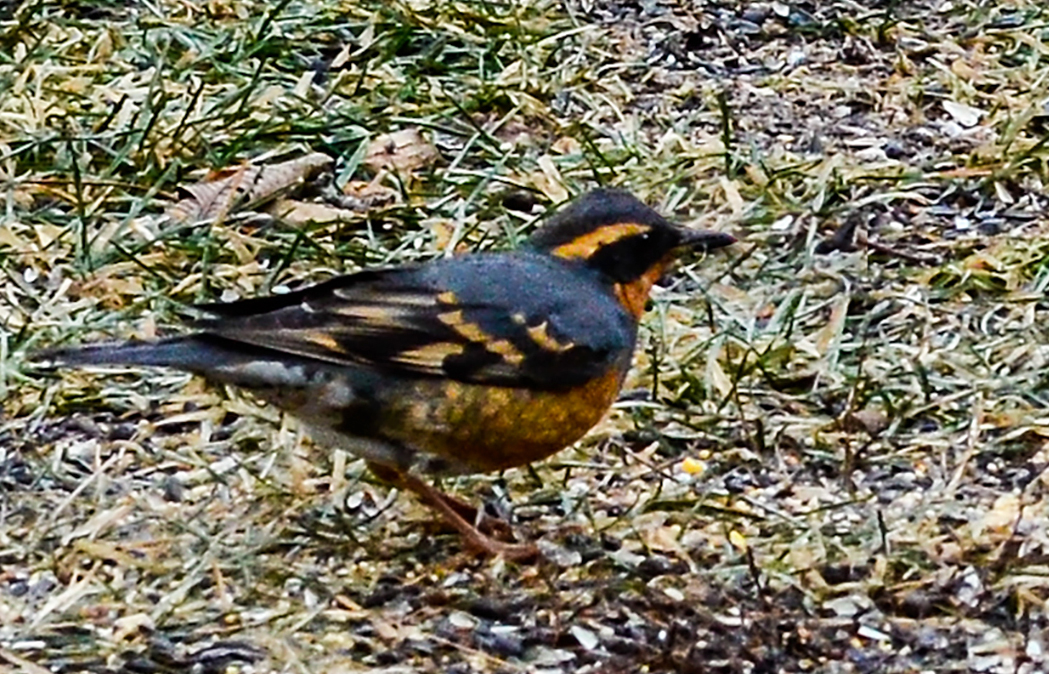
Photo by David Hoitt This Varied Thrush has been seen in Swanzey since Dec. 12.

Photo by David Hoitt
This Varied Thrush has been seen in Swanzey since Dec. 12.

Different seasons bring their own rarities.

Rarities, for the purpose of this column, are birds that are typically not seen in our region. It is not necessarily a bird that is rarely seen – it may be quite common in other parts of the country or world – but rather a bird that only every once in a while ventures into New England for one reason or another. In fact, it can also be a typical New England bird, but just seen in a season in which it is usually far away from here.

Winter is a good time for rarities because they stick out so much better. There are only so many birds that haven’t migrated for us to look at in winter, so when something different appears, it really sticks out.

Participants in the annual Christmas Bird Counts crave rarities. The point of the volunteer bird census is to count all the birds they see to contribute to a long-running data base so ornithologists can track bird population trends. There is no competition involved; no awards given. But the unwritten and unspoken truth is: CBC participants want to tally more species than the other counts held throughout the state.

So when a rarity shows up a week or two before Continue reading

Latest For the Birds column: Owls come a’hootin’

Photo by Chris Bosak A young Barred Owl clings to a branch in the woods in Danbury, Conn., spring 2016.

Photo by Chris Bosak
A young Barred Owl clings to a branch in the woods in Danbury, Conn., spring 2016.

Here’s the latest For the Birds column, which runs weekly in The Hour (Norwalk, Conn.), The Keene (NH) Sentinel and several Connecticut weekly newspapers edited by Jerrod Ferrari.

….

Throughout my birding “career,” I haven’t had great luck with owls.

I get the occasional look at a great horned owl and have only slightly better luck with finding barred owls. I’ve had modest success with snowy owls along the Long Island Sound coast in certain winters, especially during that banner year a few winters back. Short-eared owls, long-eared Owls, saw-whet owls, even screech owls? Hardly a glimpse.

But this fall has been pretty good so far in terms of owling. Not that I’ve actually seen owls — even a single one — but I have heard plenty of them. It started about two weeks ago when I heard a barred owl in the woods while I was sitting on my deck at dusk.

Then, a few nights ago, I heard a great horned owl. I knew it was fairly close, but I couldn’t pinpoint exactly where it was.

Two nights later, I had a great night of owling, and I didn’t even have to leave my yard. I heard two great horned owls calling to each other, one of which was in my side yard. I didn’t see it, as it was pitch dark, but the sound was definitely coming from close by.

The owls hooted to each other all night. I know it was all night because I was up most of it worrying about my house cat that happened to get out that night. He picked a great night to get out — the night two great horned owls are scanning the neighborhood.

At one point that night, I heard a pair of barred owls in the distance, too. I had never heard any owls from my yard before, and now I was hearing two species in one night.

Barred owls and great horned owls have very different calls. Barred owls belt out a “Who cooks for you? Who cooks for you aaallll?” It’s loud and, quite frankly, creepy. It’s a great Halloween sound. Great horned owls are more subtle when they say “Who’s awake? Me too.”

Now back to my cat. Cubby makes a great escape once a week or so and gets out. Like most pets, it’s best not to chase Cubby as he just runs farther away if he feels pursued. Plus, he’s much too agile and fast to catch anyway. Typically, he’s back in a half hour or an hour. At night, his escapes are usually even shorter. But on this night, he didn’t come home right away. I took frequent walks around the yard with a headlamp on to try to find him. No luck. I gave up on that at about 3 a.m.

I couldn’t sleep with my cat roaming the neighborhood and the constant sound of great horned owls calling to each other. I was torn between this being an awesome night or a terrible night. I certainly appreciated the owl calls, but in the back of my mind I worried about Cubby.

I put my mind at ease by knowing that, yes, owls on occasion will take a cat, but it’s highly unlikely. They are looking for mice, chipmunks, rabbits or similarly small prey. A house cat, while certainly within reason for a powerful great horned owl, is not a desirable prey. Cats are larger than an owl’s normal prey, so owls don’t typically go after cats because of the risks involved.

My mind was at ease, but not totally — certainly not enough to fall into a deep sleep. I left the sunroom door open and sliding door to the kitchen open a few inches in the hopes that Cubby would come in. I had to gauge the width of the door opening carefully as raccoons have gotten onto the enclosed sunporch before to get at the bird food. Boy, they are messy.

Finally at 4:30 a.m., I was half asleep when a loud “meow” came from the kitchen. It was Cubby, and he was fine. I had no idea where he had been or if he saw or heard the owls. I was just relieved that he was back.

I closed the doors and finally fell asleep fully with Cubby curled up at the foot of the bed.

The owls kept hooting, and I kept enjoying it, even in my sleep. When I woke up a few hours later, the sun was up and the owls had quieted. I didn’t know if they had left, but I knew they weren’t calling anymore.

I have heard them on occasion since, but not every night. I’m not sure if they are looking for nesting sites or just checking out a new neighborhood for untapped food sources, but I’m glad them came along. They are welcome in my yard anytime. I just have to be more careful with Cubby’s great escapes.
Latest For the Birds column: Loving the ‘regulars’

Photo by Chris Bosak White-breasted Nuthatch at backyard feeder, Oct. 2014.

Photo by Chris Bosak
White-breasted Nuthatch at backyard feeder, Oct. 2014.

Here’s the latest For the Birds column, which runs weekly in The Hour (Norwalk, Conn.), The Keene (NH) Sentinel and several Connecticut weekly newspapers.

The feeders went back up a few weeks ago. Nothing extraordinary has shown up yet, but it sure is nice to see the “regular” birds back.

My constant companions are nuthatches, titmice and chickadees. There is usually a downy woodpecker or two there as well, but they are not as reliable as the aforementioned birds.

I love seeing the nuthatches. I love the titmice and chick Continue reading

Latest For the Birds column: Hummingbirds are classic backyard entertainment

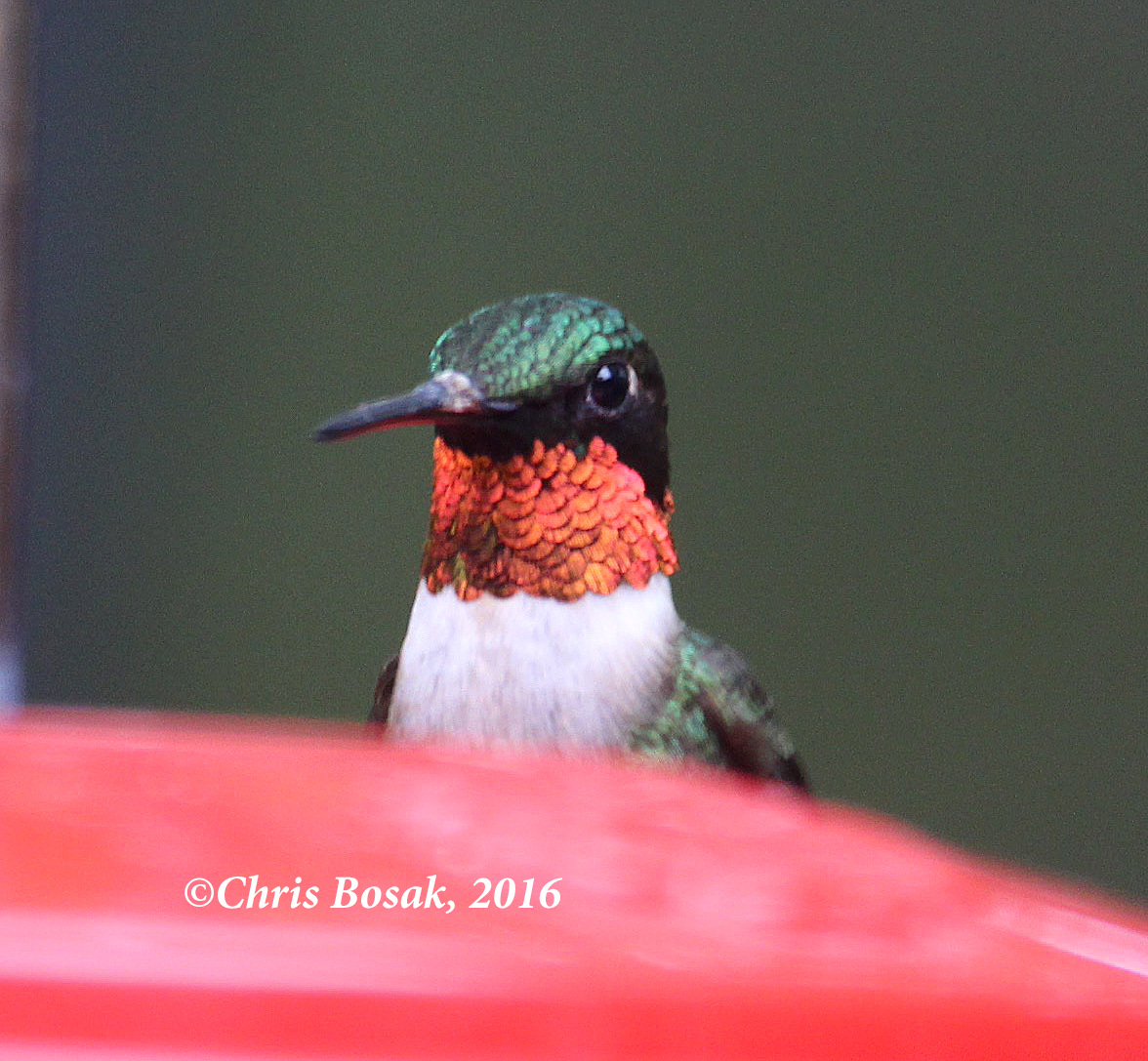
Photo by Chris Bosak A Ruby-throated Hummingbird hovers near a feeder in Danbury, Conn., summer 2016

Photo by Chris Bosak
A Ruby-throated Hummingbird hovers near a feeder in Danbury, Conn., summer 2016

Here’s the latest For the Birds column, which runs weekly in The Hour (Norwalk, Conn.), The Keene (NH) Sentinel and several Connecticut weekly newspapers.

..

The smallest of birds often provide the biggest entertainment.

I’m talking about hummingbirds, of course, and they are big, big on personality even if they are small in stature, weighing in at about an eighth of an ounce. Yes, a small fraction of an ounce, which is the smallest American standard of weight. Thank goodness for the metric system so we can put a whole number on this tiny dynamo. Hummingbirds weight about 2 or 3 grams, about the same as a penny. Not a handful of pennies or five pennies — one penny.

Photo by Chris Bosak A Ruby-throated Hummingbird eats at a feeder in Danbury, Conn., summer 2016

Photo by Chris Bosak
A Ruby-throated Hummingbird eats at a feeder in Danbury, Conn., summer 2016

I have been enjoying immensely watching hummingbirds this spring and summer at my backyard feeder and in the garden now that the flowers have bloomed – at least those that the deer didn’t get to. The only problem is that “my” hummingbirds are very territorial. Usually I see only one male at or near the feeder with the occasional female showing up, too. That was especially true this spring. They are not quite as territorial now, but are still very feisty toward other hummingbirds that show up.

It will be interesting to see what happens in the fall as last year the feeder was dominated by one female. She tolerated nothing from other hummingbirds, even those that dared fly over the house in the general vicinity of the feeder. Will the male remain and dominate, or will he fly off and the female dominate? Or will the male stick around and the female push him out? Or will they tolerate each other and share the sugar water, which is my hope. Or … OK, enough ors for now. As I said, we’ll see what happens.

If you don’t have hummingbirds that act like they own the feeders, you have a greater likelihood of seeing hummingbirds in late summer or fall because of simple mathematics. In the spring the adults pass through or settle in our area. In late sum Continue reading

Latest For the Birds column: Up to the roof to get close to a Scarlet Tanager

Photo by Chris Bosak A Scarlet Tanager sings in a tree in Danbury, Conn., July 2016.

Photo by Chris Bosak
A Scarlet Tanager sings in a tree in Danbury, Conn., July 2016.

Here’s the latest For the Birds column, which runs weekly in The Hour (Norwalk, Conn.), The Keene (NH) Sentinel and several Connecticut weekly newspapers.

Thankfully the trees are fully leafed out. My neighbors probably would have started to wonder about me. Of course, that process likely started long ago.

I found myself standing on my roof, camera in hand, keeping an eye on a male scarlet tanager that was singing his heart out among the oaks.

I had noticed the brilliant red-and-black bird a few days before. I was writing at my computer at home when I spied him through the window eating berries from those ubiquitous wild raspberry bushes, which are really invasive wineberries from Asia. The bird was impossible to miss with that beaming red plumage that puts cardinals to shame. (No offense to our beloved cardinals.) The tanager was gone by the time I opened the front door for a better look.

Continue reading

Latest For the Birds column: Like an old friend

Here is my latest For the Birds column, which runs weekly in The Hour (Norwalk, Ct.) and Keene (N.H.) Sentinel.

Photo by Chris Bosak A Blue-winged Warbler seen at Fairchild Wildflower Sanctuary in Greenwich, Conn., May 2016.

Photo by Chris Bosak
A Blue-winged Warbler seen at Fairchild Wildflower Sanctuary in Greenwich, Conn., May 2016.


It was like hearing from an old friend.

I used to visit a wildflower sanctuary in southern Connecticut fairly often, especially during the spring migration. It is a great place to find migrants such as Yellow Warblers, Bobolinks, Baltimore Orioles, Scarlet Tanagers, Eastern Kingbirds and, my favorite, Blue-winged Warblers. Not only do Blue-winged Warblers look striking (bright yellow plumage with long, thin black eye stripe), but they sound otherworldly, too. Well, maybe not otherworldly, but definitely not birdlike. They sound more like an insect — a big, buzzing insect that sputters its notes at the end.

It’s a sound I used to hear often when I visited the sanctuary. I made frequent visits there when I lived in nearby Westchester, N.Y. That was more than 10 years ago now. I hadn’t been back since.

Last week, however, the stars aligned to create the perfect scenario for a return visit. I was coming from Westchester and had about two hours to kill Continue reading

Latest For the Birds column: Goldfinch with conjunctivitis

Photo by Chris Bosak An American Goldfinch with Avian Conjunctivitis visits a birdfeeder in Danbury, Conn., April 2016.

Photo by Chris Bosak
An American Goldfinch with Avian Conjunctivitis visits a birdfeeder in Danbury, Conn., April 2016.

Here’s the latest For the Birds column, which runs weekly in The Hour (Norwalk, CT) and Keene (NH) Sentinel. I don’t always post my columns to this site, but this is an important topic so I figured I would. Thanks for supporting http://www.BirdsofNewEngland.com

I was stretched out on the lounge chair on the deck, binoculars and camera on one side, a fresh cup of coffee on the other. The sun was warm on this particular late morning. (The sun is that bright, hot thing in the daytime sky, just in case anybody forgot with all this gray, wet weather we’ve been having.)

Suddenly an American Goldfinch appeared out of nowhere. It didn’t attack the feeders from the flanks like the goldfinches and most other birds usually do. He flew right over my head and approached the feeders directly. His flight was awkward; not at all Continue reading

For the Birds column: Snow is no problem for birds

Photo by Chris Bosak A Tufted Titmouse and White-breasted Nuthatch share a feeder during a snowstorm in Danbury, Conn., Jan. 23, 2016.

Photo by Chris Bosak
A Tufted Titmouse and White-breasted Nuthatch share a feeder during a snowstorm in Danbury, Conn., Jan. 23, 2016.

Here’s the latest For the Birds column, which runs weekly in The Hour (Norwalk, Conn.) and Keene (NH) Sentinel:

One of my favorite times to watch birds is when the snow is falling. Not a driving snow with icy temperatures and high winds, but an otherwise rather pleasant day with frozen crystals falling from the sky and covering everything with a fresh coat of white.

I do not shy away from taking walks to look for birds when the snow is actively falling, in fact I thoroughly enjoy walks at such times. But I also enjoy very much watching the activity at the feeders during snow falls.

As long as the snow is not falling at too fast a rate, the birds will continue coming to feeders. Indeed, during light and moderate snow falls the birds may be seen at higher-than-usual …

Click here for the rest


When is nesting season over?

Photo by Chris Bosak A Mourning Dove sits on a nest in early July at Sellecks/Dunlap Woods in Darien.

Photo by Chris Bosak
A Mourning Dove sits on a nest in early July at Sellecks/Dunlap Woods in Darien.

Procrastinators rejoice. I’m going to give you an excuse to put off a few chores for another month or so.

Do you have trees on your property that need to come down? Bushes that need to be pruned? Perhaps a field or meadow that needs to be mowed?

Well, I’m not only giving you permission (not that you need that anyway) to hold off for a while, but urging you to do so.

An interesting email came my way this week from a New Hampshire couple. They had purchased property about 25 years ago that at the time was an abandoned Christmas tree lot. Most of the trees are now dead or dying and need to come down. The couple, to their credit, wants to make sure the nesting season is over before they go forward with any of the work.

So, just when is it safe to take down trees or cut fields that may house nesting birds?

There’s no exact date, of course. In general, though,

Click here for the rest of the article …