For the Birds: Return of the coyote

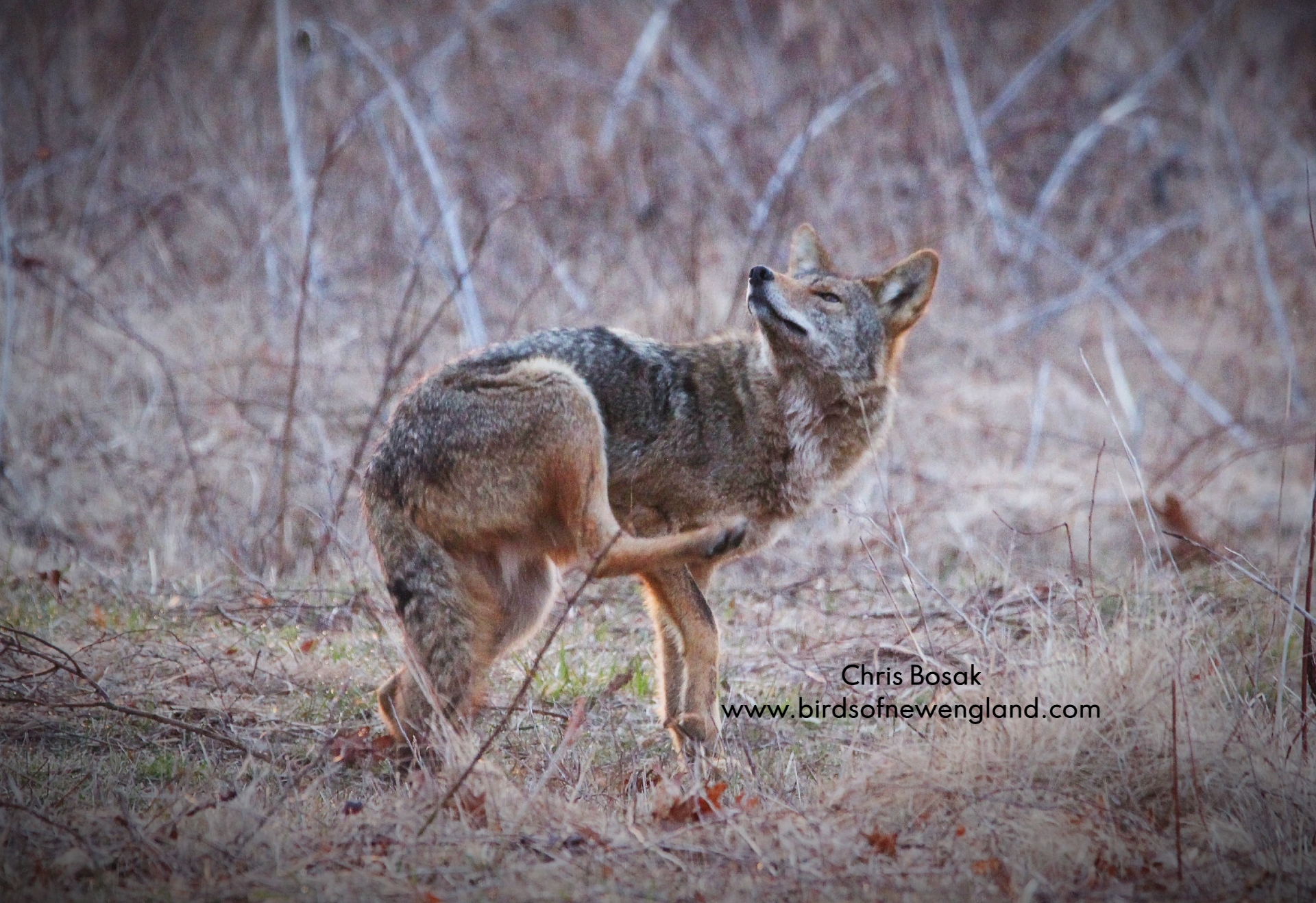
Photo by Chris Bosak A coyote scratches itself in a field at Huntington State Park in Redding, Connecticut, March 2025.

This is the second column in the last few weeks where I end up writing about and using a photograph of an unintended subject because the primary target fell through.

A few weeks ago, you may recall, I wrote about a missed opportunity to photograph blue jays harassing a barred owl. The blue jays successfully drove off the owl before I could get into position for a photo. On the walk back to the car, I came across a flock of cedar waxwings eating berries and stopped to photograph them.

This time, the intended target was American woodcock, but I ended up coming home with more photos of my coyote friend. Late in 2024, I wrote about getting lucky and spotting a coyote in a field as I passed a small break in the thick, tangled, brushy border between the woods and field. I’m assuming this was the same coyote, as I spotted it in the same field very near where I had seen it before.

But first, my intended target. American woodcocks, or timberdoodles, have been a nemesis species of mine for many, many years. I’ve seen their evening aerial displays a few times, but I haven’t found one during the day when getting a photograph would be possible. The aerial displays come shortly after sunset when the evening light has faded.

Continue reading

For the Birds: Odd ducks are fun to find

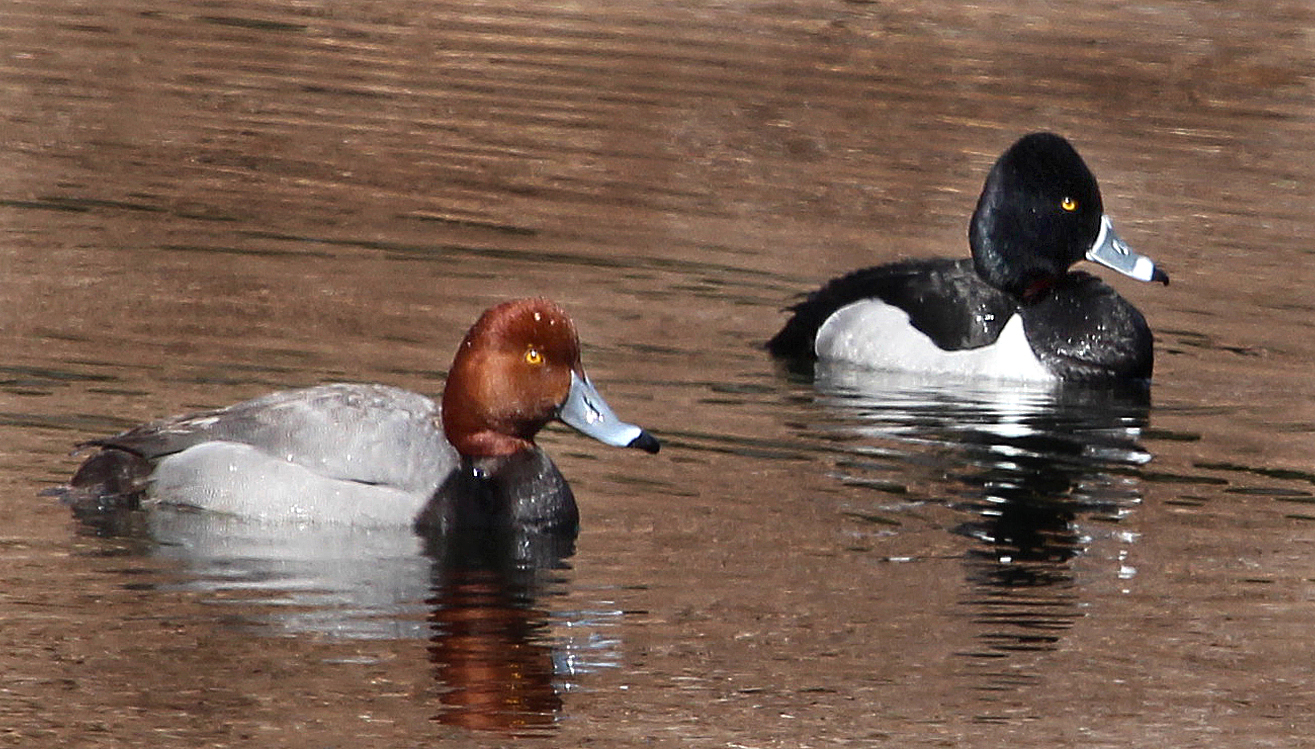
Photo by Chris Bosak A Redhead swims alongside a Ring-necked Duck in Darien in March 2014.

It’s always good to know where a little open water exists.

Whether the water doesn’t freeze during the winter because of a dam, waterfall, fountain or otherwise, these spots are great for duck watching on even the coldest of days. In fact, the coldest days may be the best time to visit these spots, as very little open water exists elsewhere, and the ducks concentrate in these little oases.

I find it interesting when different species of ducks that usually are not found together congregate in these pools of open water. I’ve seen huge rafts of scaup on Long Island Sound and some large lakes throughout the Northeast. The ducks usually stick with their own kind on these large bodies of water. But when a freeze forces them to find open water, it is not uncommon to see scaups swimming among goldeneyes, buffleheads and redheads.

Continue reading

For the Birds: Indigo bunting brightens a summer evening

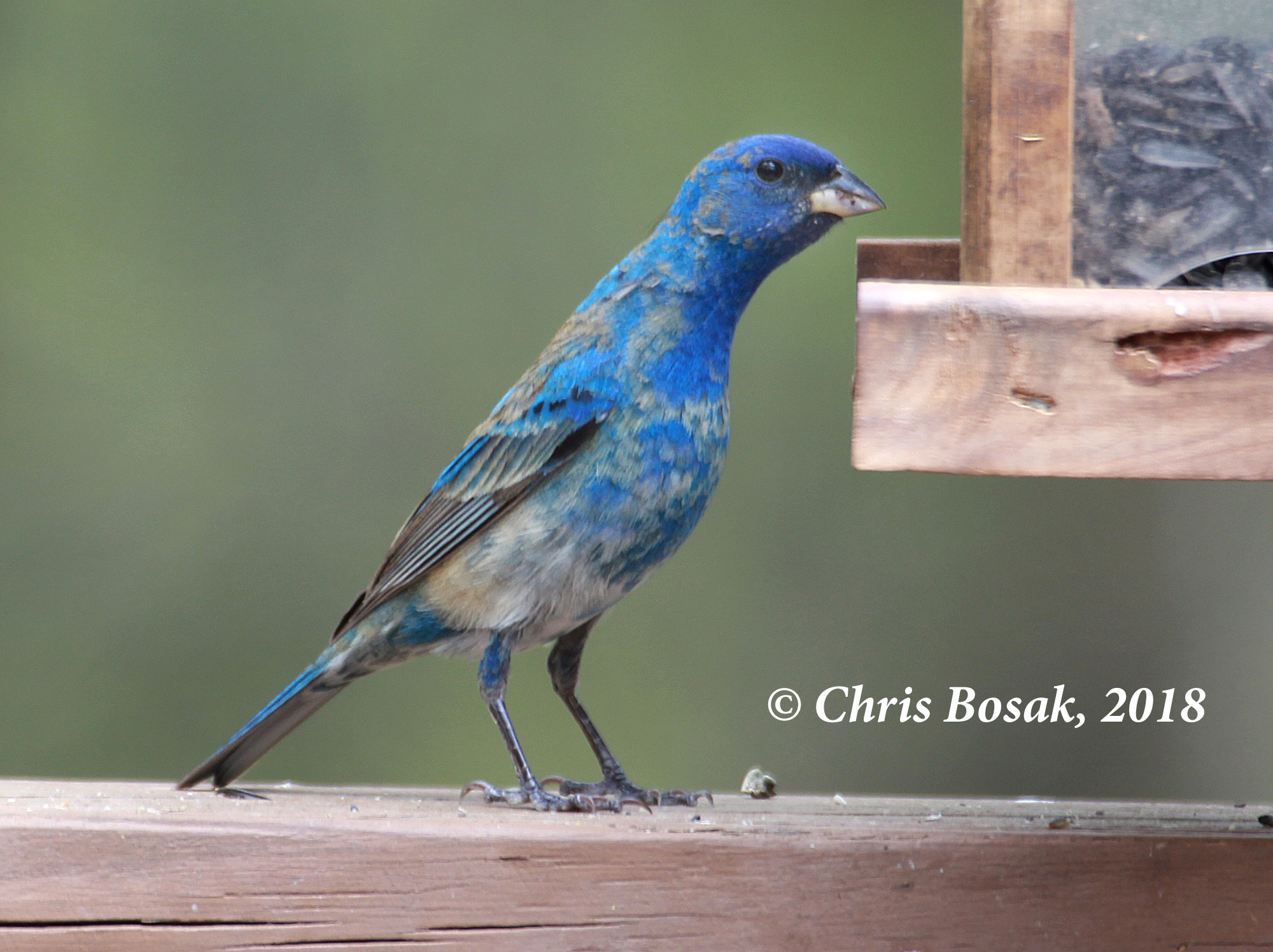
Photo by Chris Bosak An indigo bunting perches in a tree in New England, July 2021.

The song sounded familiar, but it had been months since I last heard it.

There is an indigo bunting around here somewhere I said to myself and instantly abandoned my plans for a long, strenuous walk. I knew I’d be at that spot for a while.

I couldn’t tell if the song was coming from the left or the right. It sounded like it was coming from both directions. I thought it was just because I’m getting old and my hearing was playing tricks on me.

But sure enough, there were two male indigo singing: one to the left of me and one to the right.

The bunting to the right was in the shade as the evening sun was dipping below the tree line. The bird to the left was illuminated in that magical evening light. I turned my focus to that bird.

Thankfully, the bird was fairly cooperative and even posed for a few photos in a berry tree. It didn’t eat the berries, but rather just used the tree’s branches for a vantage point.

It had been a few years since I was able to get photographs of an indigo bunting. Photographing any bird is enough to get my blood pumping, but a bird like an indigo bunting really gets the heart racing — especially when they are being cooperative.

Male indigo buntings are one of the more striking birds we see in New England, right up there with scarlet tanagers, Baltimore orioles and rose-breasted grosbeaks. Indigo buntings, like many songbirds, are sexually dimorphic, meaning the males and females look different. Also, like most birds that are dimorphic, the female is much duller than the male. The difference between the electric blue male and brown female is stark.

Continue reading

For the Birds: Bluebirds and winter

Photo by Chris Bosak An eastern bluebird braves a New England winter and visit a backyard for mealworms, winter 2020.

It’s been another great winter for bluebirds. I haven’t been lucky enough to attract them to my new house yet, but I have seen them several times out in the field and while driving along side roads.

I’ve heard from several readers who have seen these cheerful birds as well, and that’s always good to see.

I remember years ago when I was new to birding and I came across a small group of bluebirds at Surry Dam while snow fell all around. I was surprised and excited to see them. I thought bluebirds were long gone by the time winter came around in New England. I took a few photos (this was back in the days of film) and anxiously awaited the results from the lab. The photos were pretty terrible as I recall, but the day still sticks out in my head as a great birding day.

I, like most birdwatchers I would imagine, like to research new findings. I think curiosity about the natural world is a prerequisite for being a birder. I found out that the sighting wasn’t particularly rare and that many bluebirds, indeed, stay around for the winter. It didn’t Continue reading

For the Birds: Warbler season already

Photo by Chris Bosak
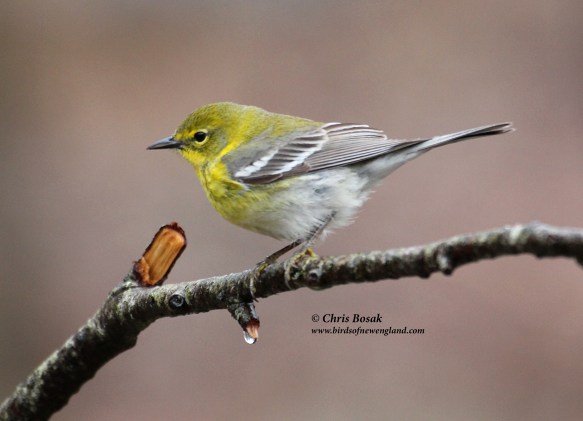
A pine warbler visits a backyard in New England, April 2020, Merganser Lake.

Another quick, one-day break from the A Day on Merganser Lake photo series to bring you the latest For the Birds column …

Could it be warbler season already?

It sure is and I’m just as surprised as the next person. Not that the first week of April is unusual for the early warblers to arrive; it’s right on time.

Still, I was surprised when I looked up and saw a pine warbler perched at the top of my bird-feeder pole system the other day. I wasn’t ready for it. In a normal year, I’d be counting down the days until the first warblers arrived. But this is no normal year. I think we can all agree on that.

Like many others, I’m sure, I’ve been consumed with COVID-19, or coronavirus. It’s on the news 24/7. Grocery stores have one-way aisles, most people are wearing masks and the cashiers are wearing face shields. My work (thankfully I am still working) is busier than ever due to the virus and the days start earlier and end later than ever.

No sports. No concerts. No parties. Heck, no talking to your Continue reading

For the Birds: Welcome mat for the typical birds

Here is the latest For the Birds column, which runs in several New England newspapers. Thanks for checking it out …

Photo by Chris Bosak A blue jay grabs a peanut from a deck railing in New England, fall 2019.

The word typical often has a negative connotation.

It is usually used to describe something boring or mundane. “Just a typical day at the office.” Or worse, as a word of exasperation to draw attention to a recurring negative behavior: “He said what? Oh, that’s so typical of him.”

But I’m going to use typical in a positive way here. After all, Thanksgiving is a fresh memory, the holiday season is upon us, and 311 is my favorite band. The band encourages “positivity” and closes its concerts with “Stay positive. Love your life.” So I will do that here with the word typical.

The other day, all the “typical” birds showed up at my feeder. And that’s a good thing.

My typicals include black-capped chickadees, tufted titmice, white-breasted nuthatches, downy woodpeckers, red-bellied woodpeckers and blue jays. You can throw juncos in there, too, during the winter — and late fall as they have already arrived.

Other birds visit from time to time, but those are the birds that are always here. Many people have written to me lately about a lack of chickadees at their feeders. It’s definitely a trend to keep an eye on, but thankfully, I still have plenty of chickadees visiting my feeders. I still haven’t solved the mystery as to why so many people are experiencing a scarcity of chickadees, but I can tell you that I see them often.

I’m not trying to be boastful about my feeders or the fact that I see a lot of chickadees. There are some obvious bird species that I hardly ever see in my backyard.

Cardinals, for whatever reason, are rare sightings at my feeders. I see them all the time in the bushes along the sides of the road when I am driving through the neighborhood, but they avoid my yard like the plague.

Although I get more than my share of juncos in the winter, I rarely see white-throated sparrows — a usual accompaniment of juncos. At my previous houses, white-throated sparrows were a common winter occurrence and easily outnumbered all other winter birds. Here, I barely see them. I’ve seen more fox sparrows here than white-throated sparrows and that’s just plain odd.

I do see a ton of chipping sparrows in the spring and summer, but not enough to add them to my typical list. I am lucky enough to get good numbers of rose-breasted grosbeaks each spring, but their length of stay is too short to make the list. I do enjoy that short window each year, though.

Ruby-throated hummingbirds miss the cut by the barb of a feather. I see them daily from late April until the end of September, but I couldn’t bring myself to include a bird that is not a year-round New Englander. The hummingbirds are off sunning themselves and gorging on insects in Costa Rica or thereabouts, not like the chickadees, titmice and nuthatches that visit me daily regardless of the temperature.

I don’t just give out the title of “typical” to anything, you know.

For the Birds: Giving for open space

A bonus For the Birds on this Thanksgiving. Happy Thanksgiving everybody.

photo by Chris Bosak
Wild turkeys in New England.

It is the giving season. Not only for presents under the tree but also for charitable giving during the holiday season — not to mention before the year ends for tax purposes. Sorry, had to add in that bit of practicality.

It’s also the time of year to be thankful, what with Thanksgiving coming up in a few days and all. Like every year, I am thankful for the joy that birds and nature bring to my life on a daily basis. We are lucky to live in New England where we get to fully experience the intensity of each season. The winters are cold, the summers are hot, the autumns are crisp and breathtaking, and the springs are sometimes slow to arrive, but totally worth the wait as the flowers bloom and birdsong fills the air.

Each season also has its bird highlights and there is never a dull moment in the woods or otherwise in the field with binoculars around your neck. Even the dead of winter has its rich rewards for the birdwatcher.

My hope, and I would guess yours, too, is that it stays that way. An often-cited study released recently shows that nearly 30 percent of North America’s bird population has disappeared in only the last 50 years. Many nonprofit organizations make it their mission, or at least part of their mission, to save birds. So, since it’s the giving season, here are a few suggestions on where to direct your charitable giving, if you are so inclined to donate to conservation efforts.

There will be no birds — or at least very few — without suitable habitat. Local organizations such as land trusts make it their mission to protect land. They have other conservation and ecological reasons for wanting to protect open space in addition to helping birds, but that is certainly one of their main objectives.

Land trusts do not have a political agenda and they don’t support a million programs that you may or may not agree with. They simply want to protect land. Most land trusts have a very small budget and many are run entirely by volunteers. You know your money is going to the cause at hand, not to a CEO making triple figures.

The other nice thing about land trusts is that the land is saved in perpetuity. It will not be wildlife habitat one year and a condo or a strip mall the next. It will always be habitat.

Do an Internet search to find the land trust nearest you. Chances are there is one that serves the town you live in.

There are other state and local conservation organizations, of course, that do great work. Again, a simple Internet search will help identify some you may want to support.

On the national level, organizations such as the Cornell Lab of Ornithology, American Bird Conservancy, Audubon Society and American Birding Association all have birds at the heart of their mission. Check their websites to see what comes with a membership as many offer newsletters, magazines, course discounts, and other benefits. Hunting organizations such as Ducks Unlimited, National Wild Turkey Federation, and Pheasants Forever also do outstanding work for habitat preservation.

There are other conservation groups, such as Sierra Club and Nature Conservancy, that are also worthy of a look as you consider your charitable giving this year.

Happy Thanksgiving everyone.

Classic For the Birds: Much learned; much to learn

Here’s a For the Birds column from 15 years ago. Yes, I’ve been writing it for that long, and even longer. Enjoy …

Photo by Chris Bosak A Snowy Egret looks for food in Norwalk Harbor.
Photo by Chris Bosak
A Snowy Egret looks for food in Norwalk Harbor.

It’s funny how things that seem so difficult at the beginning eventually become so easy.
It can be said of just about any hobby, but it certainly applies to birdwatching.
I can remember struggling with differentiating great egrets from snowy egrets. It seems somewhat silly now. Great egrets are markedly larger, have yellow bills and black legs and feet. Snowy egrets, aside from being much smaller, have black bills and yellow feet.
The differences are clear and obvious now. But, as a beginner, I saw only tall Continue reading

Latest For the Birds column: Another backyard first

Here is the latest For the Birds column, which runs in several New England newspapers.

Photo by Chris Bosak An indigo bunting visits a feeder in New England, spring 2018.

Photo by Chris Bosak
An indigo bunting visits a feeder in New England, spring 2018.

No matter how long you’ve been at it, birdwatching always presents firsts.

Wait, I used that sentence to start my column a few weeks ago. Oh well, another birding first happened this week, so I’m going with it again.

This time, it was a new bird to my feeding station. I’ve been feeding birds for a long time, and I’ve seen some great birds eating seeds or suet in my backyard.

Every year I’m thrilled when the rose-breasted grosbeaks show up. This year, a male and female have paid periodic visits for the last couple days.

It took years for me to attract hummingbirds, but now — knock on wood — it seems they are annual visitors.

A few Octobers ago, a small group of pine warblers discovered my suet feeder and stuck around the yard for about three days.

The other day, a new arrival. Settling into my lounge chair on the deck, I noticed a bright blue blotch among the leaves on the branch used by “my” Continue reading

For the Birds: In the world of mallards

Here is the latest For the Birds column, which runs in several New England newspapers.

Mallards sit on a branch overhanging a pond in New England.

Mallards sit on a branch overhanging a pond in New England. Photo by Chris Bosak


For just a moment, I was in their world.

As I stood there I could see nothing but branches, sticks and stubborn brown leaves that refused to fall off the low trees. Then I crouched like a baseball catcher and there they were: a flock of mallards taking a mid-day break in the tangled trees growing out of a small pond.

Normally mallards would not make for a memorable birdwatching outing, but this time was different.

A fairly busy road was no more than 50 yards away, and my car was about 50 feet away, but I felt as if I was visiting the ducks’ world. The area was thickly wooded and a dark canopy of towering branches hung over the pond’s edge, adding to the feeling of seclusion. It was as if the world was reduced to the woods, the mallards and me.

It was a neat sensation, one that I’ve experience only a handful of times before — usually in extreme northern New Hampshire.

It was the way the mallards acted. They didn’t flee when my feet crunched the crispy leaves as I approached. They didn’t plop into the water and swim away slowly when I crouched for my view. They stirred only slightly as I settled in for a closer look and found a more comfortable position. (The catcher’s stance lasts only so long these days for me.) Most importantly, the mallards didn’t approach me looking for a handout. That definitely would have ruined it.

I watched as the mallards simply went about their day. The average person would have been bored silly in about 30 seconds, but I was fascinated.

A drake had the best seat in the house, hogging a gnarled tree all to himself. Just off to the right was a leaning tree with half a dozen mallards sitting next to each other. Four of them were sleeping, heads turned around with their bills nestled into their backs — eyes closed. The two wakeful mallards paid no attention to me. At least eight other mallards occupied trees or branches in the same area.

Looking back, it would have been even more memorable had the birds been wood ducks or hooded mergansers — both of which were also at the pond that day — but I can’t complain about the mallards. Besides wood ducks or mergansers would have been long gone at the first snap of a twig.

Another drake swam onto the scene. It bypassed the crowded leaning tree and tried to join the male that was sitting alone. Big mistake. The duck leaned forward, hissed and snapped at the newcomer, shooing him away. It found a place nearby to roost.

A minute or two later, one of the hens left the crowded tree, took a few graceful paddles through the shallow water and climbed aboard the gnarled tree with the ornery male. The male shifted slightly, but let the hen stay. After about three minutes, the drake’s charitable mood changed and he nipped at the female, sending her away.

The mallards’ mid-afternoon break outlasted mine. I was already late for work and, knowing that, the feeling of being in a different world faded away.

It was back to the real world. But I had the dirty pants and muddy shoes to prove that I had been elsewhere.