For the Birds: Strong winter for finches forecasted

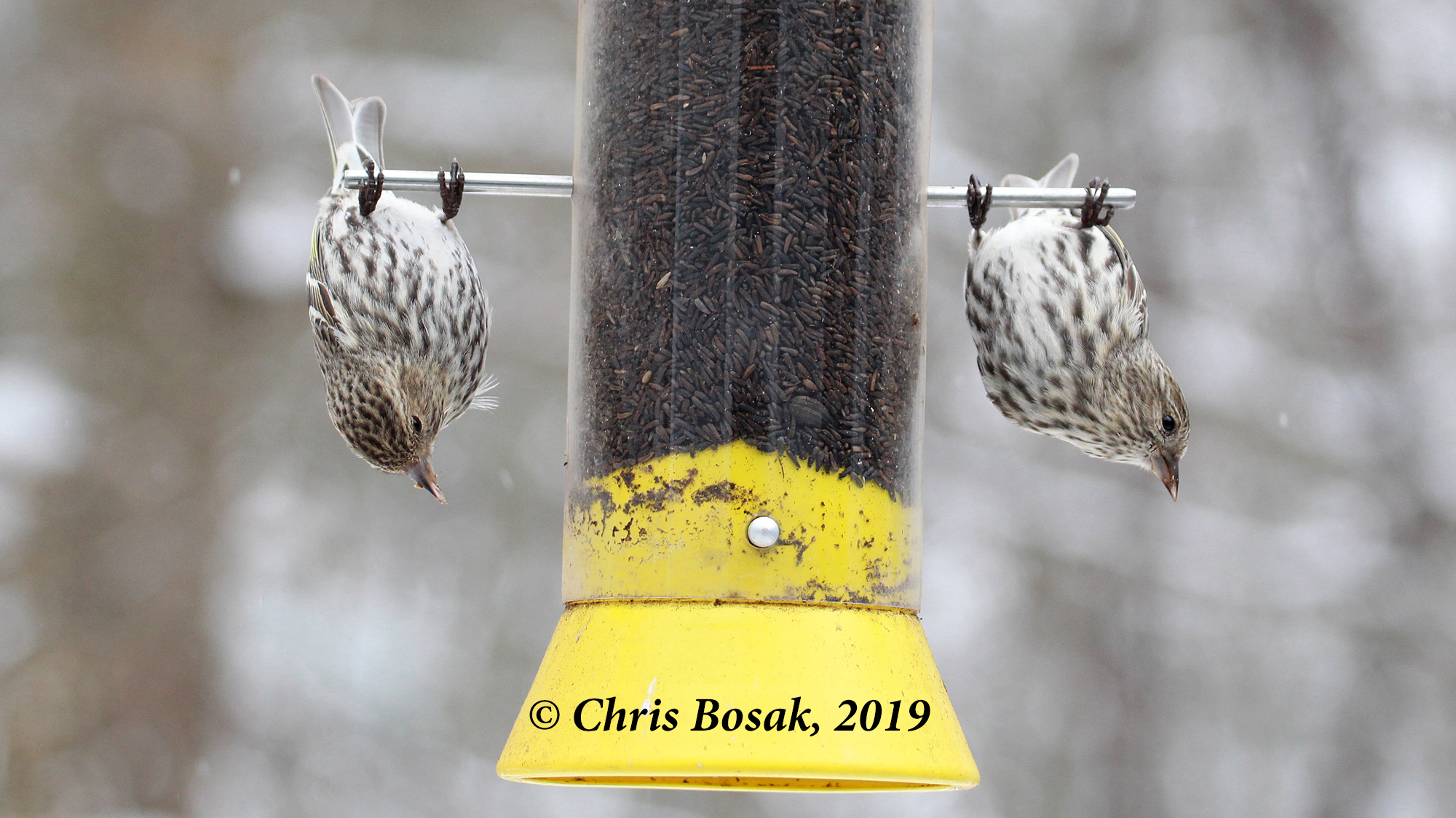
Photo by Chris Bosak Pine siskins visit a feeder in Danbury, Connecticut, March 2019.

My favorite part of winter birdwatching has always been looking for waterfowl on whatever open water remains. Searching for bald eagles in those same areas has become another favorite of mine as the population of our national bird soars, and we see them more frequently.

Winter is also arguably the best time to watch feeders in the yard, although one can easily make a case for spring being the best time when the grosbeaks, buntings and other surprises arrive. Watching the feeders in winter, particularly before a storm, is a constant treat of chickadees, titmice, nuthatches, woodpeckers, cardinals, blue jays, juncos and white-throated sparrows.

In my opinion, an underrated part of winter birding is the finch irruption, or lack thereof, depending on the year. Birds such as siskins, redpolls, purple finches, crossbills, pine grosbeaks and evening grosbeaks sometimes irrupt into our region as food supply dictates. Other birds such as red-breasted nuthatches are also lumped into the category of unpredictable winter bird visitors.

Continue reading
For the Birds: Oriole nests are something to behold

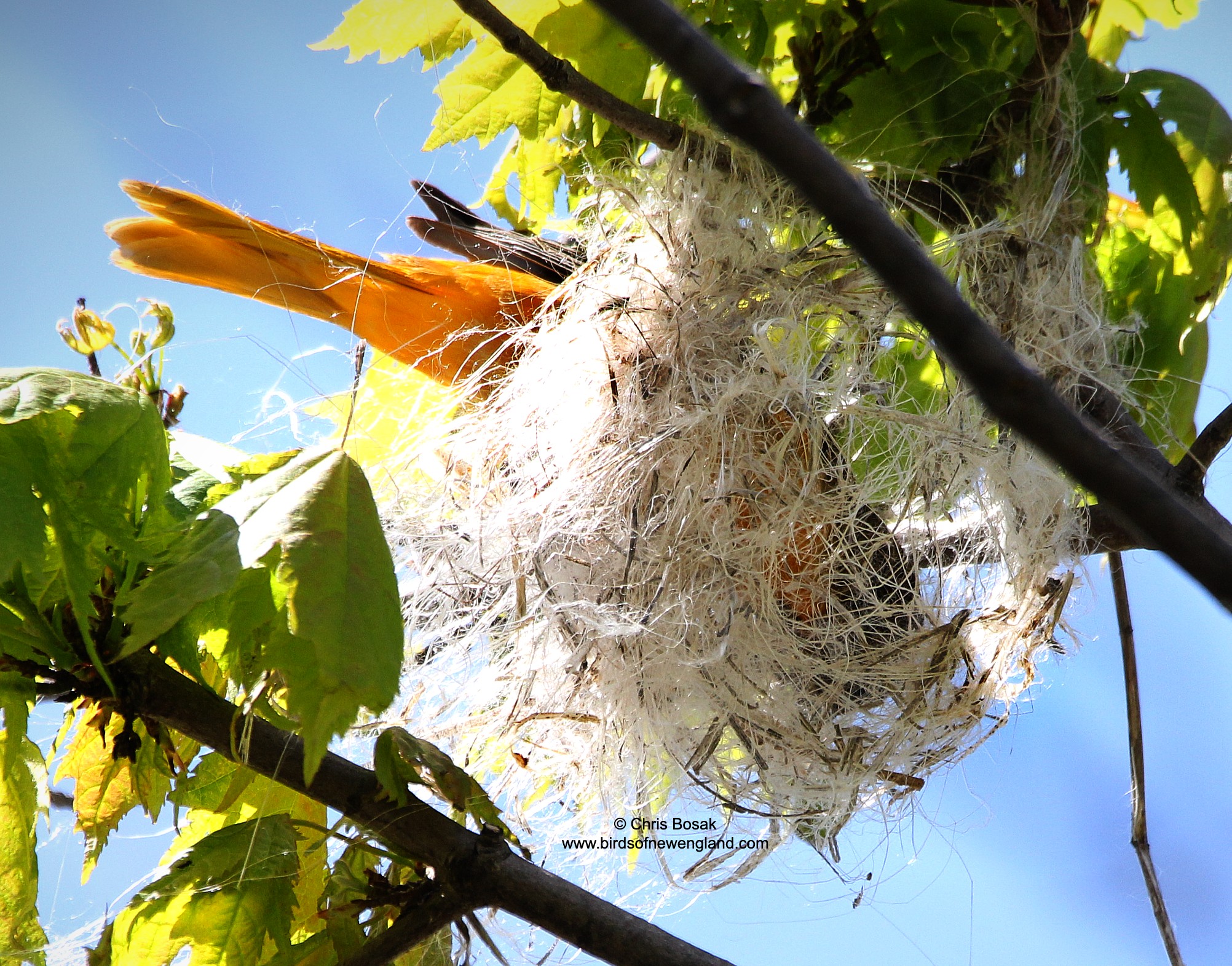
Photo by Chris Bosak A Baltimore oriole builds a nest at Presque Isle State Park, Erie, Pa., May 2025.

Everything about a Baltimore oriole nest is ingenious. From the design and materials to the location selection, the nest is a perfect haven to raise young birds safely from predators (for the most part).

Fall is the best time to find oriole nests, after the leaves have fallen. Of course, by that time, the orioles are long gone, and the nest is a mere relic of the past breeding season, but it’s still interesting to see one of the pouch-like nests dangling from the end of a branch.

The other week, I was lucky enough to watch a female oriole build one of those remarkable nests. I was walking along a trail that was teeming with yellow warblers, catbirds, and Baltimore orioles when I glanced up and saw an oriole perched at the end of a branch overhead.

Continue reading

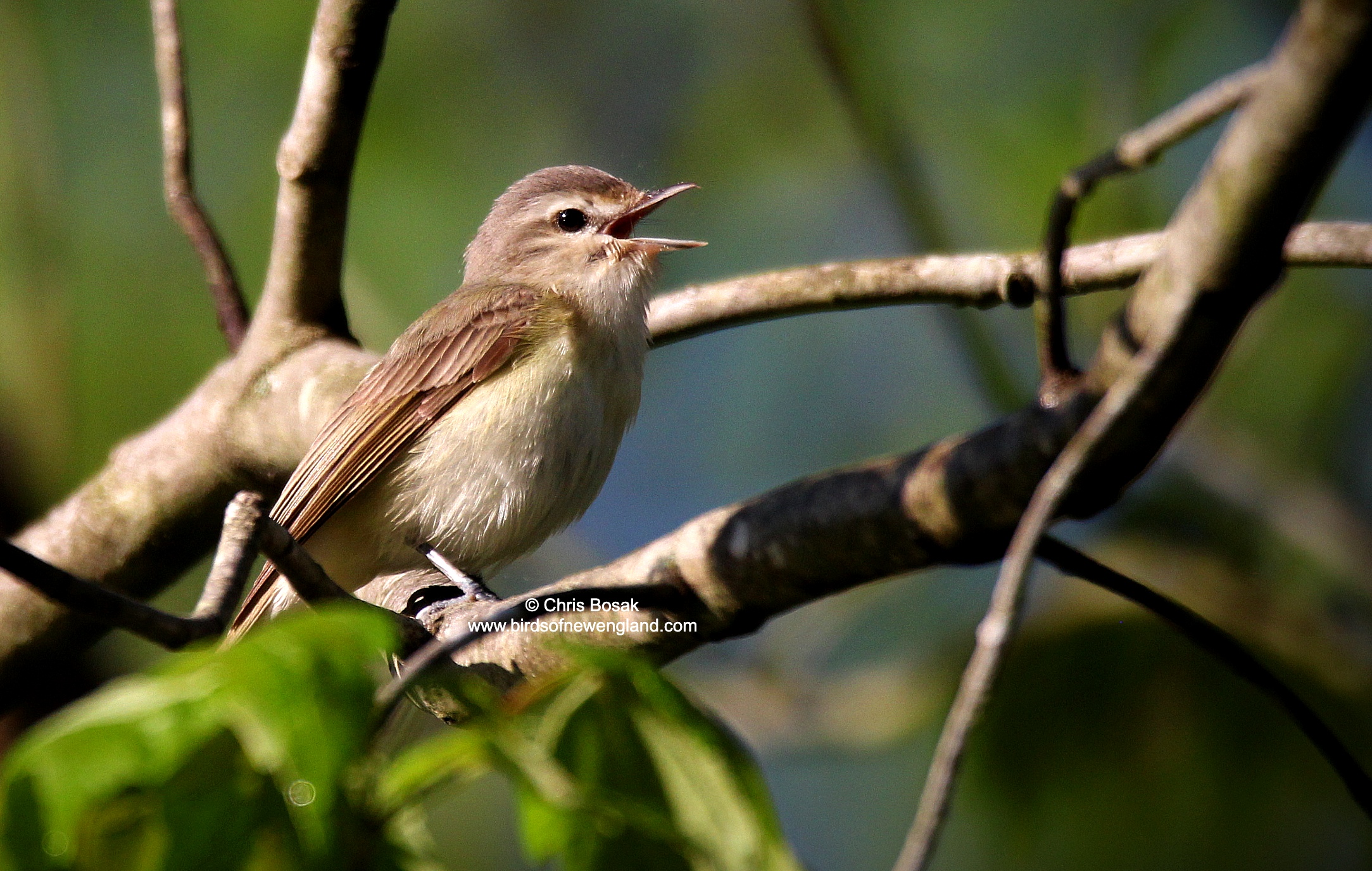
For the Birds: Warbling vireos everywhere

Photo by Chris Bosak A warbling vireo sings from a branch in New England, spring 2025.

It’s funny how you can still discover new things after so many years.

I’m sure that applies to most hobbies, but it certainly applies to birdwatching. I have only recently “discovered” the warbling vireo. The small, loquacious bird, of course, has been around for far longer than I have been birdwatching, but I am only recently taking notice of it.

Part of the reason I may not have paid it much mind previously is that it is a small, fairly nondescript bird that typically hangs out in the middle to upper branches among the leaves. It is not like some birds that take an obvious perch somewhat low in the trees or brush and are easily found on a birdwalk.

Over the last couple of years, however, I have come to know warbling vireos not only because the males sing constantly, but I am finding them almost everywhere I go in the spring.

Continue reading

For the Birds: Warblers come early

Photo by Chris Bosak A pine warbler seen March 31, 2025, at Huntington State Park in Redding, Connecticut.

It’s an early start to the warbler season for me.

I was walking at my usual patch on March 31 when I heard a familiar trill-like song from the top of a tall white pine. A fast-paced trilling usually means it is a junco, chipping sparrow, or pine warbler. All three of these birds are in New England now, so unless you are an expert at identifying birds by song, it is best to find the bird and get visual confirmation.

Like most warblers, pine warblers do not sit still for very long, so it took only a few seconds of searching to find the tiny bird moving among the branches. It was indeed a pine warbler, a mostly yellow bird with white wing bars on gray wings.

Pine warblers are always the first, or at least one of the first, warblers to show up in New England each spring. I usually do not find them until a few days into April, but this year, my first warbler sighting came on the last day of March.

Coincidentally, I saw my first chipping sparrow of the spring last week as well. Yes, spring migration is underway.

Continue reading

For the Birds: Kingfisher winter sightings

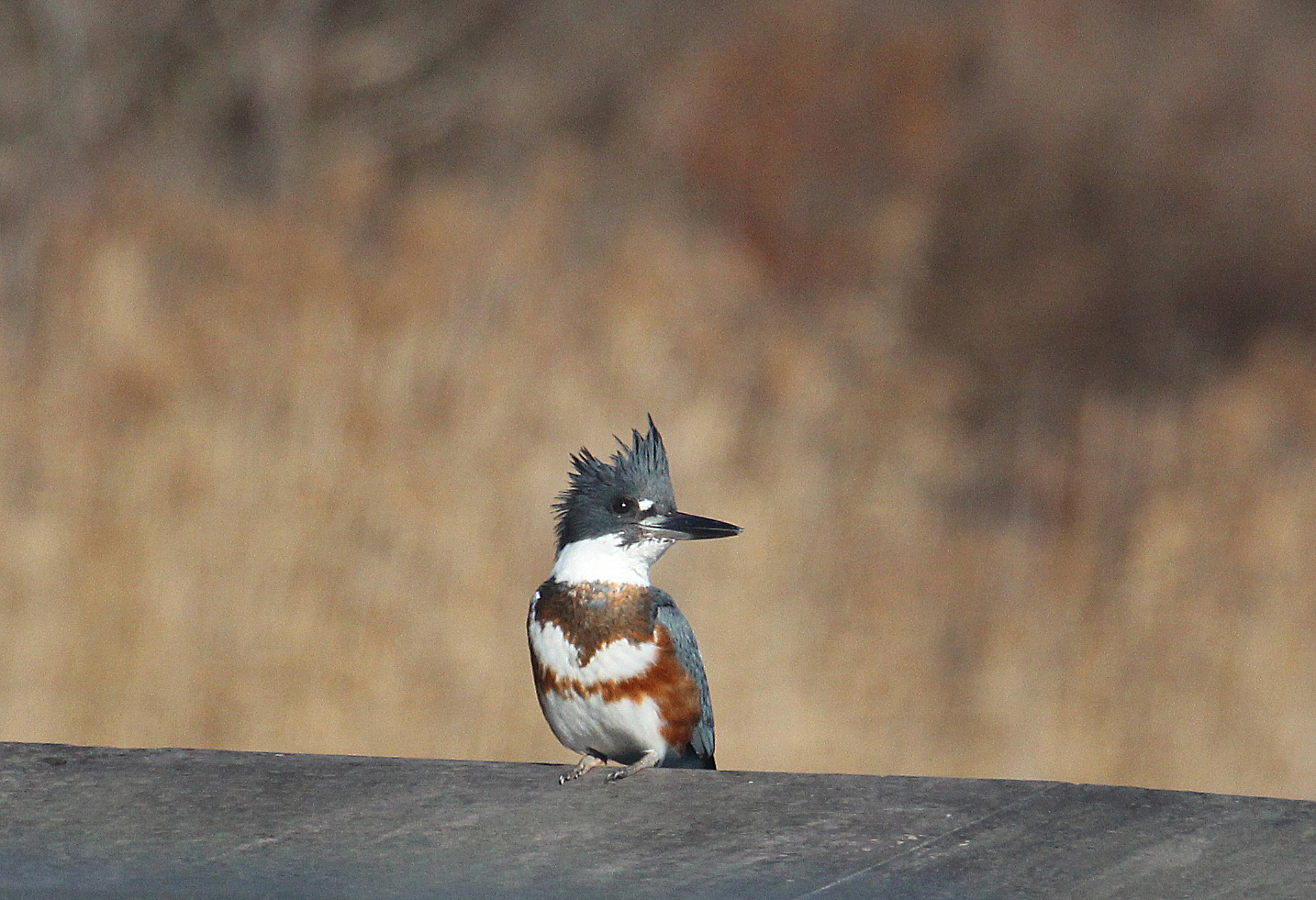
Hour photo/Chris Bosak A Belted Kingfisher seen near the Maritime Aquarium at Norwalk on Sunday during the annual Christmas Bird Count.
Photo by Chris Bosak – A Belted Kingfisher seen near the Maritime Aquarium at Norwalk on Sunday during the annual Christmas Bird Count.

What comes to mind when thinking of year-round birds in New England?

My guess is the first species that come to mind are songbirds such as black-capped chickadees, tufted titmice, or white-breasted nuthatches. The next birds that come to mind may be slightly larger, like woodpeckers, cardinals, blue jays, or mourning doves. Then it may eventually get to even larger birds such as red-tailed hawks, barred or great horned owls, mallards or turkey vultures.

Some people’s thoughts may veer off to less obvious year-round species such as eastern bluebirds and American robins, which many people may not realize are found in New England during the winter.

My bet would be that belted kingfisher would not immediately come to mind. It certainly would not have for me. I thought about that when I saw one the other day in a rather surprising place, and it reminded me that they are, indeed, year-round birds in New England.

I was walking to the cafeteria at work when I heard a familiar rattling call off to my right. Along the walkway, two consecutive small bridges span streams, one of which is small and often nothing more than a dried-up bed, and the other is a bit larger and flows meekly in dry times and mightily after heavy rains.

Continue reading

For the Birds: Phoebes shine in the spring and fall

Photo by Chris Bosak An Eastern Phoebe perches on a branch in Selleck's Woods in Darien, Conn., in late March 2015.

They aren’t the most exciting birds on the planet, or even in New England for that matter. Eastern phoebes, however, are a bright spot in the region’s birdscape.


They don’t have flashy colors, impressive size or beautiful songs — in fact, just the opposite on all counts — but there is a lot to appreciate about eastern phoebes. My favorite thing about eastern phoebes is that they are one of the first migrant birds to return to New England in the spring. While most of the colorful songbirds return in late April or early May, phoebes come back to the region in mid- to late-March.   

Their early spring arrival comes just in time for many birdwatchers. About the time we are going stir crazy and desperate for new birds to arrive following many months of winter, the phoebes return and lift our spirits. Typically, I hear the first phoebe before I see it, and it takes a few seconds for the song to sink in and register. Then, when it hits me, I look frantically for the bird and, upon laying eyes on it, get a jolt of hope that spring is indeed coming. 

Continue reading

For the Birds: Rain, rain go away – or not

The weather icons on my iPhone showed rain starting at 8 a.m. I figured that would give me about an hour of dry weather to look for some early spring migrating birds.

No such luck. The rain started even before sunrise so my hour of dry weather wasn’t going to happen. Instead of rolling over and going back to sleep (a very tempting option) or mindlessly scrolling through social media, I decided to head out into the rain anyway. OK, I did take a few minutes to do Wordle quickly before heading out.

The walk started in a light rain, and a lot of birds were out singing. Immediately, I heard robins, cardinals, blue jays, song sparrows and a field sparrow in the distance. Field sparrows have a very distinctive song that sounds like a ping-pong ball bouncing on a table with the time between bounces getting progressively shorter, just like a real ball would do.

As soon as I committed to a trail leading me farther into the woods, the rain picked up. It never turned into a downpour, but it was a good, steady rain. Thankfully, the temperature was a very manageable 55 degrees, so I just got wet instead of wet and cold. I like birdwatching in all types of weather, but a cold rain is probably the worst. Heavy wind is not much fun either, but I would take it over a cold rain.

Continue reading

For the Birds: Osprey comeback a great conservation story

Photo by Chrisi Bosak An Osprey flies over Veterans Park in Norwalk, Conn., April 29, 2015.

New England’s ospreys left the region weeks ago for warmer temperatures in the south. That doesn’t mean, however, that they are forgotten.

The return of the osprey from dangerously low numbers is another hugely successful conservation story. Last week, in honor of Thanksgiving, I talked about the turkey reintroduction and how wild turkey numbers went from zero to goodness knows how many in New Hampshire over just the last 50 years or so. Ospreys have a similar successful conservation story.

Ospreys were at critically low numbers in the 70s and slowly started making a comeback due to conservation efforts on many fronts. The osprey population is now to the point where it is safe to say it is wildly successful.

I recall working for a newspaper in southern Connecticut in the early 2000s, and a pair of ospreys building a nest on a light tower at a local beach was literally front-page news. Ospreys hadn’t nested in that city in several decades. Now that town, Norwalk, has several dozen osprey pairs nesting in it. A similar story can be told about osprey up and down the Connecticut coast along Long Island sound. Inland osprey numbers are thriving as well.

Continue reading

For the Birds: Readers take over

Photo by Chris Bosak A red-bellied woodpecker perches on a log.

You’ve heard from me; now find out what others are seeing out there.

Red-bellied woodpeckers continue to proliferate in southern New Hampshire. It wasn’t too many years ago that these large, handsome and sometimes aggressive birds were extremely rare sightings in the Granite State. Their northern expansion has been impressive and now they are seen with much greater frequency throughout the southern part of the state.

I wouldn’t say they are common sightings here yet, but they are getting there. They are now very common in Connecticut, Massachusetts and Rhode Island, so it stands to reason New Hampshire and Vermont are next.

In the last few weeks, I have heard from Monadnock Region residents Cindy and Richard who have each hosted red-bellied woodpeckers at their feeders recently. Cindy from Keene wrote that her bird visits every day. She wrote that the bird’s red head is “almost neon” when the sun hits it just right.

Continue reading

For the Birds: Loving those berries

Photo by Chris Bosak A song sparrow eats berries at Dolce Center in Norwalk, Conn.

I had just discovered a new berry tree at work and thought to myself how great it would be to see the birds raid the tree when the berries ripened.

At the time, the majority of the berries were red with a few purple ones mixed in. It wouldn’t be long now, I figured, before they were all purple and the birds would be feasting on them.

About a week later, I went back to check out the tree and it was practically picked clean. Apparently, the berries ripened quicker than I thought they would, and the birds wasted no time in having their feast.

I missed the flurry of activity that had the tree stripped clean, but I did see a lone gray catbird fly in and out to grab a few of the remaining berries. At least I wasn’t completely shut out of the show.

Continue reading