Photo by Chris Bosak
An immature Peregrine Falcon sits on prey at Veterans Park in Norwalk, CT, Dec. 2013.
Early and mid-summer can be a tricky time for birdwatchers. I know, I know. I say that about a lot of times of the year.
This is a tricky time in that many young birds are fledging, and they don’t always resemble an adult bird yet. When a young bird is found in the field, it is often difficult to determine what exactly it is.
Some young birds are fairly obvious. A young robin may not look exactly like an adult robin, but it is clearly a robin nonetheless. Many birds fall under that category. But there are other birds, such as young warblers and even some ducks and hawks, that do not yet resemble their parents and therefore require some study to figure out what they are.
It is always rewarding to see young birds at your feeder or birdbath. I’ve seen many cardinals over the years teaching their youngsters how to eat from feeders. Last summer, I had the pleasure of watching a bluebird family visit daily for an extended period eating mealworms I had left on the deck railing.
Photo by Chris Bosak
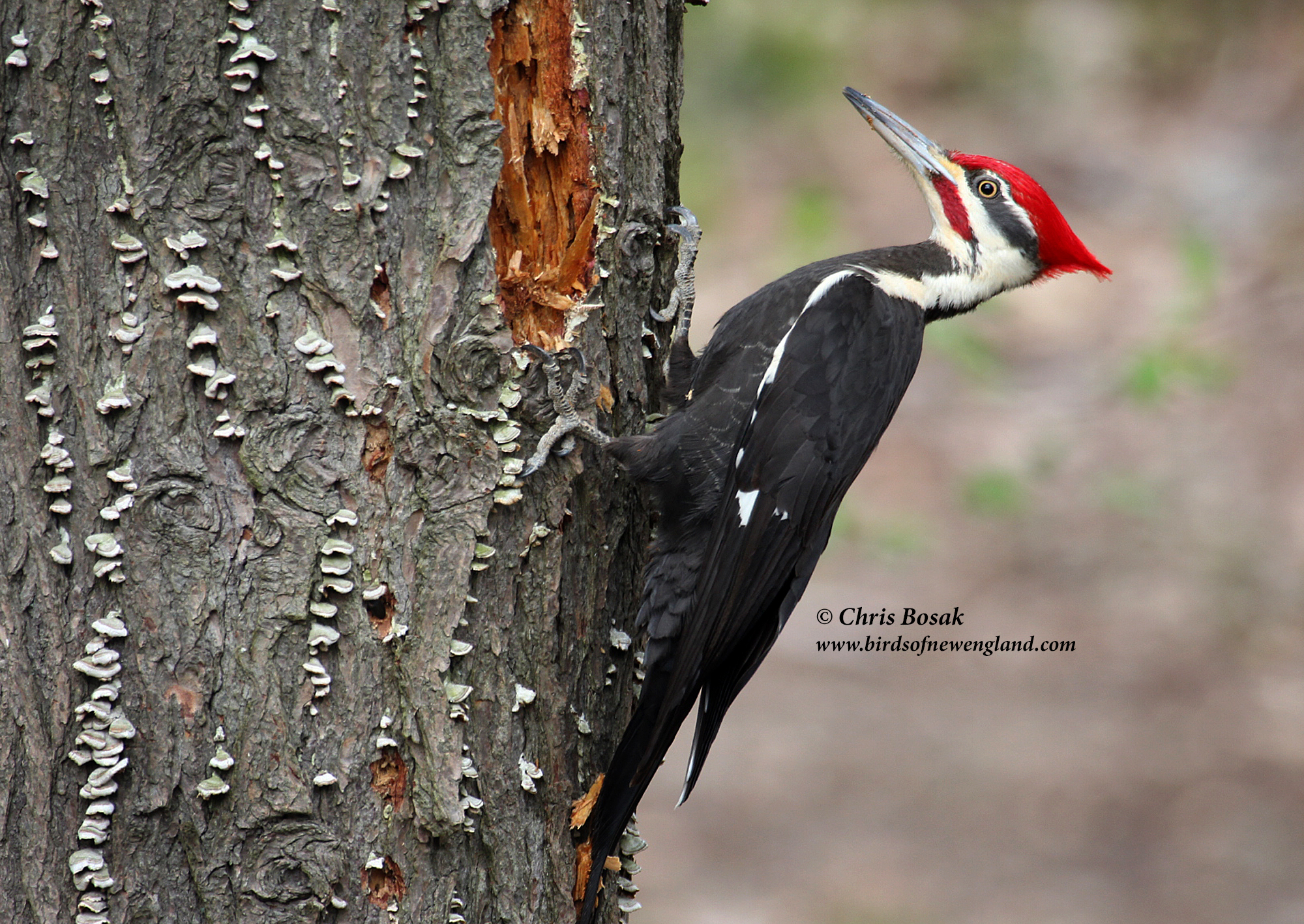
A pileated woodpecker works over a tree in New England, May 2020. Merganser Lake.
Every tree tells a story, even the dead ones. In fact, the dead ones may have the most interesting stories to tell.
A recent walk through the woods had me thinking about the trees. These particular woods were a mixture of evergreen and deciduous trees — predominantly deciduous but a few evergreens sprinkled in as well.
A large ash tree was snapped about 12 feet from the ground. The otherwise healthy-looking trunk stood tall and straight, while the rest of the tree bent down into the forest at a 45-degree angle.
I’m pretty sure I know what happened to the tree. A severe wind storm, with spotty tornado touch downs, blew through the area last summer and reduced many trees to tall trunks. It’s funny how storms impact trees differently. Some storms uproot most of the trees they damage. Other storms snap them like twigs. Still other storms, it seems, hardly damage the trees at all.
Photo by Chris Bosak
An eastern towhee seen in Ridgefield, CT, summer 2019.
June may not have the buildup and excitement of May, but it is still an interesting time in the birding and natural world.
By the time June comes around, the swarms of migrating birds have dissipated, having either gone farther north or settled into their breeding territories. June also follows May, which I would argue is the most exciting month for birding in New England. I wouldn’t say June is a letdown, but it lacks the anticipation that May has going for it. May, after all, follows months and months of cold, gray weather. May’s songbird migration is like a reward for enduring winter and early spring.
Early June does have the odd migrant still working its way north, which is nice to see. For the most part, however, the migration is over.
June is a time to recognize, appreciate and take pride in the birds that are breeding in the area. There’s something special in knowing that birds are raising young nearby. The other day, I took a walk and saw or heard eastern towhees (pictured above), yellow warblers, blue-winged warblers, common yellowthroats, indigo buntings, rose-breasted grosbeaks, bobolinks, catbirds, veeries and hermit thrushes. Those are nice sightings regardless of the circumstances, but it was particularly rewarding knowing they are breeding locally. I hope they all have a successful breeding season.
The birds, for the most part, were still fairly vocal. I heard all of the aforementioned birds singing. Finding them proved to be a touch more difficult than in May. In May, birds are still searching for or defending territory and are easy to spot. In June, more birds are hunkered down for fear of giving away their nesting site. The colorful males often jump out to grab attention while the more subtly plumaged females remain on the nest camouflaged from predators.
June also means more insects, which is good and bad. It was nice to see a few butterflies flitting among the early-blooming flowers in the meadow, but the deer flies attacking the back of my neck were not something I was quite ready for. Oh well, it’s all part of living in New England.
As the insects gain steam, the birding action will slow down over the next couple of weeks as they hang low raising young. Morning and evening are always the best times to look for birds, but this will become even truer in July and August as the heat and humidity will keep the birds in the shade during the day. Steamy August afternoons are my favorite times to wander through New England meadows looking for butterflies, dragonflies and whatever other creatures lurk in the tall grasses and flowers.
In the meantime, enjoy June and what it offers birdwatchers. There’s still plenty of action out there.
Photo by Chris Bosak
An American Redstart sings from a perch in Selleck’s and Dunlap Woods in Darien, Conn., May 2015.
Any walk through deciduous woods when the leaves are out drives home the importance of knowing what birds sound like. It can be a lesson in futility to try to find a tiny warbler at the top of a giant oak tree covered in leaves. The exercise can lead to frustration and a condition known as “warbler neck.”
My birding-by-ear skills are average at best, and I was reminded of this during a recent walk through the woods under a thick canopy. I heard several warblers and other birds, and, while I saw only a few, I was able to recognize the songs of several others. There were many birds, however, I could not find through my binoculars nor recognize by their songs or calls. As I mentioned before, it can be frustrating, but I have reached an age where I can let go of the frustration quickly and not dwell on the bird that got away. In years past, I would often hold onto the frustration long after the walk, which, after all, is supposed to be enjoyable.
Birds don’t always look exactly like they do in a field guide, whether the images are photos or illustrations. There are different plumages depending on time of year, age, sex and other factors. There is also slight variation among individuals of a species. Not every male robin looks exactly the same.
That said, birds don’t always sound exactly like they are supposed to either. A bird’s song is only one of the sounds they make and even their songs can vary greatly. Cardinals, for instance, have distinctive high-pitched call notes. They also have a distinctive song, but there are several versions of the song. The cardinal in your forsythia may have a song that is greatly different from the cardinal across the street. All of the songs are loud, clear and beautiful, but very different. Don’t get stuck thinking that the cardinal song you hear every day is the only one cardinals have. Many other birds are the same way as well.
My advice if you are just starting to learn bird sounds is to learn the common and obvious ones really well. Study what the robin sounds like. Their typical song is often translated to “cheerily, cheer up, cheer up, cheerily, cheer up.” But there is much variation in the song, and they have several calls as well, such as the “tut, tut, tut,” call.
Robins are very common in New England, so if you learn the sounds of the robin, you can save yourself much frustration on your walks by not getting hung up on a bird you will likely come across several times.
Get to know the various calls and songs of blue jays, cardinals, nuthatches, chickadees and titmice. You will hear those often throughout the year, and you can eliminate other birds in the spring when you hear those sounds during a song-filled spring morning.
Warblers and other migrants are a different story. We do not hear them year-round, but rather for only a few weeks out of the year. That is a short window to try to learn those songs in the field. Birding Internet sites and phone apps are filled with recordings of bird songs and calls. I would encourage you to learn a few warbler songs each year so as to not try to pack too much information in your head and end up not remembering anything. Learn the yellow warbler and common yellowthroat, for instance, as those are commonly heard in the spring and summer throughout New England.
Warblers are difficult to learn because there are so many of them and many of their songs are similar to each other’s. But, as I said, learn a few a year and within a couple of years you will be picking out many of the songs you hear in the woods in April and May. And if you just can’t pick it up, don’t fret or stress. Study a little more, and get it next time.
Photo by Chris Bosak
A yellow warbler perches in a tree in New England, spring 2021.
It was the type of walk you anticipate for about 11 months.
It started fairly slowly with robins and red-winged blackbirds as my only visible avian companions while a lone song sparrow sang in the distance. Soon enough, I heard a mockingbird going through its repertoire from a nearby shrubby patch. They usually belt out their songs from a fairly obvious perch and this guy was no different as I found him easily at the end of a branch.
As I watched and listened to this talented songster, a female ruby-throated hummingbird entered the scene. It hovered briefly at the honeysuckle but did not stay long as the blossoms were not quite ready to provide nectar.
A familiar song then permeated the area as dueling male yellow warblers proclaimed ownership of their respective patches. I was stuck in the middle of the rivals and enjoyed the sweet music. To us, it’s entertainment. To them, it’s a turf war with much at stake.
Photo by Chris Bosak
A cedar waxwing perches on a branch in New England, spring 2021.
I had hobbled almost all the way from the car to the entrance of work when I noticed a flock of cedar waxwings picking off leftover berries in a nearby tree.
Even with the persistent tendinitis in my feet acting up, I made my way back to the car to grab the camera. Usually, in situations like this the camera is sitting at home, but this time I was prepared for the unexpected. Cedar waxwings, in my experience anyway, are always unexpected. They are fairly nomadic, and it’s hard to go out looking specifically for them. But they appear now and then and it’s always a thrill to see them.
I retrieved the camera and hobbled back through the parking lot to the tree in question. Of course, the tree was empty when I got back as the waxwings had taken off for parts unknown.
Photo by Chris Bosak
A red-shouldered hawk perches in the wood in Brookfield, CT, March 2019.
I’ve seen a few reports of pine warblers showing up in New England already. The thick of warbler season is still weeks away, however, so let’s put warblers on the back burner for now.
Phoebe reports are bursting all over the region. Those small, rather nondescript songbirds are an early spring migrant and get a head start on the competition by their early arrival. The risk, of course, is that winter lingers into spring in New England, and phoebes have a hard time coping with the weather. It’s all about risk-reward strategy when it comes to migration for birds.
Photo by Chris Bosak
A bobcat rests in a field in New England, March 2021. (Huntington State Park)
The large field is bordered by hedgerows on three sides and woods on the fourth. Additional hedgerows divide the field perpendicularly about every 100 yards with small cutouts where the trails pass through.
I emerged from the woods and spotted something large walking along the east hedgerow about 40 yards away from the trail. It was tan, but then again so was everything else around it: the grass, the weeds, the hedgerow. I stopped in my tracks to watch it.
Before my brain fully comprehended the situation, I thought it was either a deer or a mountain lion. I quickly eliminated deer as it was clearly a large cat based on its smooth, stealthy and powerful stride. Can I finally put the mountain lion (or cougar or catamount) debate to rest with solid photos documenting the sighting?
Photo by Chris Bosak A northern cardinal perches on a hemlock branch in Danbury.
March is an interesting month for birdwatching. In terms of variety and new birds to be found, it does not rank very highly, but March does welcome our first spring migrants.
Red-winged blackbirds have been around for a few weeks already, and in fact, some had never left and remained with us throughout the winter. American Woodcock have been seen and heard throughout New England already. Their aerial displays at dusk are one of the month’s birding highlights for sure.
In a few weeks, eastern phoebes will show up in New England and for me anyway, that really signals the beginning of spring migration.
In March, we also have our remaining winter birds. Juncos and white-throated sparrows are still around my feeders, and a few red-breasted nuthatches are Continue reading →
Photo by Chris Bosak
Common Redpolls, Cove Island, Stamford, Ct. Jan. 19, 2013
Here’s a For the Birds column I wrote several weeks ago and neglected to post here for whatever reason. The content is still relevant …
…
Now the reports of redpolls are coming in.
It has been a winter full of rare-bird alerts where the sightings are coming in from the woods as well as people’s backyards. People have been reporting red-breasted nuthatches and evening grosbeaks at their feeders for a few months already. There have also been reports of pine siskins, but not in the great numbers of the big-irruption winters for that bird.
In the woods and fields, and mountains for that matter, pine grosbeaks, white-winged crossbills and red-winged crossbills have been showing up on reports. Boreal chickadees, long a target bird for life-listers south of the Boreal forest, have been found on the mountaintops of the Monadnock Region.
The exceptional winter continues with sightings of redpolls occurring throughout New England. I have heard from a few readers who have seen these small northern birds and have reported them with rightful delight. There are two types of redpolls that occur in New England: common and hoary. Common, as its name suggests, are the ones more frequently seen in New England. Redpolls somewhat resemble sparrows in size and color but have a red-topped head, black spot under the bill and rosy wash throughout that is more obvious in some individuals than in others.
Sarah from Sandwich last week reported having more than 20 redpolls at a time at her Droll Yankee feeders. Some of the redpolls preferred to grab the seeds from the ground, she wrote. Amy from Harrisville also wrote in to say she has had a lone female redpoll at her feeders.
I had dubbed last year’s cold months as the winter of the bluebird because so many people (including myself) were reporting sightings of these cheerful birds in their yards. The year before that it was the winter of the barred owl as those awesome birds of prey were being found in unusually high numbers. I have dubbed other winters in honor of snowy owls and robins.
Perhaps this is the winter of the rarity with so many different rare birds being found throughout the region. I’m using “rare” in a general sense as these birds are not particularly rare in their normal range, but they are somewhat rare sightings throughout New England. Winter typically features an irruption of a species or two, but not always this many. I can’t remember a winter with so many sightings of siskins, redpolls, red-breasted nuthatches and grosbeaks. This winter (really late fall) also featured a flight of purple finches moving sough through the region.
This could all make for some interesting notations on Great Backyard Bird Count and N.H. Winter Bird Survey checklists. I hope you got out and participated over the weekend. I look forward to seeing the results when they are available. In the meantime, keep your eyes open on your feeders and during your walks in the woods. There is still plenty of winter left, so no one knows what might show up next.



 Birds of New England.com