Photo by Chris Bosak
A red-winged blackbird sings from the top of a tree at Happy Landings in Brookfield, Conn., spring 2017.
March is a crazy and unpredictable month for wildlife watching.
One day you’re completely absorbed by winter. You bundle up, head outdoors and see all the nature that our coldest months have to offer.
The next day it appears as if spring has the upper hand. The winter birds seem to have disappeared and early migrants, such as red-winged blackbirds and eastern phoebes, fill the warm air with breeding and territorial songs. In the evening, the chorus of spring peepers dominates the airwaves.
In recent years, I have proclaimed our coldest season as the Winter of … whatever bird is being seen in unusually high numbers that winter. I remember the Winter of the Snowy Owl in 2014 and the Winter of the Barred Owl in 2019 (that winter was crazy with all the owls being seen throughout New England.) Juncos and robins have also made the list.
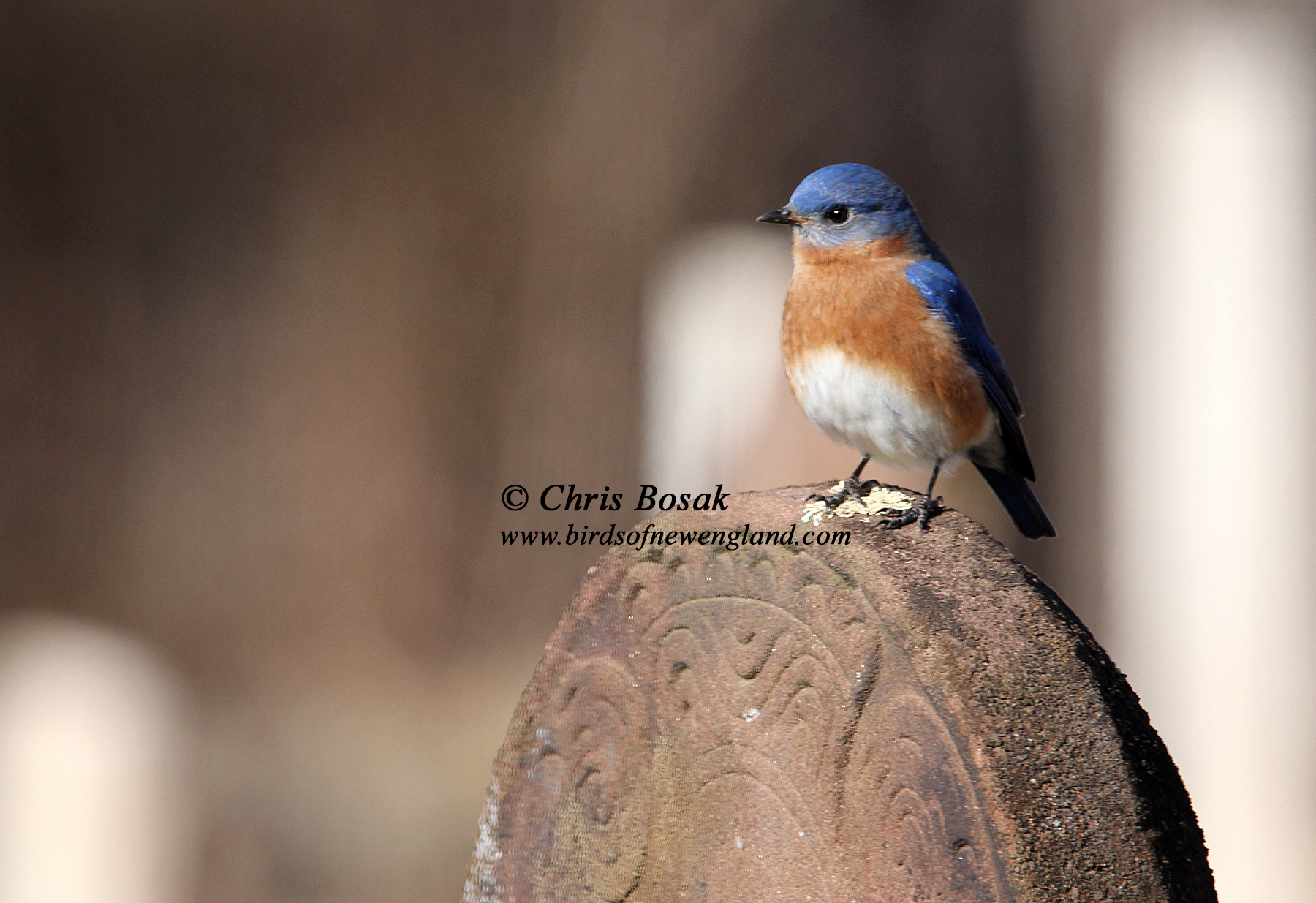
But this year, for the second time in three years, it has to be the Winter of the Bluebird. It is the first repeat selection. I should probably mention here that this is strictly my own proclamation based on my personal experiences and emails received from readers. There is absolutely nothing scientific about this.
I’ve seen bluebirds in a variety of locations this winter. I haven’t been lucky enough to attract them to my house, but I have received several emails from readers who have seen bluebirds in their yards. Many readers have sent along photos, which I appreciate and post to my blog.
Photo by Chris Bosak
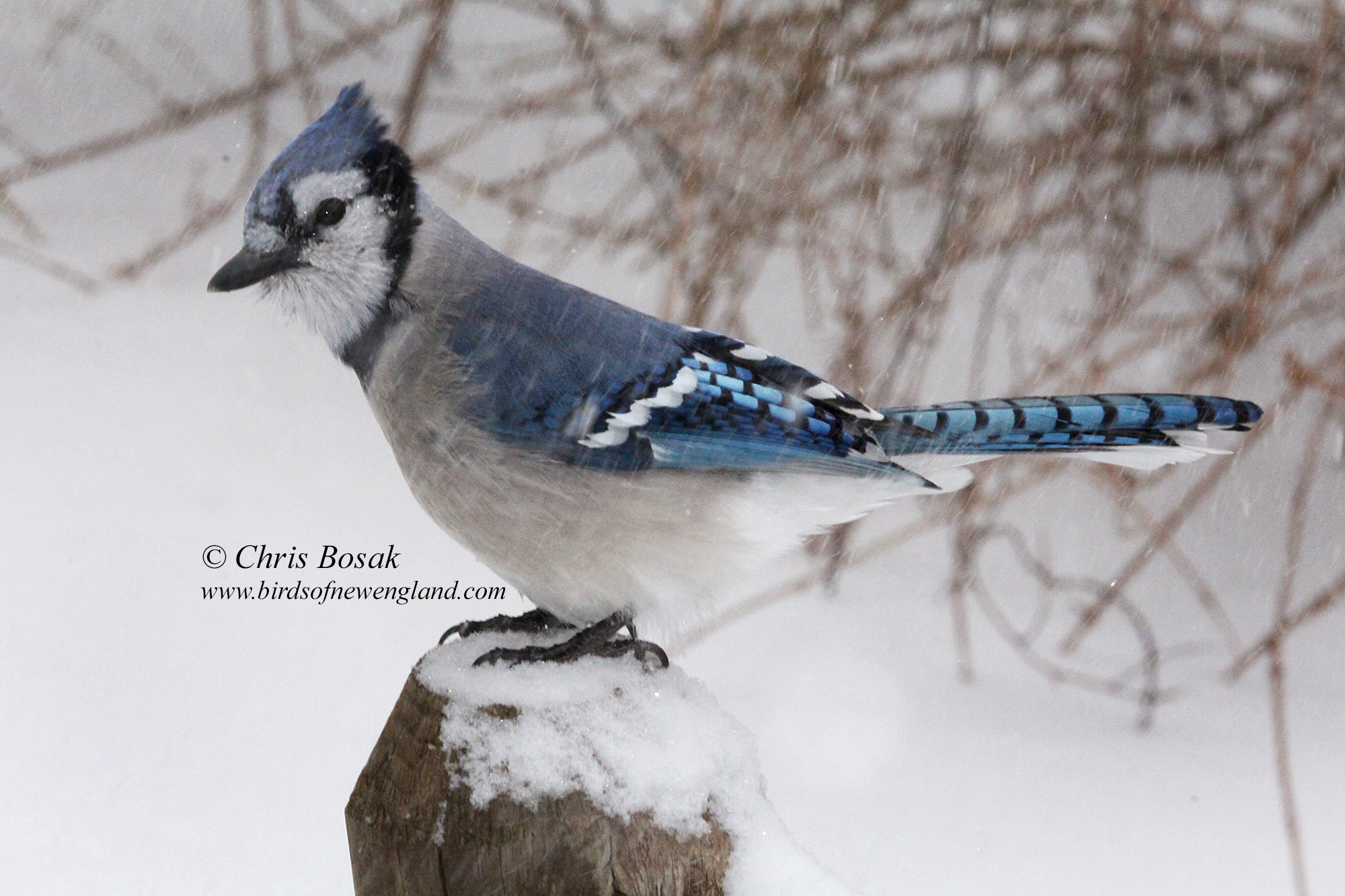
A blue jay stands on a fence post during a snowstorm in New England, Jan. 2022.
The reports keep coming in, so why not dedicate another column to what our neighbors are seeing in their yards?
Eric from Surry wrote to say he can’t keep up with the goldfinches and pine siskins and their appetites for thistle (Nyjer) seed. He said it’s been a while since goldfinches have visited his yard in large numbers, but this winter has been different.
Eric also has a few Carolina wrens that have been around all winter, while juncos have been around in large numbers. The juncos, as well as a handful of cardinals visit early, so Eric has to make sure the feeders are filled before dawn. Now that’s dedication to the birds and this great hobby. He also gets the usual woodpeckers in addition to red-bellied woodpeckers and yellow-bellied sapsuckers.
Photo by Chris Bosak
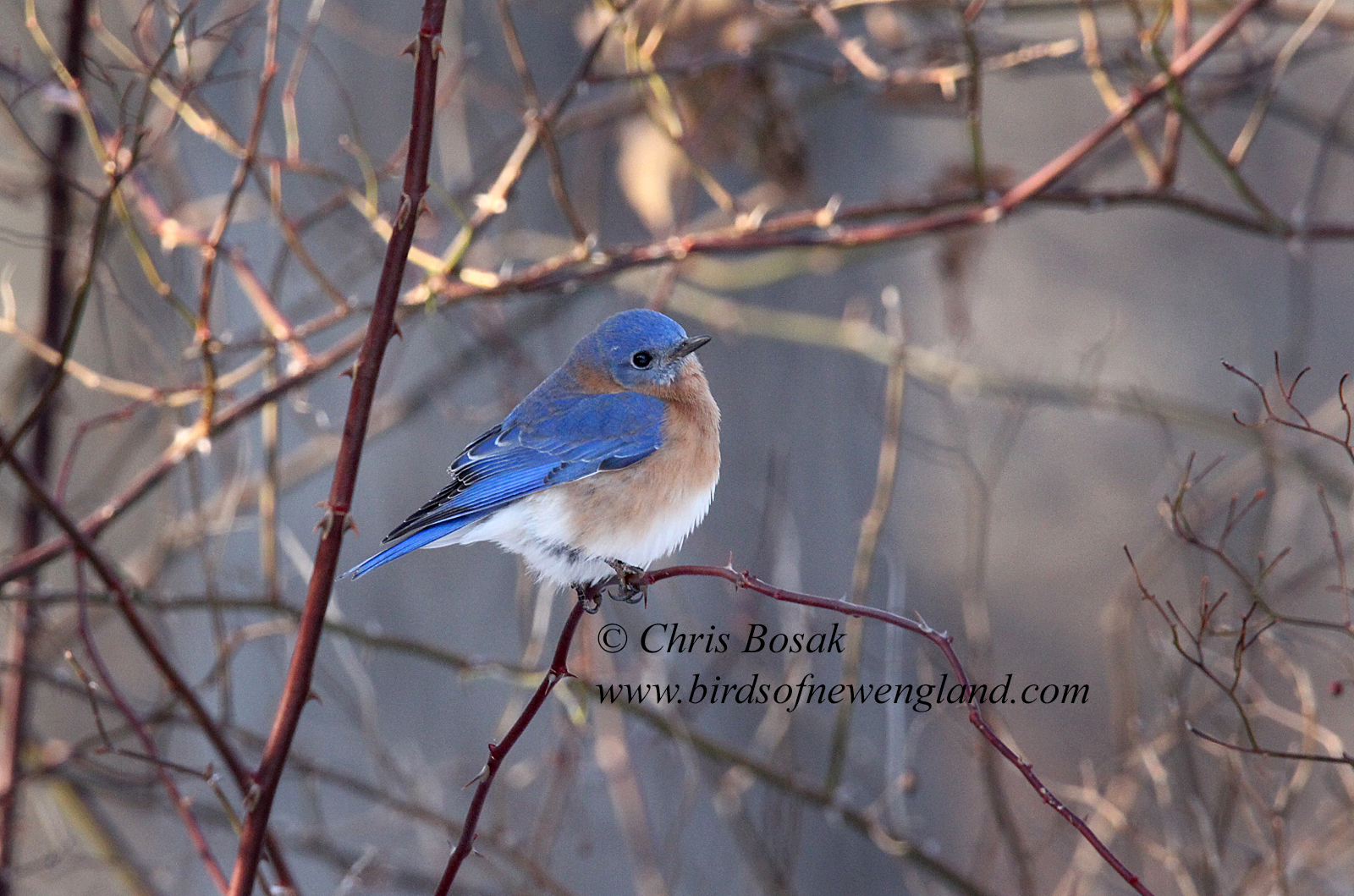
An eastern bluebird perches on a branch in New England, Jan. 2022.
My foot was finally feeling a little better so I figured I’d try a short bird walk. Turns out, it wasn’t ready for prime time. I walked a few hundred yards on the uneven snowy terrain and had to turn back.
The little I did manage to walk was along a wood’s edge with good, thick brush forming a barrier, perfect for birds to hide in. A lone white-throated sparrow and a lone tree sparrow were the only birds I saw, however. There was also a male cardinal, but he never left his protected spot among the bramble and I could spy only specks of red.
On my way back, I noticed a white-breasted nuthatch and a woodpecker in a big tree beyond the truck. I figured it was worth a closer look because I had seen a yellow-bellied sapsucker in that very tree some time ago. It turned out to be a downy woodpecker, and it had flown off to a more distant tree by the time I hobbled over there anyway.
Not all was lost, though, as the detour led me to a small flock of eastern bluebirds. Some were perched in the low branches of a nearby tree, and some were in the brush picking at berries of some sort.
Photo by Chris Bosak
Ring-billed gulls at a beach in New England.
Gulls? Who would want to write a column about gulls? Or, perhaps more importantly, who would want to read a column about gulls?
Well, I think gulls deserve a little ink considering how easy they are to find and how many of them there are. Nary a visit to any body of water goes by when you don’t see gulls, whether you want to or not. Not many parking lot visits go gull-less either.
Photo by Chris Bosak
A bobcat rests in a field in New England, March 2021. (Huntington State Park)
It’s time for my favorite column of the year; a look back at my top 10 birding highlights from the previous year.
For all its faults, 2021 was a pretty good year for birdwatching. One thing that is not on this list for the first time in nearly 20 years is the Christmas Bird Count. I look forward to the all-day event for months leading up to it, but I had to bail on my birding partner Frank this year. An as-of-yet undiagnosed foot ailment that comes and goes was acting up, so I had to sit out this year’s CBC. Bummer.
But the year did include several highlights. Here are the top 10:
10. Crossbills. A sizable flock of red crossbills entertained New England birdwatchers at a Connecticut beach in March. They flew from spruce to spruce and the birder paparazzi followed their every move. Crossbills are unique in that their upper and lower bills cross rather than meet uniformly. The adaptation helps them get at seeds in spruce cones. Read story here.
9. Loons. If I see loons in any given year, it will make this list. I was camping with Katie at Woodford State Park in Vermont and I was hopeful but not optimistic that we’d see loons. Sure enough, despite the campground being fully booked, a pair of loons swam at the far end of the lake.
8. Feeder birds. My new home is not the birding paradise that my old place in the woods was, but a fair number of birds visit. I get most of the usual suspects, but the highlight was a small number of red-breasted nuthatches that came regularly last winter. Read story here.
7. Fall warblers. Birding in the fall can be tricky with the songbirds passing through in their non-breeding plumage. Warblers can be particularly tricky. But this fall, I had a few walks whereby palm warblers and yellow-rumped warblers (two that are relatively easy to recognize in the fall) were very numerous. It was like a little flashback to spring ahead of the long winter. Read story here.
6. Clapper rail. Katie and I walked along a marsh in the spring and heard the unmistakable call of a clapper rail. We looked at an opening in the marsh and the unusual bird ran across the mudflat and disappeared into the tall marsh grasses.
5. No owl, but buntings. I walked the length of a Connecticut beach where a snowy owl had been being seen reliably for quite some time. I came up empty on the owl, but did enjoy the snow buntings and larks that were there. Read story here.
4. Cooperative indigo bunting. Indigo buntings are a thrill to see regardless of the circumstances. One August afternoon, I came across a brilliant male indigo bunting singing from an obvious perch close to the trail. Bird photography should always be so simple. Read story here.
3. Road eagle. Anyone who drives to work knows the daily commute can get rather monotonous. One morning, as I passed a swollen part of a creek where wood ducks occasionally swim, I noticed a large bird perched on a snag over the water. It was an immature bald eagle either resting or looking for prey in or around the water. A break from the norm, for sure. Read story here.
2. Continuing For the Birds. I have written my For the Birds column for well over 20 years now. I enjoy writing it as much, if not more, than people enjoy reading it. I love hearing from long-time readers as well as new readers. A lot has changed in the world over the past 20-plus years, but New England’s passion for nature has only gotten stronger.
1. Bobcat! Without question, this was the nature highlight of the year. I spotted the bobcat from afar in a field and walked in its direction. It kept walking and going about its day. When it stopped and sat in the field, I stopped and grabbed a few shots with the camera. Then I slowly walked backward away from the impressive animal. Read story here.
I can’t wait to see what 2022 brings. In many ways, it’s off to a poor start, but let’s remain positive and create some great nature highlights. Drop me a line and let me know your highlights.
Photo by Chris Bosak
A blackpoll warbler eats berries in New England, November 2021.
Birdwatching can be as easy or as difficult as you want to make it. I’ve said it before, but that is one of the things I like most about the hobby.
If you are content being able to identify a handful of birds, then that’s fine as long as you enjoy it. If you can’t sleep unless you know the species, age and sex of every bird you see, then that’s fine as well.
Most of us, including myself, fall somewhere in the middle. The middle, of course, is a pretty vast area. Knowing a robin, blue jay, cardinal and a few other species is in one area of the middle. Knowing your sparrows, shorebirds, gulls and ducks falls in another area of the middle.
People like large birds. Eagles, hawks, owls, even herons and waterfowl, get birders and non-birders alike excited.
Smaller birds? Sure, birders get excited about smaller birds too, but for non-birders, these birds have to bring something appealing to the table.
Everyone likes cardinals. They’re bright red. Everyone likes chickadees. They’re cute, tame and active. Non-birders are split on blue jays. Some like them because they are blue (and fairly large), and some dislike them because they heard jays are bully birds and they can’t let it go.
In fact, many smaller birds go completely unnoticed by non-birders, even when the birds make their presence rather obvious. A flock of white-throated sparrows or dark-eyed juncos can dart in every direction right in front of a non-birder and it will be as if nothing ever happened. A birder, however, will stop dead in his or her tracks, reach for the binoculars and try to find the little birds in the brush just to confirm an ID.
Photo by Chris Bosak
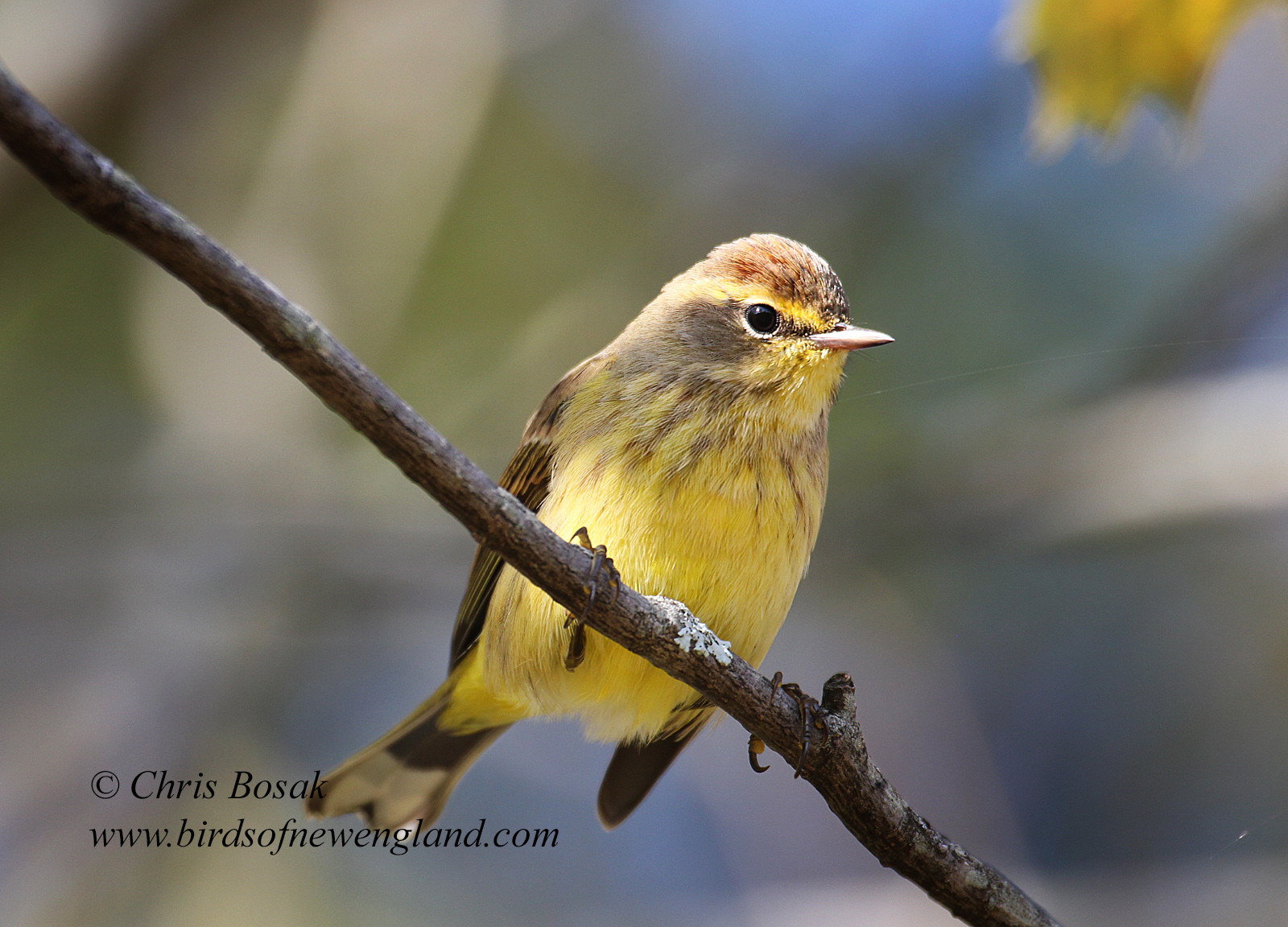
A palm warbler perches in New England, October 2021.
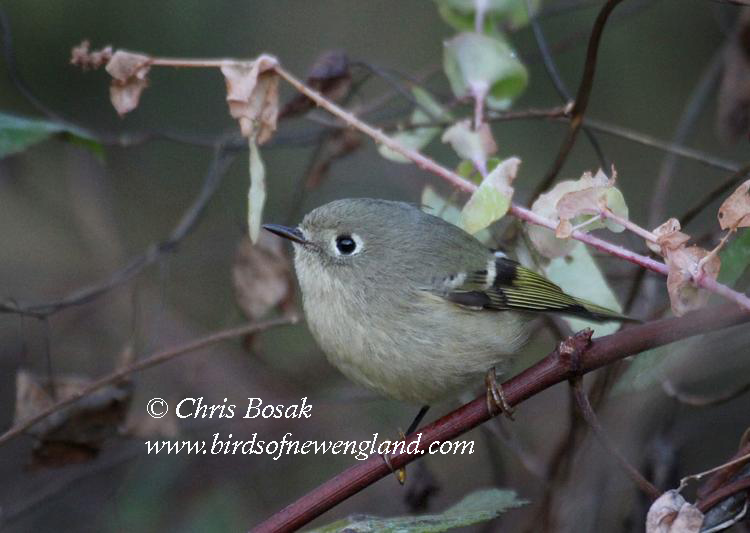
A pair of ruby-crowned kinglets flitted among the brush, and a crow or two flew overhead. That was all the bird action on the early part of the walk.
Then I heard a commotion coming from a nearby tree. It was a huge, dead maple tree with no leaves on its branches, but various types of vines climbed up its trunk and spread out among the limbs. The vines still had their leaves, making the tree look like nature had splattered various shades of red, yellow, orange and green on the venerable old guard.
Something must have been lurking among the brush because the birds were on high alert. I’ve never seen a more varied collection of bird species in one tree before. I could hardly believe it as I counted out the species in my head.
Photo by Chris Bosak
A yellow-rumped warbler eats poison ivy berries in New England, fall 2021.
Any birdwatcher knows that patience and faith are perhaps the two most important components to a successful bird walk.
I started a recent walk with high hopes, as I always do, but as the morning went on and no birds were to be found, I started to lose hope of seeing anything. To compound matters, the field at the park had recently been mowed for the first time of the year, making bird encounters even less likely.
It still would have been a pleasant walk because the autumn morning chill had given way to a beautiful and warm sunny day. But with fall migration in full swing, I was disappointed in the birding results.