Here is the latest in a series of close-up (macro) photographs I took last summer while tromping through the meadow properties of the Darien Land Trust. From July 24 to Aug. 31, I’ll post a different close-up meadow photograph on this site.
My most recent For the Birds column explains a local adventure I undertook last summer photographing in macro mode the many meadows of the Darien Land Trust. From now until the end of August I will post daily one of the photographs from that close-up adventure.
Photo by Chris Bosak A Song Sparrow seen in Selleck’s/Dunlap Woods in Darien, Conn., March 2014.
When we think of sparrows, the word “colorful” likely does not come to mind. In fact, many people refer to them collectively simply as LBJs (little brown jobs).
But if you look closely enough, a world of beauty can be found in the plumage of sparrows. We see Song Sparrows almost every day and, indeed, from a distance they do look like a boring old brown bird. When the light catches that plumage, though, an endless variety of browns and tans come together to make a striking bird. Sure, browns and tans are not necessarily colorful in the obvious sense (reds, blues, purples) but it’s a more subtle beauty.
So subtle in fact that it often takes time to appreciate. When I had artist Catherine Hamilton on my Birds Calls Radio program a few years ago, she talked about how much she liked to work with sparrows. The answer surprised me because I was expecting her to say a more colorful bird such as a cardinal or Wood Duck. I understood where she was coming from, but wasn’t completely sold on the whole beautiful sparrow thing. Then, somewhere along the line, I started to look more closely at the sparrow photographs I took. Sure enough, I discovered what Catherine was talking about. The brown birds are not simply brown. You can’t grad a brown crayon from a box and color in a sparrow. You would need fist fulls of different browns and need to change crayons frequently to capture the true essence of a sparrow.
Also, when we think of sparrows the House Sparrow is often the first one that comes to mind. House Sparrows have a beauty of their own (I guess), but I’m referring more to the native New England sparrows such as Song Sparrow, Tree Sparrow, Chipping Sparrow, White-throated Sparrow, Savannah Sparrow, Fox Sparrow, and Swamp Sparrow.
Despite my relatively new appreciation for sparrows I still have to catch myself. I still sometimes see a sparrow and immediately gloss over it and look for the next bird. Then I quickly come back to the sparrow and appreciate its subtle markings. I’m always glad I did.
So what’s your favorite sparrow of those listed below? I know “I like them all” would be most people’s answer, so I’m not even going to include that in the options. Take a stand for your favorite sparrow.
Photo by Chris Bosak A baby mallard stays dry during a rainfall by huddling under its mother’s wing.
Here’s one of my favorite Mallard shots. The chick with its head sticking out was one of several tucked under the mother’s wing during a light rain. Even common subjects such as Mallards have their photographic moments. Happy Easter weekend from http://www.birdsofnewengland.com
Photo by Chris Bosak Greater Scaup in Norwalk Harbor, late March 2014.
April, for me anyway, is a bittersweet month for birdwatching. I love watching ducks, so the period from when the “winter ducks” arrive in fall to the time they depart in the spring is perhaps my favorite time of year for birdwatching. Well, that time in spring is approaching. The ducks _ other than mallards and a few others _ will soon depart southern New England for their breeding grounds up north.
The flip side of that, of course, is that the songbirds, shorebirds, birds of prey and other spring migrants will be here soon (if they haven’t arrived already.)
I’ve been seeing fewer and fewer ducks at my normal haunting grounds over the last week or so. Remember my post last week when a Redhead shared a pond with Hooded Mergansers, Ring-necked Ducks and Wood Ducks? Well, that pond is now vacant. No winter ducks or any other ducks for that matter. I’m sure the mallards and hopefully some Wood Ducks will return. But the other ducks will likely not be seen there for another seven or eight months.
Long Island Sound and its harbors are slowing down, too, but not shutting down. I saw a few Long-tailed Ducks, Bufflehead, Red-breasted Mergansers and Greater Scaup on a recent visit to Norwalk Harbor _ but not in the numbers that I saw them just a few weeks ago. In a few more weeks, only a few straglers will be left _ until next fall, that is.
Photo by Chris Bosak Ring-necked Duck in Darien, March 2014.
It took years for me to start calling this duck by it’s proper name: Ring-necked Duck. I would invariably blurt out “Look, Ring-billed Duck.” But, unlike the Ring-billed Gull, this bird is not named for an obvious ring around its bill.
Instead it is named after a hardly-noticeable ring around its neck. Conditions, including the posture of the duck, need to be right to even see the neck ring. The ring around the bill, however, is obvious in most conditions, unless the duck is sleeping with its bill tucked into its back feathers. Even the female, which is mostly brown in color, has a ring around her bill. (She also has a faint ring around her neck.)
So why Ring-necked Duck? Ornithologists in the 1800s named many birds by studying dead specimens. Apparently with the bird so close the chestnut colored neck band is more obvious, so it was named as such. It doesn’t make a lot of sense to the average birder (like me) in the field, but it is what it is. The above photo shows both the ringed neck and ringed bill of the beautiful duck.
Ring-necked Ducks are seen throughout New England, mostly in fresh-water ponds and lakes, from late fall through early spring.
Photo by Chris Bosak A pair of Ring-necked Ducks rest at a pond in Darien, March 2014.
Photo by Chris Bosak Redhead seen in Darien pond in March 2014.
I drove past the pond at first, assuming nothing of note would be there. But that nagging voice in the back of my head said: “Go back and check. It’ll take five minutes and you’re right here anyway.” I listened to that voice, as I usually do, and it paid off, as it often does.
Photo by Chris Bosak A Redhead swims at a pond in Darien in March 2014.
The pond at Spring Grove Cemetery in Darien is small but often fairly productive. It’s a good place to see Wood Ducks in the fall and spring. Hooded Mergansers are frequent visitors in winter when the water isn’t frozen over. Ring-necked Ducks are occasional visitors. And, of course, Canada Geese and Mallards are usually there.
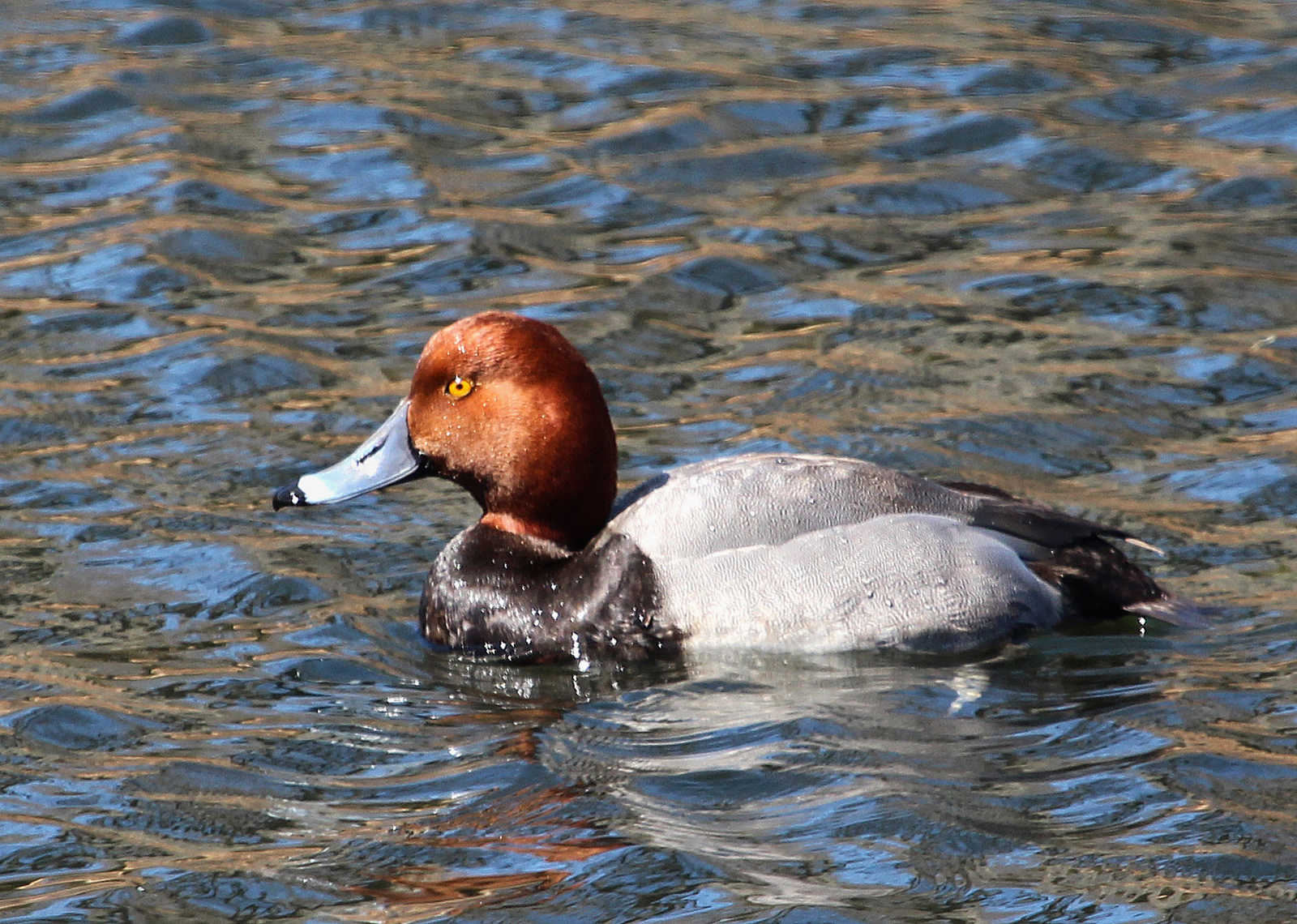
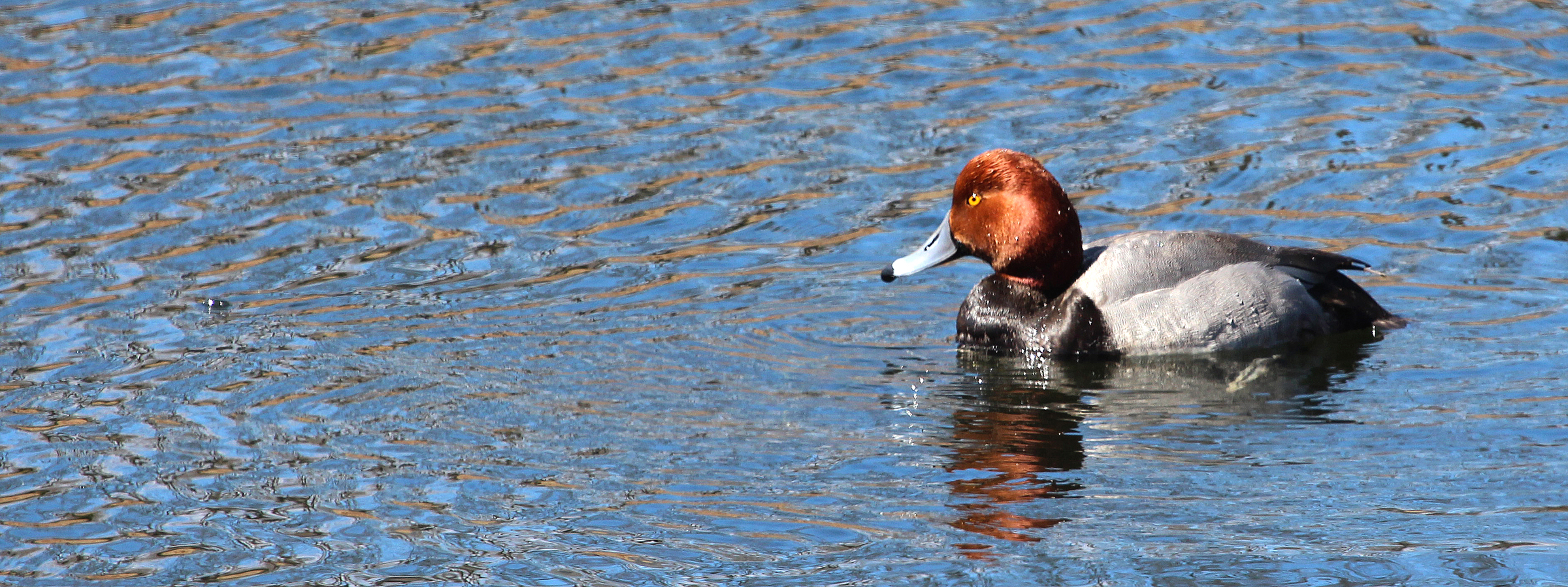
But one day this week, not only were Hooded Mergansers, Wood Ducks and Ring-necked Ducks all there, but a surprise visitor was there as well. Redheads are a beautiful medium-sized duck that are seen occasionally in New England. I’ve seen massive flocks of them in the Midwest, but only a handful of times have I seen them in New England. They are seen sometimes within huge flocks of scaup. But I’ve never seen one in New England at a pond as small as this one. It was interesting to see it among the mergansers and ring-neckeds.
This is a male Redhead. The female is much duller in color, mostly tannish brown.
In a post later this week I’ll let you know how the Redhead seemed to get along with the other ducks in the small pond.
Photo by Chris Bosak A Redhead seen in Darien in March 2014.
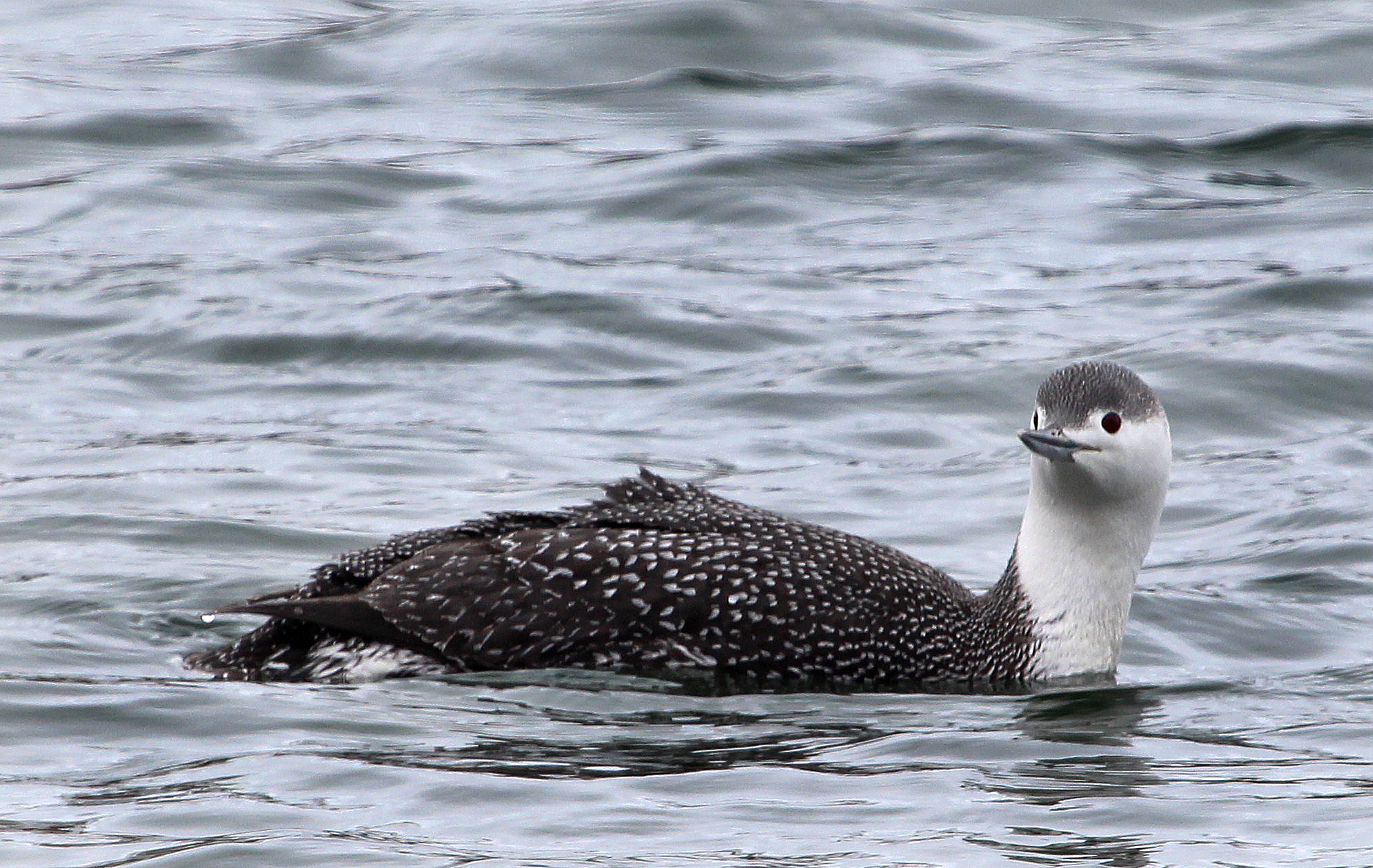
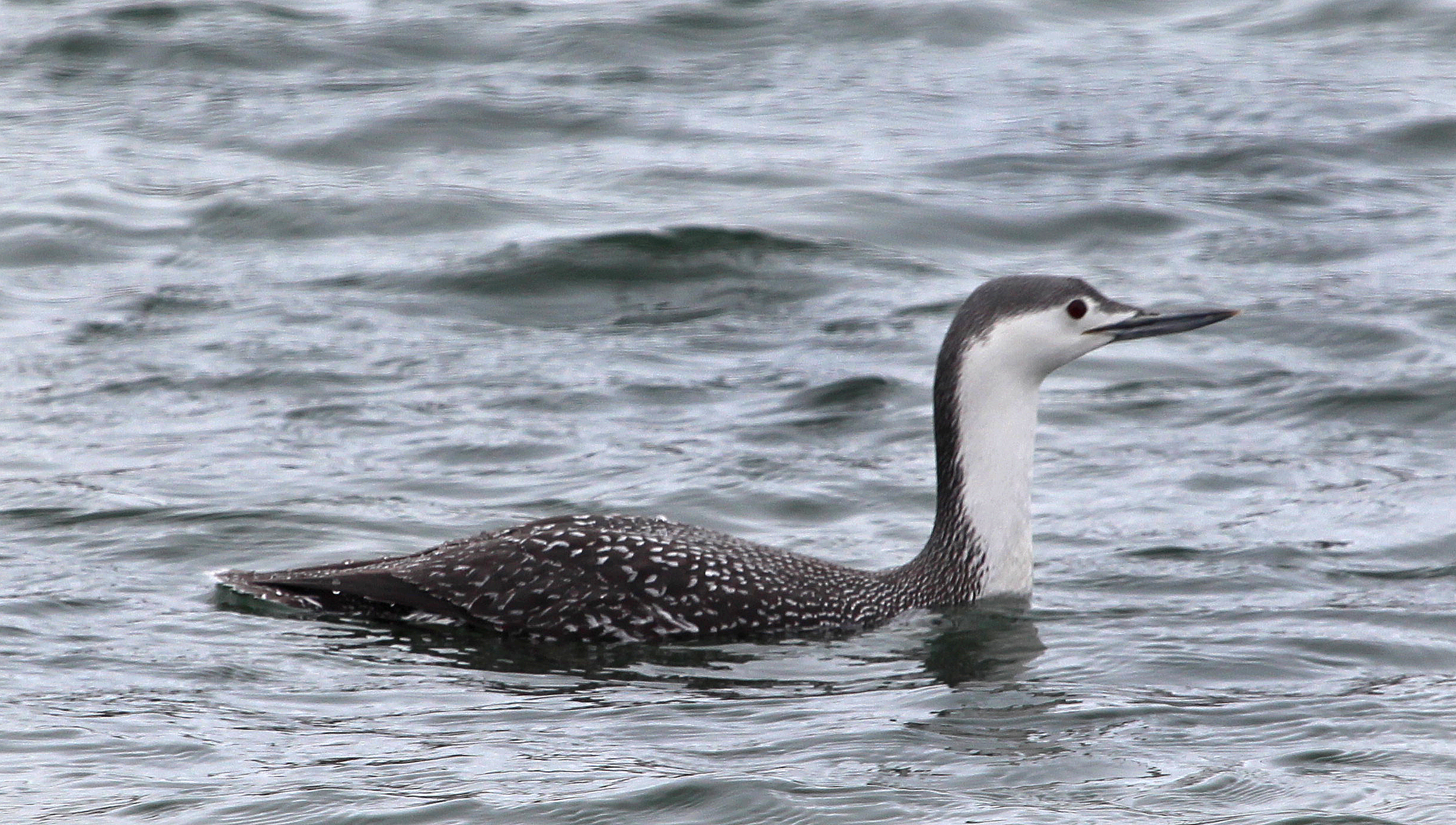
Photo by Chris Bosak A Red-throated Loon swims in Norwalk Harbor in this March 2014 photo.
I drove past Veterans Park the other day and, as is usually the case in winter, I pulled in to see what winter ducks might be around. I immediately spotted a female Red-breasted Merganser swimming somewhat near the shore. It was cloudy and the light was no at all ideal, but I managed to get a few very average photos of the bird.
It kept moving south slowly until it came up on a male Bufflehead. The two birds ignored each other, but for a brief moment they were mere feet away from each other. I snapped a few (again average) photos. I always like to see birds together that you don’t always see “hanging out” near each other.
As I was photographing the merganser and Bufflehead I noticed out of the corner of my other eye a loon close to the shore. When did that pop up? I wondered. Loons are diving birds (as are mergansers and Buffleheads) and often “pop up” far from where they dove. I refocused and took some shots of the loon. It was a Red-throated Loon, a somewhat common occurrence in the Norwalk Harbor and Long Island Sound. They breed in the Arctic and some spend their winters here in New England. Common Loons, which breed in northern New England and farther north, are also fairly common birds in the winter around here. The loons will be heading north soon so I was happy to get this late sighting.
Soon enough the loon I was photographing dove again. I never did see where it popped up next.
Photo by Chris Bosak A Red-throated Loon swims in Norwalk Harbor in this March 2014 photo.
Photo by Chris Bosak A female Red-breasted Merganser swims in Norwalk Harbor in this March 2014 photo.
Photo by Chris Bosak A female Red-breasted Merganser and a male Bufflehead swim in Norwalk Harbor in this March 2014 photo.
Photo by Chris Bosak Ring-necked Ducks swim at Selleck’s/Dunlap Woods in Darien, March 2014.
In my last post about getting out there to check out the ducks before they are gone for the summer, I listed a bunch of ducks that winter throughout New England, but breed farther north. I left off that list Ring-necked Duck. It just didn’t come to mind when I was compiling the list. Sure enough, the next day I went out for a quick bird walk and the only ducks I saw were Ring-necked Ducks. I immediately thought: Hey, I don’t think I mentioned Ring-necked Ducks in that last post.
So, finally getting its due, here you have the Ring-necked Duck, a very handsome duck that spends its winters here in New England (and well south, too) and breeds in northern New England and into Canada. As you can see from the photo, a more apt name might be Ring-billed Duck, but the scientists who named it likely had a dead specimen in hand and the ring around its neck — which is difficult to see in the field — was more visible. It took me years to stop calling it Ring-billed Duck, but I eventually got used to it.
Also, as you can see from the photo, the species is sexually dimorphic: the males and females look different. All ducks seen in New England are sexually dimorphic with the males often brilliantly colored and females usually more dull in color.






 Birds of New England.com