
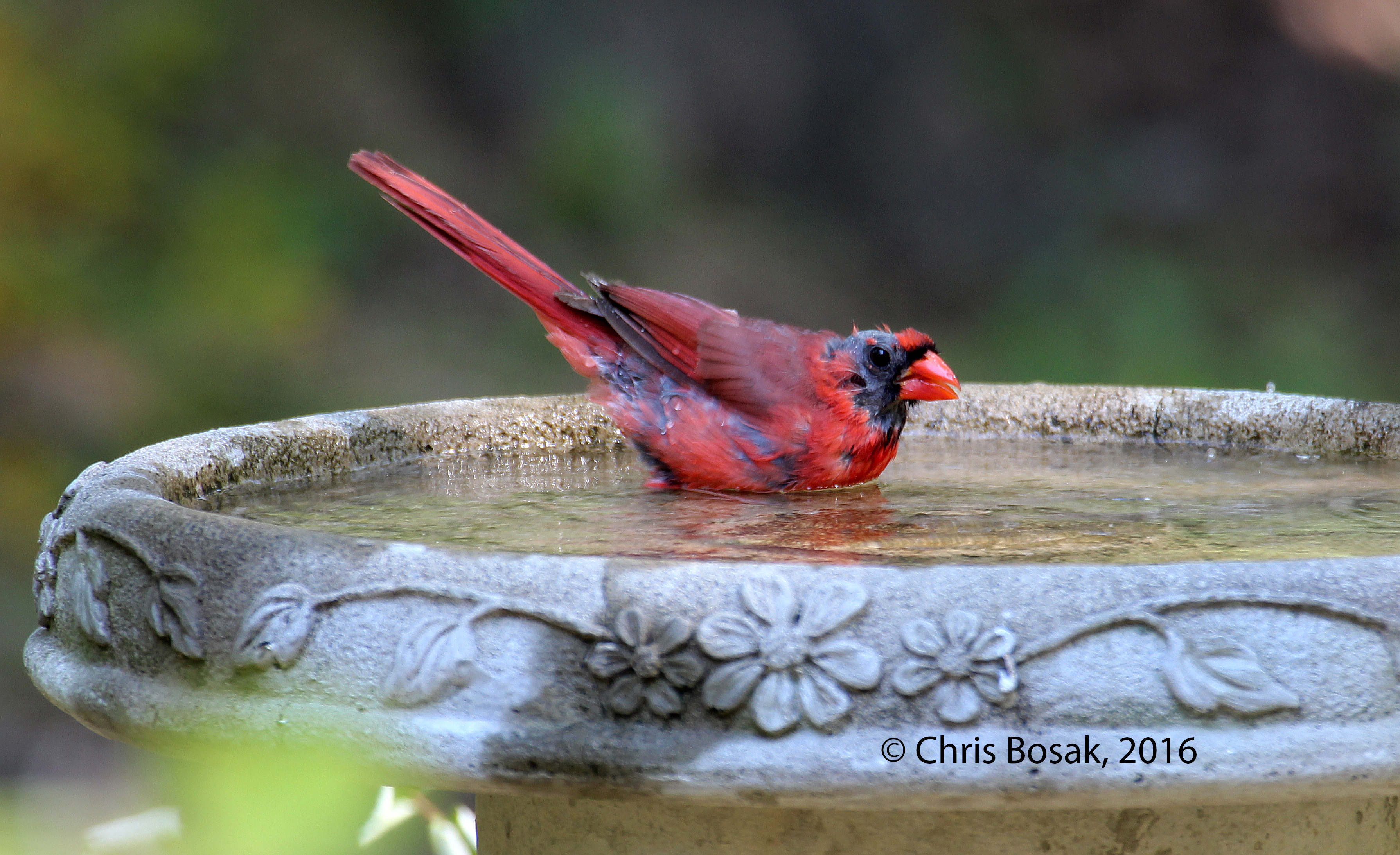
A Northern Cardinal drinks from a bird bath in New England.
I’ve seen it dozens of times, but it’s always initially startling when I see a molting cardinal with a bald head.
My home office looks over the side yard where my birdfeeders are located. (No surprise there, I’m sure.) There are tall bushes on either side of the feeders, and most birds perch in one of those before venturing over to the feeders.
Lately, the action has been predictably a bit slower as the birds are busy raising young. Throughout the day, however, the usual assortment of chickadees, titmice, nuthatches, song sparrows, blue jays, mourning doves, downy woodpeckers and cardinals pay visits. So far this summer, as a pleasant surprise, gray catbirds are my most common visitors as they come to eat mealworms and suet. They are also frequent visitors to the birdbath located a few dozen yards away. I never pinpointed it, but I know the catbirds have a nest in one of the nearby bushes.
The other day, a bright red streak flashed across the window and landed in the bush on the left. I knew it was a male cardinal, of course, but I wasn’t prepared for its appearance when it darted to the feeder perch. Like many I’ve seen before, this guy was bald as can be, his black exposed head giving him an ungainly appearance compared to how we are accustomed to seeing cardinals. It would look unappealing on any bird, but it looks even more out of place on a cardinal.
Like many birds, cardinals molt in the summer. They typically molt after the breeding season in August or September, so mid-June seemed early to see a bald cardinal. Some birds molt gradually and replace old feathers gradually over time. Cardinals, however, shed all of their head feathers at at about the same time, giving them an appearance only a mother could love. Not that the cardinals care one way or another what humans think of their appearance.
No need to fear, though. The new feathers start to grow almost immediately, and, within a few weeks, the cardinal is back to its resplendent self.
Some cardinals lose their feathers due to mites instead of a molt, but it’s much less common.
Summer is a time when many birds do not look like they do in field guides. Molting can change the appearance of adult birds. A bald cardinal is a stark example. Male wood ducks are another as they replace their brilliant breeding plumage with dull feathers. They are not often seen during this time as they lay low in the vegetation around swamps. They don’t hide because they are embarrassed by their drab appearance, of course, but rather because they cannot fly for a period of time during their molt and are in big trouble if a predator finds them.
Young birds look different from their parents for much of the summer as well. Sticking with cardinals, young birds (even males) look like female cardinals but have dark bills instead of the vibrant bills of adult female cardinals. I saw a young catbird the other day, and it already closely resembled an adult but had a more scruffy and thin appearance.
Birds, of course, are welcome sightings regardless of how they look on any particular day. A bald male cardinal or scraggly-looking catbird can visit my yard any day.
 Birds of New England.com
we sure do love our big Reds
LikeLiked by 1 person