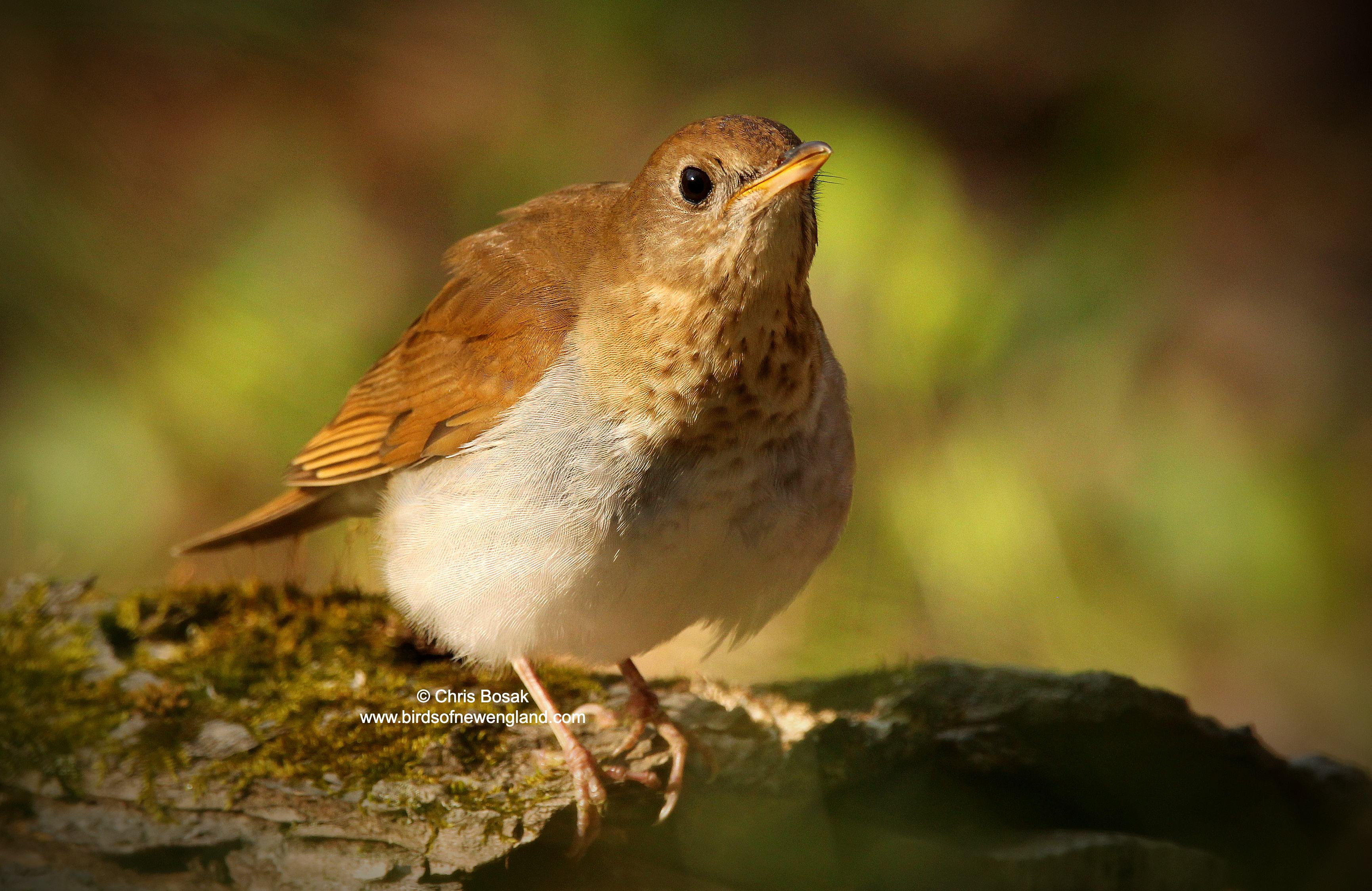
A veery at Huntington State Park in Redding, CT, May 2026.
It’s still too early to declare my Bird of the Summer, but one bird has become the clear favorite.
Of course, catbirds and robins are always common sightings in the summer, and I have certainly seen many of those on my recent walks. But ever since early May, my walks seem to be dominated by veeries.
Veeries are thrushes and indeed closely resemble the more common hermit thrush and wood thrush. There are some obvious differences, however, as veeries are a warmer reddish-brown overall with fewer and lighter spots on their chests.
Some of the other thrushes that occur in New England are not as easy to differentiate from hermit thrushes, such as gray-cheeked thrush, Swainson’s thrush, and Bicknell’s thrush.
American robins and eastern bluebirds are also part of the thrush family but are not often thought of as thrushes, as they don’t look like the other thrushes. In fact the ovenbird, a small warbler, more closely resembles the thrush family than they do. Young robins and bluebirds, when they still have spotted chests, look more like typical thrushes than grown robins and bluebirds.
The veery has a very distinctive song. To me, it sounds like the old Space Invaders game from the 1980s. The Cornell Lab of Ornithology describes it as such: “A series of variations on ‘veer,’ the song descends slightly in pitch, and resonates as if swirling around inside a metal pipe.”
Whatever works for you, I guess.
Veeries also have call notes that are not as distinctive. I’ve heard it enough this spring and summer, however, that I can pick out their call notes among the cacophony of other nature sounds.
With all that said, let’s take a look at what else is going on throughout the region.
Norma from Spofford, who is 90 years young, wrote that she saw a scarlet tanager sitting among her flowering quince bush the other week. The brilliantly colored bird gave Norma a good look for several minutes before flying off in the woods. Norma was thrilled by the sighting, as she says she has seen fewer than a dozen in all her years. The magic of New England’s birds.
Greg from Tilton wrote that he saw a red-bellied woodpecker at his feeder for the first time. Red-bellied woodpeckers continue to expand their range northward.
Victoria from Swanzey wrote in with an interesting report on her spring birdwatching. She had written in previously to let me know that she turns on Merlin (bird song and call recognition app), sets it on a rock, and “goes about her morning chores in the barnyard.” Her farm property is about 15 acres with varied habitat. She keeps track of the birds Merlin identifies on a spreadsheet. Knowing that Merlin is not 100 percent accurate, she only records birds that come up multiple times on the app.
In May alone, Merlin identified 116 different bird species. That, of course, does not include the birds that did not sing or call. The impressive list includes 26 types of warblers. “Until the Merlin app, I had not realized that the flashy ones — scarlet tanager, Baltimore oriole, indigo bunting — also make their nests here,” she wrote.
Gene from Plymouth regularly hosted at his feeder a downy woodpecker with an annoying habit of using its bill to flick away unwanted seeds to get the peanuts among the mixture, resulting in a boon for the squirrels below. The woodpecker could apparently see through the clear feeder to see where the peanuts were. Gene covered up the transparent parts of the feeder, and now the woodpecker appears to be much less picky.
I hope everyone survived the heat wave OK. Let me know if you observed any interesting bird or nature adaptations during those scorching days.
 Birds of New England.com