
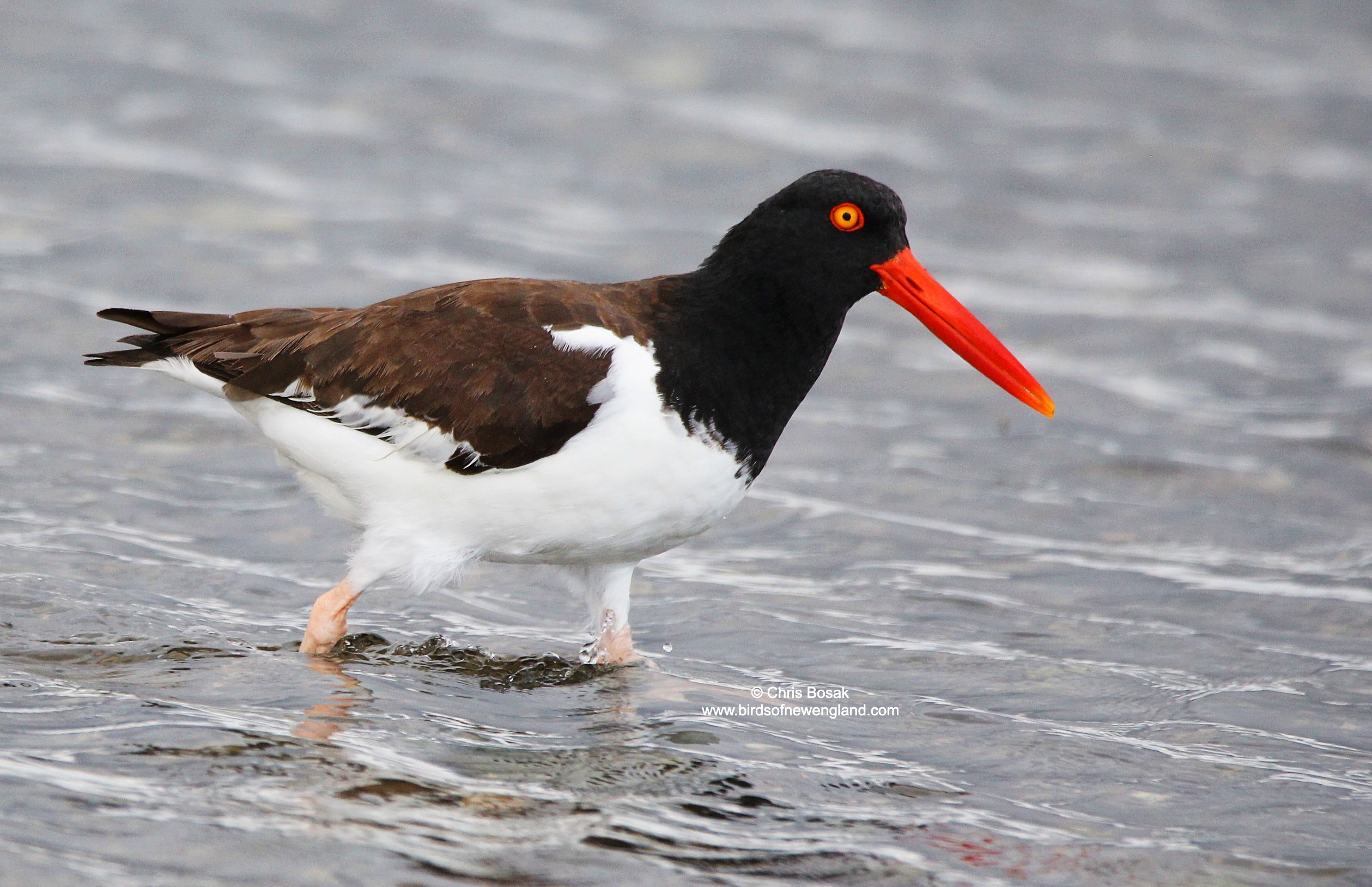
American oystercatcher, summer in New England.
A few weeks ago, I previewed the fall hawk watch season and encouraged anyone interested in seeing that spectacle to head to the nearest hawk watch site.
Mid-September is the prime time for hawk watches, so get out there now if you can.
There is a lot more to fall birdwatching than hawk watches, of course. Songbirds are heading south in large numbers too. Presumably, there are many more songbirds passing through New England in the fall than in the spring with all the first-year birds making their initial southward journey.
With all the excitement around hawks and songbirds, it’s easy to forget about the shorebird migration, which can be equally as fun. Shorebirds are an often underrated category of birds and it’s understandable considering most people do not live near the coast. Sure, certain shorebirds may be found along the edges of lakes, ponds and rivers, but they are usually found as individuals or pairs. On the other hand, the coasts of the ocean and Long Island Sound may hold flocks of dozens or even hundreds of shorebirds.
I visit from time to time a preserve on Long Island Sound in southern New England. American oystercatchers, among other birds, nest there and may be seen in pairs in the spring and summer. If a pair is successful in raising young, then, of course, the family unit will swell to three or four birds.
If a visit is timed right during fall migration, however, a dozen or more oystercatchers may be seen together on the shore poking around for food to fuel their southern migration.
Such was the case the other day when my friend Wayne and I visited the preserve. We hadn’t had a lot of luck on our previous walks in the woods looking for songbirds, but the trip to the shore more than made up for the previous birdless walks.
The walk along the shore got off to a slow start as well. We had walked about 15 minutes before we saw our first bird, a semipalmated plover. They are small shorebirds that could easily be mistaken for a killdeer.
As it turns out, there were three plovers foraging together, not a single bird. That happens often when looking for shorebirds. What starts out as a sighting of one bird quickly turns into several birds as they eventually all come into view as they move among the rocks, shells and sand.
Finally, as we neared the end of the out-and-back walk, we spotted the oystercatchers. It started as a lone bird flying across the scene, uttering its high-pitched, repetitive call. We followed that bird until it landed on the mudflats. Once our eyes were trained on the shallow pool, one of several pools left over from high tide, we saw the rest of the oystercatchers. There were a dozen or more of the flashy, large shorebirds.
American oystercatchers have black heads and chests, brown backs and wings, and white underparts. The interesting parts of the oystercatcher are the eyes and bill. They have yellow eyes with a black middle and noticeable red eyering. The bills are long, sturdy and bright orange. To see a dozen or more together is a magical sight.
As we walked along the mudflats toward the oystercatchers, I was again reminded how well some shorebirds blend in with their environment. At one point, I got to within about five feet of a least sandpiper before it quickly scurried away from me. If it hadn’t moved, I probably would have walked right past it. Then, of course, five or six more least sandpipers suddenly appeared, seemingly out of nowhere.
Eventually, I got close enough to photograph the oystercatchers. The first couple photos I got were of banded birds with two coded rings around each leg. The others were not banded. A lone black-bellied plover joined the oystercatchers on the hunt, while a few snowy egrets worked the shoreline a few yards away.
American oystercatchers are one of those birds I never tire of seeing and, no matter how many times I’ve seen them before, it’s always like I’m seeing them for the first time. Loons evoke a similar emotion. To catch them during migration in large numbers is that much better.

